
Fragmented research teams create duplicated work, inconsistent insights, and costly knowledge silos. A continuous AI intelligence source compounds organizational learning, improves AI context, and accelerates decisions. Platforms like Rocket.new unify research, competitive intelligence, and execution into one persistent knowledge layer.
The Real Cost of Fragmented Analysis Across AI Groups
What actually happens when four separate human groups each run their own partial research on the same problem?
Wasted money, duplicated human effort, and blind spots that no individual unit can see. According to the International Data Corporation, Fortune 500 companies lose roughly $31.5 billion annually through inefficient knowledge sharing, averaging over $60 million per company.
- The average enterprise runs between five and twelve different intelligence tools across its human departments
- The combination of disconnected outputs rarely adds up to a complete picture
- AI agents operating in one silo have zero access to relevant findings gathered by another human group
- Each unit builds its own process, its own knowledge repository, and its own conclusions
The AI narrative in most companies treats each group as a standalone unit. That model made sense when human researchers moved slowly, and information was scarce. In a world where generative AI can process thousands of sources in minutes, four isolated human units create more confusion than clarity.
How Knowledge Silos Form Inside Organizations
Imagine four human groups, each assigned a piece of the same task:
- A product unit uses one AI model for competitive analysis, defined by its own task priorities
- A strategy department runs a different process with a different agent and a different combination of tools
- Marketing generates findings using a third set of tools, with no connection to what other human workers already know
- Operations evaluates risks with yet another combination of AI systems, talking past every other department
The complexity of most organizations encourages this fragmentation. Human teams are evaluated on their own task outputs, not on how their work connects to other human efforts. When people cannot access each other's internal knowledge, they cannot understand overlapping findings. For example, centralized systems make every input available to every human decision maker.
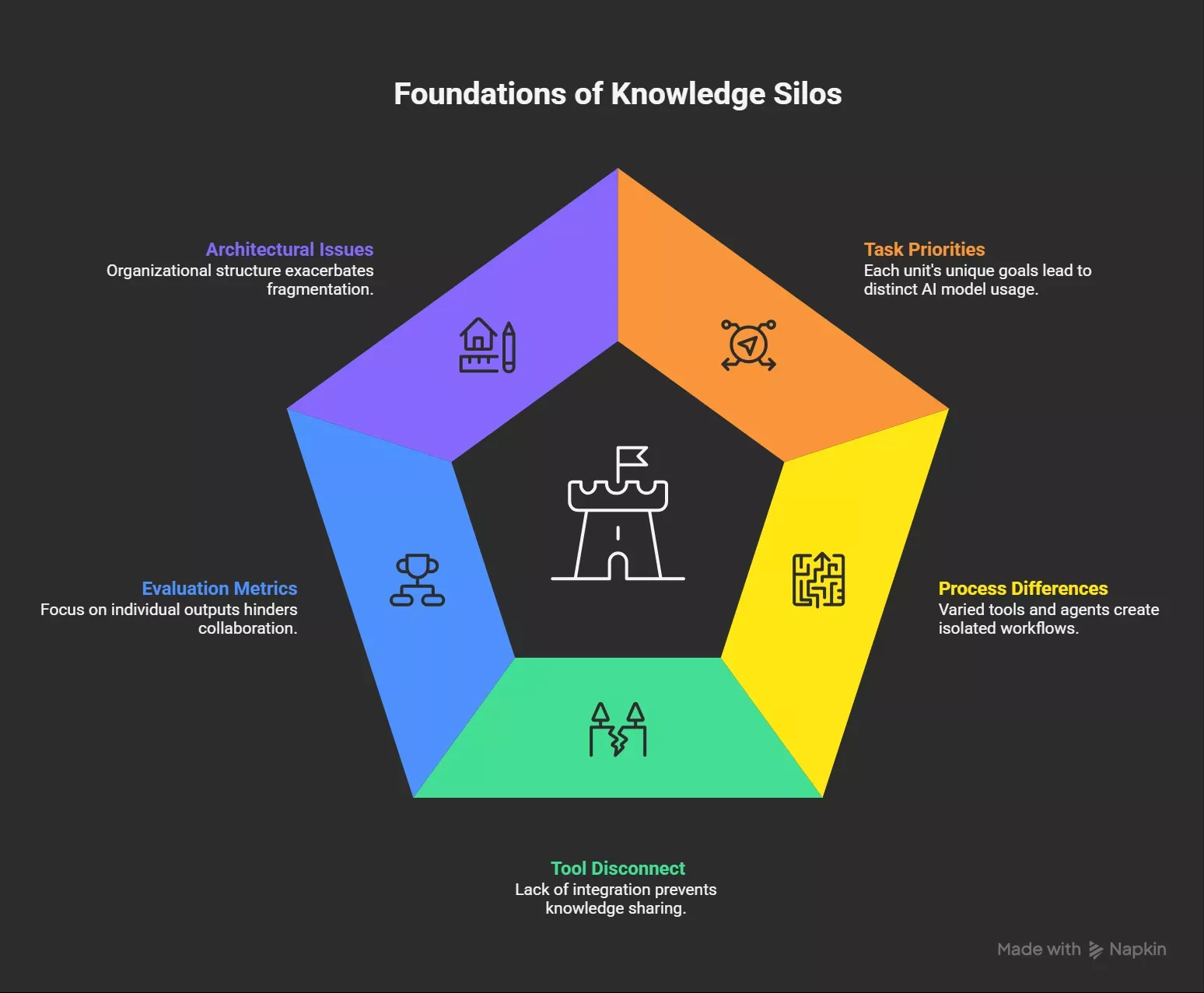
The relationship between fragmented work and poor decision-making is direct. The difference between organizations that compound intelligence and those that restart comes down to architecture and the capabilities of their knowledge systems, not the skills of individual human researchers.
The Compounding Tax of Starting from Zero
If a human group spends half a year rediscovering something the organization already learned, the real loss is the progress that the human group could have made by building on existing knowledge.
- Researchers found that knowledge workers lose an average of 209 hours each year to duplicative task work caused by information silos
- Leading organizations that centralize their knowledge base reclaim this time for complex research that benefits from a full organizational context
- Each initiative starting from zero represents wasted human effort and a missed chance to extend the organizational intelligence frontier
This compounding tax is invisible on any single task. Over the years and across teams, it creates exponential divergence. AI model capabilities improve dramatically when they draw from a complete knowledge layer, making a unified architecture a multiplier for every human and AI combination in the organization.
What a Continuous AI Intelligence Source Looks Like
From Scattered Data to a Unified Knowledge Base
A continuous intelligence source connects every data input, every competitive insight, and every human evaluation into a single model of organizational understanding. The world of AI has made this kind of system possible at a scale that was impossible a generation ago. The system grows smarter with each query, each human interaction, and each task it processes.
- Every AI agent draws from the same knowledge base, so human users across departments generate and consume data from one shared environment
- The system retains institutional memory even when human workers leave the organization
- New findings automatically update what every human member and every AI model can access
This approach matches what researchers in organizational behavior call the "organizational brain," a centralized intelligence system that synthesizes information to provide a view no individual human could build alone. The benefit is that each new task adds to the total intelligence rather than creating another disconnected fragment.
How Centralized Systems Create Better Decisions
| Factor | Four Fragmented Human Groups | One Continuous Source |
|---|---|---|
| Knowledge duplication | High, each human group rebuilds context | Low, context compounds over time |
| Decision-making speed | Slow, requires cross-group human alignment | Fast, all data in one place |
| Accuracy of data | Variable, depends on access | Consistent, draws from the full data set |
| Institutional memory | Fragile, lost with human staff turnover | Persistent, stored in the system |
| AI model performance | Limited by silo boundaries | Improved by the full organizational context |
| Tool costs | Multiplied across human groups | Consolidated, lower total spend |
Organizations that consolidate intelligence reduce time wasted reconciling conflicting information by up to 30%. Human teams benefit from recovered time by redirecting it to decision-making on complex problems that require human judgment and human skills.
The Science Behind Human AI Collaboration and Unified Intelligence
What Researchers Found About AI Agents Working with Humans
In November 2025, researchers from Stanford and Carnegie Mellon published a paper comparing 48 human professionals against four AI agent frameworks across 16 multi-step tasks. The paper challenged the AI narrative that full automation beats human involvement.
- Autonomous AI agents completed each task 88.3% faster, but achieved 32% to 49% lower success rates than humans working alone
- Hybrid human-AI teams outperformed fully autonomous agents by 68.7%
- AI augmentation improved human efficiency by 24.3% across every task category
- Full AI automation slowed human work by 17.7% due to the overhead of debugging agent mistakes
The best model is human AI collaboration, where AI agents handle processing while human workers provide judgment and evaluation. The combination of human oversight and AI systems produced improved outcomes compared to either approach alone. This paper helps us understand why the human role in AI work is changing shape rather than disappearing.
Augmentation, Synergy, and the Missing Combination
Human-AI collaboration takes two forms: augmentation, where a human-AI system outperforms a human alone, and synergy, where the combination outperforms both. Research reveals that synergy happens when the AI agent accesses a broad, continuous context.
- A paper on a Procter and Gamble study found that individual human-AI pairs matched the performance of conventional human teams
- The generative AI model helped human workers bridge functional knowledge gaps, extending their skills for tasks outside their specialization
- The combination of human judgment and AI capabilities consistently outperformed either human or AI working alone
When an AI agent accesses full organizational intelligence, human AI collaboration improves. For example, a human researcher working with a model that understands six months of prior work will generate stronger outcomes than a human working with a model that only sees the current task.
Building an Organizational Brain with AI Systems
Internal Knowledge Meets Real-Time External Information
Centralized intelligence systems create network effects where the value of each knowledge contribution increases as the knowledge repository expands.
- A single model trained on the full organizational context produces more accurate results than four models working with partial information
- AI agents in a centralized environment recognize connections that agents in siloed human groups cannot see
- Human collaboration and AI systems both benefit from this architecture because every task and every human decision adds to the whole
Collective intelligence does not emerge from adding together the outputs of separate human groups. It emerges from the connection of those outputs in a shared environment where each insight makes every other insight more valuable. The process of consolidation also eliminates redundant tools and the administrative burden of managing multiple contracts.
Why Frontier Models Need Continuous Context to Generate Value
Frontier models lack your organization's specific context. Without access to your internal knowledge, even the best AI model produces generic outputs that no human group can act on with confidence.
- Continual learning addresses catastrophic forgetting, the challenge of teaching AI models new information without destroying their existing knowledge
- Traditional methods involve retraining models with a combination of old and new data, which is expensive and impossible for most organizations
- Google has developed next-generation model architectures like Titans with a learned long-term memory module for integrating historical context
The Role of Long-Term Memory in AI Architecture
Nested Learning treats a model as a set of connected problems, letting different memory modules update at different speeds. The world of AI is increasingly talking about how to build models that understand and retain context across tasks.
- AI agents with persistent organizational context generate more relevant outputs for human users
- Organizations that centralize knowledge create an environment where AI model capabilities keep growing because each human task adds context that the model uses next
- The difference between a capable generative AI model and a useful organizational tool comes down to whether the agent retains context across sessions
What Happens When Organizations Run Partial Analysis with Separate Human Groups
Duplicated Work and Missed Patterns
For example, a tier-one automotive supplier's human battery unit spent half a year developing an improvement that had already been patented by their own company's European division three years earlier. That example cost $450,000 in redundant work and lost first-mover advantage.
- A specialty materials company maintained seven intelligence tools with 60% content overlap between them
- Human researchers spent 15 hours weekly searching across systems before starting analysis on any task
- When AI systems cannot access data from other human groups, they cannot recognize patterns spanning the organization
- Centralized systems allow human analysts to identify risks like zero-day threats that remain impossible to see when information is scattered across four separate human groups
The Six Months Problem and Catastrophic Forgetting
Nearly every organization faces this problem: the time a new human group needs to reach the understanding that the organization already had but could not access. This mirrors catastrophic forgetting in artificial intelligence, where a model learning new information destroys its ability to recall old information.
- When a human employee leaves, their knowledge and skills leave too, unless that knowledge lives in a centralized system
- Next-generation AI architectures address this with persistent memory, but only if the organizational environment supports continuous flow
- The risks of fragmented systems grow with every task that starts from scratch
The complexity of modern work demands a model where all human knowledge and AI capabilities feed a single intelligence layer. Organizations that centralize compound their knowledge at a rate that fragmented human groups cannot match, creating advantages that widen over time.
What People Are Saying About Centralized AI Intelligence
Kyle Csik, co-founder of AI platform Adaly, captured this in a recent LinkedIn post:
"Most organizations have critical knowledge trapped in documents that never make it into systems of record. The result is execution without memory and decisions without history. This is how institutional knowledge stops decaying and starts compounding." - Source: Kyle Csik on LinkedIn
That observation connects to what researchers at Harvard found in their paper on generative AI and human collaboration: the technology works best when AI agents have access to full context. Importantly, every human task that feeds back into a centralized environment makes the AI model smarter and the next human decision more informed.
How Rocket.new Handles Continuous Intelligence for AI Agents and Human Workers
Rocket.new was built to solve what this article describes: human workers in isolation, AI tools generating data without context, and organizations losing knowledge when a task ends.
Rocket is a vibe-solutioning platform that combines research, building, and competitive intelligence in one system. This technology keeps context alive, so when you start with a question, Rocket carries that context into everything you build and track. No re-explaining, no starting over.
- Vibe-solutioning platform: Describe the problem, and Rocket analyzes the market, recommends what to build, and tracks competitors
- **25,000+ templates library, free to use**: Pick a starting point, and Rocket adapts it to your context
- Saves up to 80% tokens: The architecture keeps context alive across sessions instead of regenerating it
- Supports Flutter (mobile) and Next.js (web): Ship production-grade apps from the same platform where you did your analysis
- Collaboration features built in: Human workers create and share from the same intelligence layer, eliminating silos by design
- 3 Products, One Platform: Solve, Build, and Intelligence: Investigate what to create, build it, and monitor competitors in one environment
Here are ways Rocket connects to continuous intelligence:
- Unified pipeline: AI agents access the full context of your human decisions, so every output builds on what came before
- Persistent competitive intelligence: Rocket monitors competitor signals, keeping human users on the latest information without separate evaluation processes
- Context-aware AI agents: Solve, Build, and Intelligence share one layer, so the AI model handling your task understands your organizational context and can generate outputs that reflect it
- Human AI collaboration by default: Rocket keeps humans in the loop while AI agents handle processing and continuous monitoring
One Source, One Compounding Knowledge Advantage
The question of why one continuous intelligence source is better than four teams each running partial research comes down to compounding. Fragmented work starts from zero, and findings stay locked inside the human group that generated them.
A continuous source compounds everything into a growing knowledge base that makes every future human task more accurate. The world is moving toward persistent, context-aware AI systems, and organizations that build their intelligence architecture around this ability will make better decisions at every level of human and AI collaboration.
👉See how Rocket.new turns disconnected research into one continuously compounding intelligence system.
Table of contents
- -The Real Cost of Fragmented Analysis Across AI Groups
- -How Knowledge Silos Form Inside Organizations
- -The Compounding Tax of Starting from Zero
- -What a Continuous AI Intelligence Source Looks Like
- -From Scattered Data to a Unified Knowledge Base
- -How Centralized Systems Create Better Decisions
- -The Science Behind Human AI Collaboration and Unified Intelligence
- -What Researchers Found About AI Agents Working with Humans
- -Augmentation, Synergy, and the Missing Combination
- -Building an Organizational Brain with AI Systems
- -Internal Knowledge Meets Real-Time External Information
- -Why Frontier Models Need Continuous Context to Generate Value
- -The Role of Long-Term Memory in AI Architecture
- -What Happens When Organizations Run Partial Analysis with Separate Human Groups
- -Duplicated Work and Missed Patterns
- -The Six Months Problem and Catastrophic Forgetting
- -What People Are Saying About Centralized AI Intelligence
- -How Rocket.new Handles Continuous Intelligence for AI Agents and Human Workers
- -One Source, One Compounding Knowledge Advantage