
A practical guide for solo founders and non-technical entrepreneurs on picking a profitable SaaS or startup idea in 2026, validating it with a simple landing page, and shipping a production-ready product fast using Rocket.new.
Got a SaaS idea you can't stop thinking about, but no real plan to ship it?
Here's the short answer.
A good startup idea solves one specific problem for one niche audience and you don't need months of development or a massive team to test it. The global SaaS market is projected to reach $465 billion in 2026 and $1.25 trillion by 2034 (Source: Hostinger SaaS Statistics, 2026).
The timing is right. The tools are ready. What most founders are missing is a clear path from idea to shipped product. This guide walks you through exactly that.
What Actually Makes a Good SaaS Idea in 2026?
Most startup founders don't fail because they can't build. They fail because they build the wrong thing. CB Insights research shows that 42% of startups shut down because they created something nobody needed.
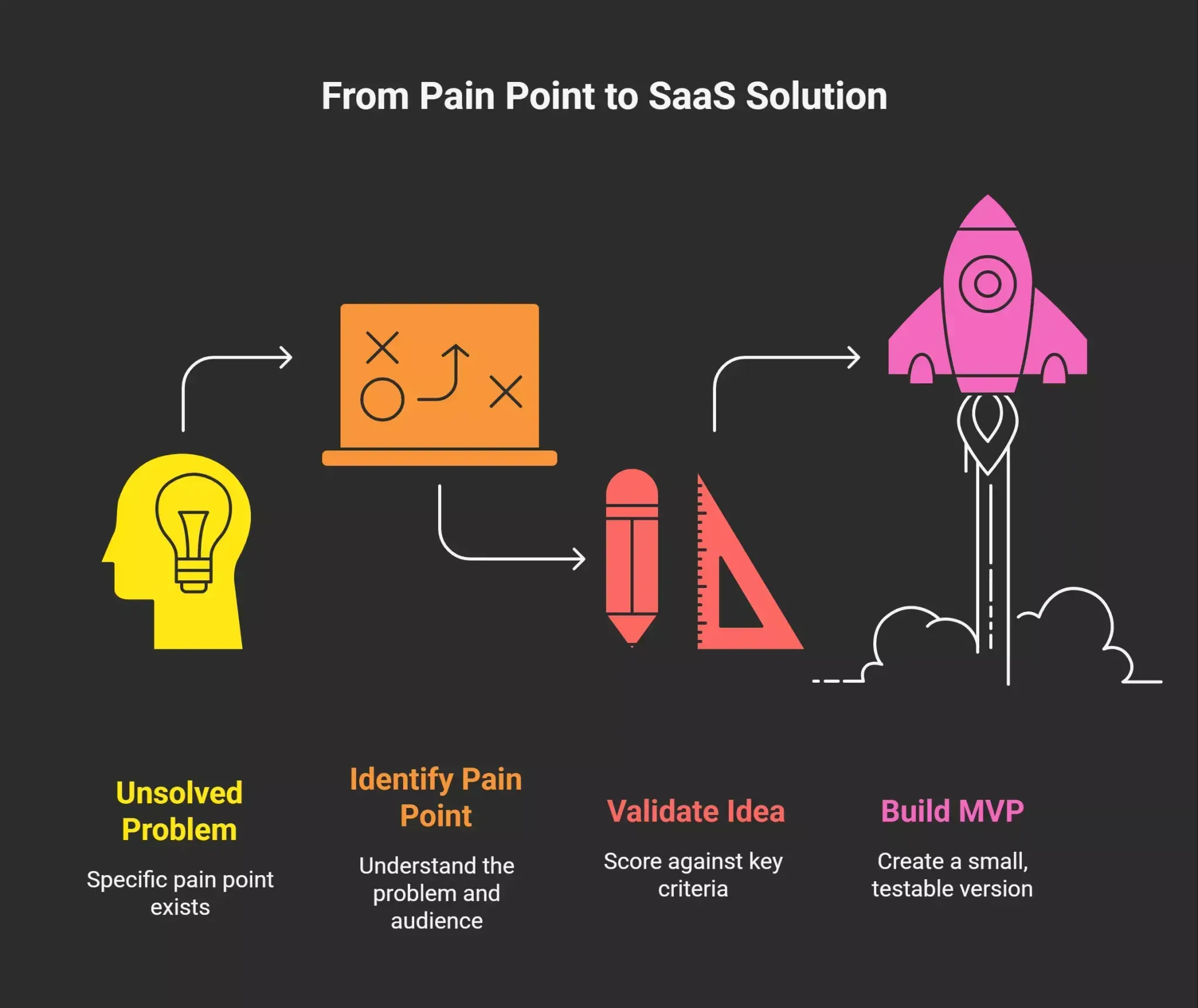 The best SaaS ideas in 2026 share a few traits:
-
They solve a specific problem someone already has
-
They serve a niche audience willing to pay for a solution
-
They're small enough to validate before investing heavily upfront
Before you write a single line of code, ask: who has this pain point, and are they already spending money somewhere trying to deal with it?
Solve One Specific Problem - Not Everything
The SaaS products that survive are the ones that do one thing really well. A SaaS business built for everyone usually solves nothing particularly well. One built for a specific problem, for a specific target audience, wins.
Think small and precise. A client portal for freelance designers. A scheduling tool for tattoo studios. A billing dashboard for small law firms. One pain point. One clear solution.
Start With Pain Points You Already Understand
Your personal experience is a competitive advantage. The specific problems you've run into at work, in your industry, or in daily life are the best startup idea sources.
Good places to find real pain points:
-
Reddit threads in your industry niche (r/freelance, r/smallbusiness, r/devops)
-
Slack communities and Discord groups for your target audience
-
App store reviews for products in your space
-
Your own job and the repetitive processes that frustrate you weekly
The honest feedback people leave in public communities is better market research than most paid reports.
Idea Scoring Criteria to Narrow Down Your List
Not every pain point is worth building a SaaS product around. Before committing, score your startup idea against these criteria:
| Criteria | Question to Ask |
|---|---|
| Pain intensity | Is this a chronic problem or an occasional frustration? |
| Willingness to pay | Are people already paying to manage this problem? |
| Niche market size | Is the audience large enough to generate recurring revenue? |
| Competitive gap | Do existing products solve this poorly for this specific niche? |
| Build complexity | Can an MVP be built in weeks, not months? |
Score each one 1-3. If your total is under 10, the startup idea needs refinement before you start building.
From SaaS Idea to Micro SaaS: Why Smaller Wins
Momentum in SaaS has shifted. It's no longer coming from massive enterprise platforms. It's coming from solo founders and small teams building focused micro SaaS products and getting them in front of potential customers fast.
According to data from Freemius, 45.7% of SaaS makers are solo founders. And roughly 95% of micro SaaS businesses reach profitability within their first year, with profit margins that can reach up to 80% (Freemius, 2025; Hostinger SaaS Statistics).
Micro SaaS is the model: one product, one niche, one recurring revenue stream.
| Category | Example Startup Idea | Target Audience |
|---|---|---|
| Productivity | Client portal for freelancers | Freelancers and agencies |
| Compliance | Legal documents generator | Small businesses and lawyers |
| Scheduling | Appointment booking for service businesses | Salons, gyms, clinics |
| Analytics | Reporting dashboard for Shopify stores | E-commerce store owners |
| Communication | Email digest summarizer for remote teams | Distributed teams |
| HR | Simple onboarding flow builder | HR teams at small companies |
The Niche Audience Advantage
When you pick a niche audience, the whole SaaS business gets clearer. Marketing costs drop. User feedback sharpens. The product does less but matters more to the people using it.
Micro SaaS founders quietly build $10k-$50k in monthly recurring revenue from markets nobody else wants to serve. The competitive advantage isn't being the biggest; it's being the most relevant to a small, specific group of potential customers.
Why 2026 Is the Right Time to Ship
The no-code AI platform market was valued at $6.56 billion in 2025 and is projected to grow to $75 billion by 2034. Today, 63% of people building apps with AI tools have no coding background, and these platforms can cut development time by up to 90% (Hostinger AI App Builder Statistics, 2026).
For startup founders in 2026, the tools to build and ship are more accessible than at any previous point. The window is open.
How to Validate Your SaaS Idea Before Building Anything
Validation is the step most startup founders skip. And it's the one that separates products that find real users from those that don't.
You don't need to build a product to validate a startup idea. You need to test whether people will pay to have the problem solved.
Build Landing Pages to Test Market Demand
A simple landing page is the fastest way to test market demand before you spend weeks or months writing code.
Your validation landing page needs to:
-
State the problem clearly in plain English
-
Show the solution in one or two sentences
-
Include a clear call to action section (waitlist, sign-up, or direct payment)
-
Be live and shareable within hours, not days
Drive a small amount of traffic through Google Ads, a targeted Reddit post, or a cold email to potential customers in your niche audience. If people sign up or pay, that's real validation. If they don't engage, you've learned something critical before investing heavily in development.
Talk to Potential Customers Before You Build
Get on calls with five to ten people from your target audience. Ask about the pain point. Ask what they currently use. Ask what they'd pay for something better.
Don't pitch. Listen. Honest feedback from five real conversations is worth more than any analytics report. You'll learn what language your users use, what they actually care about, and whether your startup idea is solving the right part of their problem.
Minimum Viable Product: What to Build First
Once validation shows real interest, it's time to build. But build the minimum viable product first - not the full vision.
A minimum viable product answers one question: Does my solution work for real users?
Strip it down. A user dashboard. A simple onboarding flow. The single workflow that creates real value. No subscription plans until there are paying customers. No advanced features until the core is working well.
Founders who ship fast and learn from user behavior win. The ones who spend months building in isolation rarely find traction.
The MVP Mental Model for SaaS Founders
Before adding any feature to your MVP, ask three things:
-
Does this help my first ten users solve the core problem today?
-
Does the product work without this feature?
-
Can this be added after launch, once I have real feedback?
If the answer to question 2 is yes, cut it. Ship what works. Add the rest when users are telling you what they need.
Common MVP Mistakes That Slow Startup Founders Down
A few patterns that stall startup ideas before they ever ship:
-
Building authentication before there's a single paying customer
-
Designing three pricing tiers before testing whether anyone pays at all
-
Spending weeks on a polished dashboard when users haven't signed up yet
-
Rebuilding from scratch because the first version wasn't perfect
The product doesn't need to be perfect. It needs to work well enough for your first ten users to get real value out of it.
What Startup Founders Are Saying in 2026
The SaaS community hasn't lost faith in the startup idea; it's just shifted what it values. A comment in a thread on r/SaaS about whether building a SaaS product is still worth it in 2025/2026 captures the current thinking:
"Software isn't going anywhere. We'll still need applications; they'll just become more AI-driven. There will always be room for new ideas, niche solutions, and products that connect with users in their own way."- Source: reddit.com/r/SaaS
That's the right frame. The window for SaaS startup ideas in 2026 isn't closing. The tools for building them are just getting better, and founders who pick the right idea and ship it fast have a genuine competitive advantage over those who wait.
Non-Technical Founders and Solo Founders: The Path is Open
Here's something that doesn't get said clearly enough: you don't need to be a developer to build and ship a SaaS product anymore.
Research from Hostinger in 2026 shows 63% of people building apps with AI tools today have no coding background. No-code platforms can cut development time by up to 90%. And citizen developers now outnumber professional software developers four to one globally.
For non-technical founders, this changes everything. You can describe what you want in plain English, get a working preview in minutes, and iterate without re-explaining your project from scratch every time something changes.
The barrier isn't a technical skill. It's knowing what to build and having the right platform to build it on.
Your Startup Idea Has a Launchpad: Rocket.new
Rocket.new is built for exactly this moment. It's the world's first Vibe Solutioning platform: a single workspace where you research what to build, build it, and monitor what matters, all without starting from zero with every new session.
Over 1.5 million people across 180 countries have used Rocket.new to ship products; from startup founders building their first MVP to enterprise teams shipping internal tools.
From Natural Language Prompts to Production-Ready Code
You describe what you want. Rocket.new builds it.
Through natural language prompts, you tell Rocket.new your startup idea: the screens, the logic, the features, the audience. It generates production-ready code in Next.js for web apps or Flutter for mobile apps. Most builds are ready to preview in 1-3 minutes.
The output isn't a mockup. It's a deployable SaaS product, with real design systems, proper navigation, SEO-ready structure, and accessibility compliance built in as standard. You iterate through chat, visual editing, or direct code access. No re-explaining the project context. No rebuilding from scratch between sessions.
Build a SaaS Business Without a Massive Team
For solo founders and startup founders who don't want to spend months in development, Rocket.new handles the production-ready side:
-
SaaS dashboards and web apps - built in Next.js with production-quality design
-
Mobile apps: iOS and Android from a single Flutter codebase, ready for App Store and Google Play
-
Landing pages: conversion-focused, with the right calls to action built in
-
Client portals: for service businesses, freelancers, and agencies
-
Internal tools: dashboards, compliance trackers, reporting systems, and onboarding flows
And it connects to 25+ services; Stripe for payments, Supabase for your backend, Mixpanel for user behavior tracking, all authenticated once and flowing into every build.
Competitive Advantage Through What Rocket.new Builds In
Every Rocket.new build ships with SEO-ready structure, WCAG accessibility compliance, and GDPR coverage by default. These aren't optional add-ons. They're part of the output. For a startup founder who doesn't want to think about legal documents, compliance, or accessibility from day one, this matters a lot.
Where Lovable, Bolt, and Cursor Fall Short
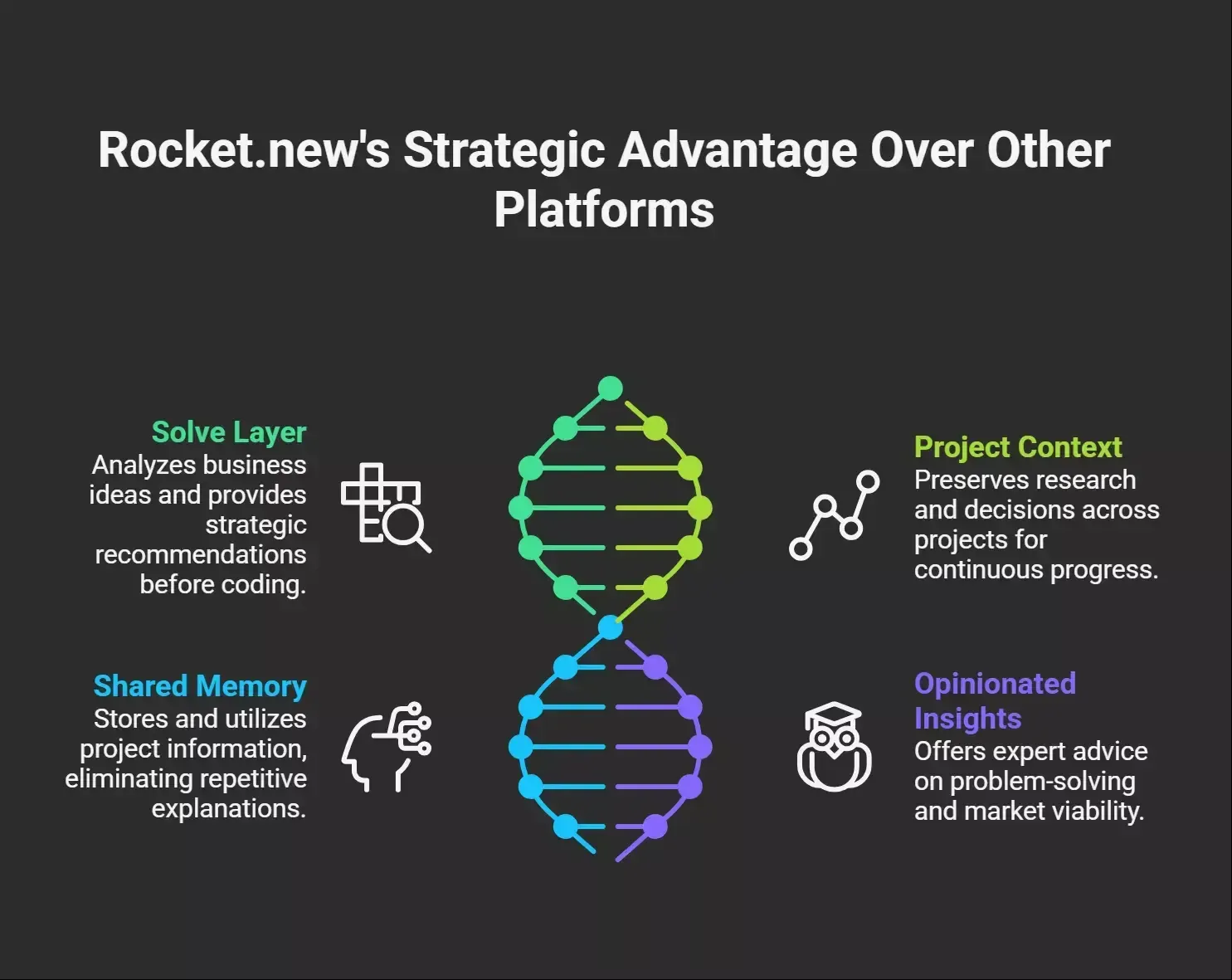 Lovable, Bolt, and Cursor are competent code generators. Give them a prompt, and they write code. But they skip the first part of the problem: figuring out what to build and whether it's worth building.
These tools build what you tell them to build. And in every new session, you start over; re-explaining your project, re-explaining your users, re-explaining the design direction. There's no pre-built intelligence. No shared memory. No opinion on whether your startup idea is actually solving the right problem.
Rocket.new is different. Its Solve layer takes your business idea and produces a complete, structured analysis with findings and recommendations before a single line of code is written. Competitive research, market context, customer problems, all in the same workspace as your build.
Context carries forward through Projects. The research you ran last week is still there when you start a new task. The decisions you made in month one inform the feature you're adding in month three. Nothing needs re-explaining. Everything compounds.
That's the fundamental difference between a code tool and a platform built for startup founders who want to build a real SaaS business.
From Startup Idea to Shipped Product: The Full Picture
The SaaS market in 2026 is wide open for founders who can pick the right thing to build and ship it fast. The biggest gains belong to those who find a specific problem, validate it quickly, build a lean minimum viable product, and get it in front of real users before spending months second-guessing every decision.
Whether you're a developer, a non-technical founder, or a solo builder with a great startup idea and no team, the tools exist today to go from concept to live product faster than any previous point in the history of software. Rocket.new is the platform built for this full arc: from the research that confirms you're building the right thing, to the production-ready code that ships it, to the intelligence that keeps you ahead of your market.
Pick your SaaS idea. Sign up with Rocket.new. Validate it. Build it. Ship it.
Table of contents
- -What Actually Makes a Good SaaS Idea in 2026?
- -Solve One Specific Problem - Not Everything
- -Start With Pain Points You Already Understand
- -Idea Scoring Criteria to Narrow Down Your List
- -From SaaS Idea to Micro SaaS: Why Smaller Wins
- -The Niche Audience Advantage
- -Why 2026 Is the Right Time to Ship
- -How to Validate Your SaaS Idea Before Building Anything
- -Build Landing Pages to Test Market Demand
- -Talk to Potential Customers Before You Build
- -Minimum Viable Product: What to Build First
- -The MVP Mental Model for SaaS Founders
- -Common MVP Mistakes That Slow Startup Founders Down
- -What Startup Founders Are Saying in 2026
- -Non-Technical Founders and Solo Founders: The Path is Open
- -Your Startup Idea Has a Launchpad: Rocket.new
- -From Natural Language Prompts to Production-Ready Code
- -Build a SaaS Business Without a Massive Team
- -Competitive Advantage Through What Rocket.new Builds In
- -Where Lovable, Bolt, and Cursor Fall Short
- -From Startup Idea to Shipped Product: The Full Picture