
Rocket.new integrates GDPR compliance directly into the build process, not as an afterthought. It automates privacy controls like consent, data minimization, and retention from day one. This privacy-by-design approach reduces risk, ensures compliance, and prevents costly audits later.
Why Does GDPR Compliance Keep Failing After Launch?
What if the reason most apps fail GDPR audits has nothing to do with the regulation itself, and everything to do with when teams address it?
GDPR fines have exceeded €7.1 billion since 2018, with European authorities processing 443 data breach notifications per day. Organizations that bolt on data protection after launch face higher compliance risk, more data breach exposure, and steeper penalties.
-
The General Data Protection Regulation applies to any organization processing data of EU residents, regardless of where the organization or its services are based.
-
Non-compliance with GDPR can result in fines of up to €20 million or 4% of the global annual turnover, whichever is higher, highlighting the financial risks associated with poor data governance.
-
Rocket.new addresses this by treating data privacy as a build-time requirement, not a post-launch patch, maintaining compliance from the first page load.
Rocket.new is a vibe solutioning platform that helps teams build and deploy web apps through natural language. Security tools, consent handling, and data protection controls are part of how you describe features, how code is generated, and how builds are approved.
The platform is SOC 2, ISO 27001, GDPR, and CCPA compliant with SSO/SAML, role-based access, and audit logs on by default.
GDPR Article 25: From Legal Text to Engineering Requirement
The General Data Protection Regulation's Article 25 mandates data protection by design and by default. GDPR requires controllers to implement technical and organizational measures, such as pseudonymisation, data minimisation, and integrated security safeguards, from the earliest stages of processing.
-
Privacy by Design means embedding data protection measures into architecture from the start, maintaining regulatory requirements across the lifecycle.
-
Organizations must document what data they collect, why they need it, and how long they keep it.
-
Under GDPR, organizations must implement appropriate technical and organizational measures to confirm a level of security appropriate to the risk, including encryption and access controls.
Traditional vs. Privacy-First Comparison
| Traditional Approach | Rocket.new Approach |
|---|---|
| Cookie consent banners installed weeks after launch | Consent management is integrated before the first service deployment |
| Data processing agreements negotiated during rushed go-lives | Processing purposes documented at requirements capture |
| Privacy policies written as afterthought PDFs | Privacy notice content generated from machine-readable metadata |
| Retention policies documented but never enforced | Automated deletion jobs are scaffolded at the schema level |
This best practice of building compliance into development addresses what 17% of privacy professionals report: their organizations do not practice privacy by design when building new apps.
Privacy-by-Design Baked into Blueprints
Every Rocket.new project can start from privacy-aware blueprints. When teams use Implement Privacy Compliance or prompt for EU-facing features, Rocket scaffolds GDPR controls before business logic is generated.
Default Secure Controls
Default templates for EU-facing services implement core data protection principles:
-
Data minimisation: Forms only collect what the stated purpose requires, following a limited collection of personal information.
-
Purpose limitation: Each data field is tagged with why it is collected.
-
Storage limitation: Retention schedules are defined at schema creation, with timeframes limited to the purpose completion.
-
Secure defaults: Encryption standards such as TLS 1.2 and SSHv2 are used to protect data during transit and at rest.
No tracking cookies are enabled by default, and no unnecessary personal data fields in forms (month of birth instead of full dates). Short log retention windows (30 days for access logs unless justified) and Role-Based Access Control scaffolding with purpose-tied scopes.
When a user describes a feature, Rocket's tools analyze it for privacy implications.
For example, if you prompt "collect customer birthdays for a loyalty program," the platform suggests the month of birth only. It flags that this requires a documented purpose and explicit consent wording.
-
This addresses what a 2024 ENISA report identified as a leading cause of GDPR violations: excessive data collection.
-
Data minimization is essential to secure data privacy practices, reducing compliance risk.
Guided Requirements Capture for GDPR Impact Analysis
Early in every build, Rocket.new can run an interactive requirements step that asks GDPR-relevant questions whenever personal data is involved. This replaces post-launch DPIA workshops that teams skip.
Data Classification at Design Time
The security tools help classify each feature across several dimensions:
-
Data categories: Identifiers, contact data, financial information, special categories (health, biometric). Sensitive data services require explicit consent and additional security measures
-
Data subjects: EU residents, employees, and minors requiring heightened data protection for all services
-
Processing purposes: Marketing, service delivery, analytics, legal obligation
-
Legal bases: Consent under Article 6(1)(a), legitimate interests under 6(1)(f) with balancing tests
-
Retention timeframes: Specific durations tied to services and purpose completion
Automated DPIA Triggers
For higher-risk scenarios like large-scale profiling, location tracking, or health data, Rocket.new can trigger a structured data protection impact assessment before generating production-ready pipelines. DPIAs identify and minimize threats early.
-
When you prompt for an email collection form, the platform classifies email as contact data collected on a consent basis.
-
It queries the schedule (suggesting 13 months max for unsubscribed users).
-
If profiling is implied, it initiates a DPIA covering necessity, proportionality, and risks
-
Mitigation measures like pseudonymisation are proposed.
Answers from this guided capture are stored as machine-readable metadata. Deloitte's 2023 privacy maturity study found that post-launch DPIA workshops miss 70% of risks.
Data Modelling with GDPR Semantics at the Schema Level
Rocket.new generates database schemas annotated with GDPR semantics derived from the requirements step. Each field carries:
-
Personal/non-personal classification
-
Special category flag (if applicable)
-
Purpose IDs linking to documented processing activities
-
Retention policy with specific durations
-
Subject rights impact (which DSR endpoints affect this field). This approach to storing personal data aligns with legal requirements, maintaining a record of consent and confirming that secure data practices support compliance
Retention and Deletion Enforcement
The platform can scaffold automated retention enforcement so policies are implemented technically. For example, scheduled jobs handle soft deletes (marking records inaccessible) and hard deletes (irreversible purge).
-
Storage can be partitioned by expiry dates to handle data collected across services.
-
Security measures such as encryption for data at rest and in transit protect personal data against accidental loss or unauthorized access.
This best practice prevents the common failure where retention policies exist as documents nobody implements. Gartner found manual retention enforcement fails 60% of the time.
Consent and Cookie Handling from the First Page Load
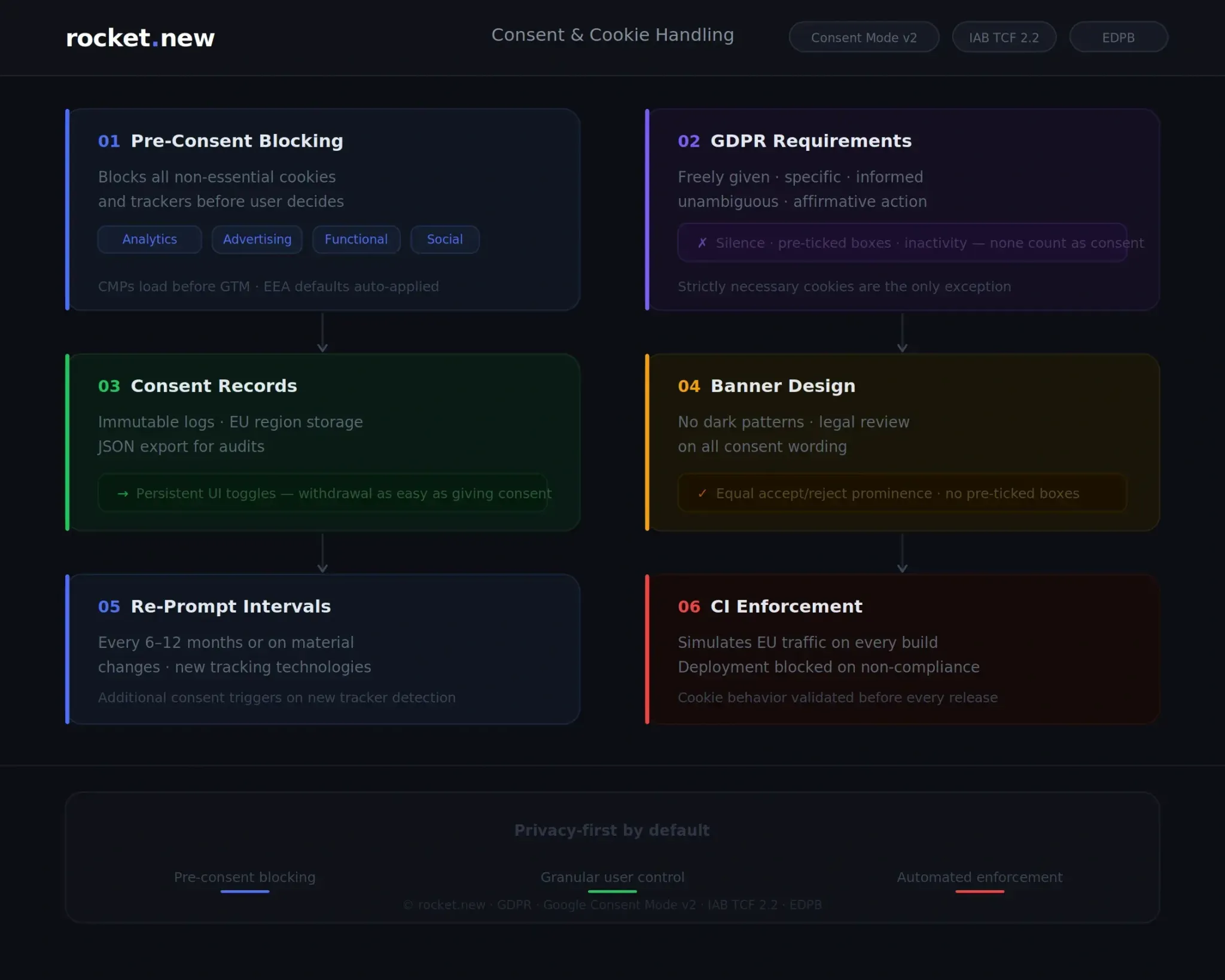
Rocket.new operates in a regulatory environment shaped by Google Consent Mode v2, IAB TCF 2.2, and strict DPA guidance on dark patterns from the EDPB.
1. Pre-consent Blocking Layer
Every EU-facing build ships with a pre-integrated consent layer that blocks non-essential cookies and trackers before consent is obtained, records granular choices per purpose (strictly necessary, analytics, advertising, functional, social), and exposes an API for app-level services to rely on consent status.
Build-time automation handles correct script ordering. CMPs defer-load before async GTM tags. Region-specific defaults apply for EEA IP addresses.
2. GDPR Consent Requirements
Under GDPR, any cookie or tracking technology that is not strictly necessary for a service explicitly requested by the user requires prior, freely given, specific, informed, and unambiguous consent before it may be set on a visitor's device. And it must consist of clear affirmative action; silence, pre-ticked boxes, or inactivity do not constitute valid consent.
3. Consent Records and Withdrawal
Immutable consent logs are stored in EU regions and exportable in JSON for audits. Easy withdrawal is provided via persistent UI toggles, ensuring individuals can withdraw consent at any time, as easily as they gave it.
4. Re-Prompt Intervals
Re-prompt intervals occur at 6–12 months or when material changes happen, and additional consent requirements trigger when new tracking technologies are detected.
5. Banner Design, No Dark Patterns
Cookie categories and consent text are generated from data classification. Legal teams review wording before deployment. Banners maintain equal prominence for accept and reject buttons, avoid pre-ticked boxes, and use no confusing language designed to nudge users toward acceptance.
6. CI enforcement
CI tests simulate EU traffic and block deployment if cookie behavior does not comply.
DevSecOps Security Tools and Privacy Tests in Every Pipeline
GDPR's requirements for integrity (Article 5(1)(f)), confidentiality, and accountability translate to DevSecOps practices. Rocket.new generates pipelines with secure controls by default. Continuous security monitoring involves integrating automated testing tools like SAST and DAST into the development lifecycle:
-
SAST: Scans source code for risky patterns like hard-coded secrets or PII logging.
-
DAST: Tests running applications for vulnerabilities.
-
SCA: Checks dependencies against known vulnerability databases, including OWASP Top 10.
-
Configuration scans: Validates TLS settings and access controls.
Continuous security monitoring helps organizations maintain compliance with standards like HIPAA, PCI-DSS, and GDPR by generating detailed audit trails and security reports. Embedding secure controls into automated pipelines helps protect against breach risk.
Privacy Unit Tests and CI Gates
Rocket.new pipelines can include privacy-specific tests:
-
Verification that no unauthorised logging of personal data occurs (IP addresses must be hashed).
-
DSR endpoint functionality tests (erasure must cascade deletes across all relevant tables).
-
Role-Based Access Control (RBAC) ensures that only authorized users have access to sensitive data.
-
Cookie compliance checks under simulated EU traffic.
Compliance checks should be consistently applied at every stage of the development process to prevent issues later on. If a code change introduces IP address logging without pseudonymisation, the pipeline flags the violation.
Automated tools also confirm applications meet legal standards. Failed checks alert teams before merge, transforming compliance into an objective pipeline gate. SANS Institute data shows manual end-of-sprint checklists overlook 30% of issues.
Data Subject Rights, Audit Logs, and Cross-Border Transfers
GDPR Articles 15-22 establish data subjects' rights: access, rectification, erasure, restriction, portability, and objection. These additional rights are essential for any organization processing personal data. Rocket.new scaffolds these as UX and API patterns.
DSR Capabilities
| Right | How Rocket Helps You Build It |
|---|---|
| Access | An authenticated self-service portal generating structured reports |
| Rectification | Edit workflows with verification steps |
| Erasure | Deletion routines with propagation across all tables |
| Restriction | Quarantine functionality prevents processing while data is retained |
| Portability | Export in machine-readable formats (CSV, JSON) |
| Objection | Opt-out toggles for specific services and processing purposes |
Admin dashboards track request deadlines against the 1-month SLA. Some rights may be limited when fulfilling a request would affect the rights of others.
Immutable Logging and Audit Trails
Standardised logging captures:
-
Consent logs with timestamps and how services collected consent.
-
DSR request handling (receipt, action, completion).
-
Admin access to personal data with actor identification.
-
Data exports and their recipients.
Immutable audit logging provides a tamper-proof trail of all data access and modifications, helping organizations demonstrate compliance. Automated pipelines gather compliance evidence from logs, supporting Article 30 documentation. Hosting and data residency choices are made at build time for cross-border transfer compliance:
-
EU-only storage for EU users (AWS eu-central-1 or eu-west-1).
-
Standard contractual clauses are embedded for any legally allowed transfers.
What Builders Are Saying
GDPR compliance stress is real. The challenge of maintaining data privacy across services, consent layers, and evolving regulations affects companies of every size.
"GDPR, privacy policies, cookie banners, data protection, every time I think I've got it sorted, something new pops up. I'm constantly second-guessing myself." - Source: Reddit r/Entrepreneur
This is exactly the problem a build-time approach addresses. When compliance practices are wired into how you describe features and how code is generated, the second-guessing goes away. Teams rely on the platform's practices rather than scrambling to add controls after launch.
How Rocket.new Handles GDPR Data Privacy Compliance
Rocket.new makes the GDPR-compliant path the easiest path. As a vibe-solutioning tool, the platform treats data protection as a first-class concern across its three products.
-
Vibe-solutioning platform that turns natural language into production-ready apps.
-
25,000+ templates library, free to use, including EU-facing privacy-aware configurations.
-
Saves up to 80% tokens compared to other AI build tools.
-
Supports Flutter (mobile) and Next.js (web) for cross-platform builds.
-
Collaboration built in with workspace, project, and task-level sharing.
-
3 Products, One Platform: Solve, Build, and Intelligence with shared context across all three.
Use Cases for GDPR-Ready Builds
-
EU SaaS launches: Companies building customer portals prompt Rocket to scaffold consent management, DSR endpoints, and deletion policies from the first request.
-
Marketing signup flows: Teams collecting email addresses rely on guided requirements to classify data collected, set time limits, and generate compliant consent banners.
-
Health and fintech services: Teams processing sensitive data use Rocket's automated tools to trigger DPIAs, implement PCI DSS-aligned controls, and manage cross-border transfers.
-
Multi-region compliance: Companies serving EU residents and California residents prompt Rocket to apply GDPR-grade controls globally.
Collaboration with Legal Teams and Data Protection Officers
Rocket.new treats legal and privacy stakeholders as participants in the build. The data protection officer, outside counsel, and compliance teams collaborate on personal data collected, processing purposes, and security requirements before code ships.
-
Machine-readable inventories auto-generated from prompts.
-
Version-controlled change history for purposes, legal bases, and requirements.
-
Previewable privacy policy templates that update as developers add capabilities.
A data protection officer can set organisation-wide guardrails:
-
"No biometric data collection without explicit approval workflow."
-
"EEA traffic must terminate in EU regions."
-
"Maximum retention 13 months for analytics data."
-
Specific PCI DSS alignment for payment processing services.
These guardrails create audit trails when overridden. When Google's Consent Mode v2 took effect, organisations updated defaults once, and every new build inherited the new consent signal handling. This addresses what industry benchmarks show as 80% rejection rates in late-stage privacy reviews.
Continuous GDPR Compliance After Launch
GDPR compliance is ongoing. Teams must demonstrate compliance continuously. Rocket.new treats every code or configuration change as a potential privacy change requiring the same checks as the original build.
-
Periodic scan results for third-party scripts and cookies
-
Real-time alerts when someone adds a new analytics or advertising tag
-
Automatic prompts to update privacy notices when purposes change
-
Detection of new technologies not in the original data classification
Regular audits and compliance monitoring demonstrate accountability. Data privacy compliance means following the laws, standards, and practices that govern how teams collect, process, and share personal data from users. When strict regulations change, new EDPB guidance or updated SCC templates can be encoded centrally.
All builds inherit the latest compliance posture. In relation to non-EU builds targeting California residents, GDPR-grade controls remain opt-in. Transparency and consent require clear communication to users about data collected and the purposes for which it is used.
Building Data Privacy Compliance Into Every Project
So, how does Rocket.new ensure GDPR data privacy compliance is embedded in the build and not appended after launch?
By making privacy controls, consent handling, and security checks part of how you describe features, how code is generated, and how builds are approved. Ponemon Institute research shows organisations adopting privacy-by-design face 40% fewer data breaches.
Start your next EU-facing project by involving your data protection officer from the first prompt.
Table of contents
- -GDPR Article 25: From Legal Text to Engineering Requirement
- -Traditional vs. Privacy-First Comparison
- -Privacy-by-Design Baked into Blueprints
- -Default Secure Controls
- -Guided Requirements Capture for GDPR Impact Analysis
- -Data Classification at Design Time
- -Automated DPIA Triggers
- -Data Modelling with GDPR Semantics at the Schema Level
- -Retention and Deletion Enforcement
- -Consent and Cookie Handling from the First Page Load
- -1\. Pre-consent Blocking Layer
- -2\. GDPR Consent Requirements
- -3\. Consent Records and Withdrawal
- -4\. Re-Prompt Intervals
- -5\. Banner Design, No Dark Patterns
- -6\. CI enforcement
- -DevSecOps Security Tools and Privacy Tests in Every Pipeline
- -Privacy Unit Tests and CI Gates
- -Data Subject Rights, Audit Logs, and Cross-Border Transfers
- -DSR Capabilities
- -Immutable Logging and Audit Trails
- -What Builders Are Saying
- -How Rocket.new Handles GDPR Data Privacy Compliance
- -Use Cases for GDPR-Ready Builds
- -Collaboration with Legal Teams and Data Protection Officers
- -Continuous GDPR Compliance After Launch
- -Building Data Privacy Compliance Into Every Project