
Need better website results? Platforms now ship optimized sites by default because fast, accessible, well-structured pages retain visitors, improve search visibility, and support stronger engagement from launch onward.
Why are platforms shipping optimized sites by default?
Because the web has changed. If your site is not accessible, fast, and structured properly, it gets ignored by users and search engines. Today, performance and compliance are not optional. They directly affect visibility, engagement, and results.
According to Google, over 53% of mobile users leave a page if it takes longer than 3 seconds to load. That directly impacts search results.
So platforms like Rocket.new focus on compliance, accessibility, and SEO from day one instead of treating them as add-ons.
This blog will help you understand why modern platforms are built this way and how it impacts real outcomes.
The Shift in SEO in 2026
So, what actually changed?
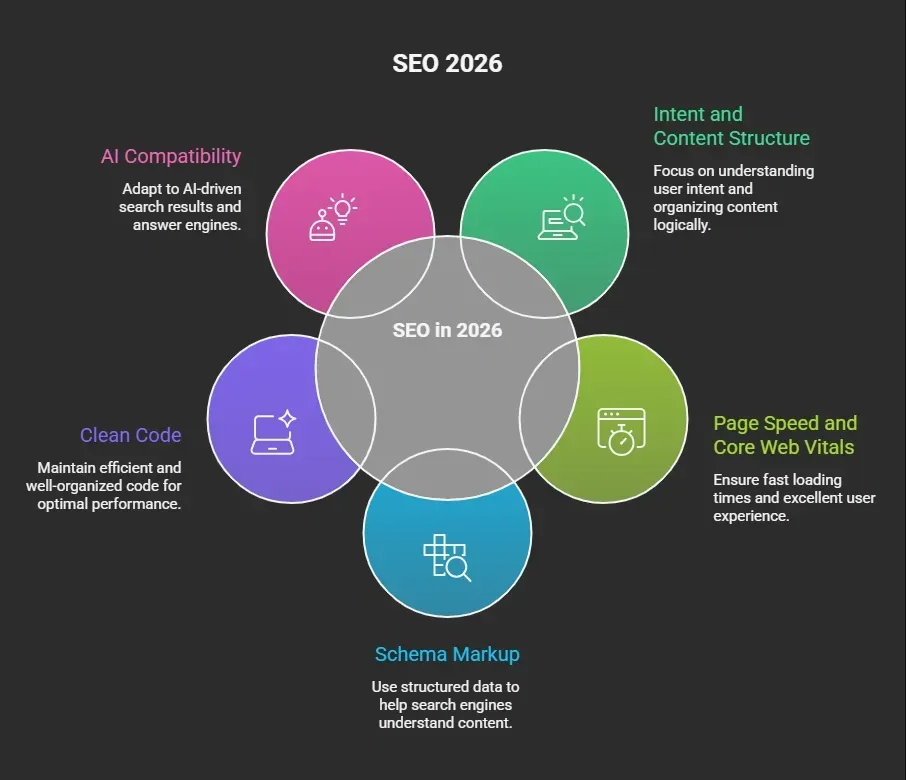
SEO today is no longer just about keywords. It now connects with AI search, answer engines, and AI-generated responses.
Search engines look deeper into structure, intent, and speed. If your site lacks proper schema markup, clean code, or fast loading pages, it falls behind.
 Older hosted builders and even some WordPress setups rely on plugins like Yoast SEO or Rank Math. They help, but they add layers, which can slow down performance.
Modern platforms handle SEO basics within the system itself. This removes extra steps, reduces complexity, and keeps your site fast and optimized from the start.
Why Default Compliance Matters
Well, think about this.
Most people who build websites are not experts in technical SEO. A small business owner or someone running online stores or service businesses just wants results.
If they have to deal with meta tags, canonical tags, structured data, and URL structure manually, it becomes overwhelming. Rocket.new flips that.
It handles:
-
GDPR compliance
-
WCAG accessibility
-
SEO ready structure
-
mobile friendly design
-
core web vitals performance
All of this happens without writing code manually. Every line of code generated follows industry standard practices. That means better search results with minimal effort.
Breaking Down the Core Pieces
So, what actually powers a system that carries context from decision to deployment? Let’s break down the core pieces based on how Rocket.new approaches SEO and discoverability.
1. SEO and Search Engines
Search engines rely on structure, clarity, and intent. Rocket builds websites with SEO fundamentals already in place, so teams don’t have to fix things later.
This improves:
-
Strong on page optimization through clean structure
-
Better internal linking for content flow
-
Alignment with keyword research and intent
-
More control over metadata and indexing
Instead of adding plugins or patches, the system sets up SEO at the foundation level. When SEO is built into the system, it keeps things simple and consistent from the start.
2. Core Web Vitals and Page Speed
Next, let’s talk about performance.
Core Web Vitals measure how fast and stable your site feels to users. Rocket focuses on performance as part of the build process.
This includes:
-
Fast loading pages with optimized delivery
-
Efficient handling of assets like images and scripts
-
Clean code structure for better rendering
These improvements support better page speed and smoother interaction, especially on mobile devices. Performance is not something you fix later. It needs to be part of the build itself.
3. Structured Data and Schema Markup
Then comes structured data.
Search engines and AI systems rely on schema to understand your content. Rocket supports structured data as part of its SEO setup.
That includes:
-
Schema for different content types like articles and pages
-
Structured data that helps search engines interpret meaning
-
Better visibility in AI-driven search and answer engines
This also supports scalable content strategies when needed. When the structure is clear, search engines and AI systems can pick up your content more easily.
Rocket.new vs Traditional Website Builder
Here’s a simple comparison:
| Feature | Traditional Website Builder | Rocket.new |
|---|---|---|
| SEO setup | Manual or plugins | Built-in |
| Core web vitals | Often inconsistent | Optimized by default |
| Structured data | Needs setup | Automatic |
| Code quality | Mixed | Clean code |
| Technical control | Limited | Full control |
| Hosting | Hosted platforms | own hosting option |
| Accessibility | Basic | WCAG ready |
This shows why many call it the best website builder for SEO in 2026.
How Rocket.new Works?
So, how does it actually work? Rocket.new is an AI powered system that helps you build websites using simple prompts.
You don’t need to write every line of code manually. The platform generates production ready code with a strong technical foundation.
Steps:
-
You describe your idea
-
The system creates layouts and pages
-
It applies SEO settings automatically
-
It structures URL structure and internal linking
-
It adds schema markup and meta tags
Every line of code is optimized for performance and clarity.
Key Features from Rocket.new
So, what do you actually get when you use Rocket in a real workflow? Based on the official docs, these features are designed to support both speed and structure while keeping everything aligned with your goals.
Here are some key features:
-
AI tools for fast builds
-
SEO ready structure
-
Schema markup support
-
Dynamic content handling
-
Clean code output
-
Mobile friendly layouts
-
Technical control with flexibility
-
Ability to build websites without heavy coding
It supports both landing pages and complex online stores.
These features make it easier to move from idea to execution without losing clarity. They help maintain consistency, improve performance, and keep everything aligned from planning to deployment.
Connecting Rocket to Modern SEO Requirements
After that, let’s connect everything back to the bigger picture. The reason Rocket.new ships GDPR, WCAG, and SEO-ready builds by default is simple. Modern SEO demands it.
Search engines today prefer:
-
Accessible websites
-
Structured data
-
Fast loading pages
-
Proper URL structure
Rocket combines all of this into one system, so teams don’t have to piece things together later.
This removes the need for:
-
A dedicated SEO team in early stages
-
Heavy reliance on SEO plugins
-
Constant fixes in Google Search Console
With built-in structure and control, teams can focus on building and scaling, instead of fixing technical gaps later.
Why This Matters for Different Users
For a Small Business Owner
A small business owner does not want to deal with technical basics. They want visibility in local search and better search results.
Rocket.new helps them:
-
build websites quickly
-
handle SEO basics automatically
-
improve content quality and structure
For Marketing Teams
Marketing teams care about SEO strategy and keyword research.
With built-in seo control, they can:
-
Adjust meta tags
-
Manage title tags
-
Track performance
Without needing deep technical knowledge.
For Developers
Developers often prefer full control and clean code.
Rocket.new gives:
-
Technical control
-
Direct control
-
Ability to customize every line of code
Without messy outputs from hosted builders.
👉Worth a Quick Read: SEO & discoverability
AI Search and the Future
Finally, let’s talk about AI search.
Search engines are moving toward answer engines. AI generated answers and AI overviews rely heavily on structured data and clarity.
Rocket.new supports AI search readiness by:
-
Adding schema markup
-
Maintaining semantic HTML
-
Structuring content properly
This helps your site stay visible in AI search results.
Building Better SEO Foundations
The problem is simple. Many people struggle with SEO because it feels technical and fragmented. They rely on plugins, fix issues later, and often miss core web vitals and structured data setup. This leads to slower sites, poor structure, and weaker results over time.
The solution is to build things right from the start. Platforms like Rocket.new combine accessibility, compliance, and performance into one system. This reduces effort and avoids repeated fixes. When the foundation is strong, growth becomes easier. That’s the real advantage of SEO-ready builds in 2026.
Table of contents
- -The Shift in SEO in 2026
- -Why Default Compliance Matters
- -Breaking Down the Core Pieces
- -1\. SEO and Search Engines
- -2\. Core Web Vitals and Page Speed
- -3\. Structured Data and Schema Markup
- -Rocket.new vs Traditional Website Builder
- -How Rocket.new Works?
- -Key Features from Rocket.new
- -Connecting Rocket to Modern SEO Requirements
- -Why This Matters for Different Users
- -For a Small Business Owner
- -For Marketing Teams
- -For Developers
- -AI Search and the Future
- -Building Better SEO Foundations