Product teams that use Rocket.new's Intelligence, Solve, and Build before locking a product roadmap arrive at planning sessions with real competitive signals, synthesized customer feedback, and structured insights, not recycled opinions. This guide shows how to make that shift before the next quarter begins.
What does your product roadmap actually reflect before your group walks into the next planning session? Most teams plan with stale information, recycled feature ideas, and opinions dressed up as product strategy. 61% of product managers already use AI or machine learning, and companies doing so have seen development efficiency rise by 25 to 30%. The gap between groups that plan with real intelligence and groups that plan from memory grows wider every cycle.
Why Most Product Roadmaps Fall Apart
A product roadmap looks finished on day one and irrelevant by week six. Product managers spend weeks building features that customers never asked for, while actual pain points sit in a backlog nobody reviews. The roadmap planning process breaks down when the document is treated as a to-do list rather than a strategy document.
So what goes wrong?
Most product roadmaps fail because they lock in specific features too early, ignore signals that arrive after the plan is set, and skip the pre-work that turns opinions into informed decisions. The product roadmap becomes a political artifact, one that reflects who argued loudest in the planning session, not what customers need.
The Real Cost of Planning Without Intelligence
Product managers spend an average of 30% of their time on manual collection that AI tools can do in minutes. The development team starts building features that sales already know customers do not want. Support tickets pile up around problems the plan does not address.
Most teams walk into roadmap planning with one slice of the picture. They have last quarter usage metrics, a few customer comments, and a competitor's pricing page someone bookmarked months ago. That is not enough context to commit an entire cycle of engineering effort. Cross-functional teams and internal and external stakeholders all deserve a product roadmap grounded in evidence, not assumptions.
Four Types of Product Roadmaps and What Each One Gets Wrong
Not all formats work the same way. The type you choose shapes what your organization can and cannot commit to. Product managers who pick the wrong format create problems for every group that depends on the product roadmap. Understanding the types of product roadmaps is the first step toward choosing the right one for your product strategy.
Feature Roadmaps
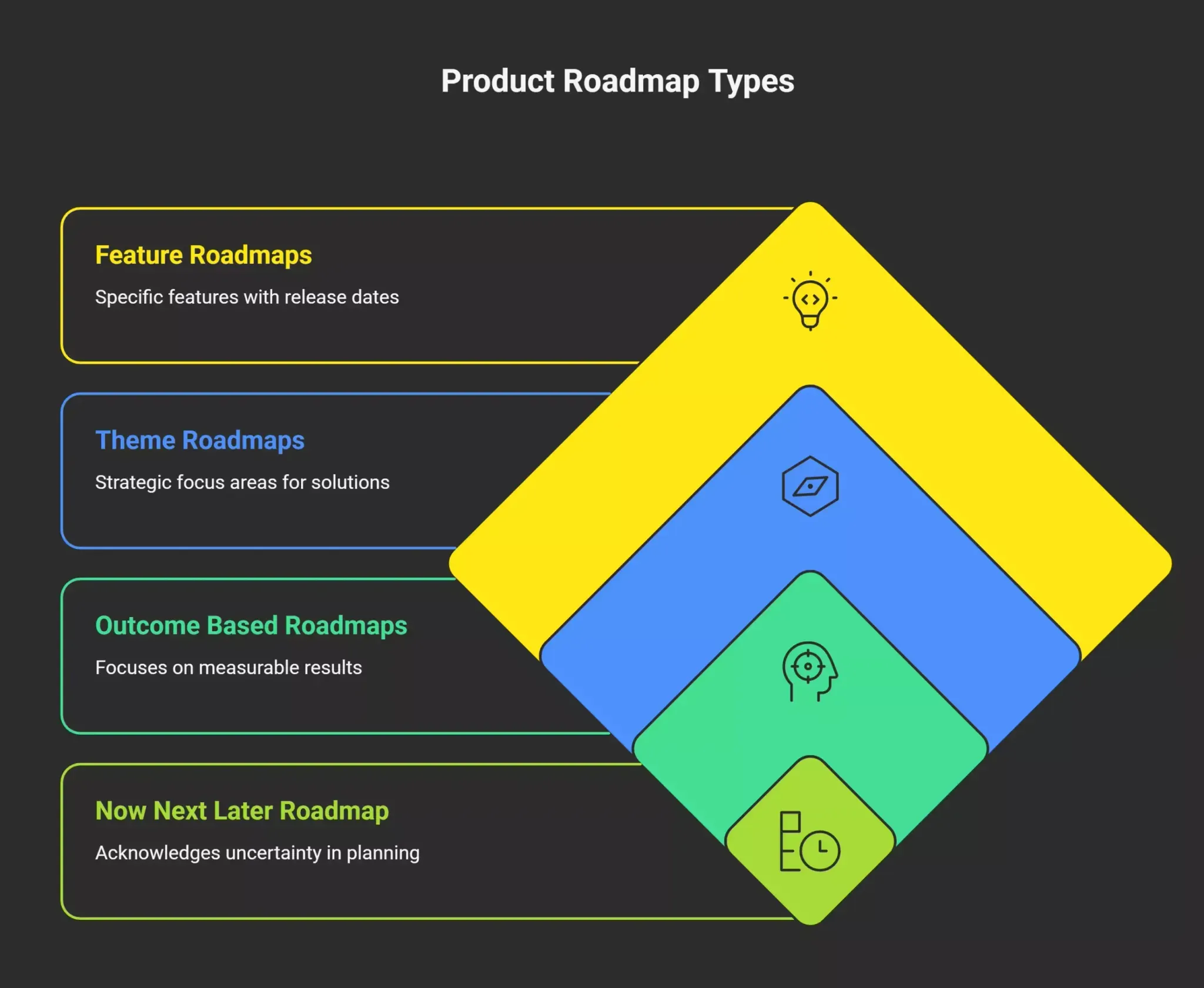
Feature roadmaps list specific features with release dates. They give sales teams and marketing teams clear visibility, which helps marketers plan campaigns and the sales team set expectations with customers. The downside: feature-based plans lock product teams into solutions before they understand the problem, and release dates become promises that push half-finished work out the door. A traditional product roadmap built around features often leads to unrealistic expectations.
Theme Roadmaps
Theme roadmaps replace specific features with strategic focus areas. They give product teams room to find solutions without committing to a particular feature too early. Theme roadmaps work well for product strategy discussions. The trade-off: the sales team and marketing groups may struggle with theme roadmaps because they lack the specificity those groups need to set expectations for customers or prepare customer-facing materials. An example product roadmap using themes might list "improve customer experience for new users" instead of "redesign onboarding screen."
Outcome-Based Roadmaps
Outcome-based roadmaps add measurable metrics to each theme. They hold product teams accountable for delivering results to customers, not just shipping features. An example product roadmap built around outcomes might target a 15% improvement in onboarding completion rather than listing "redesign onboarding flow." Outcome-based roadmaps still face visibility challenges for other departments. A rep cannot tell a customer "we are improving retention by 12%" and expect that to mean anything concrete.
The Now Next Later Roadmap
The now-next-later roadmap format acknowledges that certainty decreases the further out you plan. Items in the "now" column have clear owners, estimated effort, and defined scope. Items in the latter column carry only directional intent, with no fixed dates. This format lets product teams commit to what they are currently building while signaling where they are heading. A now-next-later roadmap pairs well with outcome-based roadmaps because it layers timing confidence on top of measurable goals.
| Type | Best For | Weakest Point |
|---|---|---|
| Feature-based plan | Sales alignment, customer communication | Locks groups into solutions too early |
| Theme roadmaps | Early-stage exploration, product strategy | Lacks specificity for go-to-market |
| Outcome-based roadmaps | Accountability, measurable results | Low visibility for non-product stakeholders |
| Now next later roadmap | Honest time horizons, flexible planning | Can feel vague to the executive team |
The Data Gap in Roadmap Planning
75% of product managers say data matters for decision-making, but only 30% are satisfied with their access to it. That gap between "we know it matters" and "we actually have what we need" is where most roadmap planning goes sideways.
Why Signal Synthesis is Time-Consuming
Product teams need to pull signals from support tickets, user feedback, usage metrics, calls with customers, and competitor activity. Each source lives in a different tool, owned by a different group, and formatted differently. Turning raw signals into structured insights that the organization can act on during a session takes days of manual work. By the time someone finishes compiling a competitive analysis, the competitor has already shipped something new.
What Groups Need Before Roadmap Planning
-
Structured summaries of feedback patterns from customers, not raw ticket dumps
-
A clear view of what competitors have changed in their product, pricing, or positioning
-
Usage data that shows which features deliver the most value and which ones customers ignore
-
Leading indicators of churn, expansion, or adoption that tell product managers where to focus
Teams need this before roadmap planning starts. Product teams that bring structured intelligence into the session start from a shared understanding and move faster toward decisions. Teams need to synthesize competitive signals, feedback patterns, and usage metrics into structured insights before the session begins.
Where Product Teams Collect Pre-Session Intelligence
Roadmap planning does not start in the session room. It starts weeks before, when various teams begin collecting signals that will shape the product roadmap.
Customer Feedback and Support Tickets
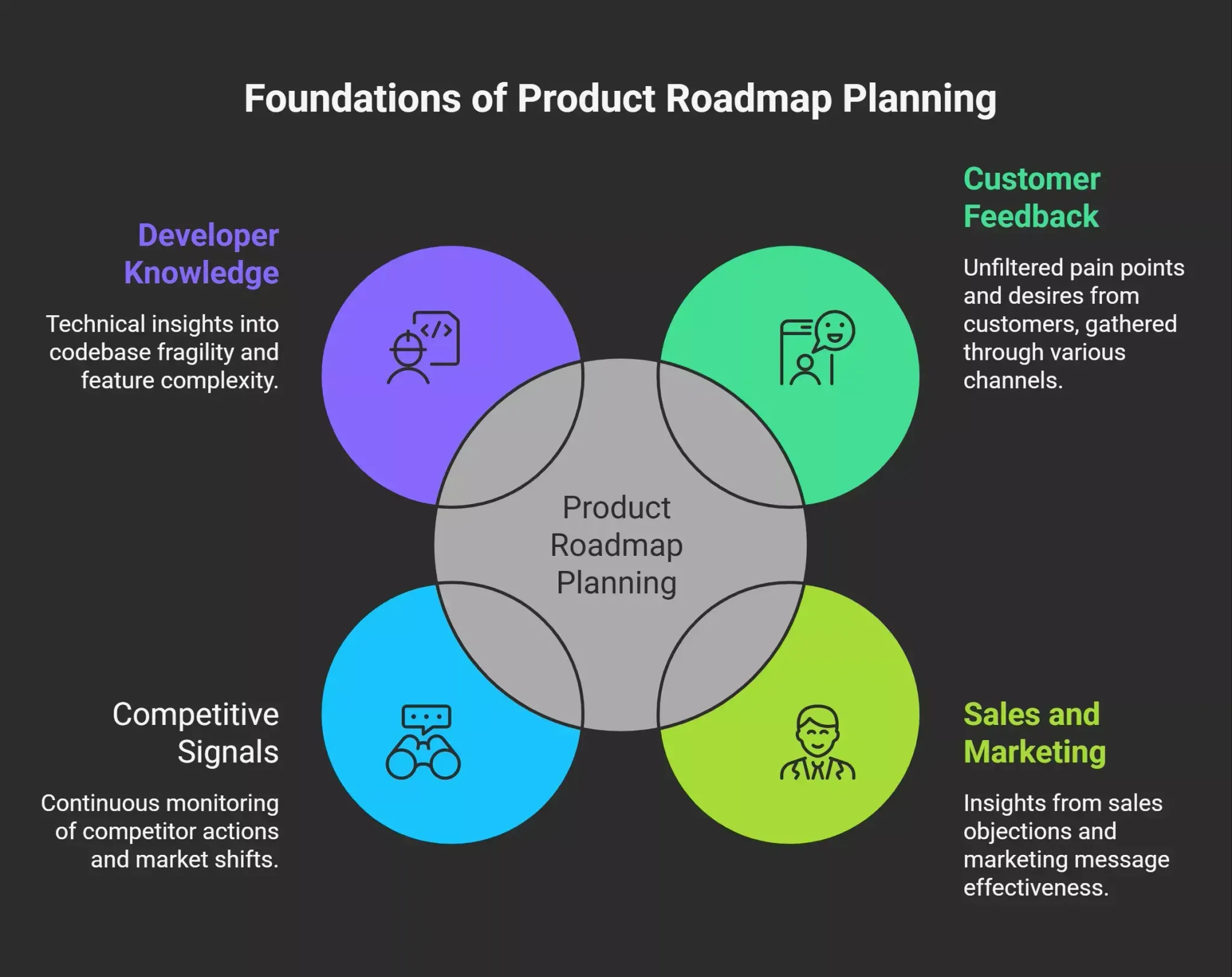
Tickets from support contain unfiltered pain points from customers. They show what breaks and what customers ask for repeatedly. Customer feedback from surveys, interviews, and NPS responses adds context that tickets alone miss. User feedback from in-app prompts gives product managers a direct line to what customers want. The challenge: customer comments arrive in dozens of formats across multiple channels. Without a system to synthesize them, the loudest voices win.
Sales and Marketing as Signal Sources
The sales team hears objections, competitor mentions, and feature gaps every day. That information rarely makes it into the product roadmap unless someone actively collects it. Sales and marketing teams can coordinate around items on the plan, but only if product managers give them the right context about what is coming and why. Marketers track which messages land with customers and which fall flat. That insight shapes which features and solutions product teams should focus on.
Competitive Signals and Market Shifts
Real competitive signals come from continuous monitoring, not one-time research. A competitor changing their pricing page, launching a new feature, or shifting their messaging all carry meaning for your product roadmap. Shifts in regulation or buyer behavior change, which features matter to customers. Many organizations do competitive research once per cycle. By the time roadmap planning arrives, that research is already outdated.
What Developers Know
Developers know which parts of the codebase are fragile, which features carry hidden complexity, and where estimated effort will exceed expectations. Ignoring their input during roadmap planning leads to plans that look great on paper but stall in execution. Backlog items from the development team often represent technical debt that, if left alone, slows down every new feature the organization tries to build.
How AI Tools Change the Planning Process
Artificial intelligence is shifting roadmap planning from a gut-feel exercise to an evidence-based process. The shift is not about replacing product managers. It is about giving them the right context before they make decisions.
Predictive Analytics and Feature Prioritization
AI tools that surface predictive analytics let product teams move from reacting to problems to anticipating them. Predictive analytics can flag which features will affect user retention, which customer segments are at risk, and which feature ideas match user behavior patterns. When product managers use predictive models during the planning process, they can prioritize features based on projected outcomes rather than assumptions.
From Opinions to Evidence
The planning process in most organizations starts with opinion and ends with compromise. AI tools automate the collection and synthesis of feedback, competitive intelligence, and usage patterns. When groups bring structured evidence into the session, buy-in from key stakeholders gets easier. It removes the "I think" from early discussions.
Getting buy-in from executives, the development team, and sales all at once requires showing evidence, not slides. This process of moving from opinions to evidence-based decision-making can lower the risk of building unwanted products by focusing on what customers actually want.
Getting Stakeholder Buy-In Before the Plan Locks
A product roadmap only works if the people who depend on it trust it. Executives, revenue reps, marketers, the development team, and support teams all need to see themselves reflected. Securing stakeholder alignment before the session is one of the most underrated steps in successful product roadmap creation.
What Each Group Wants
The executive team wants to know if the plan matches business objectives and product vision. They care about strategy, not individual features. Sales wants to know which features are coming so they can set expectations with prospects.
Support teams want to know which pain points the plan addresses so they can get ready for changes in volume. Internal stakeholders give buy-in when they see their input reflected. If the planning process ignores their signals, they ignore the product roadmap.
Making the Session Productive
A productive session starts with shared intelligence, not a blank whiteboard. Product managers who build structured reports beforehand can spend time on decisions rather than on collection. Roadmap planning works best when the session focuses on trade-offs between options, not brainstorming from scratch.
Each stakeholder group should see the relevant information beforehand. Executives get the strategy view. The development team gets the effort breakdown. Cross-functional teams stay on the same page when the product roadmap serves as a communication tool, not just a project plan.
What Product Leaders Are Saying
Product leaders across the industry are rethinking how roadmap planning works. The move toward hypothesis-driven planning is gaining ground.
"What we need to be doing is planning for outcomes. Treat your plans as a series of hypotheses you are going to test, through rapid prototyping." - Rob Seaman, CPO at Slack, ProductCon San Francisco 2025
Seaman's point hits at the core of why roadmap creation needs to change. When organizations treat items as fixed commitments, they lose the ability to adapt. When they treat them as hypotheses backed by real signals, the product roadmap stays relevant.
That shift from "plan and forget" to "plan and learn" is what separates product roadmaps that ship real customer experience improvements from plans that shuffle features around.
How Rocket.new Helps Product Teams Create a Product Roadmap Before Roadmap Planning
Rocket.new is the only platform where product teams can research a market, track competitors, and build solutions without switching tools. Every decision and insight stays in one shared context. When a group sits down to plan, Rocket already has the intelligence they need. It is the product roadmap software that connects research, competitive monitoring, and execution in a single workspace.
Solve: Deep Research for Decisions
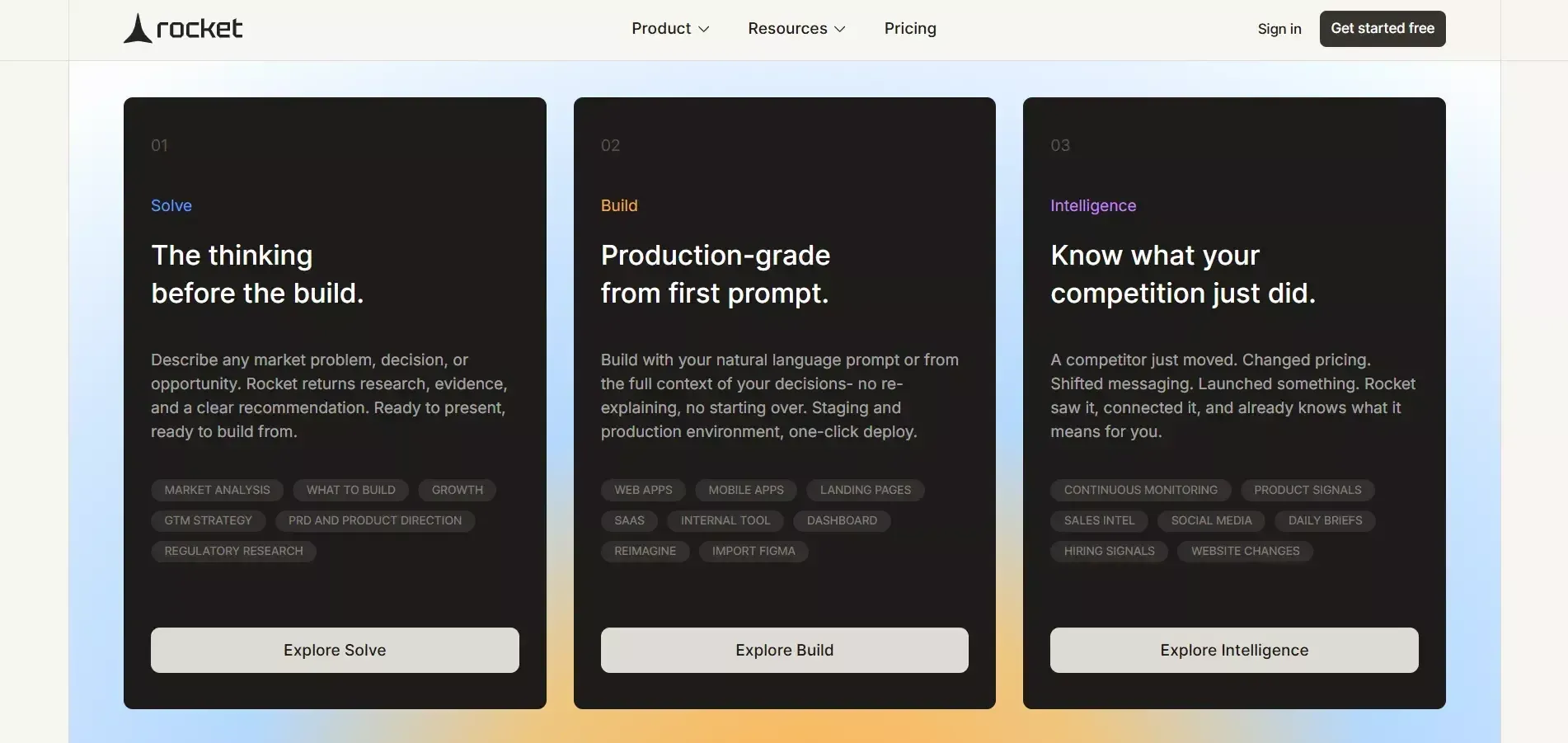
Rocket's Solve product turns business questions into structured, evidence-backed reports. Product managers can type "What are our competitors doing differently in onboarding?" and get a multi-source research report with analysis and recommendations.
Solve generates market analysis reports that highlight gaps and strategic opportunities, giving product teams the research they need before roadmap planning begins. The output is ready to share with internal and external stakeholders, which means product managers spend less time building slide decks and more time making decisions.
Intelligence: Continuous Competitor Monitoring
Rocket Intelligence tracks competitor signals across six categories: website changes, hiring patterns, reviews and sentiment, advertising strategy, social media presence, and product features. Set up monitoring once, and Rocket delivers daily briefs with changes that matter to your product roadmap.
Automated intelligence lets groups continuously monitor competitor ad campaigns, product launches, and positioning shifts. When a competitor makes a move between cycles, Intelligence catches it. That signal becomes context for the next sprint or the next product roadmap update.
Build: From Decisions to Working Products
After the organization finalizes the product roadmap, Rocket's Build product lets them move directly from plan to product. Build carries the full context from Solve and Intelligence into the development phase. No re-explaining decisions to a different tool. Product teams can prototype solutions, validate ideas, and ship production-grade code in Flutter for mobile or Next.js for web, keeping software development moving forward.
Rocket.new Features for Roadmap Planning
| Feature | What It Does |
|---|---|
| Solve | Turns any business question into a structured, evidence-backed report |
| Intelligence | Monitors competitors across 6 signal categories continuously |
| Build | Ships production-grade Flutter (mobile) and Next.js (web) products |
| 25,000+ Templates | Free starting points for any project type |
| Shared Context | All insights, decisions, and research carry into every task automatically |
| Collaboration | Team workspaces with role-based access for cross-functional teams |
Use Cases for Product Teams
-
Run a competitive teardown in Solve before roadmap planning, then set up Intelligence monitors to track changes through the cycle
-
Use Solve to analyze customer feedback patterns and surface the pain points that should shape the next product roadmap
-
Feed competitive intelligence from Rocket into the planning session so the group can see what has moved since the last cycle
-
Build quick prototypes in Rocket to validate feature ideas before committing them to the product roadmap, letting the development team test assumptions before the next sprint, and reducing estimated effort surprises
Locking a Smarter Product Roadmap Moving Forward
Using Rocket.new's intelligence before locking a product roadmap comes down to preparation. Groups that create structured plans backed by real competitive intelligence and clear customer insights build product roadmaps that survive contact with reality.
Groups that skip the pre-work build plans that look good on a slide and fall apart by mid-cycle. Roadmap-based decisions grow stronger when product managers bring evidence to the table instead of opinions. The product roadmap becomes something the whole organization can trust, and priorities shift toward delivering the most value to customers rather than debating what to build.
Stop guessing what to build next.
Start using Rocket.new to run competitive research, synthesize customer feedback, and lock a product roadmap your entire team can trust before the next quarter begins.
Table of contents
- -Why Most Product Roadmaps Fall Apart
- -The Real Cost of Planning Without Intelligence
- -Four Types of Product Roadmaps and What Each One Gets Wrong
- -Feature Roadmaps
- -Theme Roadmaps
- -Outcome-Based Roadmaps
- -The Now Next Later Roadmap
- -The Data Gap in Roadmap Planning
- -Why Signal Synthesis is Time-Consuming
- -What Groups Need Before Roadmap Planning
- -Where Product Teams Collect Pre-Session Intelligence
- -Customer Feedback and Support Tickets
- -Sales and Marketing as Signal Sources
- -Competitive Signals and Market Shifts
- -What Developers Know
- -How AI Tools Change the Planning Process
- -Predictive Analytics and Feature Prioritization
- -From Opinions to Evidence
- -Getting Stakeholder Buy-In Before the Plan Locks
- -What Each Group Wants
- -Making the Session Productive
- -What Product Leaders Are Saying
- -How Rocket.new Helps Product Teams Create a Product Roadmap Before Roadmap Planning
- -Solve: Deep Research for Decisions
- -Intelligence: Continuous Competitor Monitoring
- -Build: From Decisions to Working Products
- -Rocket.new Features for Roadmap Planning
- -Use Cases for Product Teams
- -Locking a Smarter Product Roadmap Moving Forward