
Building a minimum viable product is the fastest way to test a business idea before spending serious resources. This blog covers validation, build path selection, real-world examples, and product-market fit. Everything you need to ship an MVP that learns.
What if the biggest thing standing between your idea and a real product is not money or code, but a clear plan?
Building a minimum viable product is the fastest way to find out if your business idea works. It saves you from spending months on something nobody wants. According to CB Insights, 42% of startups fail because there was no market need for their product. That number is not bad luck. It is the direct result of building without validating first.
This blog covers more than just how to build an MVP. It shows you how to validate before you build and choose the right build path. You will also learn from five companies that shaped their industries and discover exactly when you have found product-market fit.
What is a Minimum Viable Product (and What It Isn't)
A minimum viable product is the simplest working version of your product. It solves a real problem for real users. The word "viable" carries more weight than most people give it credit for.
Ash Maurya, creator of the Lean Canvas, put it plainly. Founders cannot agree on what MVP means because they are each solving a different problem. Some treat it as a prototype. Some treat it as a beta. Some treat it as a polished v1. None of those are right. The MVP is a learning vehicle, not a product milestone.
The classic analogy holds. Your full product vision is a wedding cake. A sketch of the cake tells you nothing. A cupcake, small and complete with frosting and flavor, proves whether people like your recipe before you bake a five-tier cake.
The table below draws a clear line between common build artifacts and an actual minimum viable product.
| Artifact | Goal | Audience | Real Code? | Validates |
|---|---|---|---|---|
| Proof of Concept | Test technical feasibility | Internal team | Partial | Can we build it? |
| Clickable Prototype | Visualize look and feel | Stakeholders | No | Does it make sense? |
| Minimum Viable Product | Validate market demand | Real users | Yes | Will people use and pay for it? |
| Minimum Marketable Product | Expand to a broader market | Paying customers | Yes | Can we scale it? |
| Full Product | Grow and retain | General market | Yes | Can we dominate it? |
Only an MVP puts a real, working product in front of real users. That contact with the real world is what separates learning from guessing.
The MVP Mindset: Why Most MVPs Fail Before They Start
Most MVPs do not fail at launch. They fail months earlier, before a single line of code gets written.
The pattern repeats constantly. A founder has a business idea. Friends love it. Months get spent building a full-featured product behind closed doors. Launch day arrives. Crickets. The code quality is often fine. The real problem is that nobody stopped to ask: does this solve a real pain for real target users?
A McKinsey and Oxford University study found that IT projects without proper problem validation run 45% over budget on average. They also deliver 56% less value than predicted. MVP development exists to cut that risk before it becomes a budget crisis. It validates demand with minimal effort before you commit serious resources.
Skipping validation is not ambitious. It is just expensive. The minimum viable product approach forces you to prove your assumptions early. This is the core of lean startup methodology: validated learning before investment.
The Five Patterns That Kill MVPs in Practice
These are not edge cases. They are the five patterns that appear most often across failed MVP launches.
- Scope creep disguised as vision. The product grows in every direction because nobody drew a hard line. Three core features become ten. The launch date moves back indefinitely.
- Building too little to learn anything. Shipping something so stripped down that real users cannot complete a meaningful flow means the feedback is noise, not signal.
- Skipping the feedback loop entirely. Metrics tell you what happened. Users tell you why. You need both to make smart decisions.
- Measuring the wrong things. Tracking page views and signups while ignoring activation rate, retention, and churn teaches you nothing useful.
- Waiting for the right moment. "We just need one more feature." There is no right moment. The right moment was three features ago.
The Feature Creep Trap
Feature creep quietly kills more launches than bad code ever does. It starts with one extra screen. Then a second. Then a quick feature that takes three weeks. A focused three-feature app becomes a ten-feature monster with a collapsing timeline.
The trigger is almost always an unclear boundary between what must be done and what would be nice to have. The fix is ruthless prioritization: one problem, one target audience, and only the core features that solve that problem. Everything else goes into a backlog and stays there until after launch.
Phase 1: Validate Before You Build
The single most expensive mistake in MVP development is building before validating that anyone wants what you are building. Validation is not a phase you skip to get to the interesting part. It is the interesting part.
Market Research: Who Has the Problem and How Bad Is the Pain
Start with the problem, not the solution. Be specific enough that you can describe your target user by name and situation.
"People struggle with task management" is too broad to build on. "Freelance designers lose three to five hours a week chasing late payments" is specific enough to act on. Run your market research across three layers.
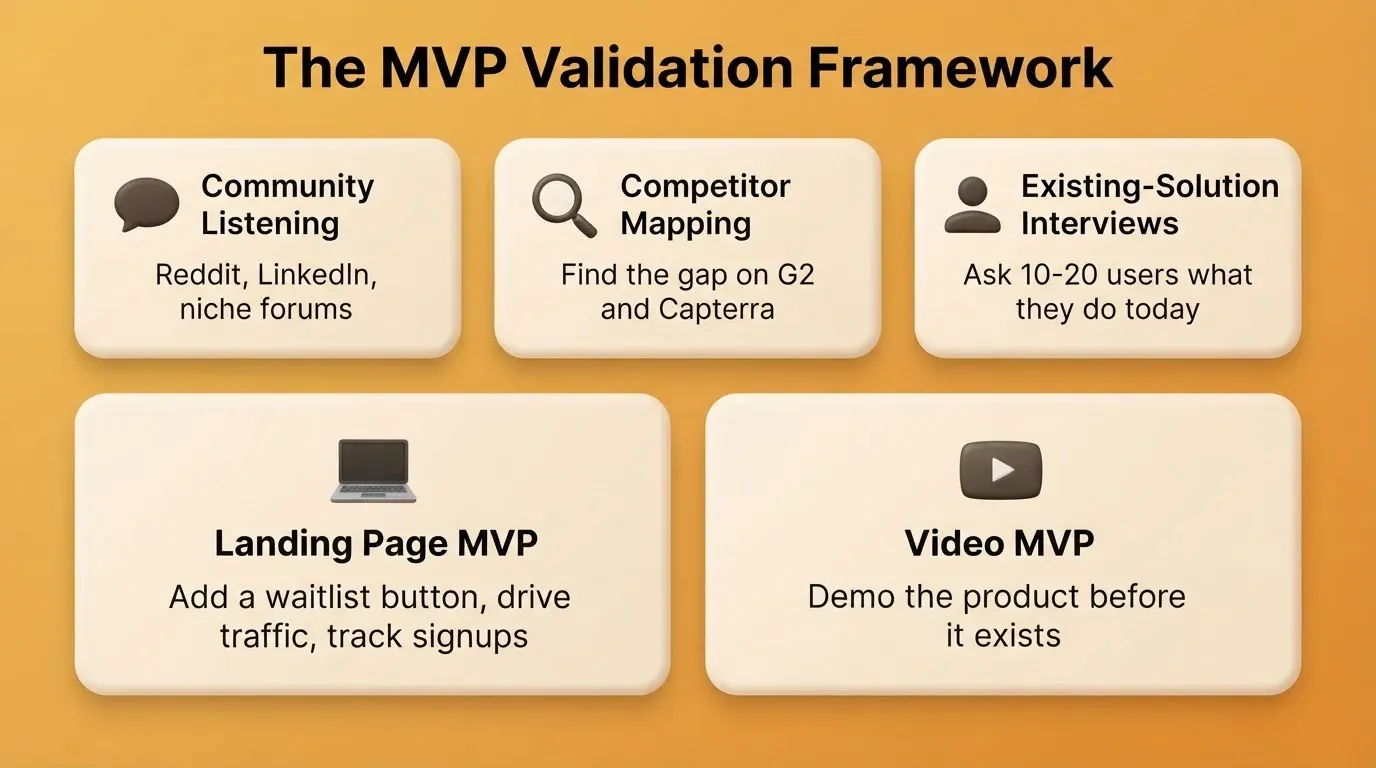
- Community listening. Check Reddit threads, LinkedIn posts, and niche forums where your target audience complains. The exact language people use to describe their pain is the language your product should speak.
- Competitor mapping. No competitors often means no market. Many competitors means demand exists. Look for the gap they all share. What do reviewers on G2 and Capterra say is missing?
- Existing-solution interviews. Ask ten to twenty potential users how they handle the problem today. Do not ask whether they would use your product. What they do today is real. What they say they might do is not.
User Interviews: How to Run a Discovery Interview
The discovery interview is the highest-ROI activity in the validation phase. Most founders skip it. The ones who do it well build products that work.
Who to interview: Target users who already have the problem you are solving. Aim for ten to twenty interviews before concluding.
What to ask:
- "Walk me through the last time you dealt with [problem]."
- "What did you try first? What did you try after that?"
- "What does it cost you in time, money, or frustration when this goes wrong?"
What to listen for: Specific stories, not opinions. When someone says "I hate how long it takes," that is an opinion. When they say "Last Tuesday I spent four hours rebuilding a spreadsheet because the client changed the brief," that is a story. Stories are buildable. Opinions are not.
Never ask "Would you use a product that did X?" People say yes to almost everything. Instead, ask what they do today.
Landing Page and Video MVP as Validation Tools
Before a single line of production code, two tools can answer the most important question: does anyone actually want this?
The landing page MVP. Describe the product, what it does, and who it is for. Add a "Join Waitlist" button, drive traffic to it, and track clicks. Buffer validated their business idea this way. A simple landing page with pricing, before any product existed, confirmed real market demand through signups. Learn how fake-door testing works in practice before you commit to building.
The video MVP. Dropbox validated their entire product with a three-minute demo video. They did this before writing a line of infrastructure code. The video drove 75,000 signups overnight. The product did not exist yet. The demand was real. A video MVP works best when the core value proposition is visual and the technical build is expensive.
Define Success Criteria Before You Launch
Validation without a benchmark is just activity. Before you run any validation experiment, write down what "validated" means in numbers.
| Signal | Weak Validation | Strong Validation |
|---|---|---|
| Landing page conversion | Under 5% email signup rate | Over 15% email signup rate |
| User interviews | 3 of 10 describe the pain unprompted | 8 of 10 describe the pain unprompted |
| Video MVP | Under 10K views, low signup rate | 50K+ views, 20%+ signup-to-view rate |
| Waitlist | Under 100 signups in two weeks | 500+ signups in two weeks |
| Sean Ellis PMF test | Under 40% "very disappointed" | 40%+ "very disappointed" if product disappeared |
The Sean Ellis test is the simplest post-launch PMF benchmark. Survey your active users and ask how they would feel if they could no longer use your product. If 40% or more say "very disappointed," you have product-market fit.
Real MVP Examples That Shaped Industries
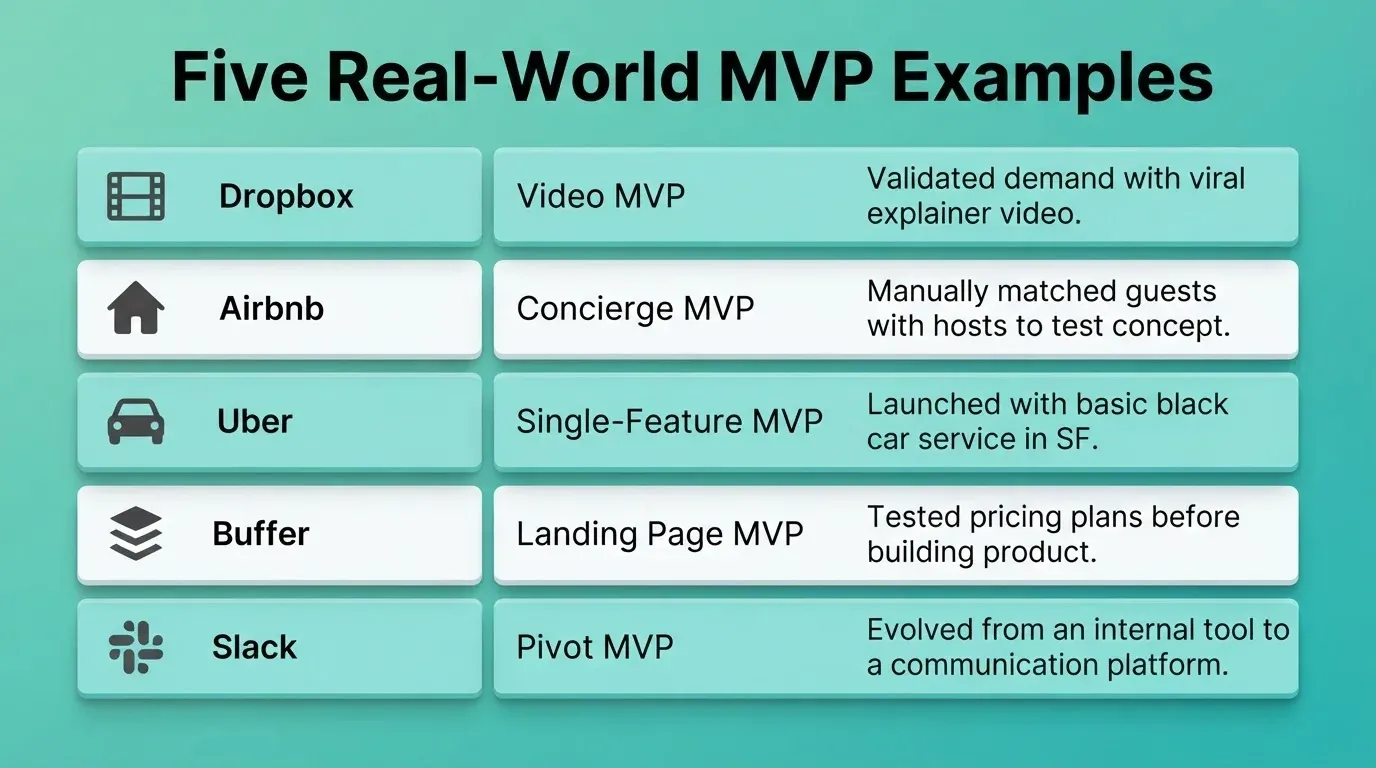
The best way to understand what an MVP actually is, and what it is not, is to see how five companies used it to build products that changed their markets.
Dropbox: The Video MVP
Drew Houston made a three-minute screencast showing the product working. It demonstrated seamless file syncing across devices before the infrastructure existed to do it. The video drove 75,000 signups overnight from a waitlist that had 5,000 people on it the day before. What it validated: The pain of file syncing was real, widespread, and unsolved well enough by existing tools.
Airbnb: The Concierge MVP
Brian Chesky and Joe Gebbia put an air mattress in their apartment, built a basic website, and rented out the space to conference attendees. There was no platform and no payment system. Just a manual, human-powered version of what would eventually become a $75 billion company. What it validated: Strangers would pay to sleep in other strangers' homes.
Uber: The Single-Feature MVP
The first version of Uber was an SMS-based app available only in San Francisco, only for black cars, and only for the founders and their friends. One feature: request a car, get a car. What it validated: People would pay a premium for on-demand transportation if the experience was reliable enough.
Buffer: The Landing Page MVP
Joel Gascoigne built a two-page website. Page one described Buffer. Page two showed pricing plans. There was no product. The click-through rate to the pricing page proved willingness to pay before a single feature was built. What it validated: Social media scheduling was a real pain point and people would pay for a solution before seeing it.
Slack: The Pivot MVP
Slack was not built to be Slack. It started as an internal communication tool for a gaming company called Glitch. When Glitch failed, the team realized the tool they had built for themselves was more valuable than the game. They pivoted and built the product around what was already working. What it validated: Team communication tools had a massive unmet need.
What They All Have in Common
| Company | MVP Type | Time to Signal | Core Hypothesis Tested |
|---|---|---|---|
| Dropbox | Video MVP | Days | Will people want seamless file sync? |
| Airbnb | Concierge MVP | Weeks | Will strangers pay to stay with strangers? |
| Uber | Single-Feature MVP | Weeks | Will people pay a premium for reliable on-demand cars? |
| Buffer | Landing Page MVP | Days | Will people pay for social scheduling before seeing it? |
| Slack | Pivot MVP | Months | Is our internal tool valuable to others? |
None of them built the full product first. All of them tested the core hypothesis with the minimum amount of work required to get a real signal.
Choosing Your MVP Type
Not every MVP is a coded app. The right choice depends on what hypothesis you are testing and how quickly you need a signal.
| MVP Type | How It Works | Best For | Effort | Time to Signal | Real-World Example |
|---|---|---|---|---|---|
| Video MVP | Demo the product before it exists | Complex or technical products | Very low | Days | Dropbox |
| Landing Page MVP | Sell the concept before building it | Validating demand and pricing | Very low | Days | Buffer |
| Concierge MVP | Manually perform the service yourself | Service-based or marketplace ideas | Low | Weeks | Airbnb |
| Wizard of Oz MVP | Front end looks automated; humans do the work | Marketplaces, booking, AI features | Medium | Weeks | Early Zappos |
| Single-Feature MVP | Build one feature perfectly, ignore the rest | Crowded markets with a clear gap | Medium | Weeks | Early Uber |
| Prototype MVP | Clickable mockup, no real back end | UX validation before committing to code | Low | Days | Any complex UI product |
| No Code MVP | Combine existing tools into a working flow | Bootstrapped founders, fast validation | Low | Weeks | Groupon (WordPress blog) |
Choose the type that gets you to your first real user feedback with the least amount of building. You can always move to a more complex version once you know the direction is right.
Define Your Product Vision and Core Hypothesis
A product vision is not a feature list. It is a one-sentence filter for every decision you will make about the MVP.
Use this combined formula before you do anything else.
Product vision: "We believe [target user] has a problem with [pain point] and will pay for [solution]."
Core hypothesis: "I believe [user] will [action] because [reason]. I will know this is true when [measurable signal]."
The second sentence is what most founders skip. Without a measurable signal, you cannot know whether your MVP succeeded or failed. Write both sentences down and commit to them. Use them as your defense against scope creep. If a proposed feature does not serve these statements, it does not belong in version one.
Next, map out the user journey your MVP needs to support. Start from sign-up and end at the core value action. Cut any step that does not lead directly toward that action.
Prioritize Features So Scope Does Not Kill Your Launch
Once the vision is set, every feature needs to earn its place in the first release. Feature prioritization is where successful MVPs are won or lost.
The MoSCoW Method
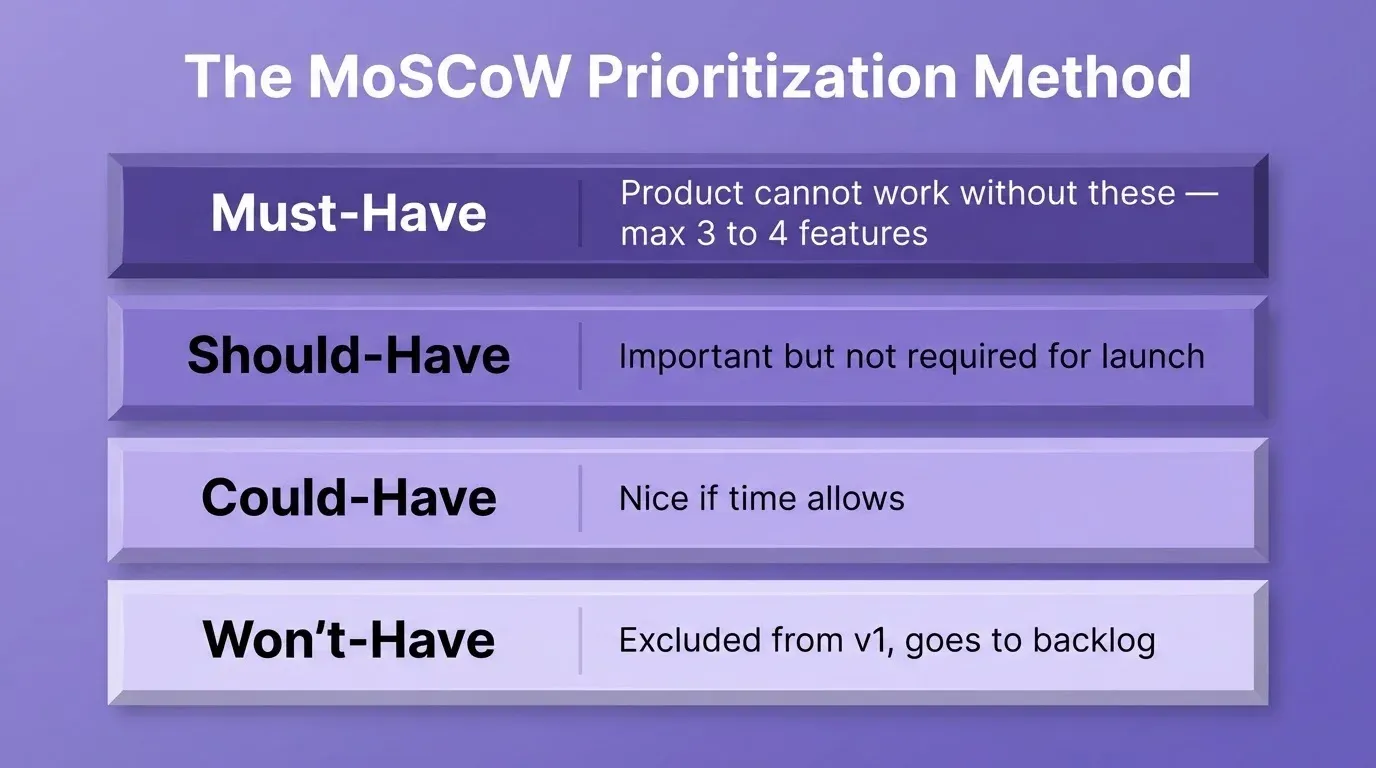
- Must-Have: The product does not work without these. Limit this to three or four features maximum. More than that and your MVP is already too big.
- Should-Have: Important but not required for launch. Gets built after the MVP proves itself.
- Could-Have: Nice if time allows. It almost never does.
- Won't-Have: Explicitly excluded from v1 and written into a backlog. Writing them down prevents the founding team from second-guessing the scope mid-build.
The MoSCoW method works because it forces the priority conversation before a sprint starts. On a whiteboard, not mid-build when changing course is expensive.
The Feature Decision Filter
Before any feature makes it onto the Must-Have list, run it through this four-question filter.
| Question | If Yes | If No |
|---|---|---|
| Does this feature test a core assumption? | Keep it | Defer it |
| Can we learn what we need without building it? | Cut it | Keep it |
| Does it serve the primary user flow? | Keep it | Defer it |
| Is the effort proportional to the learning? | Keep it | Cut it |
A feature that passes all four questions belongs in v1. A feature that fails any one of them goes into the backlog. If your MVP direction changes after launch, here is how to pivot without starting over.
Choose Your Build Path: Code, No-Code, or AI-Native
The right build path depends on what you are building, how fast you need to move, and whether you need to own the code at the end.
The Case for No-Code
No-code tools let a single non-technical founder go from idea to working prototype in days instead of months. For early validation, that speed is often more valuable than technical flexibility.
| Tool | Best For | Data Model | Code Export | Scale Ceiling |
|---|---|---|---|---|
| Bubble | Complex web apps with custom logic | Strong | No | Medium |
| Webflow | Marketing sites and CMS-driven products | Limited | Partial | High |
| Glide | Mobile apps from spreadsheet data | Simple | No | Low |
| Adalo | Mobile apps with basic database needs | Simple | No | Low |
| Airtable | Data-heavy workflows and internal tools | Strong | No | Medium |
| Rocket | Full-stack web and mobile apps, AI-native | Strong | Yes (Next.js / Flutter) | High |
However, no-code tools come with limitations you should know before you commit.
- Customization ceiling: Most no-code tools hit a wall when your product logic gets complex.
- Scale risk: Tools built on proprietary infrastructure can become expensive or unstable at volume.
- Lock-in: If you cannot export your code, you cannot migrate without rebuilding.
The Case for Custom Code
For teams with technical co-founders or a development team, custom code gives full control over architecture, performance, and future flexibility. Here are the right stacks for most MVPs.
- Web apps: Next.js on the front end, Node.js on the back end, and PostgreSQL for the database. This combination is fast, well-supported, and scales well into a full product.
- Mobile apps: Flutter lets you ship to iOS and Android from a single codebase. This cuts MVP development time significantly compared to building two separate native apps.
- AI-powered products: Python with FastAPI or Django, paired with a vector database, handles complex back end requirements well.
Pick the simplest tech stack that gives you ownership of your code and room to scale.
Build Your MVP: The Step-by-Step Process
This is the single canonical build sequence. Every step is in order for a reason.
Step 1: Write Your Hypothesis. Before anything else, write the two-sentence product vision and core hypothesis from the section above. If you cannot write it in two sentences, you do not yet understand your own product well enough to build it.
Step 2: Validate Demand. Run a landing page or video MVP before writing a line of production code. Set your validation benchmark. If you hit it, proceed. If you do not, adjust the hypothesis and try again.
Step 3: Build a Clickable Prototype. Build the prototype in Figma. Make it clickable enough for real users to complete the core user journey. Changing a layout in Figma takes thirty minutes. Changing that same layout in code takes days.
Step 4: Choose Your Build Path. Use the build path section above to make this decision. Do not revisit it once made. The cost of switching mid-build is always higher than the cost of choosing imperfectly at the start.
Step 5: Build Back End First, Front End Last. Build the back end data model first. This defines the shape of everything else. Authentication and core business logic come next. Front end UI gets built last, after the underlying structure is stable and tested.
Step 6: Run Agile Two-Week Sprints. Break work into two-week sprints. Each sprint plans a small, defined set of features, builds and tests them, and reviews working software with real people. Running ten two-week sprints teaches you far more than building for five months and launching once.
Step 7: Soft Launch to Real Users. Run a soft launch with 50 to 100 real users. Not friends or colleagues, but actual strangers from your target audience. Getting 20 real users in week three tells you more than 2,000 signups from a Product Hunt post.
Measure What Matters: Metrics, Feedback, and the Build-Measure-Learn Loop
Launch is the starting gate, not the finish line. What happens after launch determines whether the MVP actually works.
The Metrics That Matter
The difference between vanity metrics and real metrics is whether they change your decisions.
| Metric Type | Vanity (ignore) | Real (track) |
|---|---|---|
| Acquisition | Total signups | Signups from target channel |
| Activation | Accounts created | Users who completed the core action |
| Retention | Monthly active users | Day 7 and Day 30 return rate |
| Revenue | Total MRR | Revenue per activated user |
| Referral | Social shares | Organic word-of-mouth signups |
Track activation rate, retention rate, and churn from day one. If your activation rate is low, your onboarding is broken. If your retention is low, your core value proposition is not landing. Fix the right problem first.
Cohort analysis is the most useful tool for understanding retention. Group users by the week they signed up and track how each cohort behaves over time. If all cohorts churn at the same rate, you have a structural problem to address.
Feedback Channels That Actually Work
Gather customer feedback through multiple channels simultaneously. Each one gives you a different angle on the same truth.
- In-app analytics: Track what users actually do, not what they say they do.
- In-app surveys: Ask one question at the right moment. For example, "What almost stopped you from signing up?" after onboarding.
- User interviews: Run five to ten interviews per sprint cycle. Ask about behavior, not opinions.
- Support tickets: Every support ticket is a product failure. Treat them as a ranked list of what to fix next.
- Direct outreach: Email your churned users. They will tell you things your active users never will.
The Build-Measure-Learn Loop
The Build-Measure-Learn loop, from Eric Ries's lean startup methodology, is the operating system for every MVP iteration. Build the smallest thing that tests your current hypothesis. Measure what actually happens. Learn whether your hypothesis was right. Then repeat. Learn how to iterate on your MVP with AI tools to accelerate this cycle.
Common MVP Mistakes to Avoid
The path from idea to launch has predictable traps. These are the ones that show up most often, and the ones most founders wish they had caught earlier.
- Building for everyone. One specific target user. One specific problem.
- Skipping user interviews. Talking to ten potential users before writing code can save weeks of wasted development.
- Confusing MVP with prototype. A prototype is a mockup. An MVP is a working product. Shipping a Figma file and calling it an MVP means you have not tested anything with real users.
- Not defining metrics upfront. If you do not write down what "validated" means before you launch, you will rationalize whatever result you get.
- Waiting for perfection. A product that never ships never learns.
- Ignoring customer feedback. If users say a feature is confusing, believe them and fix it rather than defending the design.
- Over-investing before validation. Spending six figures on a product that has never been tested with real users is a risk most early-stage teams cannot absorb.
What Real Builders Say
Here is what a founder shared after testing Rocket for MVP building in the r/vibecoding community on Reddit. It captures something real about where the category is heading.
"I use GPT to first create a very extensive PRD, and then feed that into Rocket.new. It does a really solid job of analyzing everything... It's definitely not perfect, but for rapid prototyping or just spinning up an MVP, it feels like a big productivity boost." — r/vibecoding, Reddit
The cost of going from idea to working product has dropped significantly. Tools that once required a full development team can now be handled by a single founder with the right platform behind them.
Product-Market Fit: The Real Goal of MVP Development
Product-market fit is the moment when your product starts working for users in the way they actually live and work, not the way you imagined they would.
Watch for these signals that tell you you have found it.
- Users return on their own without being prompted.
- Retention climbs week over week without intervention.
- Early adopters refer friends without being asked.
- Support tickets start arriving, which means users care enough to report problems.
- Your Sean Ellis score crosses 40% "very disappointed" (from the validation benchmark table above).
The minimum viable product MVP is the mechanism for reaching product-market fit as quickly and cheaply as possible. Ship a basic version, collect customer feedback, adjust, and ship again. The goal is not a polished product on day one. It is a learning engine that gets smarter with every real user who touches it.
Build Your MVP with Rocket
Rocket is the world's first Vibe Solutioning platform. It is the first platform where business thinking and building happen in the same place. 1.5 million people have tried Rocket across 180 countries, from solopreneurs validating their first idea to enterprise teams running strategy and execution on the same platform.
Most tools start at line one. You describe what to build, they build it. For simple tasks, that works fine. For building an MVP, however, the thinking before the build matters as much as the build itself. That is where most tools leave a meaningful gap.
Solve: Validate Before You Build
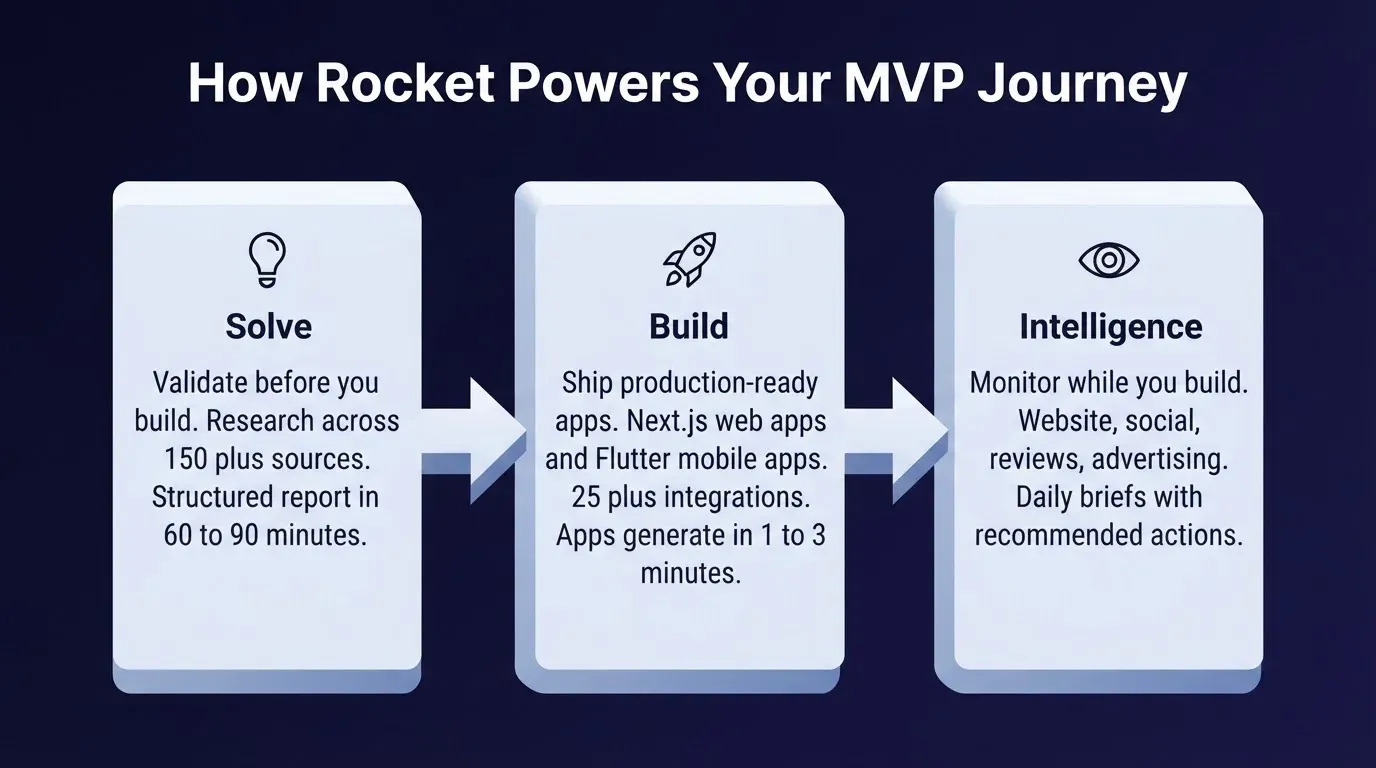
Before writing code, Rocket's Solve turns any business question into a complete, structured analysis. It runs research across 150+ sources simultaneously and delivers results in 60 to 90 minutes. Bring a market hypothesis or a product idea. Solve returns a structured report covering target users, customer pain points, competitive gaps, and risk factors. It also gives you a clear recommendation on direction. Every finding is tagged by signal strength: HIGH, MEDIUM, or LOW. Conflicting signals are called out explicitly, not smoothed over.
The Solve output does not disappear after export. It becomes the foundation of everything that follows in the project. The PRD is present when the developer opens the build task. The competitive brief is present when the landing page is written.
Build: From Idea to Production-Ready App in Minutes
Once you know what to build, Rocket's Build generates production-ready apps from plain language descriptions, Figma files, existing GitHub repositories, or templates. Every build starts from the accumulated intelligence of the project.
- Web apps come out in Next.js, production-grade, with real design hierarchy, SEO-ready structure, and WCAG accessibility compliance built in by default.
- Mobile apps come out in Flutter, one codebase ready for both iOS and Android, with dark and light theming and real navigation patterns.
- Landing pages are built from the project context, so the hero copy speaks to the specific user problem rather than pulling from a generic template library.
Refine through Chat with natural language instructions. Use Visual Edit to click any element and change it directly. Or open Code for direct source file access. There is no change limit. 25+ built-in connectors including Stripe, Supabase, Google Analytics, Mixpanel, and Mailchimp authenticate once and flow into every build automatically.
Most apps generate in one to three minutes. When the MVP is ready to go live, one click creates a live URL. You get staging and production environments, full version history, and one-click rollback.
Intelligence: Monitor Competitors While You Build
Rocket's Intelligence watches every platform your competitor operates on and tells you what it means. Set it up once per workspace. It runs automatically from that point.
Intelligence monitors four categories: website changes, social and news activity, customer reviews, and advertising strategy. Every signal is interpreted, not just collected. Daily briefs surface the most significant changes with recommended actions.
For an MVP founder, this is the difference between guessing where your market is heading and knowing it.
Rocket Pricing
Rocket runs on a credit-based system. One credit balance covers Solve, Build, and Intelligence.
| Plan | Price | Credits | What's Included |
|---|---|---|---|
| Free | $0 | 20 (one-time) | Build production-ready apps + Light Solve |
| Pro | $25/month | 100/month | Build + Light Solve |
| Rocket | $50/month | 250/month | Build + Full Solve + Intelligence |
| Booster | $250/month | 1,500/month | Build + Full Solve + Intelligence + premium support |
All paid plans include unlimited team members. Annual billing saves 20%.
Your MVP Playbook Starts Here
Building a minimum viable product is not a shortcut. It is the smartest path from idea to product-market fit. Validate before you build, learn from companies that got it right, and choose the right build path. Run a disciplined build process and measure what actually matters. AI-native platforms now compress the time from idea to shipped product. The teams that win are the ones who validate faster and iterate smarter. Start your MVP journey with Rocket today. Sign up at Rocket.new and go from idea to working product.
Table of contents
- -What is a Minimum Viable Product (and What It Isn't)
- -The MVP Mindset: Why Most MVPs Fail Before They Start
- -The Five Patterns That Kill MVPs in Practice
- -The Feature Creep Trap
- -Phase 1: Validate Before You Build
- -Market Research: Who Has the Problem and How Bad Is the Pain
- -User Interviews: How to Run a Discovery Interview
- -Landing Page and Video MVP as Validation Tools
- -Define Success Criteria Before You Launch
- -Real MVP Examples That Shaped Industries
- -Dropbox: The Video MVP
- -Airbnb: The Concierge MVP
- -Uber: The Single-Feature MVP
- -Buffer: The Landing Page MVP
- -Slack: The Pivot MVP
- -What They All Have in Common
- -Choosing Your MVP Type
- -Define Your Product Vision and Core Hypothesis
- -Prioritize Features So Scope Does Not Kill Your Launch
- -The MoSCoW Method
- -The Feature Decision Filter
- -Choose Your Build Path: Code, No-Code, or AI-Native
- -The Case for No-Code
- -The Case for Custom Code
- -Build Your MVP: The Step-by-Step Process
- -Measure What Matters: Metrics, Feedback, and the Build-Measure-Learn Loop
- -The Metrics That Matter
- -Feedback Channels That Actually Work
- -The Build-Measure-Learn Loop
- -Common MVP Mistakes to Avoid
- -What Real Builders Say
- -Product-Market Fit: The Real Goal of MVP Development
- -Build Your MVP with Rocket
- -Solve: Validate Before You Build
- -Build: From Idea to Production-Ready App in Minutes
- -Intelligence: Monitor Competitors While You Build
- -Rocket Pricing
- -Your MVP Playbook Starts Here