
Rocket.new combines Solve (research), Build (Next.js and Flutter apps), and Intelligence (competitor monitoring) in one platform. Founders who validate with Solve before using Build consistently ship stronger products than those who rely on a single prompt.
Rocket.new is a vibe solutioning platform with three pillars: Solve for research, Build for Next.js and Flutter app generation, and Intelligence for competitor monitoring. It lets founders validate ideas, ship production-ready apps, and track competitors without switching tools.
Founders who use this Rocket.new build system consistently outperform those who rely on a single prompt.
What Is Rocket.new? A Definition
Rocket.new is a vibe solutioning platform that combines three pillars in one product.
| Pillar | What It Does | What It Produces |
|---|---|---|
| Solve | Validate ideas, run market research, create PRDs, and answer strategic business questions | Structured reports with executive summary, analysis, evidence, and recommendations, exportable as PDF or PPTX |
| Build | Generate full-stack apps from natural language | Production-ready Next.js web apps and Flutter mobile apps |
| Intelligence | Monitor competitors continuously | Automated daily briefs, pricing change alerts, and trend signals delivered to a live dashboard |
Each pillar works independently. Use one, two, or all three, depending on what you need. The three pillars share context and feed into each other: research from Solve informs Build, and signals from Intelligence can trigger new Solve questions or product updates in Build.
The Big Difference: Validation vs Just Prompting
Most founders today use AI tools to generate an app from a single prompt. It feels fast. It feels smart. But it often leads to a frustrating experience.
You type a single prompt. You get an entire app. It looks decent. But then reality hits.
Users don't engage. Features feel random. The backend logic doesn't match real needs.
Now compare that with founders using a vibe solutioning platform like Rocket. They don't just generate; they validate with Solve, build with Build, and monitor with Intelligence.
What Happens When You Just Prompt?
Prompting feels powerful. You write a few natural language prompts, get generated apps, and feel like things are moving fast.
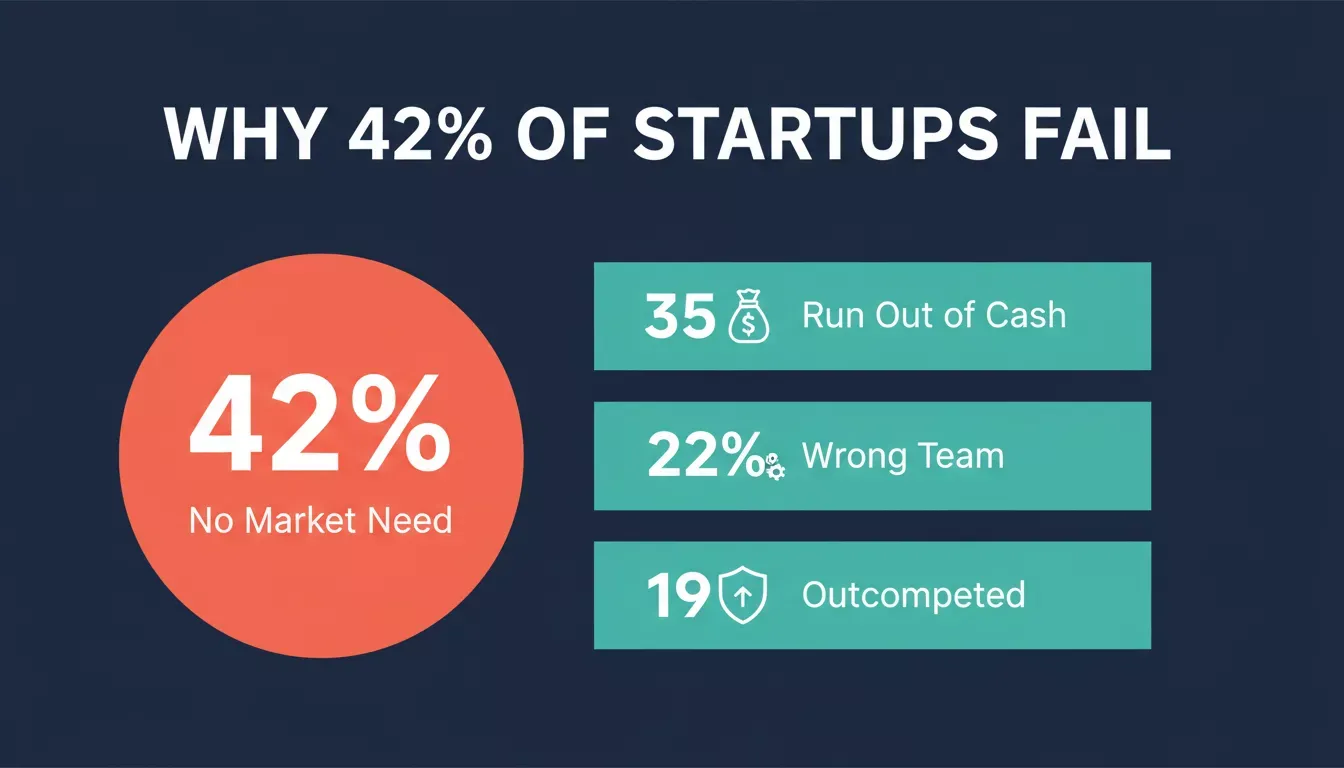
42% of startups fail due to no market need, the exact problem Solve is designed to prevent.
It becomes surface-level app building. You might create simple web apps or basic mobile apps. But scaling is hard, and many AI tools focus only on code generation rather than product thinking.
According to CB Insights' 2021 startup failure analysis, 42% of startups fail because there is no market need. That is a number that shows one thing clearly: validation matters more than speed alone.
What Founders Do Differently on Rocket
Founders using Rocket take a different route. They use Solve to validate before they build, then use Build to generate production-ready Next.js or Flutter apps, and Intelligence to stay ahead of competitors.
They focus on business thinking, not just output. They don't lose context between tasks: instead, they use @-mentions to reference findings from previous Solve reports directly inside new tasks, keeping shared project context intact across the entire workspace.
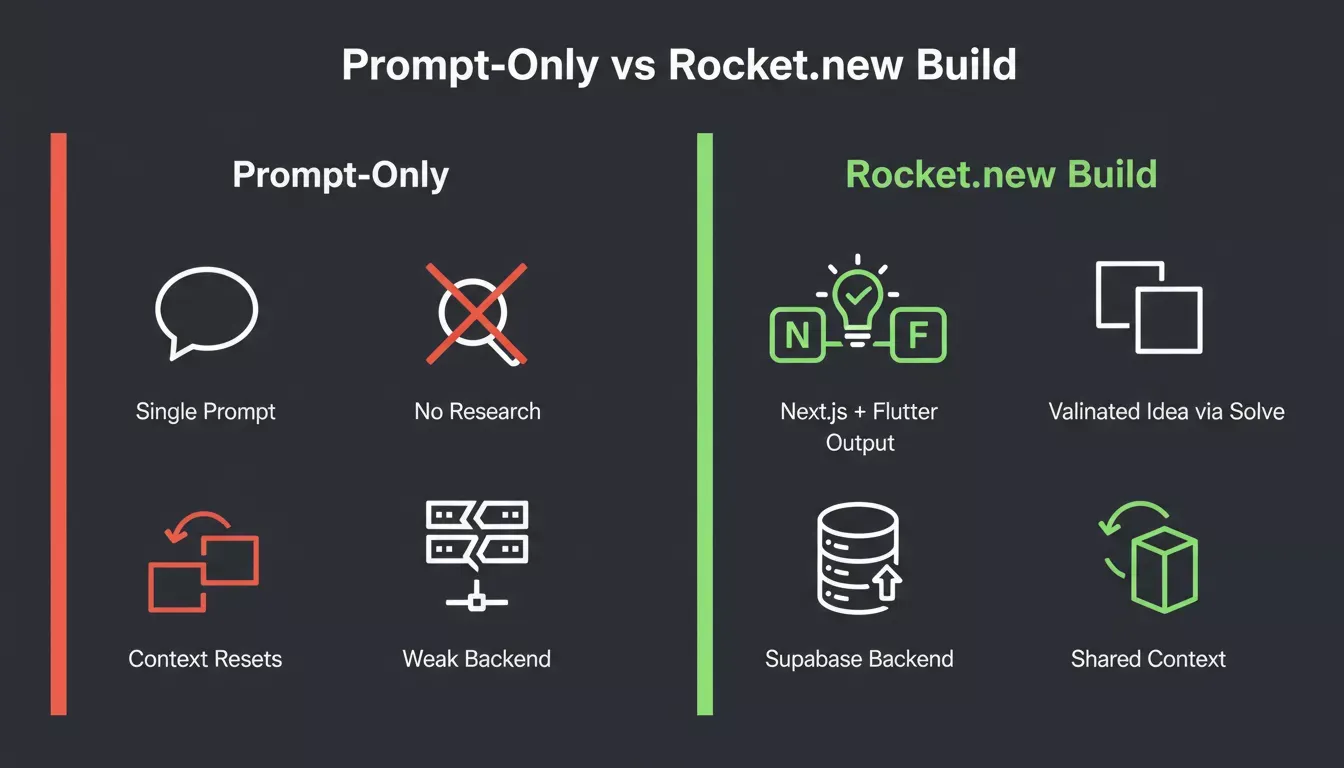
Prompt-only builders reset context every session. Rocket.new carries validated research through every step.
Here's how they approach it:
- Solve: Ask a strategic question and get a structured, evidence-backed report in minutes
- Solve: Use competitive teardowns to understand the market before writing a line of code
- Solve: Validate with real signals and export findings as PDF or PPTX for stakeholders
- Build: Generate a production-ready Next.js web app or Flutter mobile app from natural language
- Intelligence: Set up continuous competitor monitoring: pricing changes, hiring spikes, product launches, delivered automatically to your dashboard
- Iterate: Refine using AI suggestions, custom logic, and full code access
This is vibe coding done right.
Rocket.new vs No Code Tools, Prompt-Only Builders, vs Traditional Development
| Approach | Prompt-Only Builders | Traditional Dev | Rocket.new |
|---|---|---|---|
| Starting Point | Single prompt | Requirements doc | Validated Solve report |
| Research | None | Manual | Automated via Solve |
| App Output | Generated code | Custom code | Next.js web apps, Flutter mobile apps |
| Context | Resets each session | Siloed in docs | Shared across tasks via @-mentions |
| Competitor Monitoring | None | Manual | Automated daily briefs via Intelligence |
| Scaling | Hard | Expensive | Adaptable backend infrastructure, production-grade |
| Pricing Model | Per generation | Developer hourly | Transparent credit system |
Unlike many no-code tools, Rocket.new keeps generated code visible and editable, giving teams more control as they build and scale.
Why Validation Wins Every Time
Because users decide everything. If your app doesn't match real needs, it won't survive.
Founders using Rocket understand this. They focus on user feedback surfaced through Solve research, real use cases validated before Build begins, and iteration cycles informed by Intelligence signals.
They don't guess. They test. They don't rush. They refine.
Inside Rocket: The Three Pillars Explained
Rocket.new is the first vibe solutioning platform built for modern founders and product teams. It's not just another AI app builder: it's a full system where each pillar serves a distinct purpose.
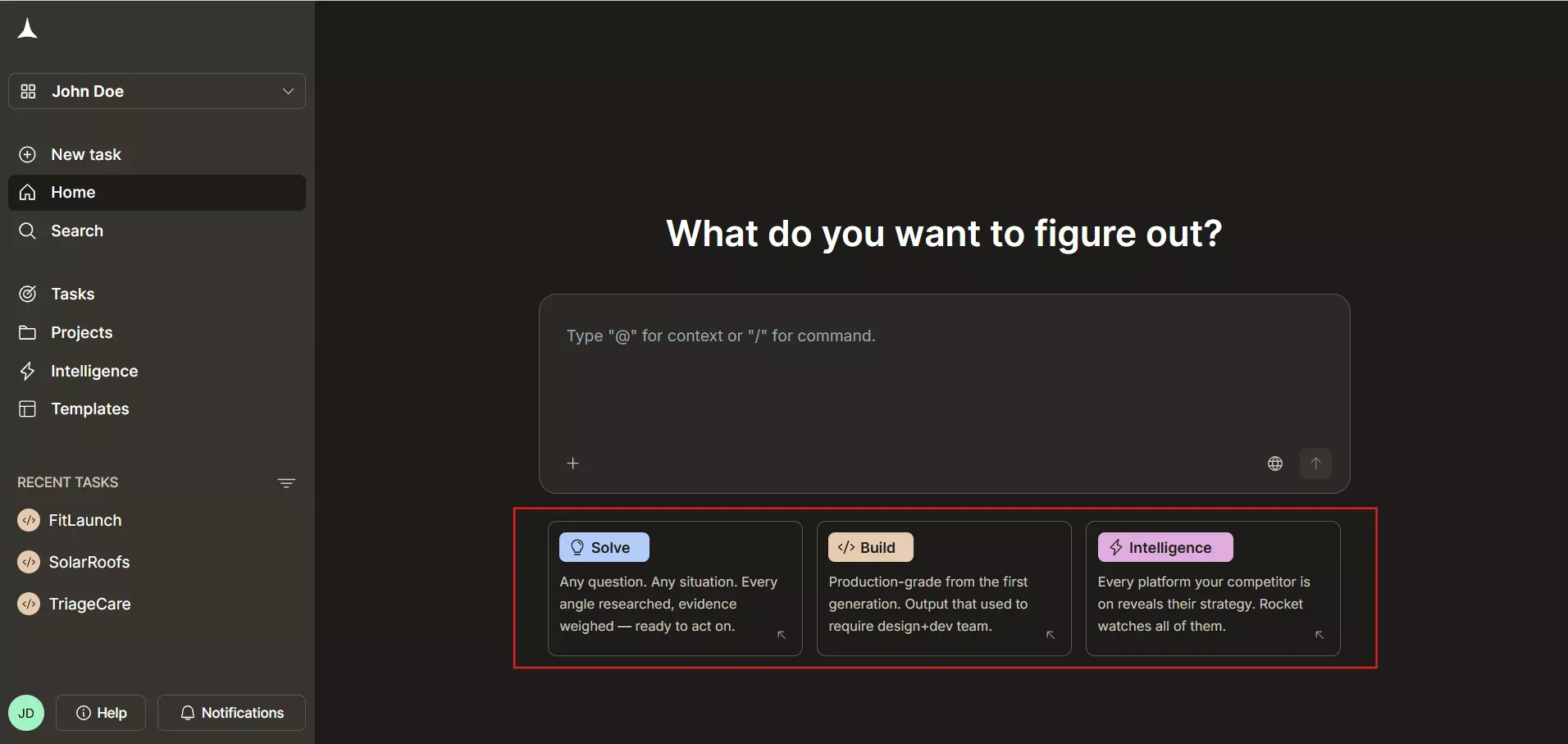
Three pillars, one platform: Solve for research, Build for app generation, and Intelligence for competitor monitoring.
Solve: Research Before You Build
Solve is Rocket's research engine. Before you build anything, Solve helps you validate ideas, size markets, run competitive analysis, and answer complex business questions.
Type a question in plain language and get back a structured, evidence-backed report built from live data. Every report includes an executive summary, detailed analysis, supporting evidence, and actionable recommendations.
Solve covers:
- Market analysis: size markets, identify trends, assess opportunities
- Competitive teardowns: compare features, analyze positioning, run SWOT frameworks
- Pricing strategy: benchmark pricing, model scenarios, and analyze willingness to pay
- Product direction: prioritize features, analyze user needs, inform roadmaps
- Investment analysis: build business cases, run due diligence
Results are exportable as PDF or PPTX and shareable via link with optional password protection.
Build: Generate Production-Ready Mobile Apps
Build generates production-ready Next.js web apps and Flutter mobile apps from natural language. You can start with a product idea, a Figma import, or templates, and Build creates the full frontend and backend, including database schema, API routes, and authentication via Supabase integration. Real-time changes are mainly made through a chat interface using natural language commands.
What Build produces:
- Next.js web apps with Supabase for auth, database, and storage
- Flutter mobile apps are deployable to the Apple App Store and Google Play
- SaaS dashboards, internal tools, marketplaces, and e-commerce stores
- Fully editable code with no lock-in
Everything stays editable, with a visual editor for direct layout and design tweaks plus built-in AI features. It also supports external APIs and services for connected workflows. Connect a custom domain and deploy with one click. The architecture can scale as backend integrations and data models evolve.
Intelligence: Monitor Competitors Continuously
Intelligence is a workspace-level dashboard in your sidebar where all competitor monitoring signals live. Set it up once, and it runs automatically.
Intelligence delivers automated daily briefs on competitor activity, pricing change alerts when competitors update their pricing pages, and trend signals across hiring, product launches, social media, and reviews.
When paired with connected analytics sources, Intelligence can also surface patterns in user behavior to inform post-launch improvements.
How Rocket.new Build Process Works Step by Step
Step 1: Ask Solve a Question
Type any business question in plain language. Solve classifies it, decomposes it into research dimensions, and runs parallel agent research streams simultaneously.
Outcome: A structured report with executive summary, analysis, evidence, and recommendations, ready to export or share.
Step 2: Use Solve Findings to Scope Your Build
Reference your Solve report in a Build task using @-mentions. Build inherits the validated context: market insights, user needs, and competitive positioning, before generating a single line of code.
Outcome: Your Next.js or Flutter app is scoped from validated research, not guesswork.
Step 3: Generate the App
Describe your app in natural language, start from a Figma import, or use a template. Build creates the backend logic, database schema, API routes, and frontend, all in one session.
The same project can generate a web app and native mobile apps for iOS and Android across multiple platforms.
Outcome: A production-ready Next.js web app or Flutter mobile app with Supabase integration.
Step 4: Iterate and Polish
Refine using AI suggestions, custom code edits, and a visual editor for direct design and layout changes, with live updates mainly handled through a chat interface that accepts natural language commands and other AI features. Add connectors for Stripe, Airtable, Notion, HubSpot, and 25+ other external API and service integrations to support seamless data flow.
Outcome: A fully customized, production-grade app with no lock-in.
Step 5: Deploy and Monitor
Connect a custom domain and launch. Your app gets a live URL immediately. Then set up Intelligence to monitor competitors automatically.
Outcome: A deployed product with continuous competitive awareness built in.
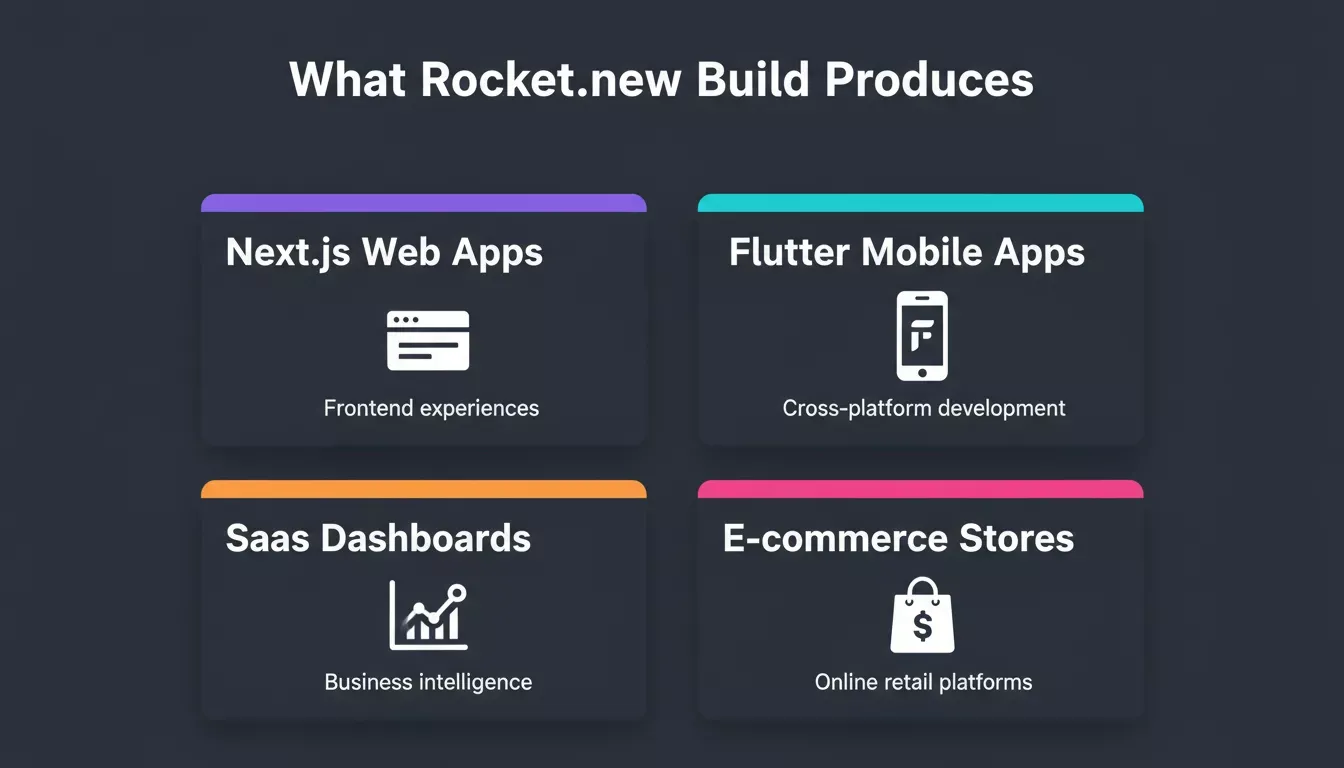
Build outputs Next.js web apps, Flutter mobile apps, SaaS dashboards, and e-commerce stores, all production-ready.
Key Platform Features
Credits System
Rocket.new runs on a transparent token-based system. You can track token usage before you run a task, and simple prompts use fewer tokens than more complex requests. Start with a free plan and buy additional tokens as needed, with no hidden costs.
Plans range from Free (20 one-time credits) to Booster ($250/month, 1,500 credits/month). The Personal Plan starts at $25/month, while Rocket Plan at $50/month includes 250 credits and unlocks the full suite: Build, Solve, and Intelligence. Unused tokens roll over on monthly plans, and on annual plans they roll over month to month within the 12-month term but expire at renewal. You can also purchase refuel tokens for larger or unexpected project needs.
Cross-Task Context via @-Mentions
Reference findings from any previous Solve report or Build session in your current task using @-mentions. Context is shared across tasks within a project, so insights from your market research flow directly into your app build without re-entering information.
Production-Grade Output
Build doesn't generate throwaway prototypes. It produces a full app suited to production-ready applications, including Next.js web apps and Flutter mobile apps with structured backend logic, plus flexible backend infrastructure and data models as requirements grow, Supabase integration for auth and storage, and production-ready code you can push to GitHub.
Audit Logs and Version Control
Track every change across your app with full version history and rollback. This is especially valuable for teams iterating rapidly on a full-stack AI builder.
Rocket.new Pricing Plans
Four plans from Free to Booster: one credit balance covers Solve, Build, and Intelligence.
| Plan | Price | Credits/Month | Key Features |
|---|---|---|---|
| Free | $0 | 20 (one-time) | Build only |
| Pro | $25/mo | 100 | Build |
| Rocket | $50/mo | 250 | Build + Solve + Intelligence |
| Booster | $250/mo | 1,500 | Full suite + SSO + premium support |
All paid plans include unlimited team members. Annual billing saves 20%.
Why Teams Prefer Rocket Over Other Platforms
Most teams struggle with tool fragmentation. They use one tool for research, another for building, and a third for competitor tracking. That breaks flow and loses context at every handoff.
For small teams, Rocket.new is a strong alternative to fragmented stacks and limited no-code workflows because it keeps research, building, and monitoring in one connected workspace.
Rocket fixes that by unifying Solve for research and validation, Build for Next.js and Flutter app generation, and Intelligence for continuous competitor monitoring, all in one workspace with shared context across every task.
Small teams and solo founders benefit most. Even technical teams value the structure because Build produces clean, production-ready Next.js and Flutter code they can extend.
What the Community Says
Here's a perspective from Reddit's r/startups community:
"AI tools that just generate apps from prompts feel cool at first, but they break when you try to scale or customize anything serious."
This is exactly what many founders experience. Prompt-only systems look impressive but struggle with real-world use because they skip the validation step entirely.
Rocket.new vs Bolt.new vs Lovable: A Direct Comparison
| Feature | Bolt.new | Lovable | Rocket.new |
|---|---|---|---|
| App Output | Web apps | Web apps | Next.js web apps + Flutter mobile apps |
| Built-in Research | None | None | Solve (market analysis, competitive teardowns, PRDs) |
| Competitor Monitoring | None | None | Intelligence (automated daily briefs, pricing alerts) |
| Context Between Sessions | Limited | Limited | Shared project context via @-mentions |
| Research Export | N/A | N/A | PDF, PPTX |
| Pricing Model | Credits | Credits | Credits with transparent pricing and no surprises |
| Mobile App Deployment | No | No | Apple App Store + Google Play via Flutter |
Rocket.new is a strong alternative for teams that need validated planning and a full app workflow, not just web-only generation.
Why Vibe Coding Is Different
Vibe coding is not just about typing commands. It's about understanding the full picture before writing code, working with validated context from Solve, and building with intent informed by Intelligence signals.
It also supports rapid prototyping with more control than typical no code tools because the generated code stays editable.
Rocket makes vibe solutioning practical. You don't just write prompts: you shape the product with research, build it with AI, and monitor it with Intelligence. Founders who want to build a startup with vibe coding find that Rocket's three-pillar approach removes the guesswork entirely.
From Idea to Complete Application
On Rocket, you can go from idea to complete application without deep coding knowledge, and without losing context at any step.
You can build:
- Next.js web apps with full backend and Supabase integration
- Flutter mobile apps for iOS and Android
- SaaS dashboards and internal tools with payment integrations
- E-commerce stores with product listings, cart, checkout, and payment integrations
- Marketing sites and landing pages with custom domains
A single project can grow into a full app across web and mobile as needs expand.
All from one platform, with research and competitor monitoring built in. This is especially powerful for founders who want to build an MVP with AI without hiring a full development team.
Final Thoughts
Stop guessing and start building products users actually want. Rocket.new combines idea validation (Solve), AI app generation (Build), and competitor monitoring (Intelligence) in one platform, so your Rocket.new build starts with evidence, not assumptions.
Start building for free today and join founders who ship smarter.
Table of contents
- -What Is Rocket.new? A Definition
- -The Big Difference: Validation vs Just Prompting
- -What Happens When You Just Prompt?
- -What Founders Do Differently on Rocket
- -Rocket.new vs No Code Tools, Prompt-Only Builders, vs Traditional Development
- -Why Validation Wins Every Time
- -Inside Rocket: The Three Pillars Explained
- -Solve: Research Before You Build
- -Build: Generate Production-Ready Mobile Apps
- -Intelligence: Monitor Competitors Continuously
- -How Rocket.new Build Process Works Step by Step
- -Step 1: Ask Solve a Question
- -Step 2: Use Solve Findings to Scope Your Build
- -Step 3: Generate the App
- -Step 4: Iterate and Polish
- -Step 5: Deploy and Monitor
- -Key Platform Features
- -Credits System
- -Cross-Task Context via @-Mentions
- -Production-Grade Output
- -Audit Logs and Version Control
- -Rocket.new Pricing Plans
- -Why Teams Prefer Rocket Over Other Platforms
- -What the Community Says
- -Rocket.new vs Bolt.new vs Lovable: A Direct Comparison
- -Why Vibe Coding Is Different
- -From Idea to Complete Application
- -Final Thoughts