Rocket.new is faster for prompt-to-app building, offering Figma integration, mobile app support, and full code export. Base44 focuses on structured backend reliability with a guided, all-in-one environment. Choose Rocket.new for speed and flexibility, or Base44 for controlled, backend-heavy workflows.
Which AI app builder ships a working product faster?
For Figma-to-app speed and full code access, Rocket.new is the faster path. For structured backend reliability, Base44 carries a different kind of strength.
According to the 2024 Stack Overflow Developer Survey, 76% of developers were already using or planning to use AI tools, and that number has since climbed to 84%. Picking the right vibe coding tool matters.
What is Vibe Coding and Why Developers and Professionals Care
Vibe coding is a development approach where you describe what you want your app to do using natural language, and an AI platform translates your description into working code. No manual syntax, no boilerplate setup, no frameworks to configure from scratch.
-
You describe what you want the app to do
-
The AI builds the code, database schema, UI, and backend logic
-
You review the live app and refine it by talking through the next changes
-
The platform handles deployment and hosting automatically
Vibe coding tools make app building accessible for non-developers while accelerating workflows for professionals who want to stop writing repetitive code. It lowers the barrier for creators who never studied computer science and represents a cultural shift where software creation feels less like engineering and more like design.
Why an AI App Builder Changes Your Setup Time
An AI app builder compresses weeks of development into hours.
-
Setup time drops from days to minutes
-
You focus on what the app should do rather than how to write the code
-
Iteration is fast because you continue building with a new prompt
-
The same tools work for non-technical founders and experienced developers
The two AI app builders dominating this conversation are Rocket.new and Base44. They share the natural language-to-app model but differ in execution, code access, and control.
Rocket.new vs Base44: Feature Comparison for Vibe Coding Tools
Here is a direct side-by-side look at what matters most when building with each platform.
| Feature | Rocket.new | Base44 |
|---|---|---|
| Natural language to app | Yes | Yes |
| Figma import | Yes | No |
| Code export | React, Next.js, Flutter | Limited |
| Free plan | Yes | Yes |
| Paid plans (starting) | From $25/month | From ~$16/month |
| Template library | 25k+ curated templates | Limited |
| Token efficiency | Up to 80% savings | Standard |
| Mobile app output | Flutter (iOS and Android) | Web-focused |
| Database setup | Auto-generated | Auto-generated |
| User authentication | Built in from prompt | Built in |
| Deployment | One-click, custom domain | Wix-hosted |
| Code files | Full export, all frameworks | Restricted on free plan |
| Collaboration | Built in | Yes |
How Rocket.new Handles Prompt-to-App Building
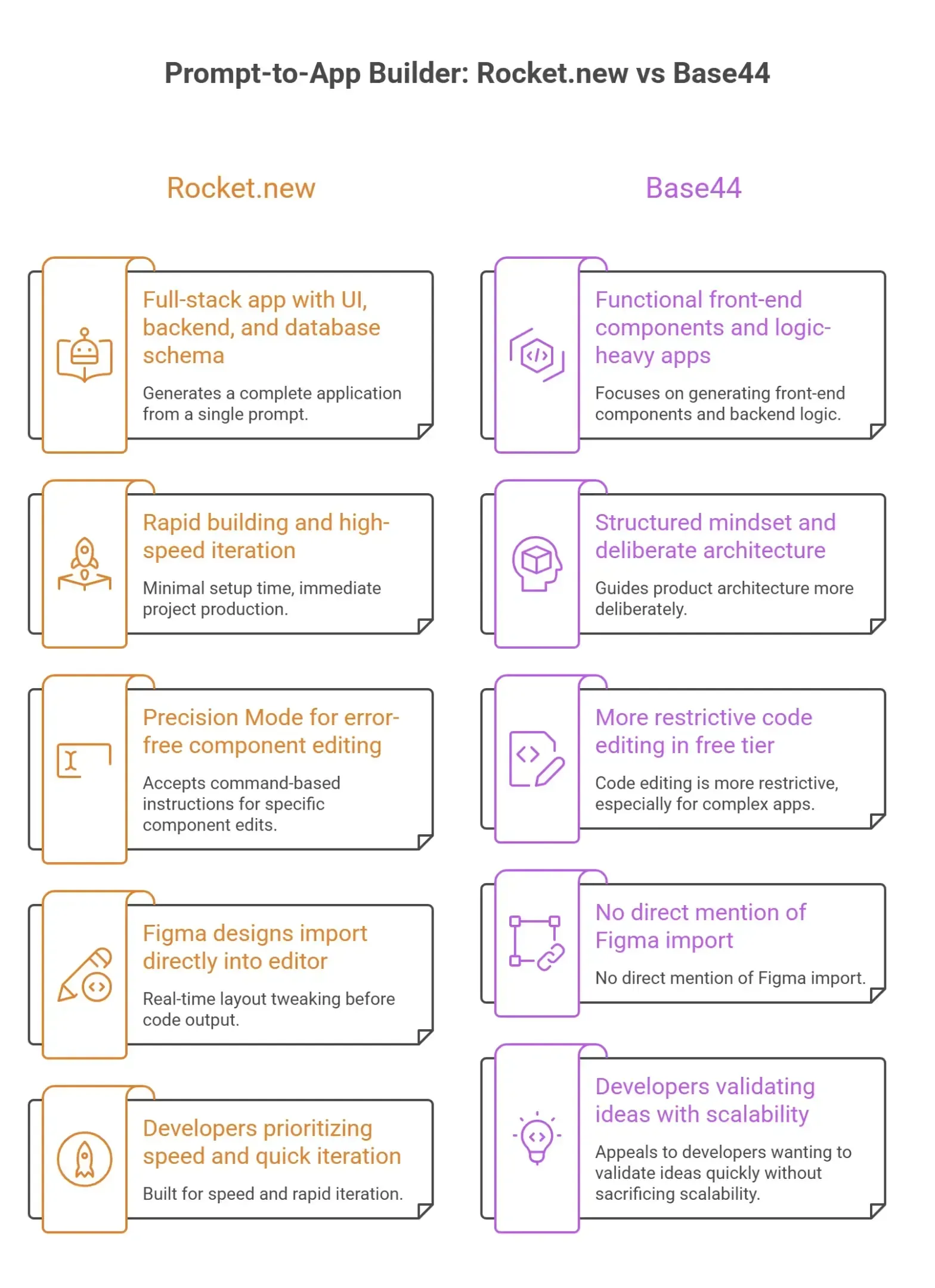
Rocket is built for speed. Open it in your browser, describe your app idea in natural language, and watch the platform produce a working project in minutes. No environment to configure, no frameworks to select before building starts.
-
Your prompt becomes a full-stack app with UI, backend, and a database schema
-
Supports Next.js and Flutter
-
Builds complex, multi-page apps from a single initial prompt
-
Precision Mode accepts command-based instructions to edit specific components without errors
-
Figma designs import directly into the editor for real-time layout tweaking before code output
Rocket.new focuses on rapid building and high-speed iteration. Setup time is minimal because the platform handles everything the moment you describe what you want to build with a detailed prompt.
How Base44 Handles Prompt-to-App Building
Base44 approaches vibe coding with a more structured mindset. The platform is focused on generating functional front-end components and logic-heavy apps from natural language with production-level reliability.
-
You describe your app idea, and the AI produces the code automatically
-
Base44 guides the product architecture more deliberately than Rocket
-
Excels at backend-heavy app logic, databases, and user access controls
-
Code editing is more restrictive in the free tier, especially when building complex apps
Base44 appeals to developers who want to validate ideas quickly without giving up scalability. The platform focuses on structured setup and deliberate workflows.
Figma Integration: A Clear Rocket.new Advantage
If you have a visual design ready and want a live app without writing code, Rocket handles it directly. Watch your Figma file become a working app in one session.
-
Import a Figma file into the Rocket editor
-
Adjust the layout in real time inside the visual editor
-
Generate code and keep describing refinements until the output matches your design
Base44 does not offer Figma integration. That is a straightforward advantage for designers and agencies who start from wireframes and need to watch a working website appear the same day.
Backend, Database, and User Authentication
Both platforms automatically handle infrastructure. The difference is in how much control you retain over where the files go after building.
Rocket.new:
-
Auto-builds database schemas alongside the frontend in the same prompt flow
-
Handles user authentication from the first prompt, no separate configuration needed
-
Connects to Stripe and Supabase for payment and database workflows
-
Produces exportable files in React, Next.js, or Flutter, you can take anywhere
Base44:
-
Automatically handles databases, API endpoints, user authentication, and hosting
-
Includes built-in analytics, email, and storage with no third-party setup required
-
Hosted entirely on Wix infrastructure with deployment built in
For straightforward apps, both platforms produce working sign-in systems and database layers from natural language alone. For apps needing rich external integrations, Rocket offers more control.
Code Access and File Structure
Code access is the key question that separates these two platforms for developers who plan to grow the app beyond the initial build.
-
Rocket.new produces structured project files and allows edits inside the browser environment
-
Full code export in React, Next.js, or Flutter is available at any point
-
Full access supports code quality review, codebase extension, and migration to other tools
-
Base44 restricts code editing on its free plan and in lower-paid tiers
-
Files from Rocket can be pushed to GitHub or opened in VS Code
-
Base44 paid plans expose more of the file structure, but code access remains limited compared to Rocket
If you plan to hand-code for a developer, edit it inside a local IDE, or migrate to a custom stack, Rocket gives you significantly more room. That accessibility for developers is one of Rocket's strongest advantages.
Free Plan and Paid Plans: What Each Offers
Both platforms offer a free plan so you can test the vibe coding workflow before committing.
Rocket.new free plan and paid plans:
-
Free starter plan includes tokens to prototype ideas and review a live app output
-
Access to the 25k+ template library at no cost, reducing setup time on every project
-
Personal paid plan from $25/month for solo developers and freelancers
-
Rocket paid plan for startup founders building weekly with reliable token capacity
-
Booster paid plan for agencies running multiple complex projects
Base44 free plan and paid plans:
-
Free plan covers core app generation with credit limits and restricted code editing
-
Paid plans start from approximately $16/month
-
Higher-tier paid plans unlock more credits, priority support, and stronger security
Most vibe coding tools offer a free plan before committing to paid plans. Both Rocket and Base44 make it straightforward to start building at no cost.
Mobile App Support and Web App Scope
Rocket.new supports Flutter, which means building production-ready mobile apps for iOS and Android happens from the same natural language prompt that produces your web app.
-
Flutter covers both mobile and web deployment targets from one project
-
Next.js handles complex web app needs with built-in SEO optimization
-
Stripe and Supabase integrations connect from the same build workflow
Base44 is built around web-based front-end generation. It can build apps with reliable backends, but relies on Wix infrastructure rather than framework-native mobile output. For teams building both websites and a mobile app together, Rocket covers more ground.
Who Should Be Building With Each Platform
Choosing the right vibe coding tool really comes down to three things: your technical level, your project scope, and your budget.
Build with Rocket.new if you:
-
Want to start building from a prompt or a Figma design with minimal setup
-
Need apps for iOS, Android, and the web from a single project
-
Want full code access and files you can hand to a developer or push to GitHub
-
Are you a non-technical founder, designer, or freelancer focused on delivery speed
Build with Base44 if you:
-
Want one AI app builder handling payments, analytics, and email marketing together
-
Prefer guided architecture framing and deliberate product structure
-
Are building apps where the backend logic is heavier than the UI
What the Community is Talking About
Real builders comparing Rocket.new vs Base44 discuss actual build times, not marketing claims.
On Trustpilot, one verified reviewer put it simply: Rocket "generates a lot from a single prompt," and after testing many other builders, called it the one they are sticking with.- Trustpilot The pattern repeats across use cases. A team racing toward a pitch deadline used Rocket.new to build a mobile beta version of their productivity app in just two days, with authentication, database, and UI all demo-ready. That prototype helped them secure early funding. - Secret Where Base44 positions itself as the structured, enterprise-leaning option, Rocket.new thrives on cultural energy, with a lively Discord filled with memes, demos, and collaborations, and a tone designed to resonate with younger creators and freelancers who feel like they are joining a movement rather than adopting a product. - Medium
Community feedback consistently highlights Rocket.new's strength in prompt-to-app generation speed, with early adopters positioning it as an MVP accelerator.
How Rocket.new Takes Vibe Coding from Idea to Live App
Rocket.new is a vibe solutioning platform that handles backend, authentication, and frontend creation instantly from natural language prompts. It is the fastest way for non-technical creators, designers, and entrepreneurs to ship.
-
Vibe-solutioning platform: Describe an app in natural language and watch it become a full-stack working app, including UI, backend, integrations, and code
-
25k+ templates library: Start from a curated template instead of an empty prompt, reducing token consumption by up to 80%
-
Flutter and Next.js support: Build mobile apps and production-grade web app output from the same platform
-
Figma integration: Turn existing design files into a live app without writing a line of code
-
Collaboration features built in: Build with a team and review progress inside the same project environment
Use cases where Rocket.new excels:
-
A designer has Figma screens ready and needs a live prototype in hours, not weeks
-
A founder wants an MVP web app and mobile app from a single natural language prompt
-
A freelancer is building multiple client websites and needs to cut setup time across every project
-
A development team wants to generate the initial codebase and extend it using full files in their preferred IDE
The Future of Vibe Coding
Vibe coding is becoming a standard part of modern development workflows. End-to-end app creation driven entirely by natural language is already well underway.
-
AI agents are beginning to handle complex development tasks triggered by natural language prompts
-
Vibe coding tools continue to cut development timelines and lower costs for a wider range of contributors
-
Software creation is becoming more conversational, giving developers space to focus on product thinking
Base44 vs Rocket will keep pushing each other in this direction as each platform improves natural language coverage and export options.
Your Next Move in Vibe Coding
The rocket.new vs base44 feature comparison for vibe coding tools comes down to what you are building and how much control you need over the output. Rocket.new is the stronger choice for teams that want speed, Figma integration, mobile support, and full code access.
Base44 suits founders who want a managed backend with integrated analytics. Both platforms have a free plan, so testing before you start building costs nothing.
Table of contents
- -What is Vibe Coding and Why Developers and Professionals Care
- -Why an AI App Builder Changes Your Setup Time
- -Rocket.new vs Base44: Feature Comparison for Vibe Coding Tools
- -How Rocket.new Handles Prompt-to-App Building
- -How Base44 Handles Prompt-to-App Building
- -Figma Integration: A Clear Rocket.new Advantage
- -Backend, Database, and User Authentication
- -Code Access and File Structure
- -Free Plan and Paid Plans: What Each Offers
- -Mobile App Support and Web App Scope
- -Who Should Be Building With Each Platform
- -What the Community is Talking About
- -How Rocket.new Takes Vibe Coding from Idea to Live App
- -The Future of Vibe Coding
- -Your Next Move in Vibe Coding