
Rocket.new generates full-stack, production-ready apps in one pass with predictable pricing. Emergent.sh uses a multi-agent system with credit-based billing that can become costly during scaling. For real-world apps and long-term scalability, Rocket.new is the more reliable choice.
Which AI app builder actually ships apps that work in the real world?
That's the real question here. Both Rocket.new and Emergent.sh let you skip writing code and go straight from idea to working product. But their approaches are different in ways that matter a lot once you're past the first demo.
According to the Stack Overflow Developer Survey 2025, 84% of developers are already using or planning to use AI tools in their workflow. Choosing the right one changes everything.
What Both Platforms Have in Common
Before breaking them apart, it's fair to say what Rocket.new and Emergent.sh actually share. Both are AI app builders that let you describe an app idea in natural language instead of writing code manually. Both target founders, small teams, and non-technical users who want to move fast.
Here's where they overlap:
-
Natural language prompts drive the build process on both platforms. You type; the AI generates.
-
Both handle web apps and mobile apps from a single workspace.
-
Both support internal tools like dashboards and CRMs.
-
Both produce code you can actually deploy, not just mockups.
-
Both support code export to GitHub for version control.
So why does the choice matter? Because the way each platform handles backend logic, pricing, and long-term scalability is completely different, and that gap shows up fast.
How Rocket.new Builds Production Ready Apps
Rocket.new is a vibe solutioning platform built for full-stack output from the start. You describe your app in plain English, and Rocket generates the frontend, backend logic, database schema, and authentication in one pass. No backend setup required separately. No stitching multiple tools together.
This is not a no-code drag-and-drop editor with limited capability. Rocket generates production-ready code using React, Next.js, and Flutter, the same frameworks professional development teams use. The underlying code is clean, exportable, and free of proprietary lock-in. The platform helps users design and launch full-stack applications quickly using natural language.
Key Features That Matter for Production
Rocket.new's key features are built around shipping, not just prototyping:
-
Prompt to full-stack apps: One prompt generates UI, backend logic, and database integration together.
-
Flutter for native mobile apps: Rocket generates iOS and Android native mobile apps directly. No hybrid workarounds.
-
Next.js for full-stack web apps: Clean server-side logic with modern web app standards.
-
Figma Import: Converts your design files into working code, not just a screenshot.
-
Unlimited custom domains on paid plans, so your app looks like a real product.
-
Code export to GitHub: Full version control from day one.
-
Live preview: See changes immediately while you build.
-
Visual editor + natural language: Switch between modes whenever you need to.
-
Reusable components: Speed up app creation without repeating yourself.
What makes this combination strong is that Rocket handles the full stack generation in a single pass. You get production-ready applications without waiting for separate agents to finish separate jobs.
Pricing That Stays Predictable
Rocket.new uses a token-based monthly model. You pay for a plan, get a token allocation, and work within it. No per-action credit burns. No wondering how many credits deploying your app just consumed.
| Plan | Price | Tokens | Best For |
|---|---|---|---|
| Starter | Free | 1M | Testing lightweight apps and basic prototypes |
| Personal | $25/month | 5M | Solo builders creating web apps and internal tools |
| Rocket | $50/month | 10.5M | Full-stack development for production-ready apps |
| Booster | $100/month | 22M | Small teams building multiple mobile apps and web apps |
The paid plans include unlimited custom domains, full code export, and access to AI-powered backend features. You know what you're paying before you start. That matters when you're building for real users.
Where Emergent.sh Creates Problems
Emergent AI is built around a multi-agent system. Specialized AI agents handle different parts of the build: one for UI, one for backend logic, one for testing, and one for deployment. The idea sounds clean. In practice, the credit model turns every one of those agent actions into a cost event.
The Credit Problem is Real
Emergent AI's pricing runs on credits, not a flat token allocation. Every action, generating code, running tests, and deploying, consumes credits. Here's what that looks like:
| Plan | Cost | Credits | Issue |
|---|---|---|---|
| Free | $0/month | 5-10 credits | Cannot deploy. Deployment costs 50 credits/month alone. |
| Standard | $20/month | 100 credits | Deployment eats half your monthly credit budget immediately. |
| Pro | $200/month | 750 credits | Better headroom, but debugging loops burns credits unpredictably. |
| Team | $250/month | 1,250 credits | Shared pool depletes fast across multiple mobile apps or web apps. |
Users consistently report running out of credits faster than expected, especially during debugging or iterating on full-stack applications. There is no cost floor. A complicated backend logic change during a debugging loop can consume a week's credits in hours.
For Emergent AI, 50 credits per month are required just to keep an app live. That's before you've touched a single feature. Users consistently report running out of credits faster than expected on Emergent, especially during debugging loops or multiple iterations.
The Ceiling You Will Eventually Hit
Emergent AI is built for experimentation and rapid prototyping. But as your app grows, it starts showing limits. Emergent's approach focuses on what the agents can handle at generation time. Custom logic, third-party services, and complex data relationships require manual cleanup that wasn't in the original natural language prompt.
Users also report that Emergent's generated apps may need significant adjustments when dealing with advanced features or edge cases, which means more agent calls and more credits consumed.
Rocket.new avoids this by generating production-grade code that developers can extend directly. The underlying code is yours, clean, and editable without going back through the AI every time.
Side-by-Side Feature Comparison
Here's a direct look at how the two AI-powered app builders compare across the features that matter for scalable app development:
| Feature | Rocket.new | Emergent AI |
|---|---|---|
| Pricing Model | Predictable monthly tokens | Credits per action (variable) |
| Native Mobile Apps | Yes, Flutter for iOS & Android | Yes, but credits consumed per action |
| Full Stack Web Apps | Yes, React + Next.js | Yes, React + Node.js |
| Backend Logic | Generated in one pass | Multi-agent, credit-per-step |
| Custom Domains | Unlimited on paid plans | Depends on credit balance |
| Code Export | Full ownership, no lock-in | Exportable, GitHub sync available |
| App Store Publishing | Supported via Flutter builds | Available but agent-dependent |
| Deployment Cost | Included in plan | 50 credits/month to keep app live |
| Visual Editor | Yes, prompt + visual hybrid | Primarily AI prompt-driven |
| Figma Import | Yes | No |
| Long Term Scalability | Built for it | Ceiling appears as complexity grows |
| Production Ready Code | Industry-standard frameworks | Requires manual cleanup for edge cases |
What People Are Saying
Builders who've used both platforms share honest takes. One user on LinkedIn who tested Rocket.new described it this way:
"I gave an AI builder just one sentence and it built a complete working app. No setup. No coding. It just worked. The tool? Rocket (by DhiWise). I've already used it to build multiple apps from one-liners." - Source
That kind of community feedback reflects what separates the two platforms. Rocket converts a plain English input into a working product with minimal friction. With Emergent AI, the experience is more iterative, which works for some teams but adds unpredictable cost and time when building anything beyond a lightweight app.
Users of Emergent AI consistently point to one problem: the credit system feels invisible until it's nearly empty. There's no equivalent concern with Rocket's token-based model since you start each month with a clear, usable allocation tied to your paid plan.
How Rocket.new Handles Building Production-Ready Apps
Rocket.new is the vibe coding platform that answers what the difference is between Rocket.new and Emergent.sh for building production-ready apps with a clear position: production readiness is the starting point, not the destination.
Here's how Rocket connects directly to the full production workflow:
-
Vibe solutioning platform: Describe your product, Rocket builds the whole thing, not just the UI.
-
25,000+ template library, free to use: Start from a proven foundation instead of blank-slate generating code every time. This cuts token usage and speeds up app development significantly.
-
Saves up to 80% on tokens: More efficient AI code generation means your budget goes further per project.
-
Supports Flutter for native mobile apps and Next.js for full-stack web apps: Both are production-grade, app store-ready frameworks. Your app can go to the Apple App Store and Google Play Store from the same Rocket project.
-
Collaboration features built in: Teams can build, review, and iterate together without switching to multiple tools.
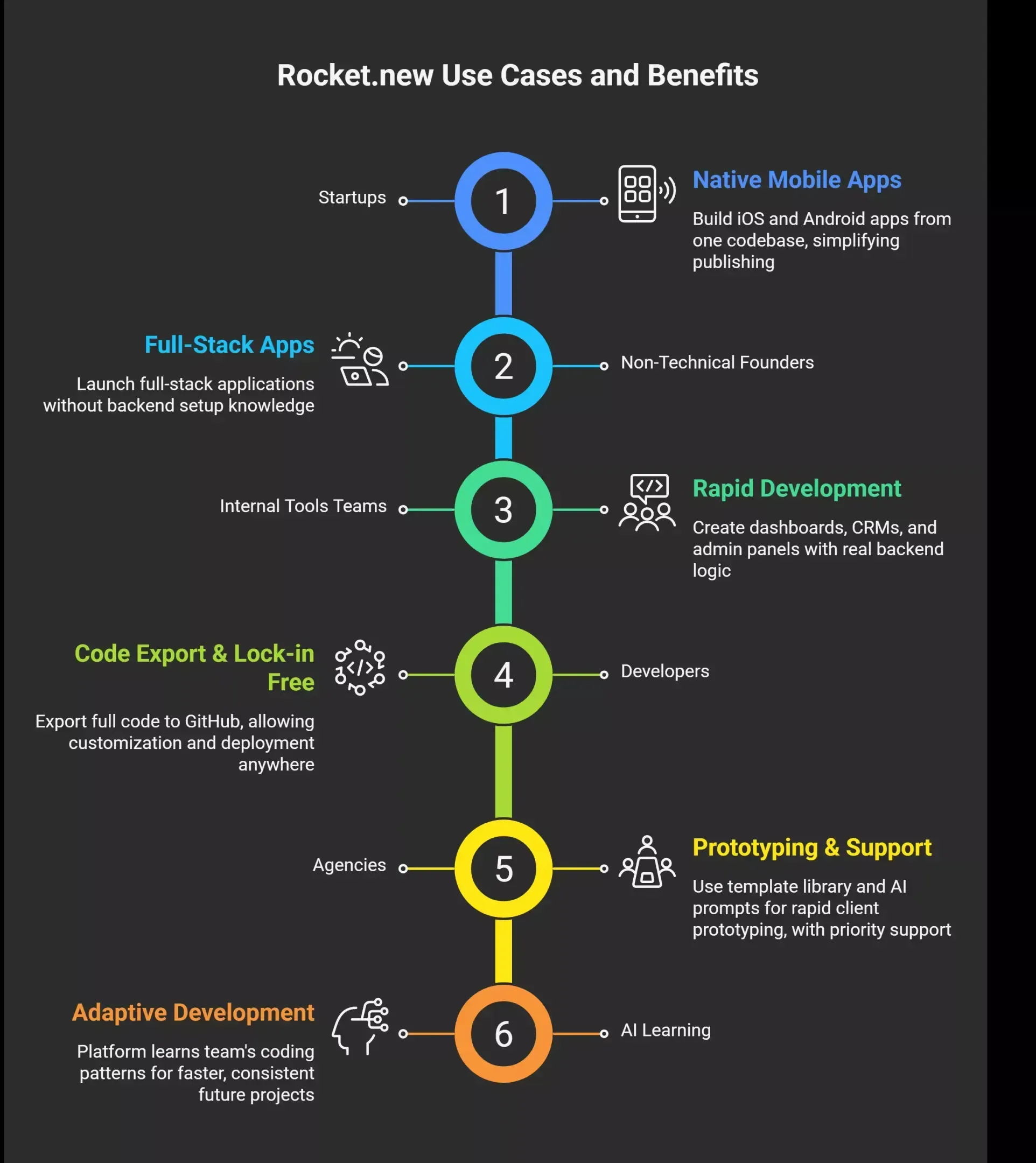
Use Cases Where Rocket.new Wins
-
Startups building native mobile apps: Rocket handles iOS and Android app store publishing without extra steps or separate development tools. One codebase, multiple platforms.
-
Non-technical founders launching full-stack applications: No backend setup knowledge required. Rocket generates the full stack output, authentication, APIs, and data layer included.
-
Teams building internal tools at speed: Dashboards, CRMs, and admin panels with real backend logic, not just frontend screens.
-
Developers who want code export without lock-in: Full exportable code to GitHub. Extend functionality, customize, and deploy anywhere. No vendor dependency.
-
Agencies doing rapid prototyping for clients: The 25k+ template library and natural language prompts cut project setup time dramatically. Priority support on higher-paid plans means you're not blocked when something needs attention.
Rocket's AI-powered platform learns from how you build over time. It adapts to your team's coding patterns, preferred frameworks, and naming conventions, so future projects move faster without losing architectural consistency.
Why Rocket.new is the Stronger Choice
The difference comes down to what "production-ready" actually means in practice. Emergent AI treats production as something you grow into, an endpoint after iteration. Rocket.new treats it as the starting condition.
Emergent AI's credit model rewards experimentation but penalizes complexity. The more serious your app, the faster the credits go. Debugging loops, backend logic changes, and app store publishing steps all consume credits. Teams working on anything beyond lightweight apps report feeling cost pressure before the product is even shipped.
Rocket.new's token model gives you a month of work with a predictable budget. Full-stack apps come out of a single generation pass. The code is clean, owned by you, and deployable to custom domains from day one.
For non-technical founders, Rocket's visual editor hybrid means you can prompt in natural language and then fine-tune without touching code or burning credits. For developers who want to extend functionality, the code export gives full control.
Emergent AI has a learning curve that shows up in credit bills. Rocket.new has a learning curve that shows up in better, faster products.
If you're choosing an AI builder for a project that needs to handle real users, go to app stores, support backend logic at scale, and stay under a predictable budget, Rocket.new is the clearer answer.
Table of contents
- -What Both Platforms Have in Common
- -How Rocket.new Builds Production Ready Apps
- -Key Features That Matter for Production
- -Pricing That Stays Predictable
- -Where Emergent.sh Creates Problems
- -The Credit Problem is Real
- -The Ceiling You Will Eventually Hit
- -Side-by-Side Feature Comparison
- -What People Are Saying
- -How Rocket.new Handles Building Production-Ready Apps
- -Use Cases Where Rocket.new Wins
- -Why Rocket.new is the Stronger Choice