
Sales intelligence software helps B2B teams find the right prospects, prioritize accounts, and act on live buying signals. The global market hit USD 3.56 billion in 2024. This guide covers what to look for, how to compare platforms, and why continuous monitoring beats static databases.
What if the biggest drain on your pipeline is not your pitch or your product, but the quality of data your sales team relies on every day?
SkyQuest's market research puts the global sales intelligence market at USD 3.56 billion in 2024, growing at 11.2% annually through 2033, a signal that companies everywhere are waking up to how much stale, inaccurate data costs them. Sales intelligence platforms exist to fix this by gathering contact data, account signals, and behavioral insights into one place so sales reps stop guessing and start selling.
This guide covers what these platforms actually do, which capabilities matter most, how to compare sales intelligence tools, and what separates the platforms that help sales teams close deals from the ones that just take up space in a tech stack.
What Does Sales Intelligence Actually Do?
Sales intelligence is not just a contact list. At its core, these platforms translate raw data about companies and buyers into context that helps sales teams decide who to contact, when to reach them, and what to say.
Sales intelligence platforms can automate lead scoring and qualification processes, helping sales teams prioritize their efforts on the most promising leads based on data-driven insights.
Good sales intelligence data tells your sales reps something a static spreadsheet never can: what is actually happening inside an account right now.
-
Account and contact mapping: These platforms identify the right people inside target companies, from decision makers and buying committee members to individual champions who move deals forward. Getting this right means your sales reps spend time on conversations, not on manual research.
-
Signal monitoring: Good sales intelligence platforms track events like funding announcements, job changes, hiring data spikes, and competitor mentions that tell you when a prospect is entering or exiting the market. These signals are what separate timely outreach from random cold calls.
-
Data enrichment: Fills gaps in your CRM records by appending verified contact data, direct dials, and firmographic details drawn from multiple data sources. Enrichment keeps records accurate and your sales teams focused on selling.
-
Intent data scoring and lead scoring: Measures the research behavior of prospects by tracking which topics they consume online, surfacing accounts actively investigating your category. Lead scoring built on intent data is far more reliable than scoring based on firmographics alone.
-
Pipeline visibility: Connects account-level signals directly to deal stages so sales teams see which deals carry risk and which are building momentum toward a close.
When these capabilities work together, sales teams get more than a database; they get a live, continuously updated picture of their market. Understanding how sales app development intersects with intelligence tooling helps teams build workflows that keep data flowing where it needs to go.
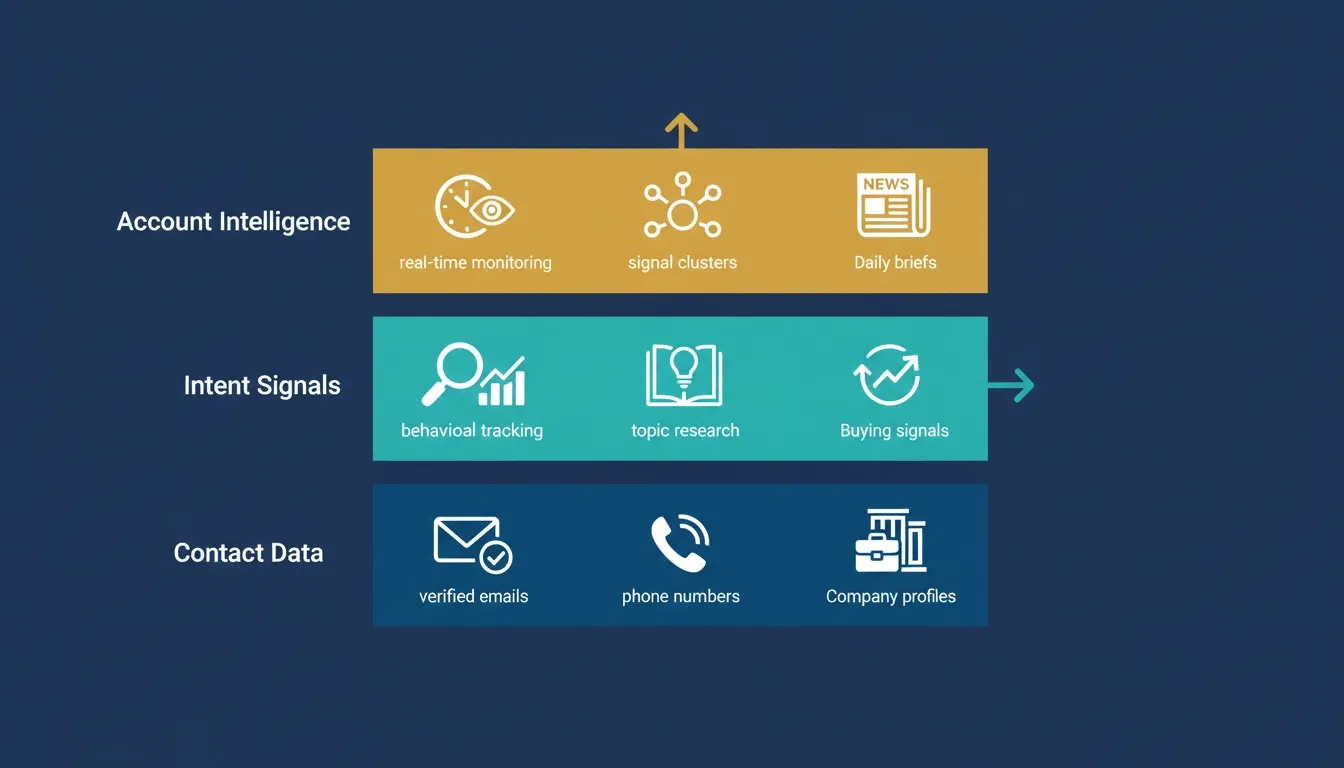 The three core layers of a B2B sales intelligence platform: contact data forms the foundation, intent signals add timing, and account intelligence drives prioritization.
The Must-Have Capabilities in Any Sales Intelligence Platform
Not every platform delivers on all fronts. Before comparing pricing or booking a demo, it helps to know which capabilities are genuinely non-negotiable for your sales team.
Contact Data and Verification: The Non-Negotiable Foundation
Bad contact data is the silent killer of outbound programs. Sales reps waste time chasing bounced emails and dead phone numbers, and marketing teams burn budget on lists that decayed months before anyone used them.
-
Verified contact data: Phone-verified mobile numbers and validated email addresses refreshed on a regular cadence, not scraped once and stored for years. Accurate contact data is the foundation of everything else that rests.
-
Direct dials: Actual mobile lines for decision makers, not switchboard numbers that redirect your call. Data providers without phone-verified direct dials are giving your sales reps a partial picture at best.
-
Data accuracy scoring: A visible confidence rating on each record so your team knows whether to trust a number before dialing. Any data provider worth evaluating should include this by default.
-
Automated enrichment: New contact records are pushed into your CRM automatically, rather than being created through manual data entry that falls behind within weeks of onboarding.
-
Account-level firmographic coverage: Consistent data across your target companies, including industry, size, location, and tech stack, with no major gaps in your ICP.
The richness and accuracy of your contact database is the foundation; every other capability in a sales intelligence platform builds on top of it.
Intent Signals and Buyer Behavior: Are Your Prospects Ready?
Timing is what most sales teams get wrong. A rep can have perfect contact data and still miss the window entirely by reaching out three weeks before or after a prospect was actively looking.
-
Buyer intent data: Aggregated signals from content consumption, webinar attendance, and topic research that indicate an account is actively evaluating solutions in your category. Without this layer, you are reaching out in the dark.
-
Behavioral data layers: Combining first-party signals from your own website with third-party intent signals from publisher networks builds a more complete picture of customer behavior than either source alone can deliver.
-
Job change tracking: A decision maker who just moved to a new company is one of the highest-value prospects in your market at that moment. Automated sales intelligence that flags these transitions means your sales reps reach out before anyone else does.
-
Account-level intent signals: Intent scored at the company level, not just the individual contact level, so you can prioritize which target companies to focus on before the right contacts even surface in your database.
-
Buying signals from trigger events: Funding announcements, leadership changes, and hiring data spikes are among the most reliable buying signals available. When a company suddenly grows its sales team, that is rarely an accident.
Intent data turns reactive selling into proactive outreach. Sales reps who consistently act on buying signals report shorter sales cycles and a higher proportion of conversations that actually progress to deals. Pairing intent signals with a strong competitive intelligence program gives sales teams a complete picture of both buyer readiness and competitive risk.
Data Enrichment and CRM Alignment
The most accurate contact data in the world loses value if it never reaches your CRM. Enrichment without CRM alignment means sales teams work from two different versions of the truth.
-
CRM enrichment on a defined cadence: Records should sync between your sales intelligence platform and your CRM on a regular schedule, not just on initial import. A one-time sync is just a list purchase with extra steps.
-
Duplicate prevention: The enrichment layer should merge duplicate contact records rather than create parallel entries that fragment your account data over time.
-
Two-way data flow: Activity logged in your sales engagement tools should update the intelligence platform too, not just flow in one direction. One-way pushes leave gaps that grow larger over time.
-
Tech stack visibility: Knowing which tools a prospect company currently uses tells you how competitive a deal might be and which pain points to lead with before the first call.
Sales and marketing teams that maintain clean enrichment pipelines spend far less time correcting CRM records and far more time in actual sales conversations.
How Do You Compare Sales Intelligence Tools Fairly?
With over 461 products listed in the sales intelligence category on G2 alone, comparing sales intelligence tools honestly is harder than it looks. Most appear similar on a feature checklist until you stress-test them on the dimensions that matter in day-to-day use.
Here is a practical evaluation framework for the best sales intelligence tools:
| Dimension | What to Test | Red Flag |
|---|---|---|
| Data quality | Run 50 real ICP contacts through the platform | Below 80% verified accuracy in your market |
| Contact coverage | Check depth for your target industry and geography | Major gaps in your actual ICP |
| Intent signal quality | Ask how intent data is sourced and refresh cadence | Single-source or batch-updated monthly |
| Lead scoring logic | Ask specifically what data the scoring draws from | Score based on firmographics only, no behavioral data |
| CRM connection | Watch a live sync demo, not a recording | Heavy admin setup required |
| Pricing model | Calculate the total cost for your team size, including add-on credits | Credits run out faster than the sales team expects |
| AI layer | Ask what AI-powered features do specifically | Vague claims, no concrete benchmarks |
| Conversation intelligence | Ask how sales calls are analyzed and what coaching insights are surfaced | Manual review only, no automated analysis |
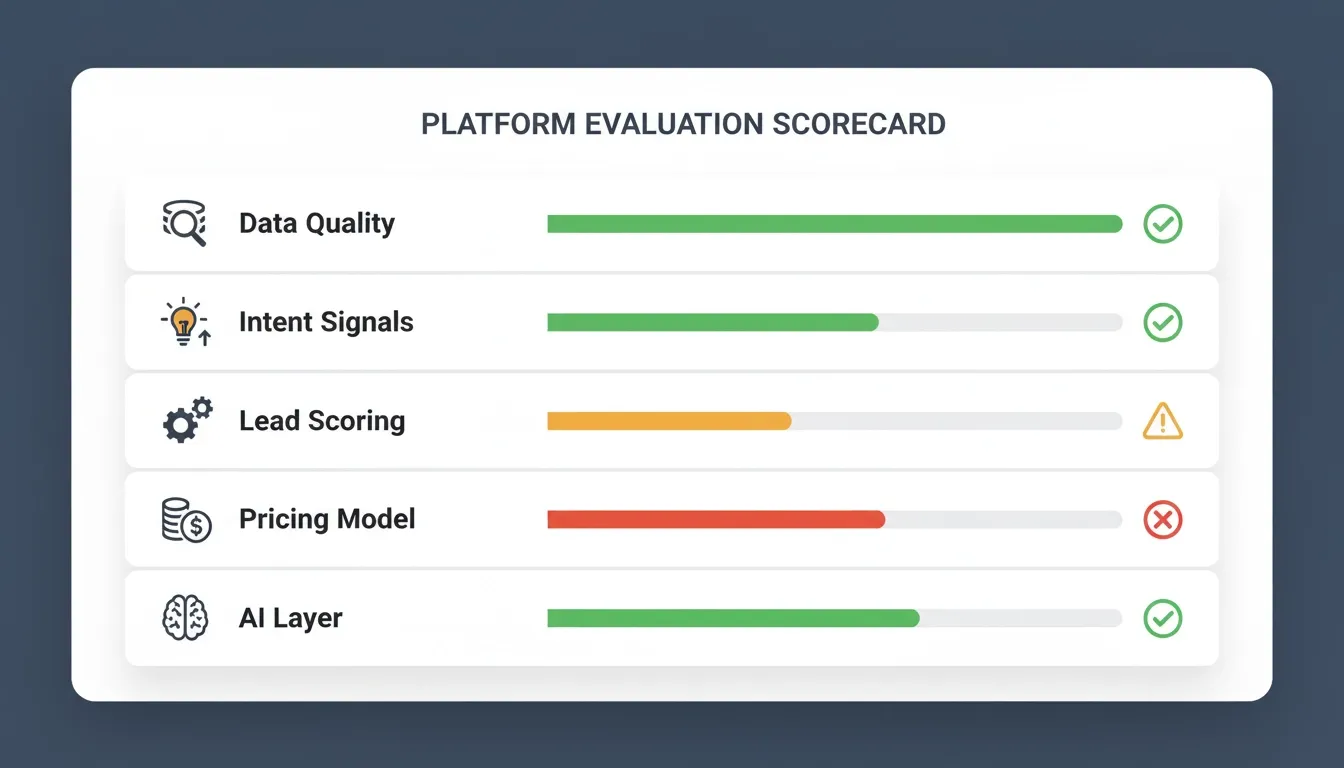 Use this evaluation scorecard to stress-test any sales intelligence platform before signing. Platforms that resist live testing are telling you something important about their data quality.
According to Mordor Intelligence's 2026 market analysis, AI-powered research is already shortening prospect research cycles from three to five hours down to ten to fifteen minutes by processing intent signals from more than 100,000 sources. That is the real benchmark for a modern sales intelligence platform. Any tool claiming AI-powered capabilities should demonstrate a concrete improvement in research speed during your evaluation, not just in a slide deck.
Well-known platforms like LinkedIn Sales Navigator lead in relationship-based signals and social data, while tools like ZoomInfo focus on raw contact data volume. That said, no single platform leads in every dimension, which is why running your actual ICP through each tool before signing is a non-negotiable step. The best sales intelligence tools for your team are the ones that perform well on your specific data, not a curated demo dataset.
The comparison does not need to be complicated. But it does need to be grounded in how your team actually sells, not how a vendor presents in a slide.
Step-by-step decision framework for shortlisting sales intelligence software, eliminate platforms that fail any critical gate before investing in a full evaluation.
What Role Does Conversation Intelligence Play in Modern Sales?
Conversation intelligence is the part of the sales intelligence stack that most teams underestimate, right up until they see what is buried in their own call data.
-
Call analysis and transcription: Every sales conversation gets transcribed and indexed, so sales managers can search across months of calls for patterns in what moves deals forward and what stalls them. Conversation intelligence built this way is the difference between gut-feel coaching and coaching built on actual evidence.
-
Coaching insights from real calls: Real-time nudges during live calls surface relevant data points, competitor mentions, or objection-handling prompts at the exact moment a rep needs them. Coaching insights generated from conversation intelligence are most valuable for newer reps still building product knowledge.
-
Deal risk identification: AI-powered analysis flags deals showing negative engagement patterns, including declining meeting frequency, one-sided talk ratios, or long gaps in the prospect response cycle. Spotting deal risks early gives you time to act before a deal slips.
-
Forecasting with behavioral context: Conversation intelligence layers sales analytics from actual conversations into your pipeline forecast, grounding predictions in real buyer behavior rather than just stage movement in a CRM. This makes predictive analytics far more reliable than models built on firmographics alone.
-
Performance benchmarking: Compare how top-performing sales reps handle objections, then use those patterns to coach the rest of the team toward similar outcomes. Conversation intelligence does not just capture data; it turns sales call patterns into a repeatable coaching engine.
Conversation intelligence connects what you know about a prospect with how those conversations are actually going. Sales analytics tell you pipeline numbers; conversation intelligence tells you why those numbers are what they are. Teams that integrate account news alerts into their sales workflow can combine call intelligence with live account signals for a complete picture before every call.
Why Modern Sales Teams Are Moving Beyond Static Data Vendors
Legacy sales intelligence vendors built their businesses on a simple premise: give sales teams a large database of companies and contacts, let them search and filter, and export results to a CRM or sales engagement platform. That worked when markets moved slowly, and buyer behavior was predictable. It no longer works.
B2B contact records now decay at roughly 30% annually, according to Mordor Intelligence's analysis. A list that was clean in January looks very different by July. Buyers research across multiple channels, change jobs at high rates, shift budgets based on market conditions, and make decisions inside buying committees of eight or more people, often before any rep knows they exist.
Static data vendors responded by adding more data: bigger databases, more contact profiles, more company records. Tools like LinkedIn Sales Navigator added social context. ZoomInfo added data breadth. But more data in a static container does not solve a freshness problem. Sales teams still end up chasing stale records, hitting wrong direct dials, and missing the moments when a key account actually becomes ready to buy.
Rocket takes a fundamentally different approach with its Intelligence capability. Rather than a database you query, Rocket Intelligence is a continuous monitoring system that watches every public surface your target companies operate on: website changes, social activity, news coverage, hiring data patterns, funding announcements, and review sentiment. Then it tells you what those signals mean for your specific pipeline, in plain language, every single day. You can see exactly how this works in the Rocket Intelligence overview.
What that looks like in practice:
-
Real-time account intelligence: A daily brief synthesizes signal clusters for every tracked account, so your sales teams know exactly what changed overnight and why it matters, before the first meeting of the day.
-
Predictive sales intelligence from signal patterns: Patterns across multiple signals predict which accounts are approaching purchase readiness before they fill out a form or reply to outreach. Predictive sales intelligence built on live signals is what gives sales teams a genuine timing advantage.
-
Job change tracking across active accounts: Automated sales intelligence flags when a decision maker in an active deal moves to a new company, turning a potential churn event into a fresh pipeline opportunity for your team.
-
Account intelligence that compounds over time: Because Rocket Intelligence lives inside the same platform as Rocket's research and build capabilities, every signal captured this week is present when your team writes a proposal or prepares for a call next week. Nothing gets lost between sessions.
-
Revenue intelligence built on real signals: Behavioral signals and account-level data combine so your sales teams walk into every deal cycle with a complete, current picture of where each account stands, not what the account looked like in a database last quarter.
Legacy data vendors give you a static map of who is out there. Rocket gives you a guide that watches the territory continuously, tells you what changed, and points your sales teams toward the accounts worth their time right now. Rocket Intelligence monitors ten signal pillars per company, including website changes, hiring data, social activity, reviews, and performance marketing, all interpreted in the context of your specific business. Sales teams that also track competitive signals before every enterprise deal closes consistently enter negotiations better prepared than their competitors.
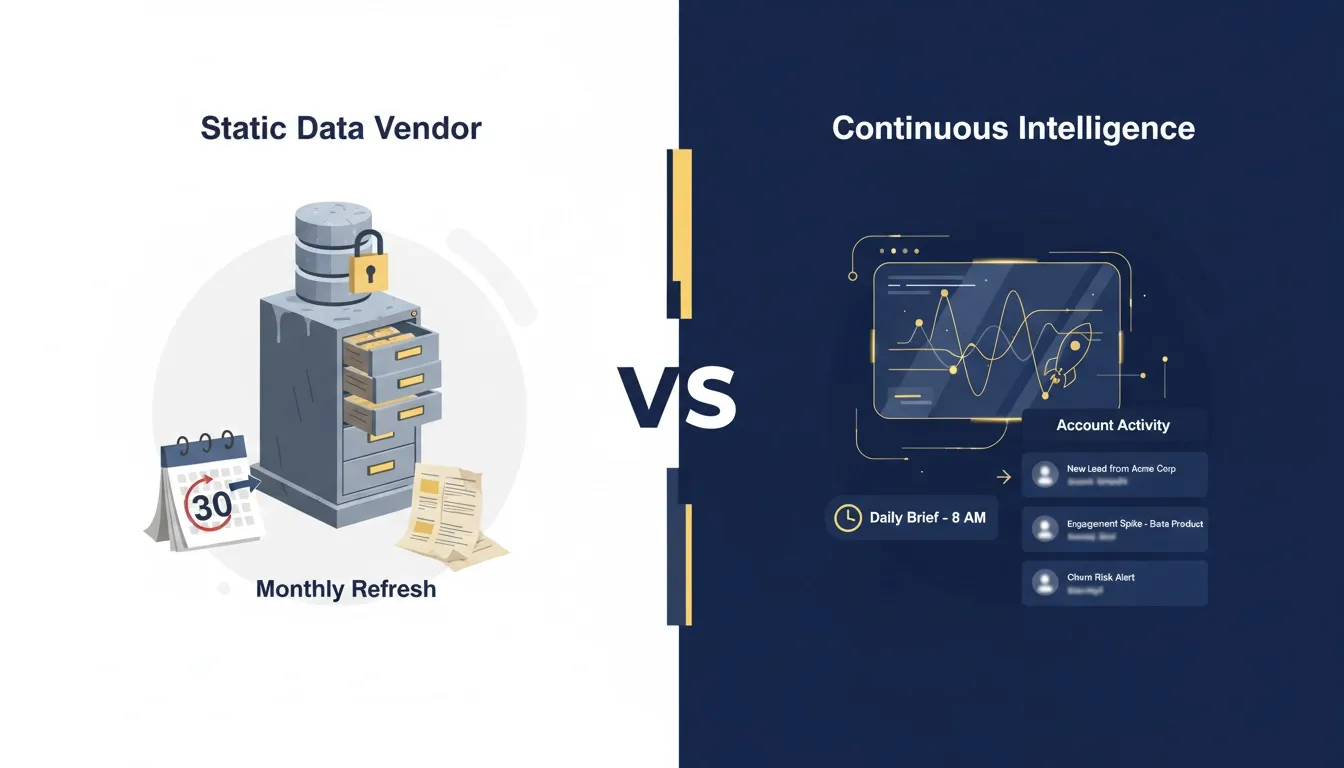 Static data vendors refresh contact lists on a schedule. Rocket Intelligence monitors every public signal your target accounts generate, every day, and tells you what it means for your pipeline.
Common Mistakes Teams Make When Buying Sales Intelligence Tools
Most sales teams have purchased at least one platform that underdelivered. Looking back, the failures nearly always trace to the same patterns.
-
Skipping the live data accuracy test: Signing a contract based on a polished demo rather than running your actual target list through the platform. The best sales intelligence tools welcome this test; the ones that resist it are telling you something important about their data quality.
-
Underestimating credit-based pricing models: Many platforms price on a credit system where each contact lookup or enrichment costs credits. Sales teams routinely exhaust their allotment within two months and then face unexpected costs to continue normal outreach.
-
Ignoring CRM connection quality: A platform with strong sales intelligence data but a weak CRM connector creates a parallel workflow that sales reps quietly stop using within sixty days. The platform you subscribe to is not always the one your team actually uses.
-
Buying on feature count instead of fit: The best sales intelligence solutions for one team can be wrong for another. A platform with 200 features your team will never use is worth less than one with thirty features used every single day.
-
Treating intent data as an optional add-on: Many platforms offer buying signals and intent data at a high extra cost above the base tier. Teams discover this after signing and find their budget does not stretch to cover it.
-
Not evaluating conversation intelligence quality: Sales calls contain some of the richest behavioral data in your pipeline. Many teams skip conversation intelligence during vendor evaluation and only notice the gap months into onboarding.
As G2 reviewer Mitali V. noted in her LinkedIn Sales Navigator review: "There's very little to dislike about LinkedIn Sales Navigator, but one minor drawback is that some contact information or lead data isn't always fully updated, which can occasionally affect outreach accuracy. Additionally, the cost can be slightly high for individual users." -(Source: G2 Sales Intelligence Reviews)
The common thread in every disappointing purchase is the same: teams evaluate on perceived coverage and miss the questions about data freshness, credit architecture, and the daily experience of actually using the tool. Teams that run a structured evaluation using a competitive intelligence evaluation cycle before signing any vendor contract consistently make better purchasing decisions.
Turn Sales Data Signals into Revenue Opportunities
The right sales intelligence platform does more than give your team a list of names to call. It tells you which accounts to prioritize right now, which contacts hold the authority to move a deal forward, and which signals point to a prospect genuinely ready to buy.
That combination, accurate contact data, live intent signals, and continuous account intelligence, is what separates platforms that build a pipeline from platforms that add work.
Start with data accuracy. Then ask how the platform handles intent signals, CRM alignment, and total cost for your team size. Those four questions will do more to narrow your shortlist than any feature comparison chart.
Rocket gives B2B sales teams the continuous account intelligence, verified contact data, and real-time buying signals that static data vendors cannot provide.
If your team is ready to move beyond querying a database and start receiving live signals about every account in your pipeline, start with Rocket.new and see what your market looks like when it updates every day.
Table of contents
- -What Does Sales Intelligence Actually Do?
- -The Must-Have Capabilities in Any Sales Intelligence Platform
- -Contact Data and Verification: The Non-Negotiable Foundation
- -Intent Signals and Buyer Behavior: Are Your Prospects Ready?
- -Data Enrichment and CRM Alignment
- -How Do You Compare Sales Intelligence Tools Fairly?
- -What Role Does Conversation Intelligence Play in Modern Sales?
- -Why Modern Sales Teams Are Moving Beyond Static Data Vendors
- -Common Mistakes Teams Make When Buying Sales Intelligence Tools
- -Turn Sales Data Signals into Revenue Opportunities