
Choosing the right platform from Rocket.new vs Replit comes down to what you are building, your team's skill levels, and how much control you need over the codebase. Modern app development platforms should support full-stack development, frontend development, and backend logic in one place, with flexibility to accommodate different skill levels alongside strong AI capability.
You describe an app. Seconds later, it exists. But which platform gets you there faster, cheaper, and ready to scale?
Over 70% of developers now use or plan to use AI tools in their workflows, fundamentally changing how web apps are built and shipped. The no-code market is heading toward $65.5 billion by 2027, and both Replit vs Rocket.new ranks among the top app builders driving that growth.
Both platforms generate code from a prompt, but the paths to production differ significantly, with real consequences for speed, cost, and long-term maintainability and scalability. The choice of app development platform is not just about the first sprint; it can shape how well your application holds up as it grows.
What Each AI-Powered App Builder Actually Does
Both platforms use AI to help you build apps, but they started from opposite ends of the development spectrum, and that origin shapes everything from testing and setup to long-term code maintainability.
Replit
It began as a browser-based cloud IDE where developers write and test code across languages without local setup. It expanded from Ghostwriter to the Replit AI Agent by 2024 and now handles code generation and web app deployment inside one workspace.
Key Features:
-
Supports 50+ language stacks for multi-language projects
-
Real-time collaboration on the Pro tier
-
Version control via GitHub sync
-
AI agent manages code, testing, and CI/CD
-
Favored for serious development work where understanding and controlling the codebase matters
Rocket.new
It is an AI-powered app builder built around natural language prompts from day one. Describe your idea and the platform generates screens, backend logic, database schemas, and deploy pipelines.
Key Features:
-
Natural language prompts drive the full build from idea to launch
-
25,000+ production-ready templates across every major vertical
-
Figma-to-code conversion for design-led teams
-
Flutter for mobile apps, Next.js for web, from day one
-
Built for all skill levels, not just developers
The AI capabilities of both platforms are converging as Replit Agent adds more automated generation, but the underlying approach to setup, iteration, and cost remains very different.
App Development Speed from Prompt to Shipping
Speed is what separates useful app builders from truly great ones. AI-driven tools help reduce time spent on repetitive tasks, allowing teams to focus on building features that matter rather than fighting infrastructure. Rapid prototyping only counts when the resulting apps are ready for real users.
Replit AI Capabilities
The Replit AI Agent generates web apps from a prompt in minutes for developers who can direct it confidently. Steering it through iterative code steps, however, requires technical fluency. Testing surfaces broken code only after the build phase consumes credits.
-
Replit AI Agent produces deprecated library syntax in some generated code output
-
GitHub sync delays of 30 to 60 seconds slow iteration on projects
-
Agent loops during testing add cost and time to every build cycle
-
Effort-based billing makes monthly costs difficult to predict, with some teams reporting $100 to $300 on AI alone
Rocket.new AI capabilities
Rocket.new removes the IDE layer entirely. It is an AI app generator that creates functional applications from natural language prompts with minimal coding required. Describe the app, pick a template or import Figma files, and the platform builds all screens and backend logic together. Testing happens inside a live preview panel, and one-click deploy sends the finished app to Netlify.
-
No setup required, no development environment to configure before you start building
-
Templates cut token usage by 80%, removing cold-start delays on every build
-
AI tools generate mobile apps and web projects from one prompt-based workflow
-
Live preview testing confirms behavior rather than uncovering broken code after credits are spent
Feature Comparison
| Feature | Replit | Rocket.new |
|---|---|---|
| Tool type | Cloud IDE + AI agent | Vibe solutioning platform |
| Mobile apps | React Native/Expo (added 2025) | Flutter (native, from day one) |
| Web apps | React, Node.js, 50+ languages | Next.js |
| AI assistance | Replit AI Agent + Ghostwriter | Natural language + Precision Mode |
| Templates | Basic starters | 25,000+ production-ready |
| Starter plan | Public projects, limited AI | Free tier with AI generation |
| Pricing model | Core $20/mo + effort-based AI | Credit-based, predictable |
| Real-time collaboration | Up to 15 users on Pro tier | Built-in across all plans |
| Version control | GitHub sync (30–60s delay) | GitHub push, one-way sync |
| Deployment | One-click autoscale | Netlify deploy |
Where Replit Creates Friction
Replit has genuine strengths for code-first developers who want complete control. But three friction points affect nearly every production timeline on the platform.
Pricing that compounds
Replit charges for development infrastructure while Rocket.new charges for AI generation credits and deployment capabilities. The free tier limits all projects to public visibility, and AI usage is billed at $0.25 per checkpoint.
-
No native spend cap to contain costs
-
Advanced features like production databases require additional spend on top of paid plan fees
-
Core plan caps real-time collaboration at 3 users
Agent loops and deprecated output
The Replit AI Agent produces deprecated library syntax in generated code. Testing catches these issues only after credits are consumed, and resolving them requires hands-on debugging knowledge that non-developers cannot apply.
-
Debugging tools require coding knowledge to navigate effectively
-
For teams building across varied skill levels, these loops are a hard stop rather than a minor inconvenience
Mobile apps arrived late
Replit added React Native support for mobile apps only in 2025. Rocket.new shipped Flutter for mobile from day one.
-
Teams needing web and mobile together from a single platform found that gap costly early on
-
Remains a meaningful speed disadvantage for mobile-first projects today
What Rocket.new Does Differently
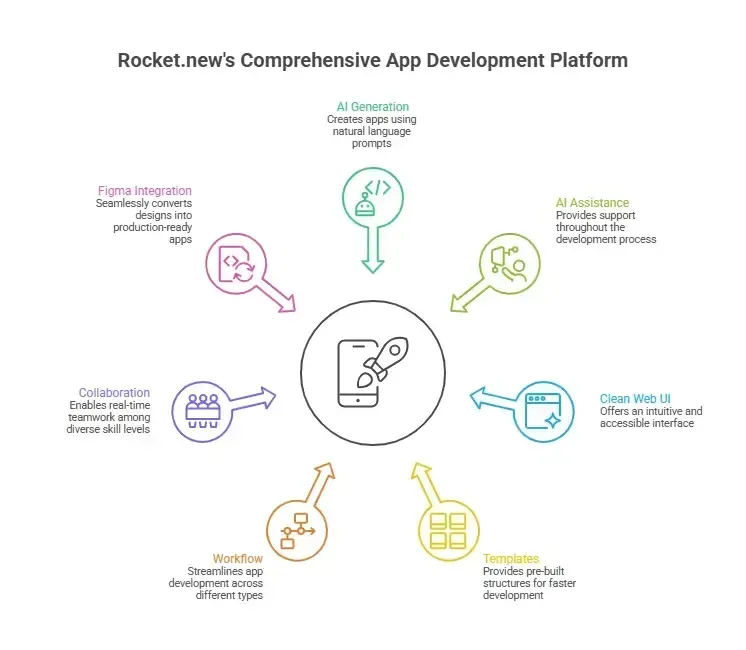
Rocket.new combines AI generation, AI assistance, and a clean web UI to help users start building instantly and move from idea to product faster than any cloud IDE. The platform uses AI-powered tools and an AI agent system to help you create apps using natural language, combining that with visual editing to make the full process accessible to users of all coding skill levels.
Templates that eliminate cold starts for building apps
-
25,000+ free templates come pre-wired with backend logic, auth flows, and database schemas
-
Support for building web and mobile apps
-
Covers every major vertical, including SaaS, fintech, HR, and e-commerce
-
Building on top of templates cuts per-build token cost by up to 80%
-
Apps start close to production-ready from prompt one
One workflow for all app types.
-
Websites, dashboards, and native mobile apps from a single natural language workflow
-
No tool switching and no separate pipelines for web versus mobile projects
-
Founders who need to ship both web and mobile together get that from one platform
Collaboration for all skill levels.
-
Real-time collaboration tools built across every stage from live preview to deployment
-
Builders, designers, and stakeholders with varied skill levels all contribute without touching code
-
Removes the bottleneck between stakeholder feedback and working, testable apps
Figma to production without handoffs.
-
Import Figma files and generate production-ready output without handoff delays
-
Design-ready teams skip the gap between mockup and working app entirely
What Production-Ready Actually Means
Production-ready code is not just code that runs. It includes auth, database wiring, API logic, and testable behavior. Rocket.new generates all of those layers from the first natural language prompt.
-
Apps include live preview testing, exportable logic, GitHub sync, and custom domains on Netlify
-
Full-stack logic is handled in one build pass, so testing confirms behavior rather than fixing broken code after credits are spent
-
The platform focuses on speed, real deployment, and practical workflows without exposing the full complexity of a development environment
Community Insights
Builders who compare both platforms are direct about the gap between the two.
"There are so many alternatives to Replit that make collaboration, speed, and AI-assisted coding way easier. It's about picking a tool that actually fits your workflow and lets you start coding instantly." - LinkedIn discussion on best Replit alternatives
That view surfaces consistently across reviews. When builders look for Replit alternatives, cost patterns and agent reliability push them toward AI tools built for production speed from the start. One Rocket.new user captured the difference clearly:
"I've tried Replit and lovable but Rocket's ability to one-shot a working app is next level."
That first-shot delivery versus debug cycles is precisely where Rocket.new pulls ahead of other app builders.
Which Platform Better Fits Your Workflow?
Replit is the right fit when you:
-
Need full development control over every line of code
-
Are comfortable managing testing and debugging inside the IDE
-
Work on multi-language or complex technical projects
-
Have the coding fluency to correct the generated output on your own
Rocket.new is the right fit when you:
-
Need to move from idea to live app as fast as possible
-
Want predictable costs without surprise AI billing spikes
-
Are building for web and mobile from a single workflow
-
Work across a team with mixed coding skill levels
-
Want to validate ideas quickly before committing to full-scale development
Ready to turn your idea into a working app without the usual delays? Start building with the platform that matches your workflow.
Table of contents
- -What Each AI-Powered App Builder Actually Does
- -Replit
- -Key Features:
- -Rocket.new
- -Key Features:
- -App Development Speed from Prompt to Shipping
- -Replit AI Capabilities
- -Rocket.new AI capabilities
- -Feature Comparison
- -Where Replit Creates Friction
- -Pricing that compounds
- -Agent loops and deprecated output
- -Mobile apps arrived late
- -What Rocket.new Does Differently
- -Templates that eliminate cold starts for building apps
- -One workflow for all app types.
- -Collaboration for all skill levels.
- -Figma to production without handoffs.
- -What Production-Ready Actually Means
- -Community Insights
- -Which Platform Better Fits Your Workflow?
- -Replit is the right fit when you:
- -Rocket.new is the right fit when you: