
Rocket.new is best for fast, AI-driven full-stack app creation without coding, ideal for founders and non-developers. Replit is better for developers who need full control, flexibility, and long-term code management. Choose Rocket for efficiency and simplicity, or Replit for precision and scalable development control.
Answering Rocket.new vs Replit, which platform is better for full-stack development depends on one question: who does the building?
Replit is a cloud IDE where developers write and control code with strong AI assistance. Rocket.new is an ai powered “vibe solutioning” app builder that generates web apps and mobile apps from natural language prompts, no configuration or setup required.
This tool comparison walks through capabilities, workflow, pricing, and migration to help you decide.
What is Rocket.new?
Rocket.new is an AI-powered vibe solutioning platform for turning ideas into production-ready applications through intelligent agents, no coding needed.
Describe your idea using natural language prompts, and the platform scaffolds a complete, deployable app: backend, frontend, database schema, authentication, and integrations, all in minutes.
Key features include:
-
Real-time collaboration on every plan
-
One-click deploy with custom domains
-
GitHub sync for version control
-
25,000-plus templates for rapid prototyping.
It covers full-stack projects, landing pages, web apps, and mobile apps from one platform. Teams save time and skip the complexity of juggling separate tools.
Creating apps with Rocket.new is optimized for speed and real deployment, not just mockups. Since its 2025 beta, Rocket.new has attracted 400,000 users and raised $15 million from Salesforce Ventures and Accel. A free plan is available, with paid plans from $25/month.
What is Replit?
Replit is a browser-based IDE that provides a complete development environment for coding, running, and deploying projects across 50+ programming languages.
Developers across all skill levels rely on Replit for AI-assisted coding, but the platform is designed first for those who want direct access to and full control over every line of code.
Key features include:
-
Replit offers AI assistance, an agent for scaffolding projects, real-time collaboration, deployment, and version control, all in the browser.
-
Replit provides full control over the development environment, making it the go-to for experienced developers managing complex projects and custom logic.
-
Multi-language projects, custom runtimes, and AI features make Replit a trusted environment for long-running builds where code ownership matters.
Unlike Rocket.new, Replit exposes the codebase directly for modification Replit's approach is to amplify developers, not replace them.
Replit vs Rocket.new: Core Features at a Glance
| Feature | Rocket.new | Replit |
|---|---|---|
| Primary approach | Prompt-driven AI generation | Code-first cloud ide |
| Web apps | Production-ready from prompts | Developer-written |
| Mobile apps | Full-stack native support | Limited native mobile |
| AI agent | Builds entire app autonomously | Amplifies developer coding |
| Real time collaboration | Built into all plans | Paid plans only |
| Deployment tools | One-click, instant deploy | Developer-managed |
| Custom domains | Yes, included | Yes, on paid tiers |
| Paid plans | From $25/month | From $25/month |
| Best for | Founders, non-developers, teams | Experienced developers |
AI Capabilities: Replit vs Rocket.new
Replit AI Capabilities
-
Enhances developer productivity with AI-assisted coding, debugging, and logic explanations
-
Gives full control over the codebase, ideal for experienced developers
-
Produces more reliable outputs for complex, logic-heavy applications
-
May break unrelated parts of the app during fixes, especially in multi-file changes
-
Requires manual debugging despite AI support, increasing time and effort
-
AI agent can lead to repeated fix attempts, raising usage costs
Rocket.new AI Capabilities
-
Generates complete, functional applications from simple natural language prompts
-
Minimizes the need for coding or technical intervention
-
Focuses on outcomes rather than implementation details
-
Ideal for non-developers building production-ready apps quickly
-
Reduces time spent on debugging and error handling
-
Offers a more practical AI app builder approach for rapid development and deployment
Workflow and Speed: Replit vs Rocket.new
| Aspect | Replit | Rocket.new |
|---|---|---|
| Workflow Approach | Code-centric workflow inside a browser-based IDE | Prompt-driven workflow using natural language |
| Development Style | Write, edit, and manage code manually with AI assistance | Describe the app and let AI generate the full application |
| User Involvement | Hands-on at every function, file, and logic level | Minimal involvement, focused on refining outcomes |
| Speed of Development | Slower, as building and debugging happen step by step | Extremely fast, generates working apps in minutes |
| Ease for Non-Developers | Steeper learning curve, requires an understanding of code | Beginner-friendly, no coding knowledge required |
| Vibe Coding Experience | Partial, developers still control implementation | Full vibe coding experience with end-to-end automation |
| Best Use Case | Complex systems require precision and long-term maintenance | Rapid prototyping, MVPs, and quick app deployment |
Pricing: Replit vs Rocket.new
| Aspect | Replit | Rocket.new |
|---|---|---|
| Pricing Model | Charges for development infrastructure and usage | Charges for AI generation and deployment |
| Free Tier | Available with limited AI agent access | Available with token-based usage |
| Starting Price | $25/month (Core plan with $25 credits) | $25/month with tiered plans ($25, $50, $100) |
| Cost Behavior | Unpredictable with usage-based billing | More predictable with fixed tier pricing |
| Scalability Costs | Can increase significantly with heavy AI agent usage | Varies based on generation complexity and iterations |
| Cost Efficiency | Better for long-term, complex projects with controlled usage | Better for quick builds and rapid prototyping |
| Billing Transparency | Less transparent due to credit-based consumption spikes | Clear pricing tiers with defined limits |
| Best Strategy | Ideal when managing code over time with controlled usage | Ideal for fast MVPs, then optionally scale elsewhere |
Who Should Choose Rocket.new?
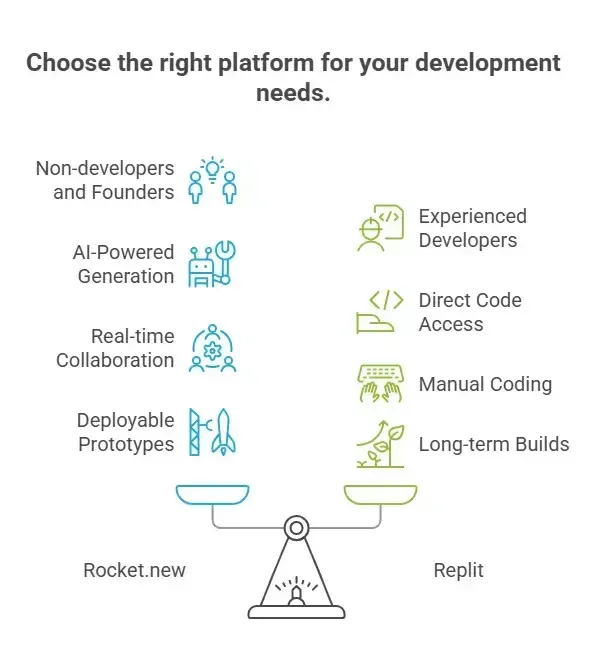
Rocket.new is the right tool for non-developers, founders, and teams that want to move fast. It is purpose-built for launching functional web apps, mobile apps, and internal tools without heavy engineering overhead, building production-ready applications with AI-powered generation and predictable costs.
Choose Rocket.new when you want to:
-
Generate full-stack web apps and mobile apps from plain-text prompts
-
Focus on product decisions rather than development configuration
-
Run real-time collaboration without the team needing to write code
-
Validate ideas and create deployable prototypes in hours
Who Should Choose Replit?
Choose Replit when you are an experienced developer or technical team that needs direct code access and full development control over a complex, evolving codebase. Replit offers a well-established developer community, broad language support, and AI tools built for coders who want to stay in control of every decision.
Choose Replit when you need:
-
Debugging tools and fine-grained code control for long-running systems
-
AI assistance alongside hands-on, manual coding
-
Support across multiple programming languages and custom runtimes
-
Advanced features and custom integrations that prompt-driven platforms cannot yet match
-
Long-term builds where the team owns and maintains every file
Best Replit Alternatives: Where Rocket.new Leads
For teams searching for the best Replit alternatives, Rocket.new consistently stands out when speed and zero-setup deployment are the priority.
Most app builders focus on one layer Rocket.new covers the entire stack, generating frontend, backend, authentication, and database structure together and delivering code ready for real deployment from day one.
Among app builders competing with Replit, Rocket.new is the strongest fit for founders who need results launched quickly.
Migration Between Platforms
Migration between Replit and Rocket.new is one-directional in practice. Code generated by Rocket.new can be exported and imported into any IDE, including Replit. Code written inside Replit cannot be fed into Rocket.new's generation pipeline.
This makes a hybrid workflow practical: prototype on Rocket.new to validate an idea fast, then export the generated code into Replit for AI-assisted development with full development control as the project matures. When seeking AI-powered momentum at the start and deep code ownership later, this approach gets the most from both app builders.
Final Verdict: Choosing Between Efficiency and Control
Deciding between these platforms comes down to a few clear signals:
-
Rocket.new is an AI-powered platform for creating production-ready applications from simple prompts, ideal for non-developers, founders, and fast-moving teams.
-
Replit is a full coding environment where developers use AI tools for controlled, hands-on coding.
-
Rocket.new makes vibe coding practical for founders and non-technical teams who need real apps fast.
-
Both platforms offer a free tier and paid plans starting at $25/month.
-
Replit vs. Rocket.new is an efficiency-versus-control tradeoff choice that depends on your team's technical depth and delivery timeline.
-
Replit's effort-based billing can be unpredictable; Rocket.new charges for generation and is straightforward.
-
The prototype-on-Rocket.new, then-continue-on-Replit approach uses both app builders effectively.
Pick the platform that matches how you build fast with AI or controlled with code, and start shipping today. Turn your idea into a live product faster by choosing the workflow that works for you and your team.
Table of contents
- -What is Rocket.new?
- -What is Replit?
- -Replit vs Rocket.new: Core Features at a Glance
- -AI Capabilities: Replit vs Rocket.new
- -Replit AI Capabilities
- -Rocket.new AI Capabilities
- -Workflow and Speed: Replit vs Rocket.new
- -Pricing: Replit vs Rocket.new
- -Who Should Choose Rocket.new?
- -Who Should Choose Replit?
- -Best Replit Alternatives: Where Rocket.new Leads
- -Migration Between Platforms
- -Final Verdict: Choosing Between Efficiency and Control