Power Apps is built for Microsoft ecosystem automation. Rocket is built for product creation. Outside an M365 shop, per-user pricing compounds fast, PowerFX transfers nowhere, and there is no code to take with you if you ever want out.
Rocket.new vs. Microsoft Power Apps is one of the most consequential platform decisions a growing team can make. The right answer depends entirely on which problem you are actually solving and how much the commercial terms of your chosen platform are allowed to change mid-build.
The Case For Power Apps, When Microsoft Wins
Power Apps is genuinely excellent within its designed perimeter. If your organization runs Microsoft 365, SharePoint, and Dynamics 365 as core infrastructure, Power Apps is the obvious choice. Your users are already in Teams, your data already lives in Dataverse or SharePoint, and Azure Active Directory handles identity.
The platform's native Teams embedding, Dataverse row-level security, DLP policies, and CoE Starter Kit governance tooling are genuine competitive advantages that no AI-first builder currently matches. Over 1,000 certified connectors, SAP, Salesforce, Oracle, and legacy on-premises systems via the data gateway, are mature, battle-tested, and maintained by Microsoft.
| Capability | Why It Matters |
|---|---|
| Native Teams + SharePoint Embedding | Zero integration work for M365 shops |
| Dataverse Governance | Row-level security, audit logging, and business rules at the data layer |
| DLP + Managed Environments | Enterprise data loss prevention, CoE Starter Kit, Purview integration |
| On-Premises Gateway | Connect to SQL Server, Oracle, and legacy systems behind firewalls |
| 1,000+ Certified Connectors | SAP, Salesforce, Oracle, mature and battle-tested |
| D365 CRM/ERP Integration | Shared Dataverse schema, no connector build required |
Power Apps is an enterprise automation tool optimized for one scenario. Outside that scenario, the economic and technical constraints change significantly.
What Power Apps Actually Costs In 2026
Most evaluations quote the headline price and miss the compounding structure underneath it. According to Microsoft's published pricing, Power Apps Premium is $22 per user per month (billed annually), the entry point for any app that touches Dataverse, premium connectors, or custom APIs.
Here is what a real team actually pays:
| Team Size | Power Apps Premium | + Power Automate | + M365 Copilot | Monthly Total |
|---|---|---|---|---|
| 5 users | $110 | $75 | $150 | $335 |
| 10 users | $220 | $150 | $300 | $670 |
| 20 users | $440 | $300 | $600 | $1,340 |
| 50 users | $1,100 | $750 | $1,500 | $3,350 |
Rocket charges flat workspace pricing, $25 to $250 per month regardless of team size. Every user who touches the app adds $22/month to your Power Apps bill, forever. Enterprise developers call this the success penalty.
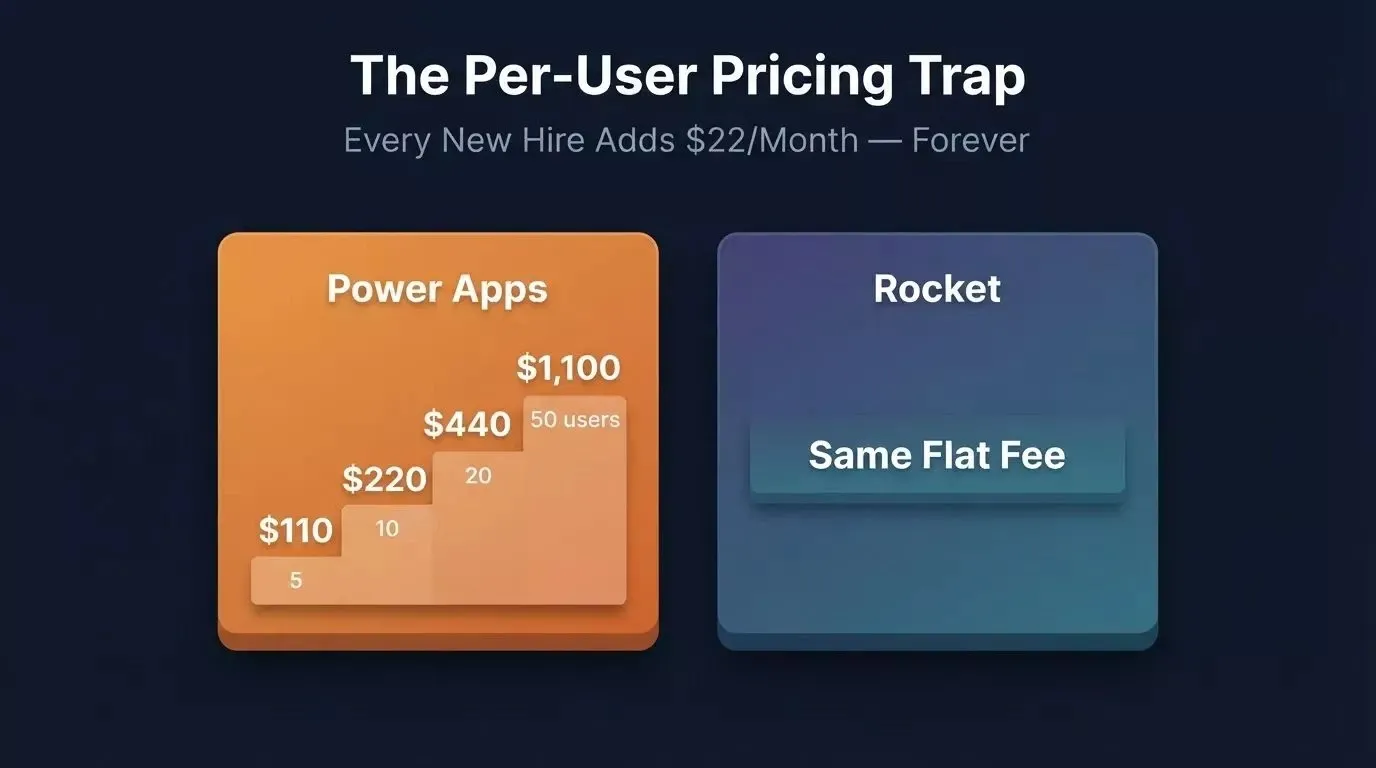
Per-user pricing compounds with every hire. Rocket's flat model stays constant regardless of team size.
Two additional licensing shifts make this worse. Microsoft discontinued the per-app plan for new Enterprise and MPSA customers as of January 2, 2026, removing the $5/user/app/month entry point and pushing new buyers directly to Premium. Simultaneously, AI Builder credits end in November 2026, requiring a forced migration to Copilot Credits. This pattern of frequent commercial term changes is a platform risk signal worth pricing into your decision.
See how Rocket handles your backend automatically: flat pricing, no per-user compounding, no mid-cycle credit migrations.
The Delegation Problem: Why Canvas Apps Break At Scale
Canvas apps have a correctness bug that most evaluations skip entirely. When a query uses a non-delegable function, Power Apps processes data locally and caps results at 500 records by default, 2,000 at the absolute maximum. According to Microsoft's official delegation documentation, "only the first 500 or 2,000 records are scanned."
There is no error message and no warning banner; end users see a complete-looking result that is actually partial.
A concrete example:* A manager filters a 50,000-record HR database by department using a non-delegable field. The app scans the first 2,000 records, returns 47 matches, and displays them as the full result. The actual match count in the full dataset is 340. The manager approves 47 requests, believing they have seen everything; 293 requests are invisible.*
Non-delegable functions that trigger this include Distinct, CountIf with nested logic, Search on non-indexed columns, and string functions like Mid, Len, Left, and Right.
Any canvas app querying more than 2,000 records with these functions is silently returning wrong answers. On Rocket, apps connect to Supabase or PostgreSQL through standard APIs with no artificial record cap.
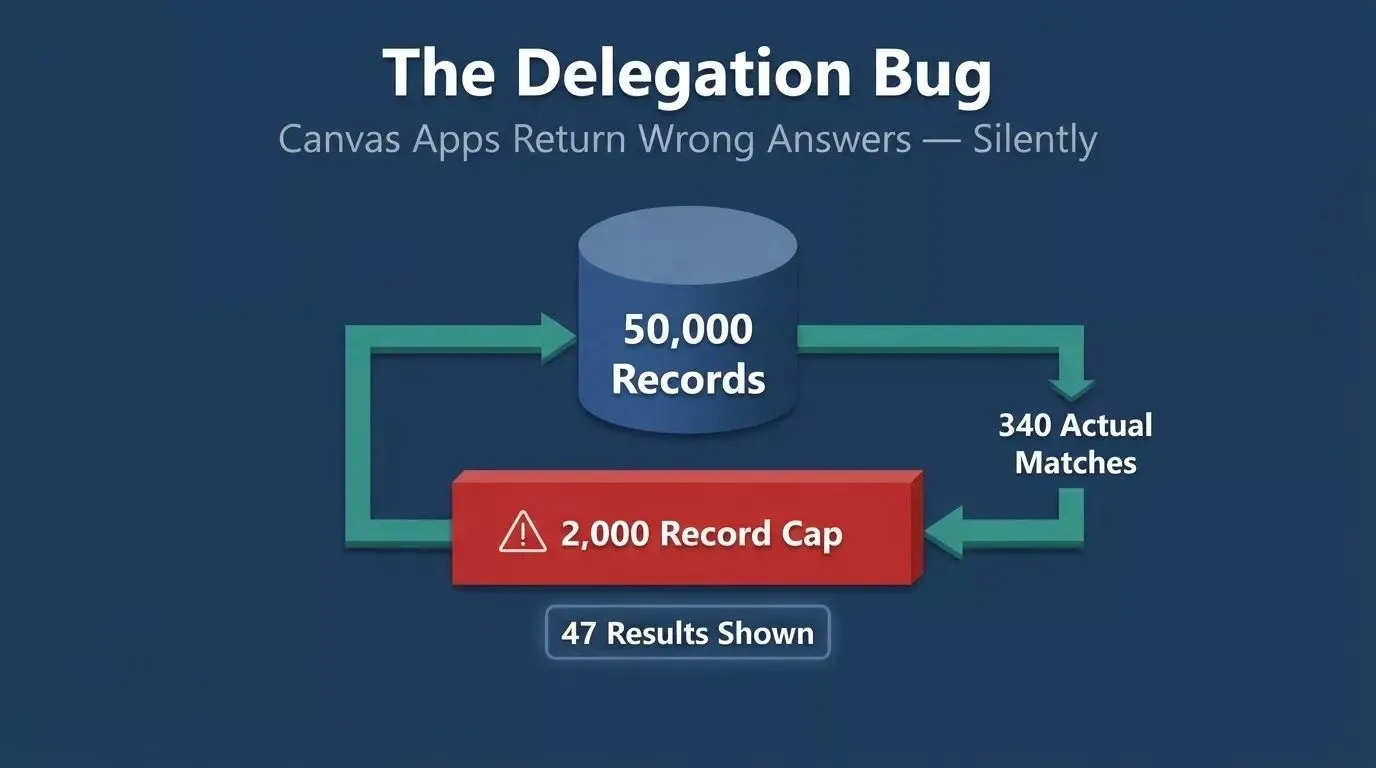
Non-delegable queries hit a hard cap and return incorrect results, not a performance warning, a correctness bug.
How Each Platform Builds The Same App
Consider a concrete use case: a 20-person team needs an internal leave-request portal with manager approvals, email notifications, and a pending/approved dashboard.
The Power Apps path:
-
Design the Dataverse table schema for leave requests, employees, and approval states
-
Build a canvas or model-driven app with PowerFX business rules for validation
-
Build a Power Automate cloud flow for approvals and email notifications
-
Assign Power Apps Premium ($440/month) and Power Automate ($300/month) licenses to all 20 users
-
Test delegation compliance for every data query
Total: $740/month before storage overages or Copilot Credits.
The Rocket path:
-
Describe the app in natural language: "Build a leave-request portal for a 20-person team with manager approvals, email notifications, and an HR dashboard"
-
Rocket generates a full Next.js application with database schema, authentication, approval logic, email notifications, and a responsive dashboard
-
Deploy from Rocket or export the full source code to GitHub
Total: flat workspace fee, regardless of team size. The output is production-ready Next.js code with TypeScript, a full npm ecosystem, and a Supabase backend.
Full Feature Comparison
| Feature | Microsoft Power Apps | Rocket |
|---|---|---|
| App Output | PowerFX canvas/model-driven app | Next.js (web) + Flutter (mobile) |
| Code Ownership | No exportable code | Full source code, GitHub export |
| Licensing Model | $22/user/month (Premium) | Flat workspace: $25–$250/month |
| 10-User Monthly Cost | $220+ (before Automate/Copilot) | Same flat fee |
| Data Limits | 500–2,000 record cap (non-delegable) | No artificial row limits |
| Mobile Apps | Web shell in app container | Native Flutter iOS/Android |
| AI Features | Copilot Credits (AI Builder EOL Nov 2026) | Stable AI providers included |
| Connectors | 1,000+ (SAP, Salesforce, Oracle) | 25+ (Stripe, Supabase, Mixpanel) |
| Deployment | Microsoft cloud only | Rocket cloud or self-hosted |
| Governance | DLP, Managed Environments, Purview | Role-based access, workspace controls |
| Pre-Build Research | None | Solve (research-grade intelligence) |
| Competitive Monitoring | None | Intelligence layer |
| Tech Stack | PowerFX (proprietary) | TypeScript, Next.js, full npm |
| On-Premises Connectors | Yes (data gateway) | No (cloud-native only) |
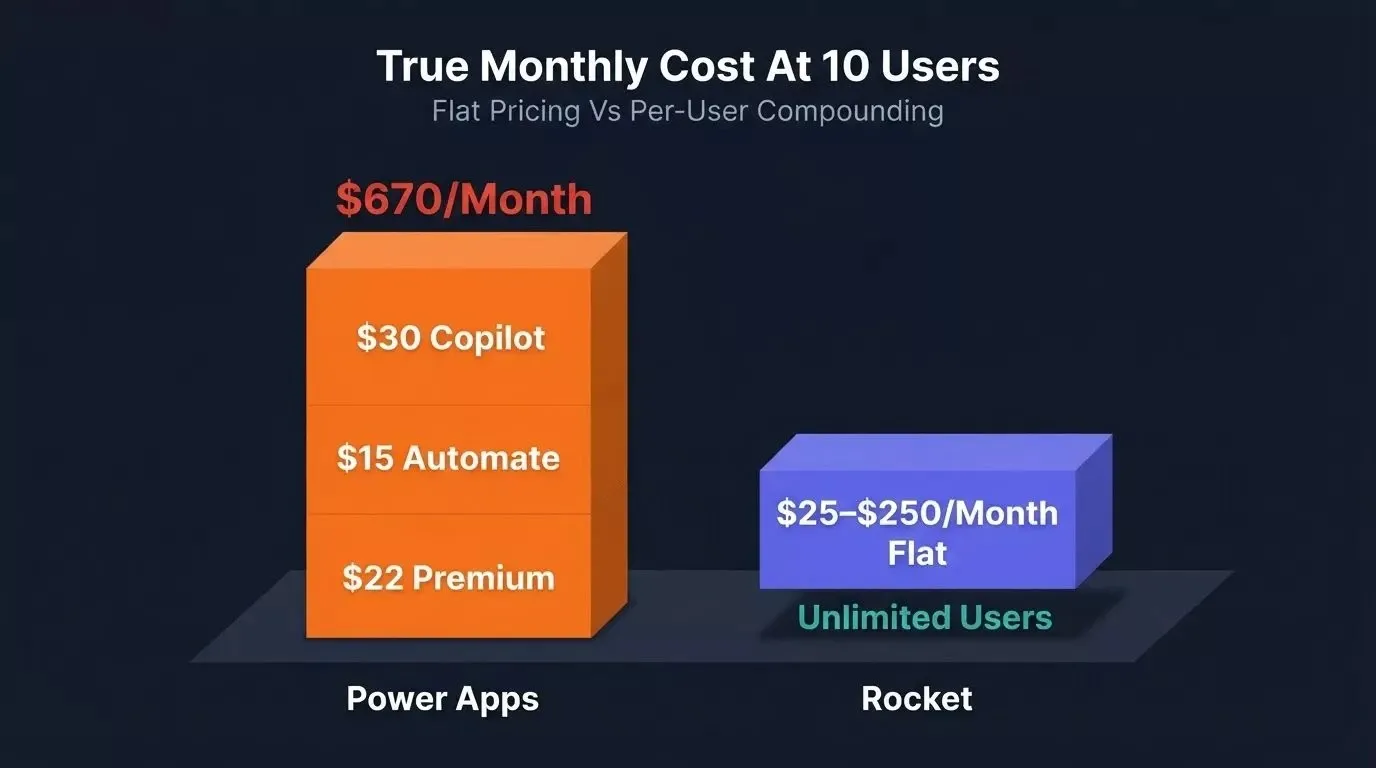
At 10 users, Power Apps Premium plus Power Automate plus Copilot totals $670/month. Rocket stays at the same flat fee.
The Lock-In Calculation
Power Apps generates zero portable code. Every business rule, validation, and workflow trigger exists as a PowerFX formula inside Microsoft's runtime. If you leave the platform, you do not migrate; you rebuild from scratch. PowerFX is proprietary, and skills built in it transfer to nothing outside the Microsoft ecosystem.
Microsoft has changed Power Apps licensing terms twice in the past twelve months: the per-app plan was discontinued in January 2026, AI Builder reached EOL in November 2026, and licensing enforcement for grandfathered seeded licenses began in February 2027. Each change requires budget re-approval, IT change management, and, in some cases, application rework.
Rocket generates standard Next.js and Flutter code. Download it, push it to GitHub, deploy it anywhere. The code you own today is the code you own in five years, regardless of what any platform's pricing does.
Who Should Choose Power Apps
Power Apps is the right choice when your organization runs Microsoft 365 E3 or E5, your data lives in Dataverse or Dynamics 365, and IT governance with DLP and Purview compliance is non-negotiable. It is the right tool when users are already in Teams, datasets are modest, and every formula is delegation-compliant.
If M365 integration is your priority and your team already lives inside the Microsoft ecosystem, Power Apps is a serious platform that deserves serious consideration.
Who Should Choose Rocket
Rocket is the right choice when:
-
You are starting fresh with no Microsoft infrastructure dependency
-
Your team is growing, and per-user pricing would compound significantly with every hire
-
You need a native mobile app, not a web shell in an app container
-
You want to own the codebase and deploy or migrate without vendor permission
-
You want pre-build research (Solve) and post-launch competitive monitoring (Intelligence) in the same platform
Final Verdict
Microsoft Power Apps is the right tool for Microsoft ecosystem automation, M365-heavy organizations with Dataverse data, licensed users in Teams, and IT governance that needs DLP and Purview integration.
Rocket is the right tool for product creation, from-scratch builds, growing teams, and organizations that want flat pricing, portable code in Next.js and Flutter, and no exposure to mid-cycle licensing changes. Solve handles pre-build research; Intelligence handles post-launch competitive monitoring. There is no Power Platform equivalent to either.
Choose the platform that was designed for the problem you are actually solving.
Build your first app on Rocket.new, flat pricing, no PowerFX, full code ownership. Free to start.
Table of contents