Carrd ($19/yr) is the fastest way to launch a static one-page site, perfect for validation. Rocket.new ($25/mo) generates the full-stack product that the page announces: auth, database, mobile app, Stripe, deployed. Sequential tools, not competing ones.
Rocket.new vs Carrd is not a fair fight, and that is the point.
Carrd is $19 a year and will have your landing page live in under an hour, scoring 98/100 on page speed, with zero security patches ever needed. But Carrd is architecturally static: no server, no database, no backend.
The moment someone signs up from that page, and you need to give them an account, your product has outgrown the tool that announced it. That is the story of most great products built in 2026.
What Makes Carrd Genuinely Great
Carrd has earned its reputation by doing one thing exceptionally well. The Makerstack community calls it "a scalpel, not a Swiss Army knife", and that framing captures exactly why it works.
-
$19/year for Pro Standard ($1.58/month): custom domains, contact forms, and signup forms via Mailchimp, Kit, HubSpot, Klaviyo, beehiiv, Loops, MailerLite, Brevo, and Ghost, 20+ native email integrations built for capture funnels
-
$9/year Pro Lite: premium URLs, no branding, unlimited elements
-
Free tier: up to three sites, core features, no credit card required
Sub-one-hour launch, rated 9.5/10 for ease of use. Static HTML with zero server overhead delivers 98/100 page speed; Framer scores 92; Webflow scores 87 in independent benchmarks. Zero maintenance by architecture: no plugin conflicts, no security patches, no hosting management.
For creator profiles, artist pages, musician bios, link-in-bio pages, coming-soon announcements, event RSVPs, and newsletter landing pages where the entire funnel is from page to email signup to nurture sequence, Carrd is the correct tool, full stop.
Still validating? Keep the Carrd. When you are ready to build, Rocket.new is free to start.
Carrd Pricing at a Glance
| Plan | Price | Sites | Custom Domains | Forms | Email Integrations |
|---|---|---|---|---|---|
| Free | $0 | 3 | No | No | No |
| Pro Lite | $9/yr | 3 | No | No | No |
| Pro Standard | $19/yr | 10 | Yes | Yes | 20+ native |
| Pro Plus | $49/yr | 25 | Yes | Advanced | 20+ native |
The Architecture Behind Carrd: What "Static" Actually Means
Carrd's output is a static HTML file. No server processes requests. No database stores data. No backend logic runs. This is the design decision that makes Carrd fast, cheap, and zero-maintenance, and it defines a hard ceiling.
Static HTML served from a CDN is the fastest possible delivery mechanism for a web page. But it also means navigation is via anchor links; you are still on the same URL. Multi-page workarounds require separate disconnected Carrd sites, not routing. Embedded Stripe and PayPal widgets work at the buy-button level only. "There is no server. You cannot implement custom authentication. Security is entirely managed by Carrd."
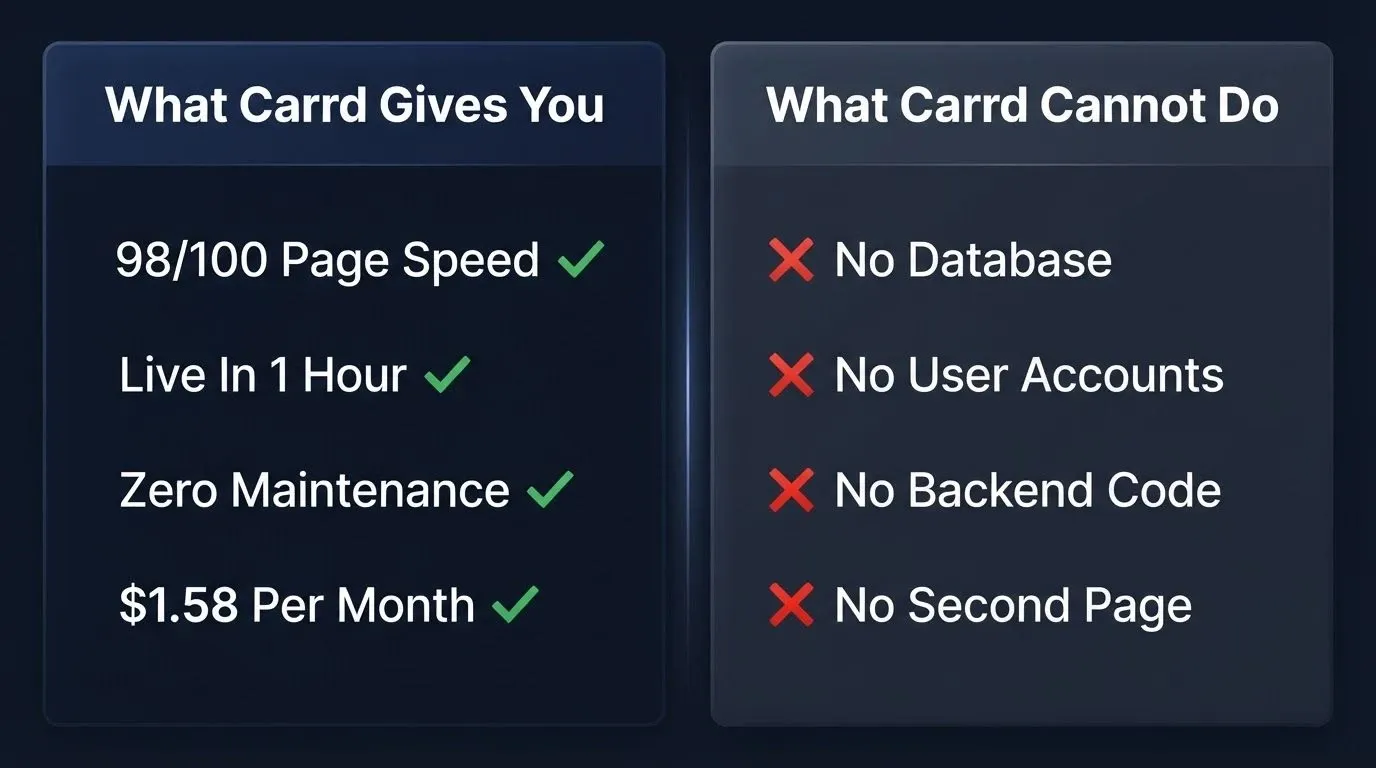
The ceiling is not a bug. It is the same architectural decision that makes Carrd score 98/100 on page speed. You cannot have both.
The Graduation Moment, When You Have Outgrown Carrd
Graduating from Carrd is a success signal, not a failure. It means your idea worked. The page validated demand. Now the product needs to exist.
The trigger moments are specific: someone signed up, and you have no account system to put them in; you want to show different content to different users; your product needs more than one URL.
Analysis of community reviews shows 11 of 33 users cite the single-page limit as the reason they left; the canonical complaint is multi-page architecture and CMS capability for SEO.
A developer described the ceiling precisely: "Carrd is good at one thing: one page. The moment you need a second page, a /pricing, an /about, a /blog, you're either hacking single-column scroll or jumping to Squarespace ($192/yr) or Wix ($192/yr+)."
What Each Platform Actually Builds
The clearest way to understand the difference is a concrete use case: a solo founder building a SaaS tool for freelancers.
Carrd output: one beautiful HTML page with email capture, signups going to Kit or Beehiiv, professional and fast at $19/year, live in under an hour. Rocket output: a full Next.js application with landing page, signup and login flows, user dashboard, Supabase PostgreSQL database, Stripe billing with subscription management, a Flutter mobile app for iOS and Android, deployed to staging and production with GitHub sync.
The key insight: with Rocket, the landing page is not the product; it is the entry point to the product.
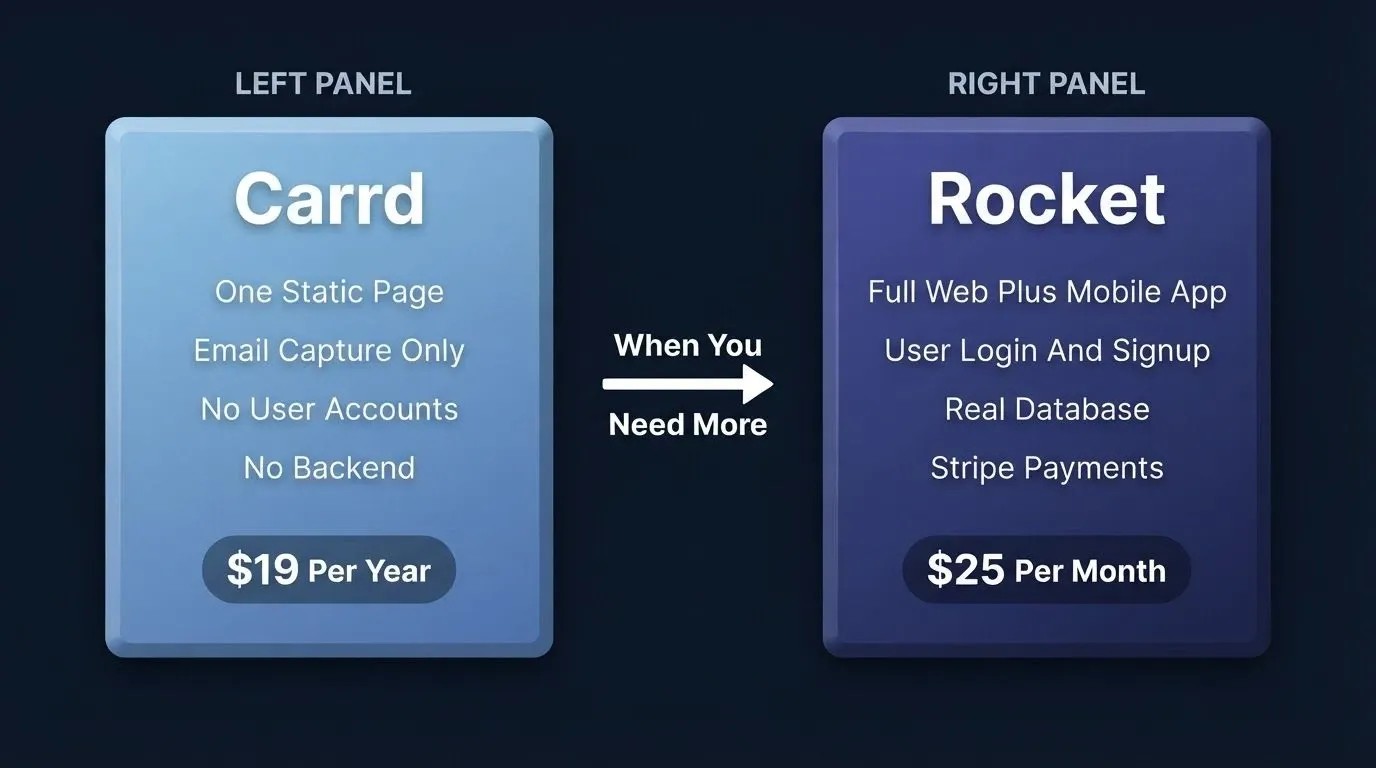
What Carrd can build vs. what Rocket can build
The Validation-to-Product Lifecycle
Full Feature Comparison
| Feature | Carrd | Rocket |
|---|---|---|
| Output type | Static HTML file | Full-stack Next.js + Flutter mobile |
| Pages | Single page, one URL | Multi-page with full routing |
| Backend logic | None | Next.js API routes |
| Database | None | Supabase PostgreSQL |
| User authentication | Site-wide password only (Pro Plus) | Supabase Auth, social login, role-based access |
| Mobile app | Responsive web only | Flutter iOS and Android |
| Payments | Embedded buy-button widget | Native Stripe with subscriptions and customer accounts |
| Email integrations | 20+ native | Via 25+ integrations |
| AI code generation | None | Natural language to production code |
| Version control | None | GitHub sync with rollback |
| Deployment | Single CDN publish | Staging and production, one-click |
| Custom domains | Pro Standard+ | Yes, automatic HTTPS |
| Code export | Static HTML (Pro Plus) | Full codebase, always accessible |
| Figma import | None | Yes, preserves design system |
| Page speed | 98/100 | Optimized production builds |
| Starting price | $0 (Free tier) | $0 (Free plan) |
| Paid price | $19/year | $25/month |
The Price Comparison Done Honestly
Carrd Pro Standard costs $19/year, $1.58/month. For static use cases, nothing competes on value.
Rocket's free plan includes app generation, preview, and basic deployment. The Pro plan starts at $25/month with credits and tokens for extended AI usage, team features, and production deployment.
"If all you need is a static page, paying $25/month for Rocket is wasteful. If you need an app, paying $19/year for Carrd is architecturally impossible." One buys you a static page. The other buys you a full-stack application developer, a designer, a database, and a mobile build pipeline.
What Does the No-Code Shift Mean for Teams?
80% of technology products and services will be built by non-developers by 2026. The no-code and low-code platform market reached $65 billion in 2026, growing at roughly 26% annually. 70% of new applications now use low-code or no-code platforms for development.
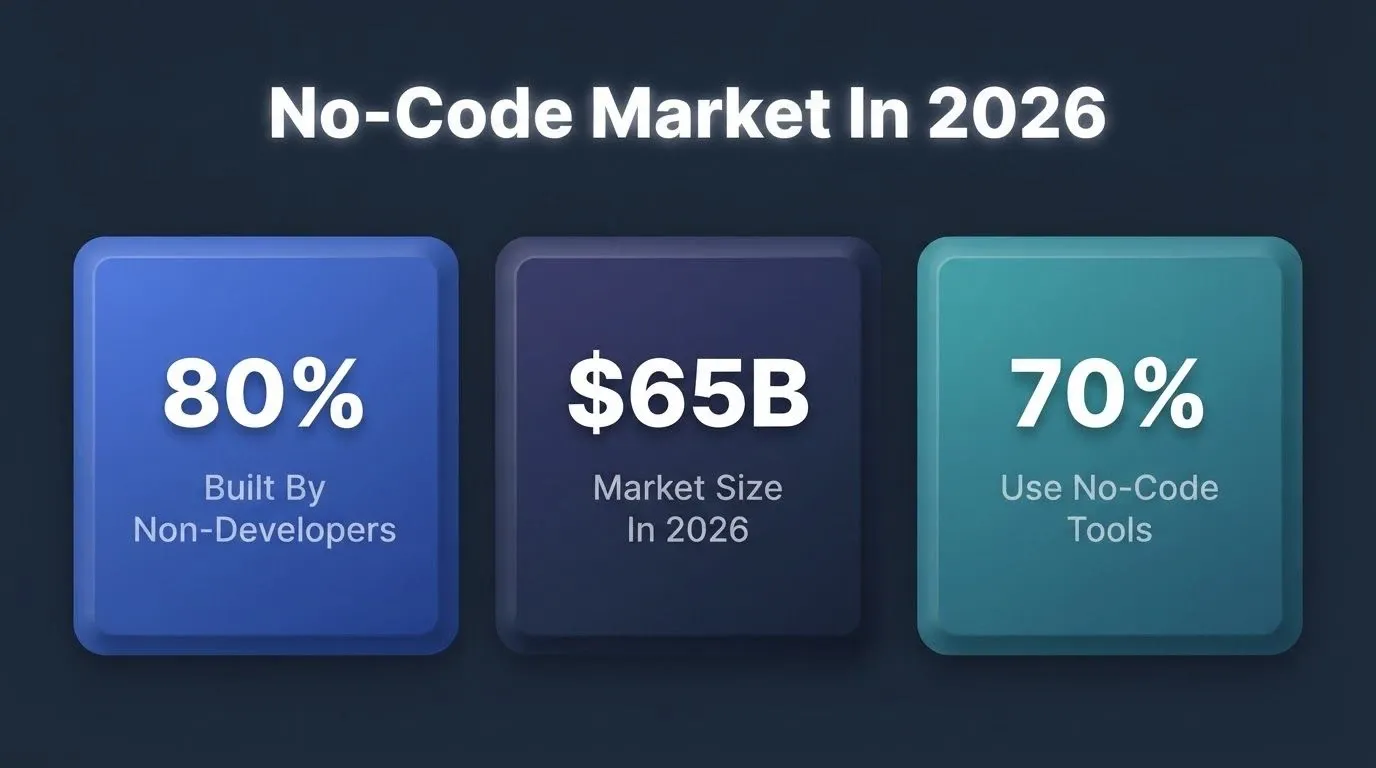
No-Code market Stats 2016: 80% by Non-Developers, $65B Market Size, and 70% use no-code tools
The tools that win are the ones that know their job. Carrd knows its job: one beautiful static page, fast, cheap, zero maintenance. Rocket knows its job: the full-stack product that page was announcing. For small business owners, the website builder for small business comparison covers both tools in context. For the broader landscape, website builders vs Rocket 2026 maps the full picture.
When to Keep Using Carrd
Carrd is the right tool when one beautiful page is the complete job:
-
Artist, musician, and writer profiles: Rocket is massively over-engineered for a portfolio page
-
Coming-soon and waitlist pages: pure validation before a product exists
-
Event RSVPs and one-page event sites: one page, one job, done
-
Newsletter landing pages: when the entire funnel is page to email signup to nurture sequence
-
Link-in-bio pages: creator and influencer profiles
See how founders ship landing pages on Rocket.new when they need more than a static page, but if a static page is genuinely all you need, Carrd is the correct answer.
When to Move to Rocket
The decision is architectural, not preferential. Move to Rocket when:
-
Users need to create accounts and log in: Carrd has zero native authentication
-
Content needs to change based on who is viewing it: Carrd renders one static HTML file at build time
-
The product needs more than one page or URL: Carrd is single-page by deliberate architectural design
-
You want to ship a mobile app: Flutter iOS and Android; Carrd is responsive web only
-
Payments need backend logic: full Stripe with subscriptions; Carrd embeds a buy-button widget only
-
You have validated with Carrd and are ready to build: this is the graduation moment
Non-technical founders should read who should choose Rocket before deciding.
How Rocket Generates the Full-Stack Product
Rocket is not a page builder. It is an AI-powered app builder that generates production-ready apps from natural language prompts. You describe what you want, and Rocket delivers working code: frontend, backend, database schema, user authentication, and one-click deployment.
-
Full-stack web applications built in Next.js with Tailwind CSS, responsive UI, and SEO-ready markup
-
Native mobile apps built in Flutter that deploy to both iOS and Android from one codebase
-
Supabase backend with PostgreSQL database, auth, edge functions, and row-level security
-
GitHub sync for version control, code export, and team collaboration
-
25+ integrations including Stripe, Google Analytics, Mailchimp, Notion, Linear, Airtable, and Mixpanel
The workflow runs in three steps: describe your app in natural language, generate production-ready code with real design systems and proper data structure, and then launch with one click to staging or production. Every generated file is accessible and ready for editing, maintainable code that developers can extend. For a deeper look, see Rocket's backend architecture.
The Transition Play: Using Both Together
The most practical approach for many founders is sequential, not either/or. Keep Carrd for the marketing page and email collection while building the product in Rocket in parallel. When the Rocket app is ready, migrate traffic from the Carrd waitlist to the live product; your early signups become your first users.
See how founders go from Carrd waitlist to live product with the market validation to deployed product workflow.
Ready to build the product your Carrd page is announcing? Describe your app idea on Rocket.new and ship a full-stack application in one session, free, no setup required.
Table of contents
- -What Makes Carrd Genuinely Great
- -Carrd Pricing at a Glance
- -The Architecture Behind Carrd: What "Static" Actually Means
- -The Graduation Moment, When You Have Outgrown Carrd
- -What Each Platform Actually Builds
- -The Validation-to-Product Lifecycle
- -Full Feature Comparison
- -The Price Comparison Done Honestly
- -What Does the No-Code Shift Mean for Teams?
- -When to Keep Using Carrd
- -When to Move to Rocket
- -How Rocket Generates the Full-Stack Product
- -The Transition Play: Using Both Together