
Rork is a capable mobile-only prototyping tool, but it falls short the moment you need web apps, full backend logic, or a production-ready build. Rocket.new covers both web and native mobile from a single natural language workflow, with automated backend setup, 25,000+ templates, one-click deployment, and GitHub sync built in.
Is Rork AI Really the Best Option for Building Mobile Apps?
Not always. Rork does some things well. But the moment your project needs full-stack capabilities, backend logic, or a live app that scales past an MVP, it starts showing its limits fast.
That's exactly why builders are searching for alternatives. And one platform keeps coming up: Rocket.new.
The low-code/no-code market is growing at 25% annually, sitting at a $50B global opportunity. Rocket.new itself hit 400,000 users and $4.5M ARR within three months of its beta launch. That's not luck.
So let's break down what Rork offers, where it falls short, and why builders increasingly choose Rocket.new instead.
What Rork AI Actually Does
-
Converts natural language prompts into native mobile apps using React Native and Expo
-
One codebase runs on iOS, Android, and web simultaneously
-
Real-time device preview via Expo Go for fast testing
-
Full code export with ownership, no vendor lock-in
-
Raised $2.8M from a16z and draws 743,000 monthly visits with an 85% growth rate
-
Built exclusively for mobile applications, with no support for web apps or internal tools
Rork is solid for quick vibe coding and mobile prototyping. You type a description, and the AI builds an app. Simple enough. So why are builders looking elsewhere?
Where Rork Starts to Slip
The Honest Limitations
-
Mobile only: No web apps, no landing pages, no internal tools. If your product needs to run in a browser, Rork can't help.
-
No visual editor: Post-generation UI tweaks require more prompts. There is no drag-and-drop or direct editing layer.
-
Backend logic is shallow: Real-time payments, push notifications, and advanced backend setup typically require additional engineering work outside the platform.
-
Deployment is manual: App Store submissions require developer accounts, certificates, and signing. "No-code" does not mean zero effort here.
-
Complex features are a stretch: One Reddit reviewer who tested nearly every AI app development tool put it plainly: "the AI often struggles to interpret user requirements accurately for intricate functionality."
If your app idea is simple and mobile-first, Rork works fine. If you need full-stack applications, production-ready code, custom domains, or anything past mobile, you need more.
Rocket.new: The Full-Stack Answer Rork Cannot Give
Built for More Than Day One
Rocket.new is an AI-powered vibe-solutioning platform that generates full-stack web and mobile applications from natural language prompts. Users simply describe their app ideas in plain English, and the platform converts them into functional applications.
CEO Vishal Virani put it clearly: "We are building the first vibe solution platform, which is not solving just a problem of day one, but what we are focusing on is solving the problem of day two."
Supports backend development with the entire backend setup, API endpoints, database structure, and deployment all in one place, no writing code required, and no separate backend configuration needed.
The ideal platform should be built to handle real users, real data, and increasing complexity without requiring a full rebuild later. That's precisely the standard Rocket.new is designed to meet.
That is the defining difference. Rocket.new is not chasing demo speed. It is building something you can actually ship, scale, and maintain without having to rebuild from scratch a few months later.
Key Features of Rocket.new
-
Full-stack generation from one prompt: Frontend, backend logic, API endpoints, database structure, and authentication all come out together.
-
Web apps and native mobile apps both: Next.js for web, Flutter and Dart for native mobile apps.
-
Figma-to-code conversion: Import your Figma files and turn them into working front-end components with responsive layouts.
-
Precision Mode: More than 100 structured commands for granular, manual control when natural language prompts alone are not enough.
-
GitHub sync: Version control is built in from day one, no extra setup needed.
-
Custom domains: Connect your own custom domains and launch with a professional URL on every project.
-
One-click Netlify deployment: Your production-ready app goes live without wrestling with server configs.
-
Pre-built templates: Library of 25,000+ industry-specific templates spanning verticals such as technology, fintech, health and medical, e-commerce, SaaS, HR, logistics, and more, each pre-configured with a production-ready structure and fully customizable via natural language prompts or the visual editor.
-
Enterprise-grade security: Audit logs, data protection, and role-based access are baked directly into the platform.
-
Exportable generated code: No proprietary lock-in. The code is yours to take anywhere.
What Rocket.new Has Already Built
-
Over 500,000 applications created, from e-commerce and fintech to mental health tools
-
Customers from Meta, PayPal, and PwC use it for mobile apps and web apps
-
ARR hit $4.5 million with projections reaching $60-70M by June 2026
-
About 25 minutes to generate a complete production-ready app, trading raw speed for depth
-
About 45% of projects are mobile apps, and 55% are web apps, showing a genuine range
Feature Comparison: Rocket.new vs. Rork vs. Top Alternatives
| Feature | Rocket.new | Rork | Bolt.new | Lovable |
|---|---|---|---|---|
| Web apps | ✅ | ❌ | ✅ | ✅ |
| Native mobile apps | ✅ Flutter/Dart | ✅ React Native | ❌ | ❌ |
| Full stack apps | ✅ Complete | ⚠️ Limited | ✅ | ⚠️ |
| Backend logic | ✅ Auto-generated | ⚠️ Basic | ✅ | ⚠️ |
| Visual editor | ✅ Real-time | ❌ | ✅ | ✅ |
| GitHub sync | ✅ | ✅ | ✅ | ✅ |
| Custom domains | ✅ | ❌ | ✅ | ✅ |
| Landing pages | ✅ | ❌ | ✅ | ✅ |
| Internal tools | ✅ | ❌ | ⚠️ | ⚠️ |
| Figma import | ✅ | ❌ | ❌ | ❌ |
| Audit logs | ✅ | ❌ | ❌ | ❌ |
| Free tier | 1M tokens | Yes | Yes | Yes |
| Paid plans from | $25/month | Message-based | Varies | Varies |
Top Alternatives in This Space
It is also worth knowing the broader landscape. Top alternatives in this space include CodeConductor, Lovable, Bolt.new, FlutterFlow, Meku.dev, and Emergent AI, each with its own strengths:
-
Bolt.new excels at creating, testing, and deploying full-stack web applications immediately as a browser-based IDE, making it a strong pick for developers who want instant execution without leaving the browser.
-
Lovable is popular for rapid, visual-first creation of React/Supabase apps and includes real-time collaboration tools that let teams co-edit applications simultaneously.
-
FlutterFlow offers clean code export and complex backend logic for developers wanting granular control over their mobile and web output.
-
Meku.dev provides high-quality React/Tailwind code generation with strong GitHub integration for teams prioritizing version control from day one.
-
CodeConductor.ai is a no-code platform built specifically for teams that need to build, deploy, and scale production-ready AI systems, with built-in GDPR/HIPAA compliance and role-based access control, making it a better fit for enterprises than for early-stage startups.
-
Emergent AI is a strong alternative for production-ready builds, though it is primarily optimized for long-term product development.
Rocket.new strikes the balance between quick launches and genuine scalability, covering both day one speed and day two durability.
Pricing: What You Are Actually Paying for
Understanding Paid Plans Matters
Token-based pricing can feel unpredictable, and Rocket.new is no exception. Token consumption varies by generation complexity, and some users report credits depleting rapidly before meaningful features are built.
APK build failures that consume tokens without producing a working app have also been flagged. Factor these in before committing to a paid plan.
Rocket.new Paid Plans
-
Free tier: 1 million tokens, enough for simple app exploration and early testing
-
Starter paid plan: $25 per month for 5 million tokens
-
Pro paid plan: $100 per month (or $80 per month billed annually) for teams, high-volume full-stack app flows, and production apps
-
Custom domains, GitHub sync, and code export are all included in paid plans
-
Gross margins at 50-55% signal a platform built to last, not one burning cash to acquire users
Rork Paid Plans
-
Message-based pricing where one prompt exchange equals one message credit
-
Paid plans scale by volume only
-
No web app access, regardless of which plan level you choose
The Cost Efficiency Verdict
If you need production-ready applications across both web and mobile, Rocket.new's paid plans deliver more total value. Rork's paid plans cover only mobile app building. You would still need a second tool for everything else, which adds up fast.
Use Cases Where Rocket.new Wins
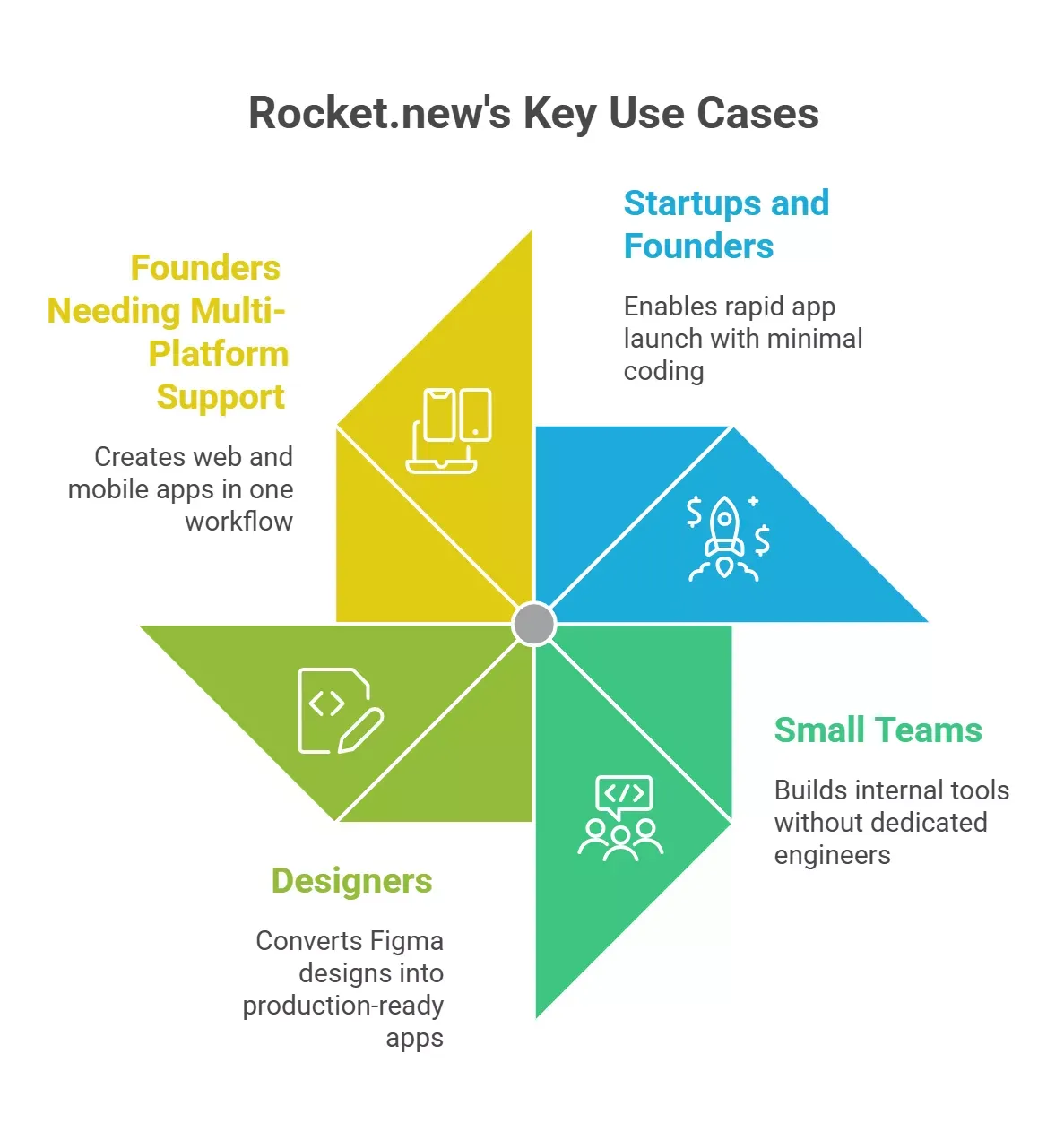
Startups and Founders Launching Fast
Rocket.new is designed for startups and small teams looking to launch quickly without a traditional development cycle. It automates full backend setup, supports rapid prototyping without sacrificing a production-ready foundation, and takes an idea to a live app in under 30 minutes for most projects. Natural language prompts drive the entire process with minimal coding knowledge required.
Small Teams Building Internal Tools
Build dashboards, admin panels, and internal tools backed by real backend logic. Full-stack applications are generated from plain English descriptions, with no dedicated engineering team needed. Rocket fits teams that are lean, scrappy, and need production-ready code without the overhead.
Designers with Figma Files
Import existing Figma designs and convert them into production-ready web apps. The real-time visual editor lets you make live UI adjustments without writing code, skipping the usual handoff friction between design and development.
Founders Who Need Web and Mobile Both
One AI app builder covers multiple platforms with no switching mid-project. Next.js for web apps, Flutter and Dart for native mobile apps, and custom domains for every project in one unified workflow.
Community Insight: What Real Builders Are Saying
From the People Actually Using These Tools
On Rocket.new's homepage, several users report genuine surprise at the output quality. One wrote:
"I just one shotted a prompt using @rocketdotnew and I can't put into words how astronomically better it is than any other no code AI tool. Actually made me question why I ever paid for Bolt, Lovable, V0, a0 etc." (Rocket.new user testimonial)
And on the Rork side, this Medium review by AI Benchmarked captured the community mood well:
"Rork.app can be cool for whipping up simple apps or MVPs super fast... BUT it's buggy, deployment is a nightmare for some, customer support seems non-existent."
That gap, quick tests versus anything serious, is exactly where Rocket.new steps in. Several users report building a Rork prototype first, then moving to Rocket.new to turn it into a working production app. That upgrade path is telling.
What "Production-Ready" Actually Means
The term gets used loosely across the AI app builder space. A production-ready app should actually meet a clear set of standards.
The Seven-Point Checklist
-
Handle real users without breaking under a realistic load
-
Have secure authentication and data protection built in
-
Connect to real data through a proper database structure
-
Expose API endpoints for third-party service integrations
-
Deploy to a live app with custom domains attached
-
Include audit logs for compliance and tracking user behavior
-
Scale as complexity grows without requiring a full rebuild
Rocket.new delivers all seven by default. Rork delivers two or three at best. That is the difference between a prototype and a real product.
Choosing the right platform ultimately comes down to whether you need flexibility for experimentation or stability for predictable budgets and production-ready applications.
The Build Journey: Rork vs. Rocket.new
Fewer manual steps. More automation. A live app that works end-to-end from day one.
How AI Agents and AI Features Set Rocket.new Apart
Most builders focus on the front-end output when comparing AI app builders. That is the wrong lens.
The real differentiator is what runs in the background. Rocket.new uses AI agents across different stages of development in parallel. One handles code generation. Another manages backend logic. Another validates the generated code before deployment. This is vibe coding at a more complete level than most tools offer.
Rocket's AI features work together to produce a whole, working app rather than disconnected pieces. The result is production-ready code that holds up under real usage, not just in a preview window.
The Real Reason Builders Choose Rocket.new
Once builders experience a true AI-powered platform that handles the full stack, going back to a mobile-only tool feels like a step backward. Rork is fine for exploring mobile app ideas quickly. It is not built for production-ready applications that serve real users, cover web apps, or support internal tools at scale.
The search for Rork AI alternatives leads to a direct answer. Rocket.new does more, covers more ground, and produces production-ready applications that survive past the demo stage. That said, it's worth going in with clear expectations around token costs and building reliability, especially for mobile projects.
With 400,000 users across 180 countries, backing from Salesforce Ventures and Accel, and an AI-powered platform that handles native mobile apps and web apps from a single natural language workflow, Rocket.new earns the top spot. Choose Rocket. Spend less time rebuilding and more time shipping.
Ready to build your next app? Start with Rocket.new's free tier and go from prompt to production-ready application in minutes.
Table of contents
- -What Rork AI Actually Does
- -Where Rork Starts to Slip
- -Rocket.new: The Full-Stack Answer Rork Cannot Give
- -Key Features of Rocket.new
- -What Rocket.new Has Already Built
- -Feature Comparison: Rocket.new vs. Rork vs. Top Alternatives
- -Top Alternatives in This Space
- -Pricing: What You Are Actually Paying for
- -Understanding Paid Plans Matters
- -Rocket.new Paid Plans
- -Rork Paid Plans
- -The Cost Efficiency Verdict
- -Use Cases Where Rocket.new Wins
- -Startups and Founders Launching Fast
- -Small Teams Building Internal Tools
- -Designers with Figma Files
- -Founders Who Need Web and Mobile Both
- -Community Insight: What Real Builders Are Saying
- -What "Production-Ready" Actually Means
- -The Seven-Point Checklist
- -The Build Journey: Rork vs. Rocket.new
- -How AI Agents and AI Features Set Rocket.new Apart
- -The Real Reason Builders Choose Rocket.new