Build a production-ready MVP this weekend without writing a single line of code. Rocket.new helps non-technical founders ship real apps fast. Learn the key difference between MVP development and a prototype, and which to build first.
Are you building a prototype to show investors a click-through demo, or shipping an MVP that real users can sign up for and pay you?
These are very different things, and mixing them up is one of the most common (and expensive) mistakes founders make.
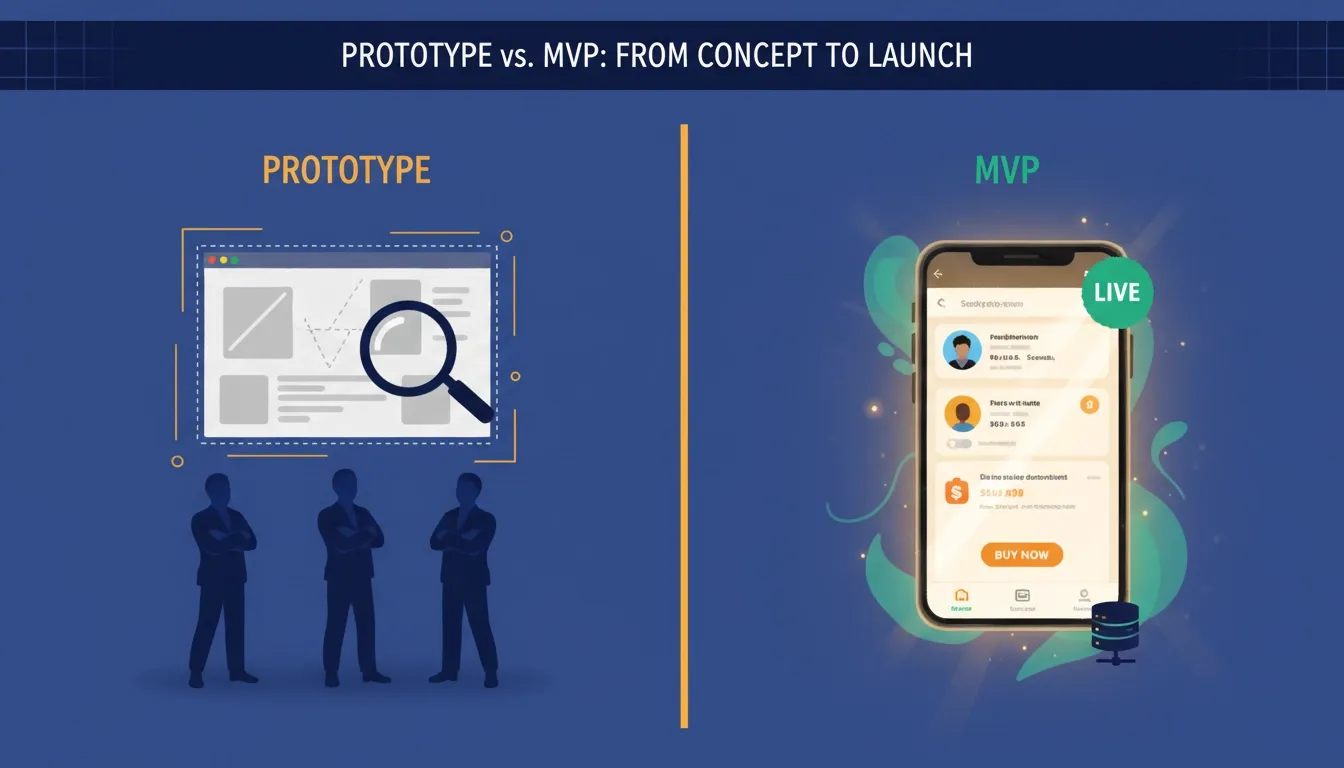
Here's the short answer: a prototype shows what your idea could look like. A minimum viable product is a working product that real users can actually use. That distinction matters more than most people realize.
Here's a number to put it in perspective: 34% of startups that fail do so because they never found a real product-market fit. Not because their idea was bad. Because they kept planning and prototyping without ever putting something real in front of real users.
Prototype vs MVP: What's the Real Difference?
A lot of founders use these terms interchangeably, and it's easy to see why. But they serve completely different goals, cost very different amounts, and belong at different stages of your project.
| Dimension | Prototype | MVP |
|---|---|---|
| Purpose | Validate concept and UX design | Validate market fit and willingness to pay |
| Audience | Internal team, investors, stakeholders | Real users in the market |
| Backend | Often not needed | Required and functional |
| Database | Usually mocked or skipped | Real, structured, and live |
| Code quality | Quick and disposable | Production-ready |
| Typical lead time | Days to one to two weeks | Two to eight weeks (or this weekend with AI tools) |
| Success metric | Does this feel right? | Do people use it and come back? |
The table makes the difference clear on paper, but the real trap is not in the definition. It's in the decision about which one to build and when.
What a Working Prototype Is (and Is Not)
A prototype is a model that simulates how your product will work. Think Figma screens, a click-through demo, or a working front end with no real backend behind it.
-
It is designed for internal testing, investor demos, or user research
-
Nobody is relying on it, paying for it, or coming back to it in a real context
-
Prototypes answer concept questions: does this flow make sense to someone who isn't me?
-
They help you figure out whether the idea resonates with the people you want to serve
-
They let you communicate the concept clearly before committing to any new code
A prototype is a communication tool, not a product. Its job is to help you figure out what to build, not to be the thing you actually build.
What a Minimum Viable Product Is
A minimum viable product is a working, deployable product stripped down to only the core features needed to deliver real value to real users.
-
Real users can sign up, use it, and ideally pay for it
-
You're not simulating the experience; you're delivering it
-
MVPs answer completely different questions than prototypes do
-
Will real users actually use this? Are they willing to pay? What do they ask for after using it for a week?
-
The user feedback you get from a live MVP is built on real behavior, not assumptions from a demo
An MVP is your first real conversation with the market, not a pitch, not a simulation, but an actual product in real hands generating real data.
Which One Should You Build First?
This depends entirely on where you are in your process and what you're actually trying to learn right now.
-
Build a prototype first if you need to validate a complex user flow before committing to a technology stack
-
Build a prototype first if you're pitching investors who want to see the concept before you spend on development
-
Build a prototype first if the design decisions are genuinely uncertain and need user input before the build begins
-
Skip straight to the MVP if your idea is clear enough to describe in one sentence
-
Skip straight to the MVP if you have access to an AI app builder that can generate a working app in hours
-
Skip straight to the MVP if what you need is real user behavior data, not design opinions from a demo
-
Non-technical founders with a focused, clear idea usually get more value from shipping a real MVP fast than from spending weeks on Figma screens
The prototype phase only adds genuine value when you have specific decisions to test before building. If you know what to build, build it.
Why Non-Technical Founders Keep Getting Stuck
MVP development has traditionally sat outside the reach of founders who can't write code, and that gap has pushed a lot of good ideas into either prototype limbo or expensive development contracts.
-
Building a full-stack app with a working backend, database, and front end used to take weeks and cost anywhere from $8,000 to $25,000 for even a simple build
-
Without a technical co-founder or development budget, most non-technical founders get stuck in prototype mode, showing click-through demos but never shipping real software
-
The cost of staying in prototype mode: you collect design opinions instead of product data, you never find out if people will actually pay, and the market moves on while you're still polishing screens
"Trying to build my MVP and realized I can't code to save my life. Curious where fellow non-tech founders found their first dev. Did you team up with a friend, hire an agency, or used ChatGPT to do it yourself?" - u/FurTechGenius, r/startups, June 2025
-
The top reply was direct: "Start building MVP from NO Code Platforms like Lovable, Replit etc., you don't need a tech founder."
-
That sentiment matches what the data shows: by 2026, 65% of all application development activity will use no-code or low-code platforms
-
What used to require a development team and a four-figure budget can now be done in a weekend with the right platform
 The tools have caught up with the problem. Non-technical founders now have a real path to a working MVP without a six-figure development budget or a technical co-founder on the team.
What Actually Belongs in Your MVP: Core Features Only
The hardest part of MVP development is not the building. It's the editing. Most founders try to include too many features and end up spending months instead of a weekend.
-
Every MVP needs exactly one core problem it solves, not five related problems, just one
-
Include only the minimum core features needed to deliver that solution, nothing decorative, nothing aspirational
-
Build a real way for users to interact with the product and give you user feedback
-
Run every feature through a simple test: can a real user solve the core problem without this feature? If yes, cut it. If it's a genuine blocker to using the product at all, keep it. Everything else waits for V2.
-
The discipline to cut is what separates teams who ship from teams who are still in planning twelve weeks later
Here's a decision flow to run every potential feature through before it makes the build list:
Every feature you cut from V1 is a feature you can add in V2, based on what real users actually asked for, not what you assumed they'd want.
The Weekend MVP Plan: A Practical Structure for Fast Iteration
A weekend is 48 hours, and that's enough time to ship a working MVP if you have the right tool and keep the scope tight.
-
Friday evening (two to three hours) — Define and decide: Write the single problem your MVP solves in one sentence. List no more than three core features for V1. Write a short paragraph describing the app as if you're explaining it to a friend.
-
Saturday (five to six hours) — Build: Use an AI app builder to generate your full-stack app. Iterate through chat to fix flows, adjust screens, and add your branding. Get the database, backend, and front end working and connected.
-
Sunday (three to four hours) — Test and launch: Share with ten to fifteen people who represent your target market. Collect their first round of real user feedback. Fix the genuine blockers. Skip the nice-to-haves. Hit publish.
-
The one rule that makes this work: if a feature wasn't in your original three-item list, it does not get added this weekend. It goes on V2.
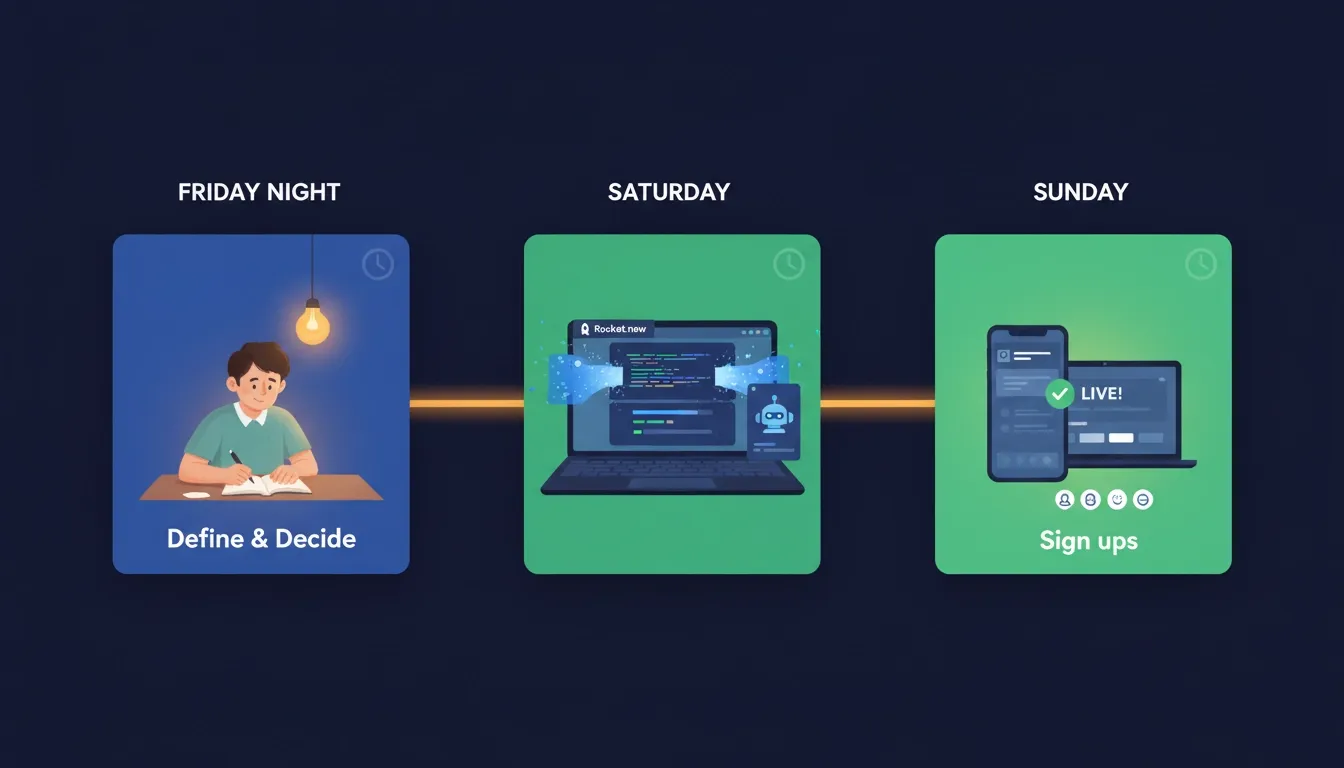 Teams that commit to a real ship date consistently move faster and learn more than teams who plan indefinitely. A working app in your users' hands on Sunday beats a perfect prototype that ships three months from now.
Launch Your MVP This Weekend with Rocket.new
Most tools start at the build. Rocket.new starts at the decision, and what gets built from that foundation is already grounded in real thinking, not just a fast response to a prompt.
-
Over 1.5 million people across 180 countries have tried Rocket, from solo founders validating ideas to enterprise teams running strategy and execution on the same platform
-
Non-technical founders and product managers get a system that thinks with them, not just a code generator waiting for instructions
-
The platform covers what other tools leave entirely to you: pre-build intelligence, shared memory that compounds across tasks, and production-ready code without a development team
From Idea to Working App in Minutes
The build process on Rocket.new is designed to get a non-technical founder from a plain-language description to a live, working app without touching a config file or writing a line of code.
-
Describe your idea in plain language: Type something like "Build a SaaS dashboard for freelancers to track client projects and invoices," no technical knowledge required
-
Rocket auto-assigns the technology stack: Next.js for web apps, Flutter for mobile apps, no tech stack decisions fall on you
-
Production-ready code in one to three minutes: What comes back is not a mockup or a prototype. It is a fully functional app with UI, navigation, logic, and production-ready Next.js or Flutter code
-
Refine through conversation: After the first generation, change the data model, adjust screens, add features, all in context, without re-explaining what you already built
-
Launch with one click: Web apps get a live staging URL instantly; mobile apps can be shared via a web preview link, downloaded as an APK for Android testing, or submitted directly to the Apple App Store and Google Play
Most tools start at the build and leave the thinking to you. Rocket.new starts at the decision, which means the first version of your app reflects genuine product thinking, not just a fast response to a one-line prompt.
What Rocket.new Can Build for Your MVP
Rocket.new covers the full range of product types a startup or non-technical founder would need to ship as an MVP.
| Build Type | What You Get |
|---|---|
| Web apps | SaaS platforms, dashboards, internal tools, customer portals, AI-powered apps |
| Mobile apps | iOS and Android from a single Flutter codebase, one build, two stores |
| Landing pages | Conversion-focused landing pages with SEO structure and fast load times |
| E-commerce | Product catalogs, checkout flows, payment connections |
| Internal tools | OKR trackers, client portals, onboarding systems, compliance dashboards |
Whatever your MVP is, the platform generates it as a working, deployable product, not a wireframe, not a mockup.
The Features That Matter Most for MVP Development
For a non-technical founder trying to ship a real product this weekend, the gap is never just code speed. Rocket.new covers the parts other builders leave entirely to you.
-
Solve — Think Before You Build: Rocket.new starts at the thinking, not the code. The Solve feature takes any business question and produces a structured analysis, market sizing, competitive context, product direction, before you commit to building anything. For non-technical founders unsure of what to build first, this changes the planning process.
-
Context — Memory That Carries Forward: Every decision you make in Rocket.new compounds. Research from Solve feeds into your Build. Intelligence signals inform your next iteration. Nothing needs to be re-explained across tasks. Each task makes the next one smarter.
-
No developer needed to wire up your services: Stripe, Supabase, Google Analytics, Mailchimp, Mixpanel, Linear, Notion, all authenticate once and flow into every build automatically. Your MVP ships with its integrations connected from day one, not added later by someone who knows how to configure APIs.
-
Staging and Production Environments: Separate environments, full version history, and one-click rollback come standard. When something breaks at 11pm Saturday night, you roll back, fix it, and push again, no work lost.
-
Built-in Analytics from Launch Day: Rocket tracks visitors, conversions, accessibility, and Core Web Vitals automatically after go-live. Real performance data from day one, with zero extra setup.
These aren't optional add-ons. They're part of every build. Non-technical founders get the same platform infrastructure that a fully staffed development team would normally spend weeks setting up manually.
How Rocket.new Compares to Other AI Builders Using AI Agents and Technology Stack
Lovable, Bolt, and v0 are capable tools for getting a front end generated quickly from a prompt, but they share structural gaps that matter a lot for early-stage founders trying to ship something real.
-
No pre-build intelligence: These tools build what you tell them to build. They have no opinion on whether what you're building is worth building. All the market research, competitive context, and strategic direction still has to come from you, somewhere else.
-
No shared memory architecture: Every session starts fresh. Coordination between tasks and decisions happens outside the tool, which adds friction and means context gets lost between iterations.
-
You manage the platform: API keys, backend configuration, error handling, and performance at scale are the user's responsibility, creating real blockers for non-technical founders at exactly the wrong moment.
-
No redesign capability: Lovable, Bolt, and v0 generate from scratch. They can't read an existing site, understand what's working, and selectively improve it. Rocket.new's Redesign feature handles this with eight slash commands across three categories.
They build what you tell them to build. Rocket.new figures out what's worth building, then builds it. For founders who want to ship their MVP this weekend and learn from real users, that difference shapes the outcome.
Ship Your MVP vs Prototype This Weekend
The problem is rarely that founders don't know how to build. It's the gap between idea and shipped product. For most non-technical founders, that gap gets filled with planning, second-guessing, and switching between tools that don't talk to each other.
MVP development used to mean hiring a development team, waiting weeks, and spending thousands. Platforms like Rocket.new have changed that reality for builders, startups, and product managers who want to move fast and stay lean. A non-technical founder can now ship a working, production-ready app this weekend, without writing a single line of code, without managing complex systems, and without a budget that belongs to a different stage of growth.
Pick the right problem to solve first. Keep the scope small. Use a tool that does the thinking with you. Get real users in front of your app as fast as possible. The user feedback you collect from a live MVP in two days is worth more than six months of prototyping.
Table of contents
- -Prototype vs MVP: What's the Real Difference?
- -What a Working Prototype Is (and Is Not)
- -What a Minimum Viable Product Is
- -Which One Should You Build First?
- -Why Non-Technical Founders Keep Getting Stuck
- -What Actually Belongs in Your MVP: Core Features Only
- -The Weekend MVP Plan: A Practical Structure for Fast Iteration
- -Launch Your MVP This Weekend with Rocket.new
- -From Idea to Working App in Minutes
- -What Rocket.new Can Build for Your MVP
- -The Features That Matter Most for MVP Development
- -How Rocket.new Compares to Other AI Builders Using AI Agents and Technology Stack
- -Ship Your MVP vs Prototype This Weekend