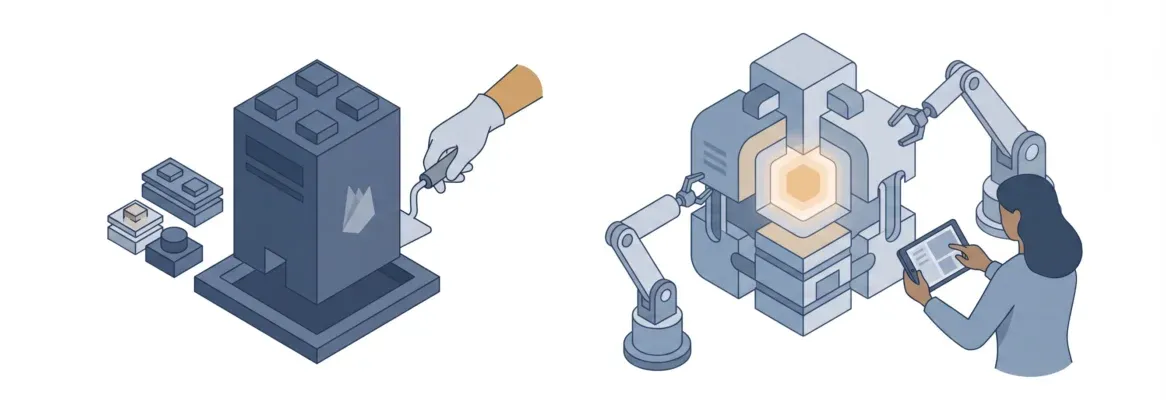
Choosing between Rocket.new and Rork AI isn’t about which tool is better, it’s about what you’re building. If you need a full product with backend, web, and mobile ready to ship, Rocket.new gets you there faster. If your focus is purely native mobile apps with advanced iOS features, Rork AI fits better. For most founders, Rocket.new turns ideas into real, working products, not just prototypes.
Are you a founder staring at two AI tools, wondering which one actually gets you from idea to shipped product faster? If you're weighing Rocket.new against Rork AI, the answer comes down to this: what you're building matters more than which tool sounds cooler.
Rocket.new is a full-stack, web-and-mobile AI app builder that has crossed 400,000 users across 180 countries and hit $4.5M ARR within three months of beta launch. Rork AI is a focused mobile-native builder that hit $550,000 ARR within two months of going viral. Both are real, both are growing, and both serve different purposes. So let's get into the details.
What is Vibe Coding and Why Does it Matter?
-
Vibe coding is a shift in how apps get built. Instead of writing code line by line, you describe what you want in plain language and the AI does the rest.
-
The concept lowers the barrier for founders, designers, and small business owners who have a clear product idea but no formal coding background.
-
It treats app creation more like a conversation and less like a syntax exercise.
-
Vibe coding is no longer a fringe experiment. It's quickly becoming the expected default for early-stage product work.
So when someone says "I built this in a weekend," vibe coding is usually how that happened.
The Key Question: What are You Actually Building?
Before comparing tools, get clear on your output. This is the key question that shapes everything else.
-
Building a website, SaaS dashboard, or internal tool? You likely want a full-stack platform.
-
Building a native iOS or Android app for the App Store? A mobile-first builder fits better.
-
Prototyping across both web and mobile? That's where Rocket.new stands out clearly.
Both platforms use natural language as the input. Both produce working apps fast. The difference is in how far that output goes before you hit a wall.
Rocket.new: The Vibe Solutioning Platform Built for Serious Builders
Rocket.new is a vibe solutioning platform, not just a vibe coding tool. That phrasing is intentional. The goal isn't just code generation. It's production-ready applications you can actually ship.
What Makes Rocket.new Stand Out
-
Backed by serious money: Rocket.new raised a $15M seed round from Salesforce Ventures and Accel in September 2025.
-
Full-stack output: The platform handles frontend, backend logic, database schemas, and deployment from a single prompt.
-
Figma-to-code: Import Figma files and turn them into live, editable layouts.
-
Native mobile apps: Generates Flutter apps alongside Next.js web apps.
-
Supabase backend: Built-in backend integration with Supabase covers user authentication, data storage, and API connections out of the box.
-
One-click deployment: Deploys to Netlify with custom domain support.
-
Generated code you own: Export the generated code anytime with no proprietary dependencies.
-
Precision Mode: 100+ structured commands for developers who want granular control.
-
Curated templates: Pre-configured curated templates for SaaS apps, dashboards, e-commerce, fintech, and more.
-
SEO built in: Landing pages come with built-in SEO optimization.
About 80% of Rocket.new's users have been building what co-founder Vishal Virani calls "serious applications," ranging from fintech tools to B2B platforms, not just quick landing pages.
How Rocket.new Connects to the Founder's Real Problem
Founders don't just need a prototype. They need something that works when a real user opens it. That's the gap Rocket.new was built to fill.
When you type a prompt and press enter, Rocket.new doesn't just generate a wireframe or a basic screen. It produces a working application with backend automation already configured. You don't need to wire up user authentication separately. You don't need to set up database schemas on a different platform. The platform handles the heavy lifting across the entire stack.
This matters for startup teams who need to move from idea to MVP in days, not months.
Use Cases Where Rocket.new Shines
-
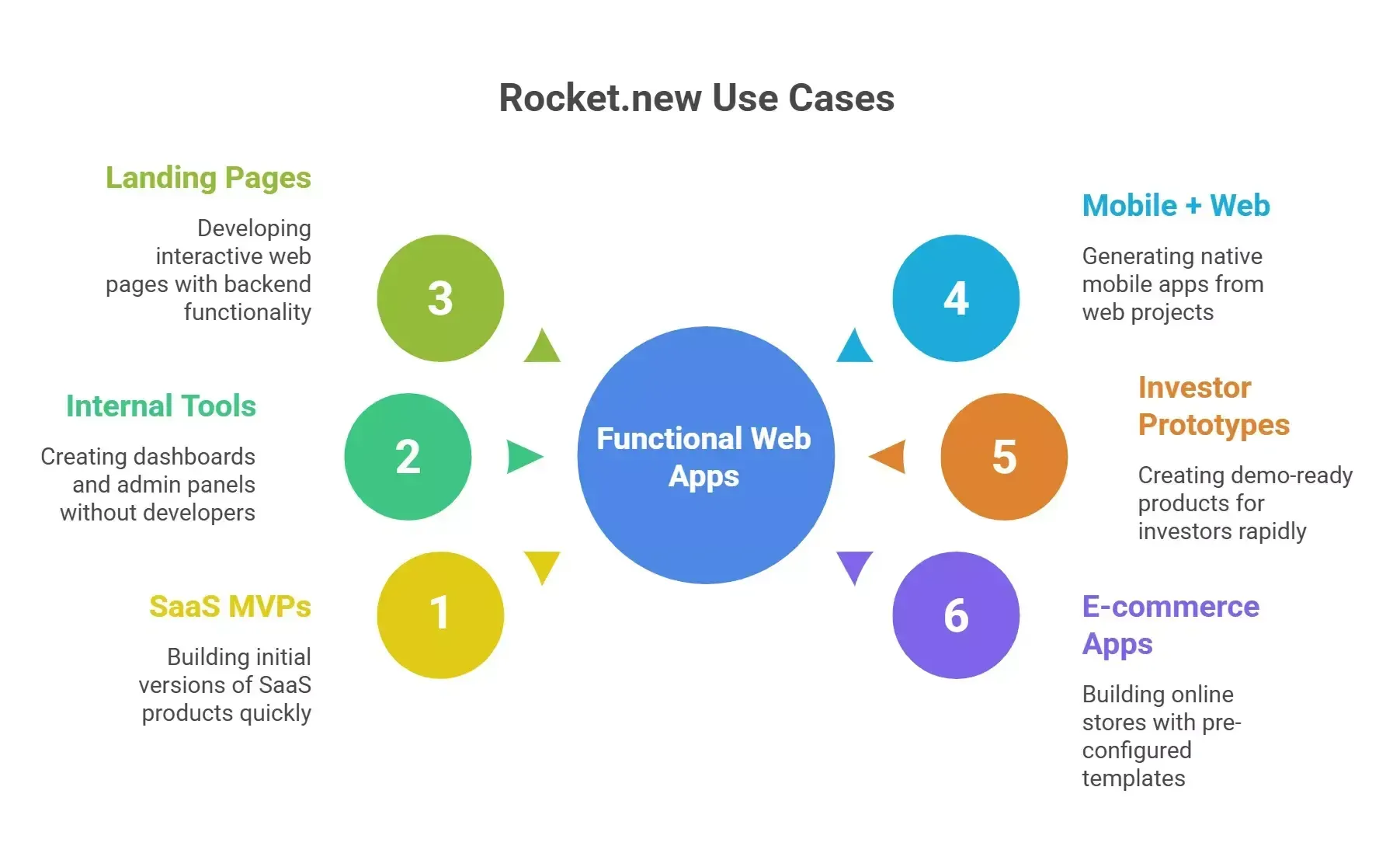
SaaS MVPs: Teams describe their product vision in natural language commands and get a functional web app with backend logic in one session.
-
Internal tools: Build dashboards, CRMs, and admin panels without hiring a developer.
-
Landing pages with actual backends: Not just static pages. Full working apps with forms, databases, and workflows.
-
Mobile + web together: Build a website on Rocket.new and also generate a native mobile app that shares the same Supabase backend.
-
Rapid prototyping for investors: Get from a single prompt to a demo-ready product without spending an entire day configuring infrastructure.
-
E-commerce apps: Pre-configured templates with product catalogs, cart logic, and payment integration.
What is Rork AI?
Rork AI is a mobile-first platform that uses artificial intelligence to generate native React Native apps from text prompts. It was built by Levan Kvirkvelia and Daniel Dhawan, who went from near bankruptcy to raising $2.8M from a16z after a single tweet went viral.
What Rork AI Does Well
-
React Native output: Produces genuine React Native code, not web wrappers. Apps feel native on both iOS and Android.
-
QR code preview: Scan a QR code and test your AI app on a real device in under 15 minutes.
-
Rork Max: A premium tier at $200/month for building advanced native Apple ecosystem apps, including SwiftUI apps, 3D widgets, and Vision Pro experiences.
-
Advanced iOS features: Supports AR/LiDAR, HealthKit, and Siri Intents through Rork Max.
-
Expo integration: Uses Expo EAS for streamlined App Store and Play Store deployment.
-
Curated templates: Social apps, tracking apps, gaming apps, and more.
-
GPT-5 powered: Uses GPT-5 to translate prompts into functional React Native code.
Feature Comparison: Rocket.new vs. Rork AI
Here's a direct look at how these two platforms stack up side by side.
| Feature | Rocket.new | Rork AI |
|---|---|---|
| Primary Focus | Full-stack web + mobile apps | Native mobile apps (iOS/Android) |
| Output Technology | Next.js, Flutter | React Native (Expo) |
| Backend Logic | Built-in, automated | Limited for complex needs |
| User Authentication | Native Supabase integration | Basic, via third-party APIs |
| Database Schemas | Auto-generated with Supabase | Limited |
| Landing Pages | Yes, with SEO support | Not the focus |
| Internal Tools | Dashboards, CRMs, admin panels | Limited |
| Mobile Apps | Flutter native mobile apps | React Native apps |
| Figma Import | Yes | No |
| Code Export | Full ownership, no lock-in | React Native code export |
| Free Plan | 1M token free plan | No free plan |
| Paid Plans | Starts at $25/month | Starts at $20/month (100 messages) |
| Rork Max Tier | N/A | $200/month for SwiftUI/Apple native |
| Deployment | One-click Netlify + custom domain | Expo EAS for App Store |
| Version Control | Available | Not native |
| Vibe Coding Style | Vibe solutioning platform for Mobile and Web | Vibe coding for mobile |
The Pricing Reality
Money matters when you're early-stage. Here's what you're actually looking at.
Rocket.new Pricing
-
Free plan: 1 million tokens to test the platform. That's enough to build a few small features and understand the workflow.
-
Starter/Personal: Paid plans starting at $25/month for 5 million tokens.
-
Rocket/Booster: Higher tiers for agencies, technical founders, and teams building complex, multi-screen applications with ongoing iteration.
-
Pricing is token-based, tied to project complexity rather than per-action.
Rork AI Pricing
-
No free plan: No free tier available, which makes initial testing a paid commitment.
-
Base plan: Starts at $20/month for 100 messages.
-
Rork Max: $200/month for high-end Swift and native Apple ecosystem apps. No free trial.
The honest take: Rocket.new's free plan gives you real room to test before spending anything. Rork's pricing model starts at cost from day one.
Steep Learning Curve? Let's Be Real.
Neither tool has a steep learning curve for basic use. But there are differences worth knowing.
-
Rocket.new has Precision Mode with 100+ structured commands, which can feel like a lot if you're new. The platform's token system also requires some understanding before you build complex apps.
-
Rork AI keeps the interface simple for generation, but deploying to the App Store is not one-click for serious apps. You'll need Apple Developer accounts, app signing, and certificates.
So the real steep learning curve for Rork shows up at deployment, not creation.
The Full-Stack Advantage
This is where Rocket.new separates itself clearly from Rork. Rork is a mobile code generator. Rocket.new is a full-stack app development platform.
When you build with Rocket.new:
-
You describe your app using natural language.
-
The platform sets up your frontend automatically.
-
Backend automation handles data flows and workflows.
-
Database schemas get created with no input from you.
-
User authentication is wired in.
-
You press Enter one more time and hit deployment.
That full-stack coverage means founders can build working applications without ever switching tools. You stay in one place from idea to shipped product.
Who Should Use Rocket.new?
-
Non-technical founders who want production-ready apps without writing code
-
Small business owners building customer-facing tools or booking systems
-
Teams building SaaS dashboards, admin panels, or landing pages with real backend logic
-
Startups doing rapid prototyping before raising a round
-
Builders who need both web and mobile apps from a single prompt
Who Should Use Rork AI?
-
Founders who specifically need App Store native apps as their primary deliverable
-
Teams building advanced iOS features: AR, HealthKit, Siri Intents via Rork Max
-
Indie makers building simple mobile utilities, games, or habit trackers
-
Developers who want a React Native head start they'll refine locally
Rocket.new for Landing Pages, Internal Tools, and Backend Automation
Landing pages: Rocket.new generates landing pages with built-in SEO, custom domains, and full backend support. Users describe the page using natural language commands and get a live, deployable web page, not a static HTML file.
Internal tools: Dashboards, CRM panels, and admin tools for managing user roles and sensitive data. All backed by Supabase's built-in security.
Backend automation: Set up recurring workflows without writing a single line of code. Backend automation runs in the background so builders stay focused on product decisions, not infrastructure.
The Artificial Intelligence Behind Both Platforms
Both tools use artificial intelligence, but approach it differently.
-
Rocket.new combines Anthropic, OpenAI, and Google Gemini models with its own deep learning systems trained on proprietary DhiWise datasets. Each part of the stack: frontend, backend, and database gets handled by the model best suited for it.
-
Rork AI uses GPT-5 to translate natural language prompts into React Native code. The focus is narrow and mobile-specific.
Version Control and Long-Term Scalability
-
Rocket.new supports version control through code export and GitHub-compatible workflows.
-
Rork AI allows React Native code export, but persistent version control isn't native to the platform.
As apps grow in complexity, many teams find that Rork doesn't support the scalability needed for multi-platform production growth. Rocket.new was built for production-ready output from day one.
The vibe coding shift is also cultural. Speed of validation is now a competitive edge. Founders who can test an idea in a day outpace those waiting months for a developer hire. Rocket.new's vibe solutioning approach covers the full build cycle, not just a single output.
Community Momentum: Rocket.New is growing fast
The numbers speak here. Since beta launch:
-
Over 400,000 users across 180 countries.
-
Over 10,000 paid subscribers.
-
$4.5M ARR within three months of launch.
-
$15M seed round from Salesforce Ventures and Accel.
-
US leads revenue at 26%, followed by Europe at 15–20%.
That community momentum is hard to ignore. These aren't vanity metrics. They reflect real builders who are shipping real products.
So, Should Founders Use Rocket.new Instead of Rork AI?
Here's the direct answer: yes, for most founders, should founders use Rocket.new instead of Rork AI comes down to a clear yes, with one specific exception.
If your entire product strategy centers on a native iOS app with advanced Apple ecosystem features like 3D Widgets, Vision Pro, or deep HealthKit integration, Rork Max earns serious consideration.
For everything else, SaaS tools, dashboards, landing pages, internal tools, mobile apps, backend automation, e-commerce, or multi-platform products, Rocket.new covers more ground, produces more complete output, and gives you a free plan to start with zero risk.
The vibe solutioning approach at Rocket.new treats your idea as the beginning of a full product, not just a mobile prototype. That's a meaningful difference when you're building something real.
Table of contents
- -What is Vibe Coding and Why Does it Matter?
- -The Key Question: What are You Actually Building?
- -Rocket.new: The Vibe Solutioning Platform Built for Serious Builders
- -What Makes Rocket.new Stand Out
- -How Rocket.new Connects to the Founder's Real Problem
- -Use Cases Where Rocket.new Shines
- -What is Rork AI?
- -What Rork AI Does Well
- -Feature Comparison: Rocket.new vs. Rork AI
- -The Pricing Reality
- -Rocket.new Pricing
- -Rork AI Pricing
- -Steep Learning Curve? Let's Be Real.
- -The Full-Stack Advantage
- -Who Should Use Rocket.new?
- -Who Should Use Rork AI?
- -Rocket.new for Landing Pages, Internal Tools, and Backend Automation
- -The Artificial Intelligence Behind Both Platforms
- -Version Control and Long-Term Scalability
- -Community Momentum: Rocket.New is growing fast
- -So, Should Founders Use Rocket.new Instead of Rork AI?