
Validating a business idea on Rocket means using the Solve feature to confirm real market demand, map competitors, and test your value proposition before writing any code. This blog covers the complete step-by-step process, from describing your idea to reading the first user signals, so you build only what the market actually needs.
Can you really validate a business idea without writing a single line of code?
Yes. Many smart entrepreneurs now test demand, collect feedback, and talk to real users before they build anything. They don't rush into writing code or creating full apps. They focus on understanding the market first.
According to a CB Insights analysis of 431 VC-backed startups that shut down since 2023, 43% cited poor product-market fit as a primary cause of failure. That clearly shows one thing. Validation comes before building. Not after.
If your business idea doesn't connect with potential customers, no amount of code will fix it. In this blog, we walk through a practical process to validate your idea using Rocket, step by step.
Why Most People Fail Before They Even Start?
It usually begins with excitement. You have a business idea, and it feels strong. So you jump straight into building an app, thinking the idea alone will work. You open an app builder, start writing code, and spend weeks or even months creating something.
Then reality hits.
- No users
- No customers
- No demand
The issue is not the app itself. It's the lack of validation. The idea was never tested in the real market, there was no real data to support it, feedback from real users was missing, and there was no proof that people would actually pay.
A business idea needs to be tested before you build anything. You need to understand the market, talk to users, and collect honest feedback. Keep it simple. Don't rush into writing code. Validate first, then build with confidence.
What Validation Really Means?
Validation is not guessing. It's not asking your friends if your idea sounds cool.
It's about:
- Talking to real users
- Understanding the market
- Checking if people will pay money
- Collecting honest feedback
You are trying to determine one thing: does this idea solve a real problem? If the answer is yes, you move forward. If not, you adjust. That's how strong businesses are built.
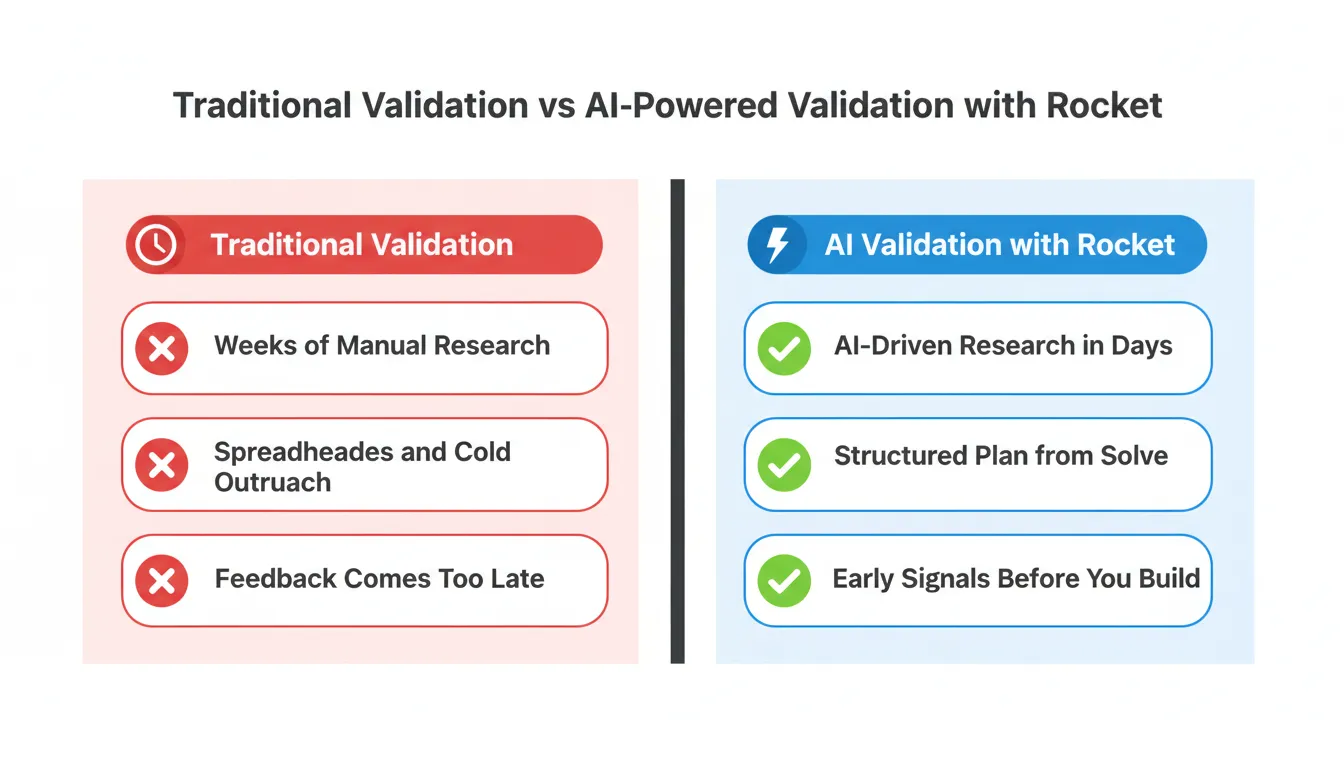
Traditional Validation vs. AI-Powered Validation
Here's how things used to work versus how they work now with Rocket:
| Step | Traditional Process | AI-Based Process with Rocket |
|---|---|---|
| Idea validation | Weeks of manual research and interviews | AI-driven research in days |
| Building | Writing code manually | Using an AI app builder |
| Testing | After launch | Before launch |
| Feedback | Late stage, after build | Early users, before build |
| Cost | High | Low |
The difference is clear. You don't need to spend months building web apps or mobile apps without knowing if they make sense.
What Is Rocket and Why It Starts Before the Build
Rocket is the world's first Vibe Solutioning platform. Vibe Solutioning is the practice of thinking rigorously before building, and building from that thinking, all in one platform. Research. Decide. Build. Operate. Grow. One system.
Most AI tools help you build faster. None of them tell you what to build. That is the problem Rocket was built to solve. Where other builders hand you a blank prompt and say "tell me what to build," Rocket starts by helping you figure out what is worth building, through a feature called Solve.
1.5 million people have tried Rocket across 180 countries. Founders, product teams, and operators use it to go from a rough idea to a validated, deployed product without the wasted cycles that kill most early-stage projects.
![Traditional validation vs AI-powered validation with Rocket]
Where Rocket Comes In With Solve
Solve is Rocket's AI-powered research and strategy layer. It takes a rough business idea and transforms it into a structured, evidence-backed plan you can test before building anything.
What Solve Does
- Breaks down your idea into its core problem, solution, and target user
- Analyzes market demand and identifies whether the problem is real and widespread
- Surfaces competitive landscape insights, including who else is solving this problem and how
- Generates a structured plan with suggested features, a business model, and a go-to-market hypothesis
- Helps create validation assets like landing pages and messaging frameworks
- Guides the validation process step by step, from idea to first signal
Instead of starting with code, you start with thinking, clarity, and direction. Solve acts like a guide. It helps you move from a rough idea to something real that you can test with users.
How to Validate a Business Idea on Rocket: Step-by-Step
This is the full validation workflow. Follow these steps in order. Do not move to building until Step 6 gives you a clear signal.
![6-step business idea validation workflow on Rocket]
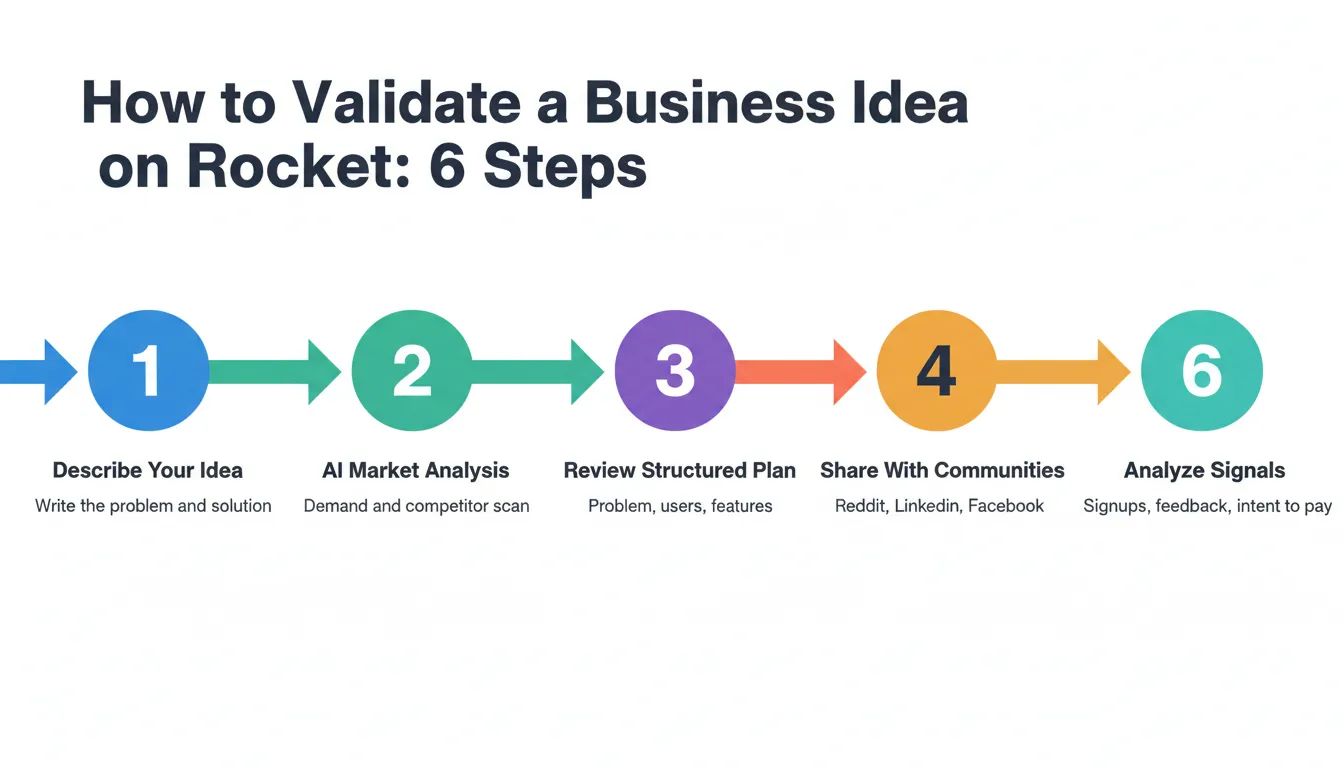
Step 1: Describe Your Idea Open Solve and write your business idea in plain language. Focus on the problem, the target user, and your proposed solution. The more specific your input, the more actionable Solve's output will be.
Step 2: AI Analyzes Market and Demand Solve processes your idea against real market data. It looks at demand patterns, existing solutions, user behavior signals, and market size indicators to assess whether your specific idea has a viable market.
Step 3: Review Your Structured Plan Solve returns a structured output including a problem statement, target user profile, competitive landscape overview, suggested MVP feature set, and a preliminary business model. Review it critically. Look for assumptions that need testing.
Step 4: Create a Validation Landing Page Use Rocket's build tools to create a simple landing page that presents your solution. State the problem clearly, describe your solution in one or two sentences, and include a call to action such as an email signup or waitlist. You are not building the product. You are testing whether people care enough to act.
Step 5: Share and Collect Feedback Post your landing page in the communities where your target users spend time. Reddit communities relevant to your niche, Facebook groups focused on your target user's problem, LinkedIn posts directed at the right professional audience, and niche forums all work well. Ask specific questions, not just "what do you think?"
Step 6: Analyze Data Track visit-to-signup conversion rates, quality of comments, how many people say "I have this exact problem," and how many ask about pricing or availability. A strong validation signal is people taking action, not just saying the idea sounds interesting.
That's your validation process. You're not guessing anymore. You're making decisions based on real data and feedback.
Use Cases: What Validation Looks Like in Practice
SaaS Founder Validating a Productivity Tool
A solo founder had an idea for a task management tool for freelancers. Instead of building, she used Solve to analyze the market. Solve surfaced a specific gap: no tool integrated client billing natively. She built a landing page focused on that angle, posted it in three freelancer Facebook groups, and collected 47 email signups in 72 hours. That signal justified building an MVP.
Agency Validating a New Service Offering
A digital marketing agency wanted to launch an AI content audit service. Solve's competitive teardown revealed three competitors already offering similar services at lower price points. Rather than abandoning the idea, Solve helped them identify a differentiation angle: compliance-focused audits for regulated industries. A targeted LinkedIn post to healthcare marketers generated 12 direct messages in one week.
Non-Technical Founder Testing a Marketplace Idea
A founder with no technical background had an idea for a local services marketplace. Using Solve, they generated a full market analysis, identified the top three existing players, and mapped gaps in service coverage for rural areas. They created a landing page in Rocket, shared it in local community Facebook groups, and used the feedback to refine their target geography before writing a single line of code.
Where to Find Early Users for Validation
You don't need thousands of users in the beginning. You just need the right ones who care about your idea.
Best Channels for Finding Early Validation Users
- Reddit — Find subreddits where your target user discusses their problems. Read threads before posting. Contribute genuinely before sharing your idea.
- Facebook Groups — Niche groups are often highly engaged. A post in a 5,000-member group of your exact target user is worth more than a post to 50,000 general followers.
- LinkedIn — Ideal for B2B validation. A targeted post or direct message campaign to people with the right job title can generate high-quality feedback quickly.
- Product Hunt Ship — Lets you create a "coming soon" page and collect waitlist signups before you build anything.
- Indie Hackers — A community of builders who will give you honest, direct feedback on your idea and your validation approach.
As shared on LinkedIn by a founder who validated cheaply before building: "Sketch a landing page with your proposed solution. No code yet... run a small ad test and see if anyone signs up. If not, pivot. Validating cheaply saves months of wasted work."
This is exactly the approach Rocket enables. Validate first. Build only when the signal is clear.
What to Focus On During Validation: The Five Key Signals
Validation is not random. You need to focus on a few key areas that actually tell you if your business idea makes sense in the market.
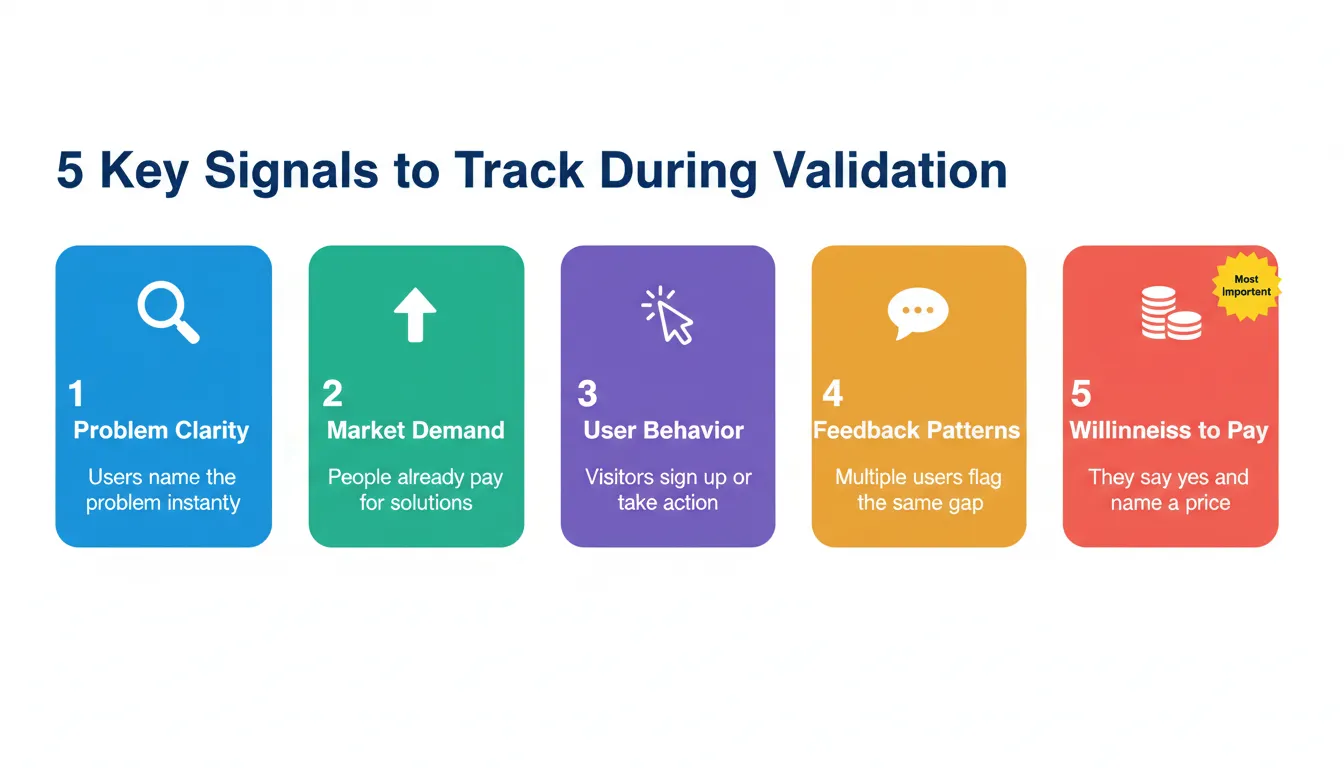
1. Problem Clarity
Can you describe the problem in one sentence and have your target user immediately say "yes, that is exactly what I deal with"? If you need to explain the problem at length, it may not be painful enough to build a business around.
2. Market Demand
Are there existing solutions people are already paying for? Existing competition is a positive signal. It confirms the problem is real and people are willing to spend money on it. The question is whether your solution is better, cheaper, or different in a way that matters.
3. User Behavior
Do people take action when they see your landing page? Clicks, signups, and direct messages are behavioral signals that matter far more than opinions. Someone saying "that sounds interesting" is not validation. Someone entering their email address is.
4. Feedback Patterns
Look for recurring themes in the feedback you receive. If five different people mention the same missing feature, that is a product direction signal. If three people ask about a use case you had not considered, that is a market expansion signal.
5. Willingness to Pay
This is the most important signal. Ask directly: "If this existed today, would you pay for it? How much?" People who say yes and give you a number are your earliest potential customers. People who say "maybe" are not yet validated buyers.
If people are ready to pay for your service, that's a strong signal. If they only like the idea but don't want to pay, that's a warning sign. Keep your focus tight during validation. The right signals will help you decide whether to move forward or improve your idea.
Common Validation Mistakes to Avoid
Even with the right tools, founders make predictable mistakes during validation. Here are the most common ones and how to avoid them.
Validating with friends and family. Friends and family will tell you your idea is great because they care about you. Validate with strangers who have the problem you are solving.
Treating survey responses as validation. Surveys tell you what people say they will do. Behavior tells you what they actually do. A landing page with a real call to action is always more reliable than a survey.
Building before validating. Every week you spend building before validating is a week you could have spent learning whether the idea is worth building at all.
Validating the solution instead of the problem. Many founders fall in love with their solution and try to validate it directly. Validate the problem first. If the problem is real and painful, solutions can be adjusted.
Stopping after one round of validation. A weak first signal does not mean the idea is dead. It means you need to refine your positioning, your target user, or your solution angle and test again.
According to the Startup Genome Project, startups that pivot one to two times have 3.6x better user growth and raise 2.5x more money than those that never pivot. Validation is the process that makes smart pivots possible.
How Validation Connects to Building on Rocket
One of the most underappreciated advantages of validating on Rocket is that the research context from Solve carries directly into the build phase. Most tools create a hard handoff between research and development, forcing you to re-explain your idea from scratch.
Rocket retains the context from your Solve session and uses it to inform how your app is built. The market analysis, user profile, competitive landscape, and feature direction all carry forward. The product you build is grounded in the same research that validated the idea. To understand how this research-to-build flow works in practice, see how Rocket's Solve feature differs from asking a standard AI question.
For founders who want to go deeper on market research before validation, the guide on doing market research and validating a business idea covers the full research workflow.
Validation Checklist: Are You Ready to Build?
Before moving from validation to building, confirm you can answer yes to all of the following:
- Problem can be described in one sentence and target users immediately recognize it
- At least three people who have this problem have been identified, none of them friends or family
- A landing page is live and has been shared in at least two relevant communities
- At least 20 meaningful responses have been received (signups, comments, or direct messages)
- At least five people have expressed willingness to pay
- Top two or three competitors have been identified and the differentiation is clear
- MVP feature set is based on feedback, not assumptions
- Target user can be described in one paragraph including their problem, their current workaround, and why it is not good enough
If you can check all eight boxes, you are ready to build. If you want to see what a validated idea looks like when it moves into production, this breakdown of what you can build on Rocket shows the full range of products founders ship after validation.
Solving the Right Problem First: The Rocket Approach
Most AI tools start after the hardest decision has already been made. Rocket starts before it. The most expensive mistake in any business is not bad execution. It is good execution of the wrong thing.
Rocket's Solve feature is built around this belief. It is not a chat tool. It is not a search engine. It is a structured intelligence layer that turns a rough idea into a decision-ready plan, grounded in real market data, before a single line of code is written.
Founders who use Solve before building get a clearer sense of who they are building for, what features actually matter, and where their idea sits relative to the competition. That clarity does not disappear when they move to the build phase. It compounds. Every decision in the build phase is made with the full context of the research that preceded it.
For a deeper look at how Rocket's intelligence layer connects market signals to product decisions, see how Rocket's validation loop works from market research to MVP. And if you are evaluating whether to build an MVP this weekend or spend more time validating first, the Rocket MVP playbook walks through the decision framework.
Validate First, Build With Confidence on Rocket
The founders who succeed are not the ones who build the fastest. They are the ones who learn the fastest and build only when the signal is clear. Validation is not a delay. It is the work that makes everything after it faster, cheaper, and more likely to succeed.
Rocket makes this shift practical for any founder, regardless of technical background or budget. Solve gives you a research analyst, a market strategist, and a competitive intelligence layer in one place. The build tools let you create validation assets in the same session. And the context from your research carries directly into development so nothing is lost when you are ready to build.
You have a business idea worth testing. The best time to validate it is before you write a single line of code. Start validating your idea on Rocket today and find out if the market is ready for what you want to build.
Table of contents
- -Why Most People Fail Before They Even Start?
- -What Validation Really Means?
- -Traditional Validation vs. AI-Powered Validation
- -What Is Rocket and Why It Starts Before the Build
- -Where Rocket Comes In With Solve
- -What Solve Does
- -How to Validate a Business Idea on Rocket: Step-by-Step
- -Use Cases: What Validation Looks Like in Practice
- -SaaS Founder Validating a Productivity Tool
- -Agency Validating a New Service Offering
- -Non-Technical Founder Testing a Marketplace Idea
- -Where to Find Early Users for Validation
- -Best Channels for Finding Early Validation Users
- -What to Focus On During Validation: The Five Key Signals
- -1. Problem Clarity
- -2. Market Demand
- -3. User Behavior
- -4. Feedback Patterns
- -5. Willingness to Pay
- -Common Validation Mistakes to Avoid
- -How Validation Connects to Building on Rocket
- -Validation Checklist: Are You Ready to Build?
- -Solving the Right Problem First: The Rocket Approach
- -Validate First, Build With Confidence on Rocket