*A proposition canvas maps what customers want against what a product or service delivers. Build the customer profile first by documenting customer jobs, pains, and gains, then design a value map with products and services, pain relievers, and gain creators that match. When the two sides align, you have a strong value proposition.
According to CB Insights' analysis of 431 shut-down startups, 43% cited poor product-market fit as a primary cause of failure, this framework helps you spot that risk before it compounds.
What Is the Value Proposition Canvas and How Does It Work?
What if the biggest threat to your product is not your competitors or your pricing, but a gap between what your team built and what customers actually care about? According to CB Insights' analysis of 431 shut-down startups, 43% cited poor product-market fit as a primary cause of failure.
A well-constructed value proposition canvas gives teams a structured way to test that gap before it becomes a crisis.
Alexander Osterwalder and Yves Pigneur developed the framework at Strategyzer as part of a larger strategic toolkit, distilling the relationship between a company's offering and its customer segment into six building blocks on a single canvas. This guide walks through every section, with a completed example and a free template at the end.
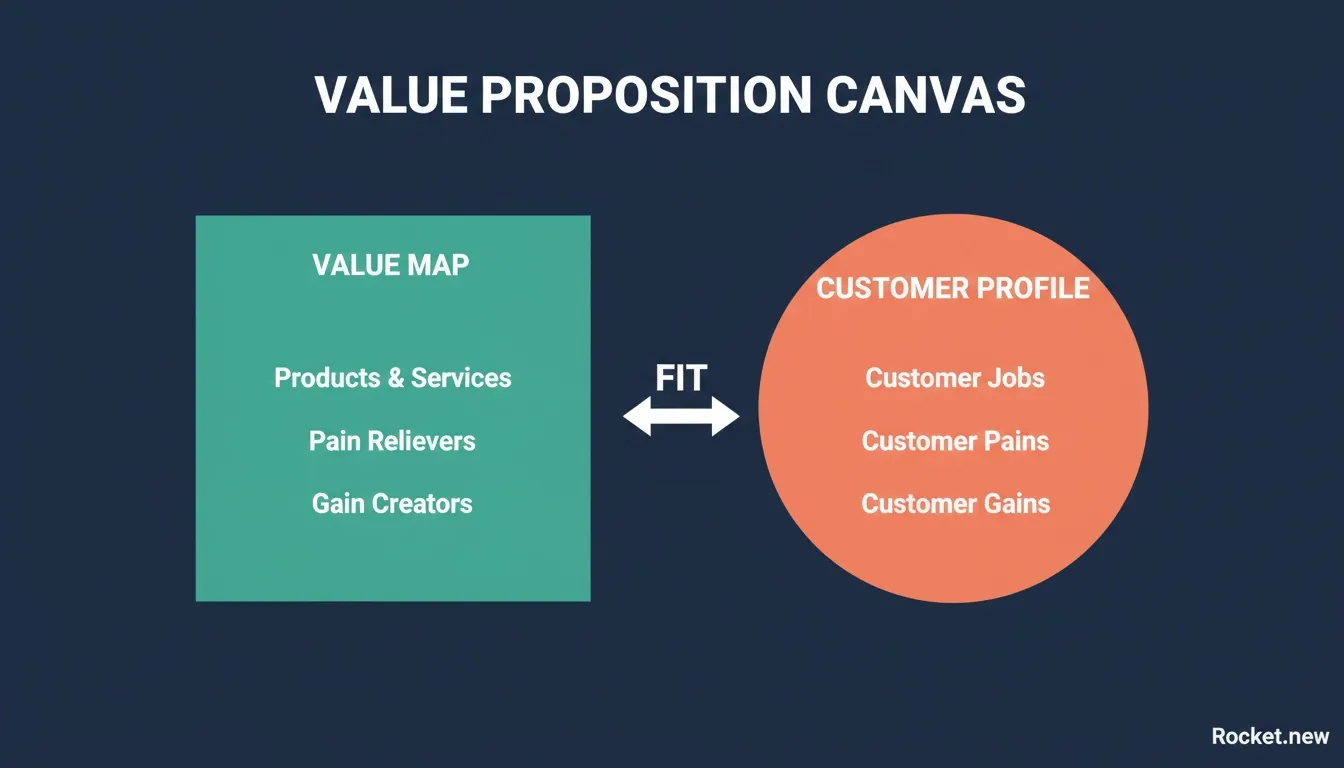 The value proposition canvas: value map (square) on the left maps directly to the customer profile (circle) on the right.
The value proposition canvas has six building blocks split across two halves: a square on the left for the value map, and a circle on the right for the customer profile. Each side answers a different question, and the real utility of the canvas shows up when both sides talk to each other.
| Component | Side | What It Captures |
|---|---|---|
| Customer jobs | Customer profile (circle) | Tasks, goals, and problems customers want to address |
| Customer pains | Customer profile (circle) | Negative experiences, risks, and obstacles that arise |
| Customer gains | Customer profile (circle) | Outcomes and benefits customers want |
| Products and services | Value map (square) | Everything the company offers |
| Pain relievers | Value map (square) | How specific offerings address top-ranked pains |
| Gain creators | Value map (square) | How specific offerings deliver top-ranked gains |
Teams that jump straight to building features without filling in the customer side end up with pain relievers and gain creators that address the wrong things entirely.
The Customer Profile: Jobs, Pains, and Gains
The customer profile holds three distinct categories, and each one deserves real attention before you touch the value map side.
Customer jobs describe the tasks, problems, and goals a customer segment is trying to address. These split into functional jobs (practical tasks, like tracking monthly expenses or managing a team schedule), social jobs (how customers want others to perceive them), and emotional jobs (how they want to feel). The jobs-to-be-done framing is deliberate here: focus on what customers are trying to accomplish, not just on demographics.
Customer pains cover the negative experiences, obstacles, and risks that come with trying to get those jobs done today. Pains range from frustrations about cost and time to fears about outcomes, to barriers that stop customers from even attempting the job. Writing these out explicitly tends to surface customer needs that a product team would never spot from the inside looking out.
Customer gains describe the outcomes and benefits customers want, not just the absence of pain. Some gains are expected (the minimum baseline customers require), some are desired (welcome extras), and a few are genuinely surprising delights that customers would love but would never think to ask for.
Ranking your customer jobs, pains, and gains by importance is the step most teams skip. That ranking is exactly what separates a useful canvas from a vague document that gathers dust after the first session.
The Value Map: Pain Relievers and Gain Creators
Once the customer profile is clear, the value map becomes much easier to build with intention rather than guesswork.
Products and services form the foundation of the value map. These are the specific offerings a company provides, whether a software product, a service delivery model, or some combination of both.
Pain relievers describe how those products and services address the top customer pains from the customer profile. The goal is not to address every pain. Focus on the ones that ranked highest for your customer segment.
Gain creators explain how the offering creates the gains customers value most. Same logic: target the gains that matter most, not every benefit the product could theoretically deliver.
The value map and the customer profile need to line up. That alignment is what proposition design is built on, and it is why the two sides of the canvas are drawn facing each other.
Business Model Canvas: How the Two Tools Connect
The value proposition canvas was designed to work alongside the business model canvas, and understanding how the two canvases relate gives you a fuller strategic picture.
The business model canvas covers the full business across nine building blocks: key partners, key activities, revenue streams, cost structure, customer segments, channels, and more. The value proposition canvas zooms in on one specific area and explores it in much greater depth.
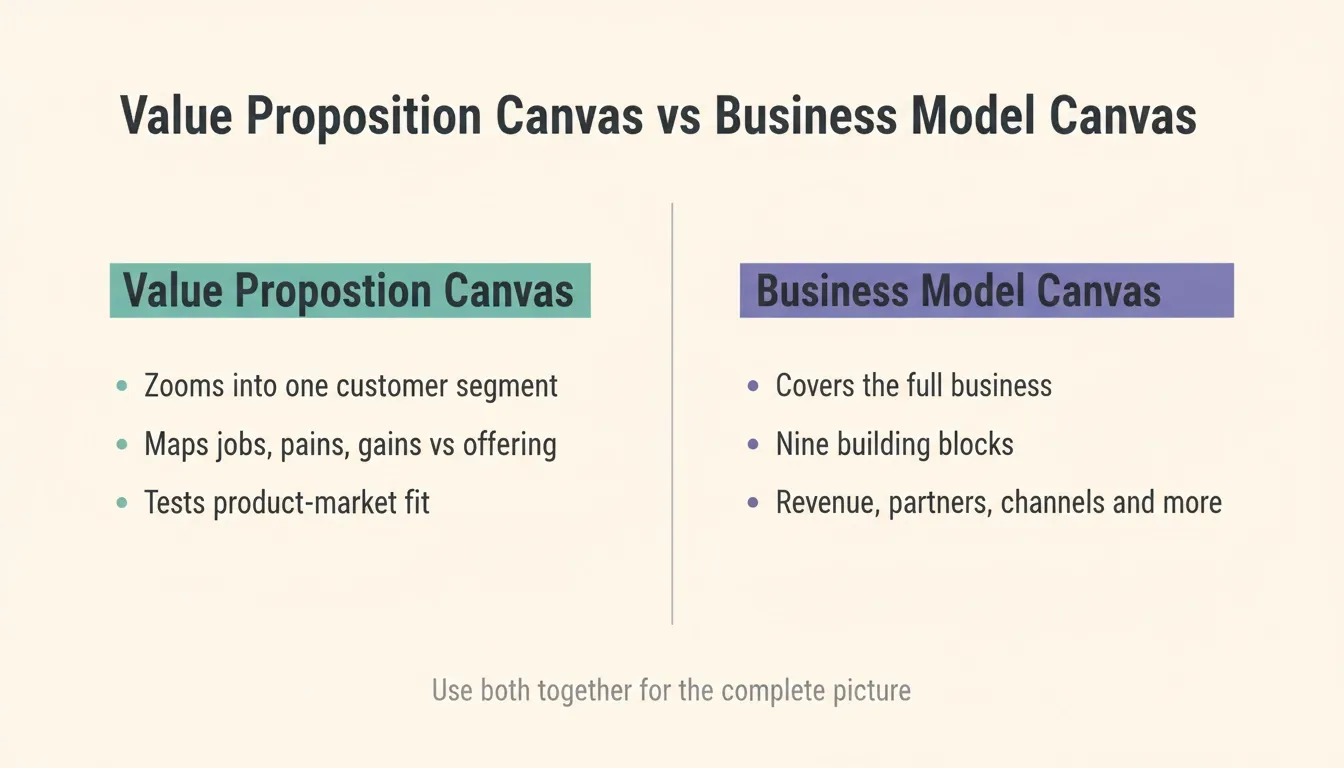 The value proposition canvas is a close-up lens on the core offer; the business model canvas covers the full business picture.
Research from Harvard Business Review on the elements of value shows that what customers actually value spans dozens of functional, emotional, and social dimensions. Think of the two canvases as nested tools: one for the full business picture, one for the core offer.
Teams that skip the close-up often build technically sound business models around propositions that never fit the customer segment. Most business model failures trace back to propositions that never matched what the customer segment truly needed.
Why Poor Product-Market Fit Kills Products
The data on this is consistent and worth understanding before you run your first canvas session.
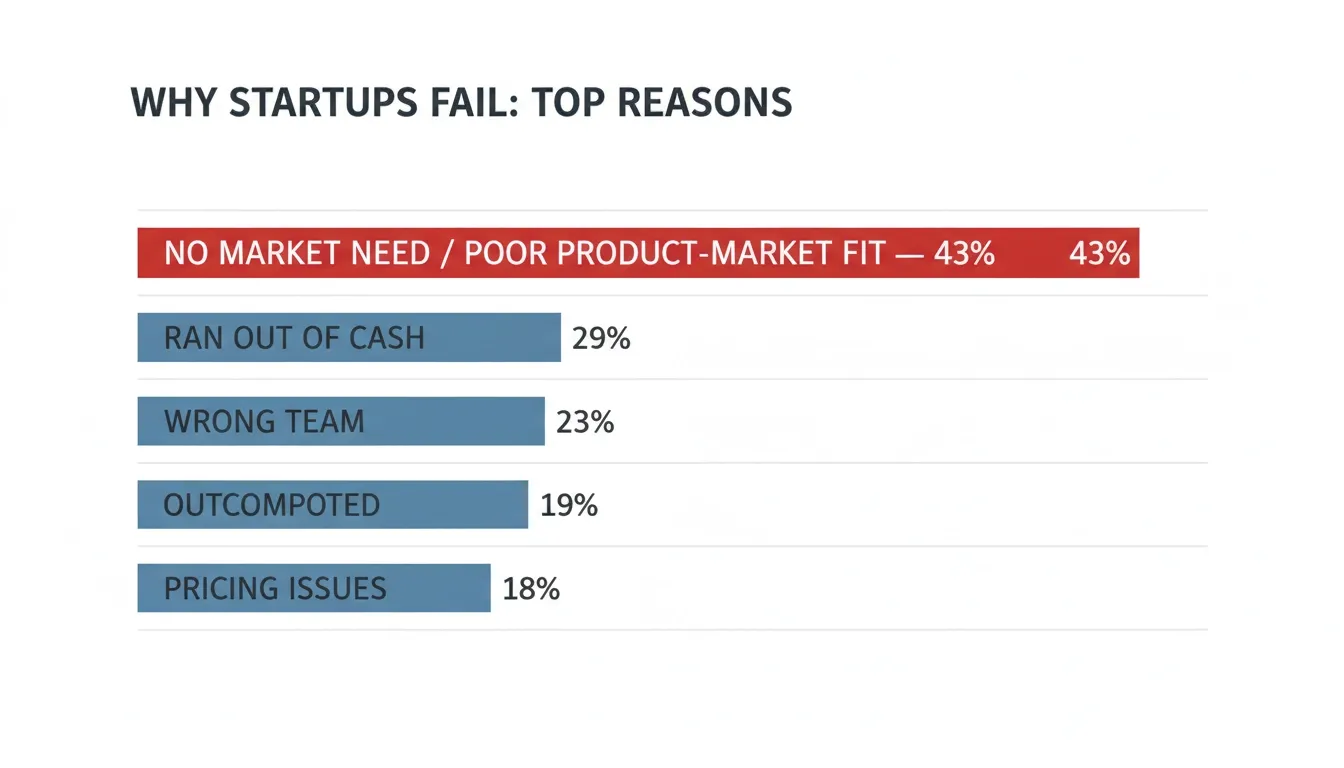 Poor product-market fit is the leading cause of startup failure, ahead of funding, team, and competition issues.
43% of failed startups cited no market need as their primary reason for shutting down. This is not a problem of execution. It is a problem of proposition design. The canvas exists specifically to surface this mismatch before a product ships, not after. Teams that validate their business idea before building consistently reduce this risk.
How Do You Fill Out Each Section?
Filling out a value proposition canvas works best when you follow a specific sequence: start with the customer profile, then move to the value map. Working in the other direction almost always produces a canvas that defends existing features rather than genuinely mapping to what customers want.
Six steps to fill out a value proposition canvas: customer profile steps in indigo, value map in orange, fit check in green.
Customer Jobs: What Does Your Segment Want Done?
The customer segment you choose shapes everything that follows. Before listing a single job, you need a foundation of real customer data.
Start with customer interviews. Product thinker Teresa Torres puts it plainly:
"Customer interviewing is one of the most valuable activities a product team can do. It's simply the easiest, most sustainable way of learning about your customers and what they need. This knowledge gives teams a competitive advantage that compounds over time." (Product Talk, Dec 2022)
Once you have that foundation, list every functional job, social job, and emotional job you can identify for your target customer segment. Rank the jobs by how much they matter to your customers. The ones at the top of the list are the ones your products and services need to address first.
Teams that skip this step tend to build for internal assumptions, not for actual customer needs. The customer segment definition is not a detail. It is the starting point for all the work that follows.
Customer Pains and Customer Gains: What Really Matters
With a clear list of customer jobs in hand, the next step is mapping the pains and gains that come with those jobs.
For customer pains, think about what negative experiences arise when customers try to do those jobs today. What frustrations do they carry?
What obstacles get in the way? What risks make them hesitate? List every pain you can identify, then rank them by severity.
For customer gains, consider what outcomes customers expect as a baseline. What results would delight them past those baseline expectations? Some gains are about cost savings; others are about social status, positive emotions, or simply getting a job done with less effort.
The ranking step is not optional. It is never realistic to address every pain or create every gain for your customer segment. The ranked list tells you where to put the effort.
Matching Your Offering: The Fit Test
This is where teams either find their product-market fit or discover they are missing it.
Map your products and services against the ranked pains and gains from the customer profile. For each pain reliever, ask: does this address a top-ranked pain, or does it solve something customers barely notice? For each gain creator, ask: does this deliver a gain customers genuinely want, or just one that seemed technically interesting to build?
Use the canvas as a pressure test. If your pain relievers mostly target low-ranked pains and your gain creators focus on gains customers did not name as priorities, that is valuable data, not a failure. It is a signal to refine before you ship.
When your pain relievers and gain creators address the top-ranked items on the customer profile side, the canvas signals fit. That fit is the foundation of strong propositions that hold up in a competitive market.
A Real-World Value Proposition Canvas Example
Seeing a filled canvas makes the framework concrete. Here is how a music streaming service might map out its value proposition canvas example.
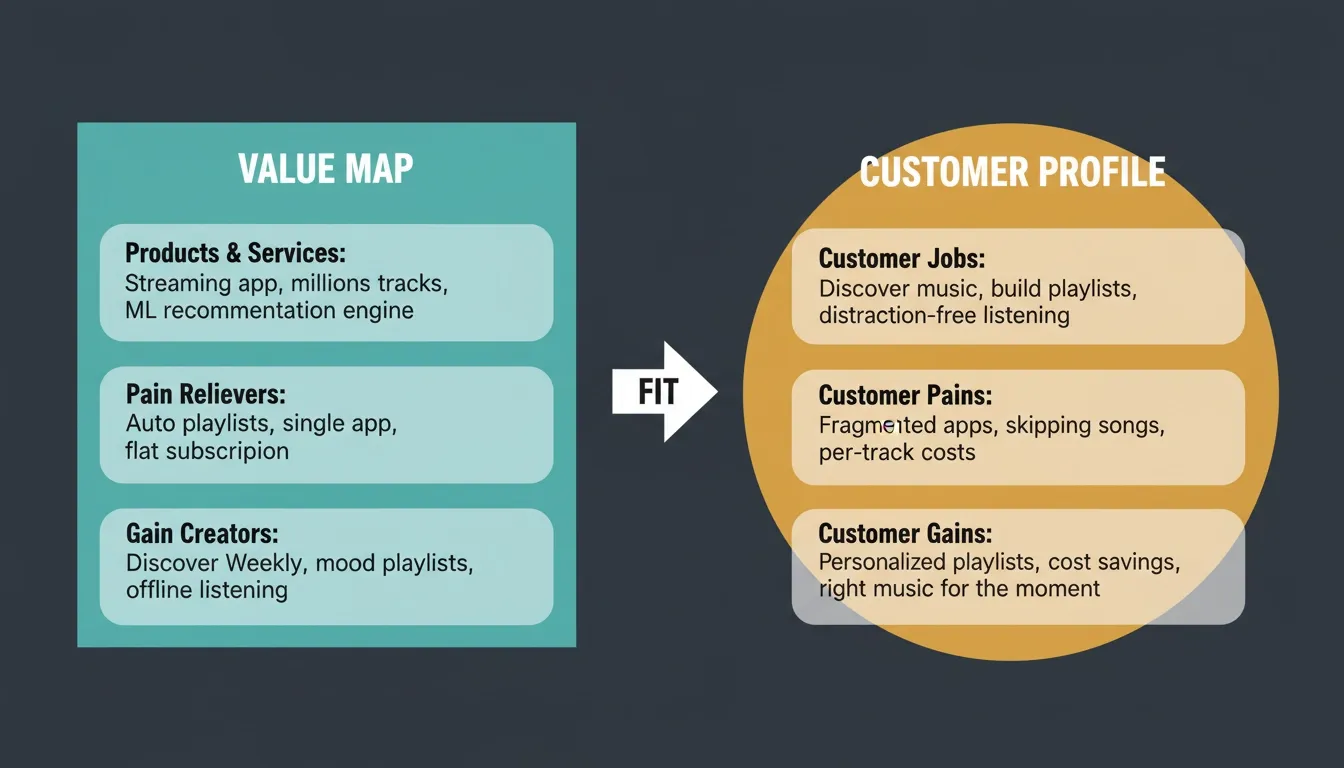 A completed value proposition canvas example: every pain reliever maps directly to a ranked customer pain.
| Component | Content |
|---|---|
| Customer jobs | Discover new music; build playlists for different moods; listen without distractions during work or exercise |
| Customer pains | Managing music scattered across multiple apps; wasting time skipping songs that miss the mood; paying per track for music that may disappoint |
| Customer gains | Personalized playlists served automatically; cost savings from a flat monthly subscription; always having the right music for the moment |
| Products and services | Streaming app with tens of millions of tracks and a machine-learning recommendation engine |
| Pain relievers | Automatically generated personalized playlists that learn from listening behavior; a single app replacing a fragmented set of services; flat subscription pricing removing per-track costs |
| Gain creators | Discover Weekly and similar features that surface new artists aligned to taste; mood-based playlist categories; offline listening that removes connectivity as an obstacle |
This example shows how the six components connect. The pain relievers directly address the highest-ranked customer pains. The gain creators deliver on the gains the customer profile named. The fit is visible on the canvas itself, and that visibility is the whole point.
What Makes a Good Value Proposition?
A strong value proposition does three things at once.
It addresses customer jobs that genuinely matter to your customer segment, not marginal jobs or hypothetical ones, but the tasks and goals customers ranked as most important in your research. It relieves customer pains that are genuinely severe.
Addressing mild inconveniences does not differentiate a product or service in a competitive market where customers can choose from many options.
It creates customer gains that customers care about enough to change their behavior for. A good value proposition is not a list of product features. It is a promise that the offering fits the customer's real situation. Companies that built enduring propositions did so by continually testing that fit and refining their proposition design based on what they learned.
Teams using Rocket's Solve feature can run structured research sessions to validate customer jobs and pains before committing to a proposition direction, turning the canvas from a workshop exercise into an evidence-backed deliverable.
Your Free Value Proposition Canvas Template
Once you understand the framework and have seen it in action, a clean value proposition canvas template makes it much easier to run your own session.
Download the official Strategyzer template and print it large enough for sticky notes, or use a digital whiteboard where the whole team can contribute remotely. The six-section layout is designed to be filled in during a structured working session, not completed solo at a desk.
A first-pass canvas session typically runs two to four hours. The goal on day one is not a perfect canvas. It is a shared understanding of who the customer is, what they need, and whether the current products and services fit.
Plan to continually refine the canvas as customer interviews produce new data and the market shifts. Teams that treat the canvas as a fixed document tend to find it accurate for about a quarter, then gradually out of date as conditions change. Revisit your propositions whenever a significant customer insight changes your view of the customer segment, or whenever competitive moves shift what your value map needs to address.
For teams building products alongside their proposition work, Rocket's no-handoff context system keeps market research, canvas insights, and build tasks in one place, so insights from your canvas session do not get lost before they make it into the product.
Does Your Proposition Hold Up Against Competitors?
Filling out a canvas based on your own assumptions is a starting point. The harder and more valuable question is whether your propositions still hold up when placed next to what competitors offer.
According to CB Insights, 43% of startups that failed cited poor product-market fit as a primary cause. Many of those failures were not about bad products in isolation. They were about propositions that failed to stand out in a competitive market where other companies were addressing the same customer jobs.
Mapping your own canvas is only half the work. The other half is understanding what competitor propositions look like: which customer pains do they address, which gains do they create, and critically, what do they miss?
Manual competitive research has a fundamental limit: it is slow and episodic. A competitor can update its proposition on its homepage, change pricing, or launch a new feature overnight. You might not notice for months.
How to Address Customer Needs Your Rivals Are Missing
Finding the gaps in competitor propositions requires more than a one-time look at their website.
Build separate canvases for your top two or three competitors using their public-facing products, pricing pages, and messaging. The value map you fill in for them tells you which customer jobs they address and which they leave untouched. Compare the value maps side by side. Are multiple competitors addressing the same customer pains? Those are baseline expectations, not differentiators.
Look for the customer needs ranked highly in your own research but absent from every competitor's value map. Those represent real chances to build propositions that stand apart from the field. The gaps you find here are the building blocks of a market position that is genuinely hard to copy, because it is grounded in customer needs your competitors have not yet chosen to address.
Revisit this comparison regularly. Competitor propositions shift faster than most teams expect, and a positioning gap that exists today may close by next quarter. Teams that track competitor moves continuously stay ahead of these shifts rather than reacting to them after the fact.
How Rocket Intelligence Reads Competitor Propositions for You
Mapping your own propositions is something a good team can accomplish in an afternoon. Keeping that view accurate as the competitive market shifts is a different challenge entirely.
Ten Signal Pillars, One Dashboard
Rocket Intelligence monitors companies across ten signal pillars including website changes, social media activity, people and hiring, product and technology, reviews and community, GTM activity, news and media, business and finance, traffic, and competitive signals. You can spot when a competitor changes their positioning before it shows up in a customer conversation or a lost deal.
Rocket Intelligence covers ten signal pillars per competitor, delivering ranked Intel to your dashboard rather than a raw alert stream.
The platform delivers ranked, personalized Intel to your dashboard rather than a raw stream of alerts. When a competitor shifts their messaging, updates their pricing, or signals a new product direction through a hiring push, Rocket surfaces what that change means for your business specifically.
Why Manual Approaches Fall Short
Manual approaches such as checking competitor websites periodically, piecing together signals from multiple tools, or setting up generic keyword alerts all produce the same result: late, incomplete, and disconnected information about competitive movements. Your propositions end up designed around yesterday's competitive market.
For teams actively working on proposition design, Intelligence closes the loop between a static canvas and the live competitive market.
Why the Value Proposition Canvas Works
A value proposition canvas works because it forces a simple, honest question: does what you offer actually match what customers need? The six building blocks give teams a shared language for that conversation, and the framework scales from a two-person startup to a large product organization with equal effectiveness.
Build Products That Fits Your Customers
Get the free template, run your first session, and keep going from there. The canvas is most valuable when it becomes a habit, something your team returns to every time customer interviews, market shifts, or competitive moves suggest your propositions need to change.
Start Building Today Start building products that fit your customers from day one. Rocket gives you the research, competitive intelligence, and build tools to go from proposition canvas to live product without losing context at any step. Sign up and start building for free.
Table of contents
- -What Is the Value Proposition Canvas and How Does It Work?
- -The Customer Profile: Jobs, Pains, and Gains
- -The Value Map: Pain Relievers and Gain Creators
- -Business Model Canvas: How the Two Tools Connect
- -Why Poor Product-Market Fit Kills Products
- -How Do You Fill Out Each Section?
- -Customer Jobs: What Does Your Segment Want Done?
- -Customer Pains and Customer Gains: What Really Matters
- -Matching Your Offering: The Fit Test
- -A Real-World Value Proposition Canvas Example
- -What Makes a Good Value Proposition?
- -Your Free Value Proposition Canvas Template
- -Does Your Proposition Hold Up Against Competitors?
- -How to Address Customer Needs Your Rivals Are Missing
- -How Rocket Intelligence Reads Competitor Propositions for You
- -Ten Signal Pillars, One Dashboard
- -Why Manual Approaches Fall Short
- -Why the Value Proposition Canvas Works
- -Build Products That Fits Your Customers