
Most competitor analysis efforts produce profiles that go stale before the next sales call. A structured template captures firmographics, product details, and GTM signals in one place, giving every team consistent, actionable data. Rocket.new keeps those profiles live, so you always walk in prepared.
Why do sales reps walk into competitive deals with profiles that have already expired?
According to Crayon's 2023 State of Competitive Intelligence, 66% of software company sales opportunities are competitive. That puts a rival in the room for the majority of deals your team runs.
The problem isn't a lack of interest in profiling. It's that most teams build a profile once, file it away, and pull it out six months later when the competitor has already shifted pricing, rebranded a product tier, or hired aggressively into a new vertical.
Good competitor analysis starts with understanding what a profile actually needs to hold, why the format matters as much as the data inside it, and how keeping profiles current changes the quality of every decision that flows from them.
What Goes into a Competitor Profile?
A competitor profile is more than a website URL and a pricing page screenshot. It's a structured document that gives any team member a working picture of how one competitor operates, where it targets customers, and what it communicates to the market about itself.
Direct vs. Indirect Competitors
When scoping which rivals deserve a profile, the first question is what kind of competition they represent. Direct and indirect competitors show up differently in your deals and demand different strategic responses.
-
Direct competitors target the same customers with a similar product and a comparable value proposition. These are the rivals that come up most often when prospects are evaluating options side by side.
-
Indirect competitors solve the same problem through a different approach: a different delivery model, an adjacent product category, or a broader platform that overlaps with yours.
-
Tracking both sets matters for complete competitive profiling. New competitors frequently start as indirect players before moving into your core market, so catching that shift early gives your marketing and sales teams a meaningful lead.
The Right Scope for Each Profile
Not every competitor deserves the same depth of coverage. Use the same template structure for all profiles, but calibrate how much you complete based on competitive weight.
-
Primary rivals (those showing up repeatedly in won and lost deals) get every section filled in and refreshed on a regular cadence.
-
Secondary companies (competitors targeting similar businesses from a different angle) get a lighter profile covering firmographics, product overview, and market position.
-
Watch-list rivals (newer entrants or indirect players moving closer to your space) get a placeholder profile that grows as the threat develops.
"To determine your competitors, start by talking with your internal teams to learn who they consider competitors." — Jennifer Hall, Associate Director of Agency Marketing, Vision Media (via HubSpot Competitive Analysis Guide)
Rocket's firmographic data guide covers the core company-level attributes and how to collect them for your target market. Starting with defined tiers prevents the common mistake of building one thorough profile for a single competitor while leaving the rest of the competitive field unmapped.
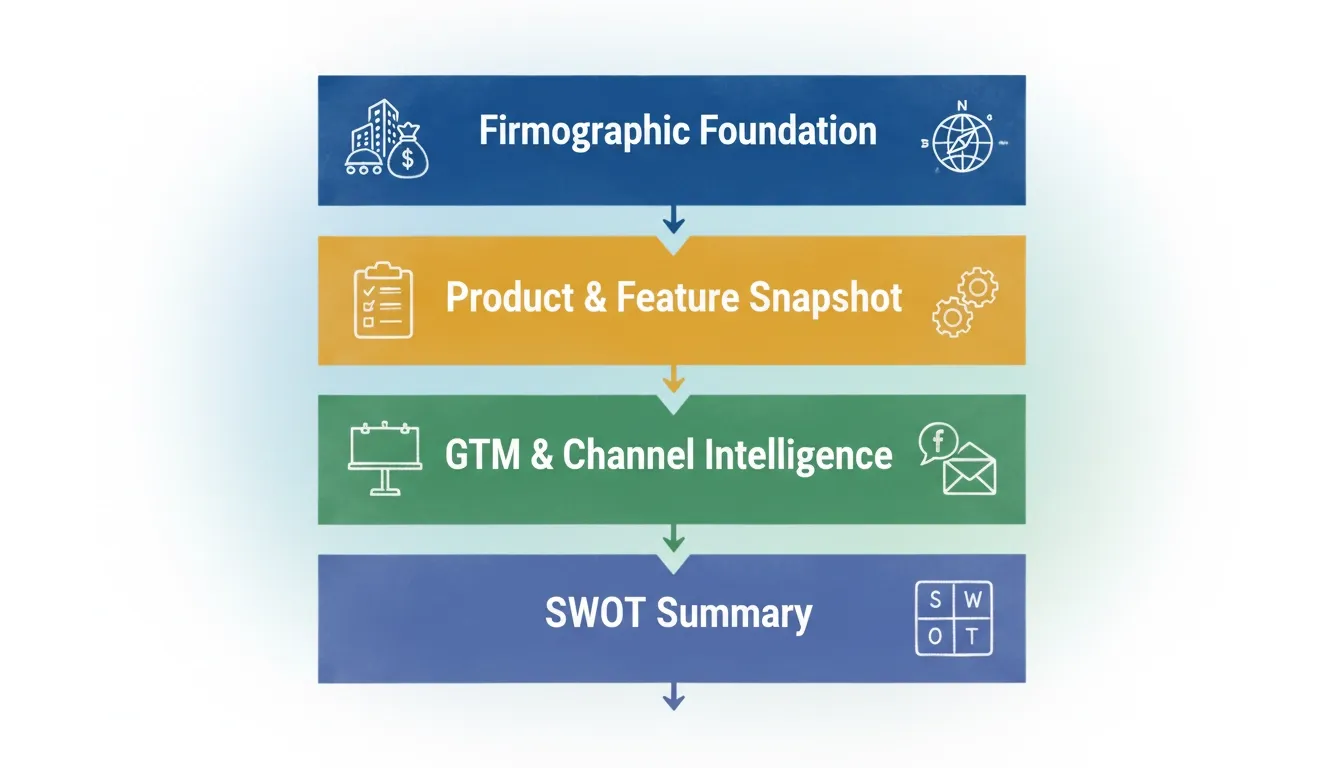 The four layers that form every complete competitor profile
Which Sections Should Every Profile Include?
A well-built competitor profile covers three distinct layers: who the competitor is as a company, what it sells and how, and how it goes to market. Each layer answers different questions and gives different teams the context they need.
Firmographic Foundation
The firmographic layer gives your team the organizational context behind every other data point in the profile.
-
Company size and headcount: a signal for how fast the competitor can build, hire, and respond to market changes.
-
Funding and ownership: venture-backed, bootstrapped, or publicly traded status shapes risk tolerance and marketing investment pace.
-
Geography and target market: where the competitor operates and which customer segments drive its priority.
-
Revenue band and growth trajectory: even rough estimates help gauge competitive weight and whether the rival is in growth mode or contraction.
Annual reports, public filings, and funding announcements are strong primary sources for this layer.
Product and Feature Snapshot
This layer documents competing products and the details that matter most when your team evaluates rivals head-to-head.
-
Core product features: what the product does, what it doesn't, and where customers report gaps through online reviews and app stores.
-
Pricing tiers and pricing pages: how packages are structured, what contract terms the competitor uses, and whether pricing is publicly visible.
-
Product demos and trial access: what the first-touch experience looks like and which customers it's built for.
-
Technical foundation: the underlying architecture and what the competitor can deliver relative to your own product offerings.
Reading customer reviews on G2 and Capterra surfaces both the competitor's strengths and the friction points customers raise consistently. Competitive strategy frameworks help structure how you interpret what you find and connect it to your own positioning decisions.
GTM and Channel Intelligence
The GTM layer maps how the competitor runs its marketing motion and organizes its sales team.
-
Marketing strategies and channels: which platforms the competitor invests in, from organic content and Google Ads to social media and outbound email sequences.
-
Messaging and value proposition: the core claims made across channels, including the customer value angle the competitor leads with in its advertising and copy.
-
Sales structure: how the competitor organizes its motion, whether it runs on product-led growth, inbound, outbound, or a hybrid approach.
-
Brand positioning and loyalty signals: how the competitor's marketing presents the brand and how sticky that customer base appears based on review patterns and tone.
Understanding how a rival runs its marketing motion helps your team identify the channels and messages where you can take a meaningfully different approach. For a deeper look at how continuous monitoring connects to your sales cycle, see how Rocket turns competitor data into sales intelligence.
| Profile Section | Primary Sources | Key Questions |
|---|---|---|
| Firmographic | LinkedIn, Crunchbase, annual reports | Size, funding, target market, ownership |
| Product & Features | Websites, app stores, product demos | Feature gaps, pricing tiers, contract terms |
| GTM & Channels | Social media, Google Ads, customer reviews | Marketing channels, brand positioning, sales structure |
| SWOT Summary | All sources above | Strengths, weaknesses, market opportunities, threats |
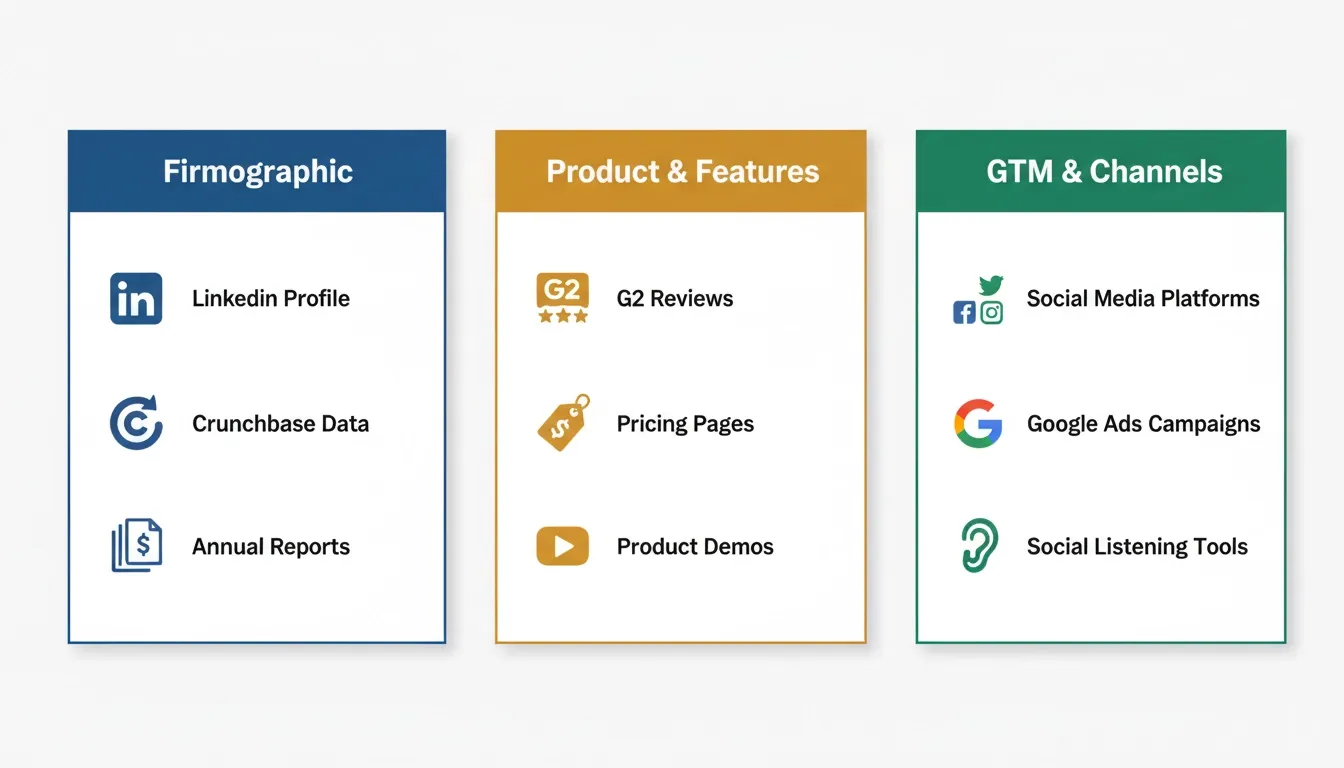 The three core sections of a competitor profile and the sources that feed each one
How Do You Build a Competitor Profile Template?
Building a reusable template is what turns one-off competitor research into a repeatable competitor analysis program. It needs to be structured enough that two people completing it for two different companies produce comparable, actionable output.
The SWOT Layer
A SWOT analysis sits at the end of every well-designed competitor profile. It functions as a summary layer that distills the full profile into something a marketing team, sales rep, or product manager can act on quickly.
-
Strengths: areas where the competitor genuinely outperforms, based on customer feedback, win data, and positive review trends. These are the strengths your teams need a direct response to.
-
Weaknesses: the gaps that appear repeatedly in reading customer reviews and analyzing deal outcomes. Knowing competitors' weaknesses allows your team to craft sharper, more specific positioning.
-
Market gaps: the opportunities the competitor hasn't captured, including underserved customer segments, product categories avoided, and pricing bands it doesn't cover.
-
Threats: new product launches, pricing strategy changes, and marketing partnerships that could shift market share toward the competitor.
A SWOT analysis distills the full profile into a summary that teams can act on without re-reading the entire dataset.
Scoring Strengths and Weaknesses
Raw SWOT notes have limited value without prioritization. A simple scoring model turns qualitative observations into comparable intelligence across profiles.
-
Rate each strength and weakness on a 1-3 scale based on impact and data confidence.
-
Weight factors that appear consistently in your deal loss data more heavily. If one competitor's onboarding keeps coming up as the reason customers chose it, that's quantitative data worth building a specific response to.
-
Track how each factor changes between refresh cycles. A competitor whose weaknesses are visibly closing is a higher priority than a static list of problems from last quarter.
A competitive analysis framework built around consistent scoring makes it easier to compare profiles across rivals and spot patterns. The CI collection cycle guide covers how to structure a repeatable collection and analysis process around your template. A business plan for any new market entry gets sharper when it starts from well-maintained competitor profiles rather than assumptions.
1flowchart TD
2 A([Define Competitor List]) --> B([Collect Firmographic Layer])
3 B --> C([Document Product & Features])
4 C --> D([Map GTM & Channel Intelligence])
5 D --> E([Run SWOT Analysis])
6 E --> F{Profile Gaps Remain?}
7 F -->|Yes| G([Research Gap Sources])
8 G --> C
9 F -->|No| H([Share Profile with Team])
10 H --> I([Set Refresh Cadence])
11 I --> J([Monitor Ongoing Signals])
12 J --> K{Update Trigger Hit?}
13 K -->|Yes| B
14 K -->|No| J
15
16 classDef startNode fill:#EEF2FF,stroke:#4F46E5,color:#1E293B
17 classDef processNode fill:#F0FDF4,stroke:#16A34A,color:#1E293B
18 classDef decisionNode fill:#FFF7ED,stroke:#F97316,color:#1E293B
19 classDef outputNode fill:#F8FAFC,stroke:#64748B,color:#1E293B
20
21 class A startNode
22 class B,C,D,E,G,J processNode
23 class F,K decisionNode
24 class H,I outputNode
Competitor profile build and maintenance workflow
Why Do Most Competitor Profiles Go Stale?
Profiles are built as a project, not maintained as a process. A competitor doesn't pause and wait for your team's quarterly review cycle before changing messaging, launching a product update, or shifting its pricing strategy.
What Happens When Data Goes Cold
When competitor data ages without updates, the downstream effects compound across every team that uses it.
-
Sales reps quote pricing tiers that the competitor restructured months earlier, losing credibility mid-call.
-
Marketing teams write positioning copy targeting weaknesses the rival has since addressed in a new release.
-
Product managers deprioritize roadmap features based on old analysis, missing the signals that show where rivals are now investing.
-
Strategy decisions rest on a market analysis that no longer reflects current conditions, costing real opportunities in the process.
Many businesses treat profile updates as a low-priority task until a deal loss makes the gap impossible to ignore.
The Signals Teams Miss
The most valuable signals for updating a competitor profile don't arrive as press releases. They surface in job postings, social media patterns, and review shifts before any formal announcement confirms them.
-
Job postings reveal where a competitor is building capacity before any product or marketing announcement. A cluster of enterprise sales hires signals a market expansion play months in advance.
-
Positive reviews rising rapidly: a competitor with strong upward review momentum is closing its previous weaknesses. Tracking that momentum tells you when to revise your competitive edge assumptions.
-
Social listening tools pick up shifts in messaging and brand tone before updated pricing pages or product demos reflect them publicly.
-
Google Ads and web analytics tools show how competitors reach their target audience and when they're testing new messaging in paid channels.
-
Former employees on LinkedIn and in industry communities often share candid context about roadmap direction and internal shifts that public materials don't capture.
Catching these signals requires more than a quarterly check. Predictive competitive intelligence explains how teams use continuous monitoring to act on competitor signals weeks before a formal announcement confirms the direction.
When one competitor goes quiet on social media and content marketing simultaneously, that absence is itself a signal. Combined with other data points, it often precedes a significant strategy shift that hasn't been publicly announced yet.
According to Crayon's 2023 State of Competitive Intelligence, 66% of software company sales opportunities are competitive. That puts a rival in the room for the majority of deals your team runs, making fresh, structured profiles a revenue-critical asset, not a nice-to-have.
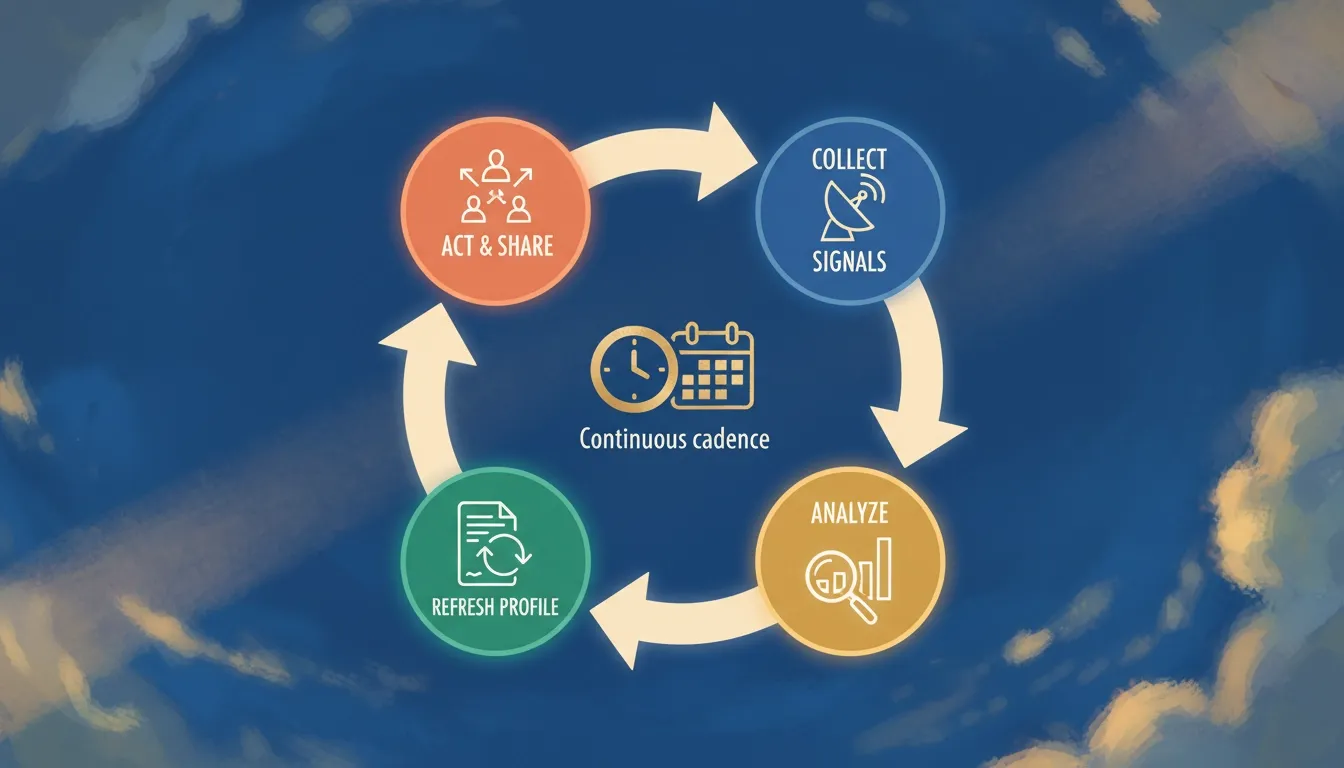 The four-step cycle for keeping competitor profiles current
How Rocket Intelligence Builds Live Competitor Profiles
Manual profiling tools ask your team to check sources, update spreadsheets, and distribute reports on a schedule the market doesn't share. The result is a program that consistently runs behind the rivals it's supposed to track.
Continuous Monitoring Across Ten Pillars
Rocket Intelligence tracks every competitor you add across ten concurrent signal sources: website changes, social media activity, news coverage, GTM signals, traffic shifts, product updates, people movements, business signals, customer reviews, and a cross-pillar overview. Artificial intelligence handles the interpretation layer, connecting signal patterns automatically rather than requiring manual analysis from your team.
-
Website and product monitoring catches pricing updates, new feature announcements, and messaging shifts without manual checking. When a competitor changes its positioning, your teams see it quickly.
-
Hiring signal tracking reveals growth trajectory and strategic intent before any press release confirms them. Enterprise sales hires read as a market expansion play; a cluster of infrastructure engineers signals a product investment.
-
Review and social listening tools aggregate what customers actually say about rivals across G2, app stores, and social media channels. You see competitors' strengths and the friction customers experience, not the polished marketing version.
-
Cross-pillar intelligence connects patterns that single-channel tools miss entirely. A pricing strategy shift combined with a hiring push and a messaging change is a very different signal than any one of those data points alone.
Every team (sales, marketing, and product) gets a profile view built around the decisions they're actively making. Sales gets deal-ready competitive summaries. Marketing gets positioning context. Product gets roadmap signals. For a full breakdown of how the intelligence layer works across teams, see Rocket's competitive intelligence software guide.
From Profile View to Deal Decision
Where tools like Crayon and Klue focus on monitoring and alert distribution, Rocket connects live competitor profiling directly to the decisions happening across your sales, marketing, and product teams.
According to McKinsey research, companies that act on rich market and customer data generate 40% more revenue than those that treat intelligence as a reporting function. The competitive edge in any market comes from acting on current data, not from compiling better-looking documents after the fact.
Understanding the full competitive landscape also means knowing how rivals position themselves visually and structurally. How to analyze, map, and visualize the competitive landscape walks through the frameworks that turn raw profile data into a clear strategic picture.
Profiles That Win Before the First Sales Call
A competitor profile is only as good as the decision it informs. The template gives your team a consistent structure; freshness gives that structure real value. When both are in place, sales, marketing, and product teams all start from the same current picture of who they're competing against.
The companies that treat competitor analysis as an ongoing process rather than a periodic project build compound knowledge about their rivals over time. That knowledge shapes sharper positioning, better messaging, and faster responses when the market shifts in ways that catch less-prepared competitors flat-footed.
Ready to move from stale spreadsheets to live competitor profiling? Rocket.new's Intelligence feature tracks your rivals continuously across ten signal sources and serves each team the profile view they need for their next decision. Start building on Rocket and give your team live competitor profiles from day one.
Table of contents
- -What Goes into a Competitor Profile?
- -Direct vs. Indirect Competitors
- -The Right Scope for Each Profile
- -Which Sections Should Every Profile Include?
- -Firmographic Foundation
- -Product and Feature Snapshot
- -GTM and Channel Intelligence
- -How Do You Build a Competitor Profile Template?
- -The SWOT Layer
- -Scoring Strengths and Weaknesses
- -Why Do Most Competitor Profiles Go Stale?
- -What Happens When Data Goes Cold
- -The Signals Teams Miss
- -How Rocket Intelligence Builds Live Competitor Profiles
- -Continuous Monitoring Across Ten Pillars
- -From Profile View to Deal Decision
- -Profiles That Win Before the First Sales Call