
Vibe coding generates code from casual prompts, fast and iteratively. Prompt engineering structures every instruction before the AI writes a line. Knowing which to use, and when to switch, is what separates a prototype from a production app.
Which approach actually gets you to a working product faster?
Vibe coding uses casual natural language to generate code quickly, with minimal upfront structure. Prompt engineering uses detailed, structured instructions that define context, constraints, and expected behavior before the AI generates anything. Both rely on large language models. The right choice depends on what you are building, who will use it, and how much is at stake.
Vibe coding vs prompt engineering is one of the most searched questions in AI-assisted development. This guide gives you a complete, practical comparison: what each approach is, how each works, when each wins, and how to combine them.
What is Vibe Coding?
Vibe coding is an AI-assisted development style where you describe what you want in casual, natural language. The AI then generates code with minimal upfront structure. The term was coined by Andrej Karpathy in early 2025 and quickly became a defining phrase in the developer community.
The workflow is conversational. You type something like: "Build a simple login app with email validation and aria attributes." The AI generates code. You review it, test it, and iterate. If something is missing, you ask again.
The thinking happens after the AI generates code. You react to what comes back, patch issues, and iterate toward something that works. It feels less like programming and more like directing a capable collaborator in real time.
How Vibe Coding Works in Practice
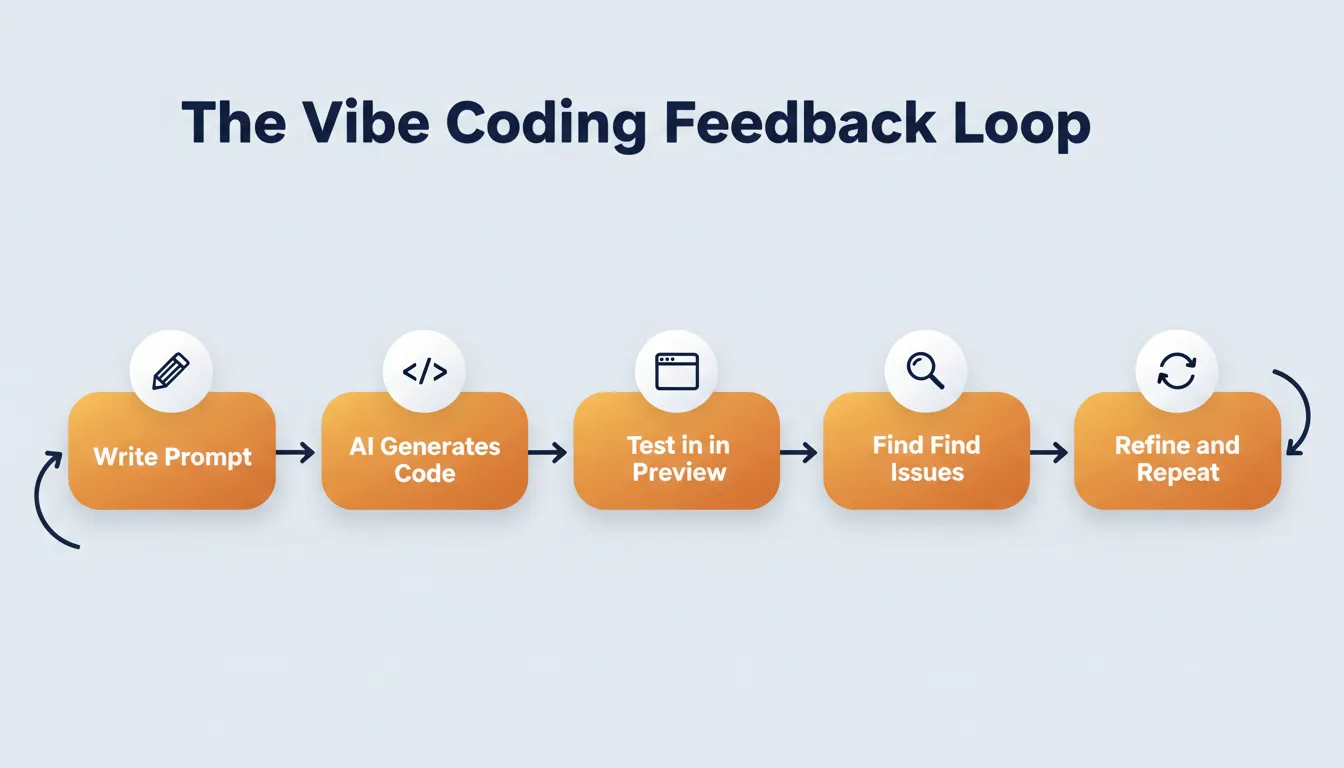
Vibe coding follows a short feedback loop. First, you write a casual, natural language prompt describing the feature or app. Next, you review the AI-generated code output. Then, you test it in a live preview or local environment. After that, you send follow-up prompts to fix issues or add features. Finally, you repeat the process until the feature is complete.
Vibe coders use smaller, incremental prompts rather than one large specification. They treat the AI like a creative partner, not a specification executor.
What Vibe Coding Is Best For
- Rapid UI prototyping and wireframe-to-code conversion
- Building quick internal tools and dashboards
- Exploring ideas before committing to a full architecture
- Generating boilerplate code and repetitive components
- Early-stage startup MVPs where speed matters more than structure
According to the Stack Overflow Developer Survey 2023, 70% of all respondents are using or are planning to use AI tools in their development process. The survey covered 89,184 developers across 185 countries.
The Limitations of Vibe Coding
Vibe coding works well at the start. As complexity grows, the gaps appear. The model fills in gaps with assumptions, and those assumptions are often wrong for your specific use case. Without upfront structure, different parts of the app can follow different patterns.
You also fix problems after they appear rather than preventing them. Casual prompts rarely specify authentication flows, input validation, or data handling rules. These security blind spots become costly later.
What Is Prompt Engineering?
Prompt engineering is the deliberate practice of designing AI prompts to produce accurate, consistent, and production-ready outputs. Instead of describing what you want casually, you structure your prompt with context, constraints, user stories, data models, and expected behavior.
The thinking happens before the AI generates code. You define the problem, constraints, and expected behavior upfront. The AI then executes against a clear specification.
A prompt-engineered request for the same login app might look like: "Create a full-stack authentication module using React and Node.js. Follow clean architecture. Define a User data model with fields: id, email, passwordHash, createdAt. Implement bcrypt password hashing. Add input validation for email format and minimum password length of 8 characters. Include error handling for duplicate emails and invalid credentials."
The difference is not just length. It is specificity, structure, and the amount of thinking done before the AI generates anything.
Real Prompt Engineering Examples
Here is how the same task looks across three levels of prompt engineering:
Level 1 — Vibe coding prompt:
"Build a user dashboard."
Level 2 — Basic prompt engineering:
"Build a user dashboard for a SaaS app. Include a sidebar with navigation, a metrics overview section showing monthly revenue and active users, and a recent activity feed."
Level 3 — Full prompt engineering:
"Build a user dashboard for a B2B SaaS app using React and TypeScript. Target users: account managers. Key screens: Overview (monthly revenue, active users, churn rate, 30-day chart), Activity feed (paginated, with timestamps and user avatars), Settings (profile editing with email validation). Data model: User { id, name, email, role, createdAt }. Use Tailwind CSS. Follow camelCase for variables, PascalCase for components. Include loading states and empty states for all data-dependent sections."
The gap between Level 1 and Level 3 is not just detail. It is the difference between a prototype and a production-ready starting point.
Core Techniques in Prompt Engineering
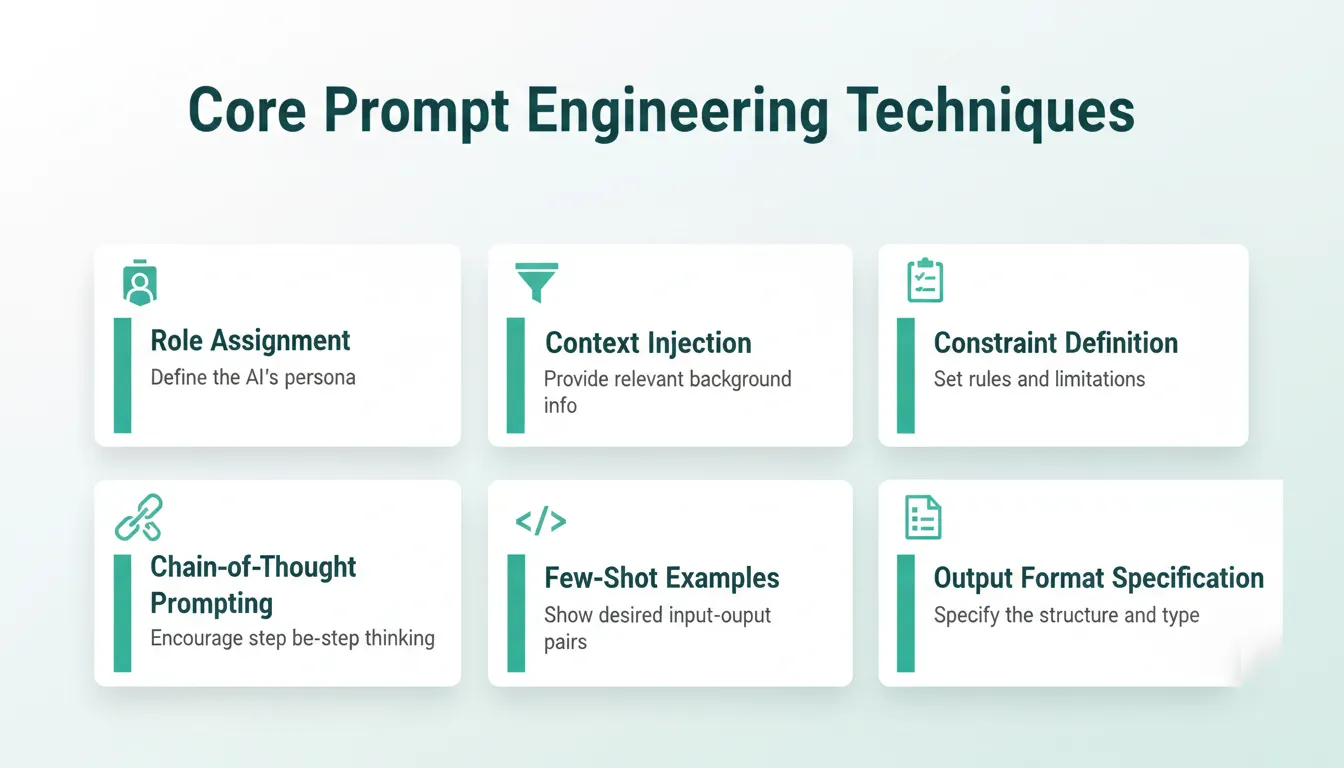
Effective prompt engineering relies on several well-established techniques. Role assignment tells the AI what role to play, such as "You are a senior backend engineer specializing in Node.js security." Context injection provides the business logic, user personas, and technical constraints upfront. Constraint definition specifies what the output must and must not include.
Chain-of-thought prompting asks the AI to reason through the problem before generating code. Few-shot examples provide patterns for the AI to follow. Together, these techniques give the AI everything it needs to produce consistent, reliable output.
For a deeper look at these techniques, the prompt engineering best practices guide covers the full range of strategies for accurate AI results.
What Prompt Engineering Is Best For
- Enterprise applications with complex business logic
- Systems requiring consistent coding standards across a team
- Security-sensitive applications where assumptions are dangerous
- Long-running projects where maintainability matters
- Integrations with external APIs where error handling is critical
Vibe Coding vs Prompt Engineering: Side-By-Side
The fundamental distinction comes down to where the thinking happens, either before or after the AI generates code.
| Dimension | Vibe Coding | Prompt Engineering |
|---|---|---|
| Prompt style | Casual, conversational | Structured, detailed |
| Where thinking happens | After generation | Before generation |
| Context provided | Minimal | Rich and specific |
| Developer control | Medium | High |
| Iteration style | Reactive | Preventive |
| Best for | Prototypes, UI, MVPs | Enterprise apps, APIs, production systems |
| Skill required | Low barrier to entry | Requires domain knowledge |
| Output consistency | Variable | More predictable |
| Debugging frequency | Higher | Lower |
| Time to first output | Faster | Slower, but fewer revisions |
| Security risk | Higher | Lower |
| Team collaboration | Harder to standardize | Easier to standardize |
Workflow Comparison: Building The Same App Two Ways
Here is how each approach handles building a task manager app from scratch.
The Vibe Coding Workflow
You start with: "Create a simple task app with add and delete features." The AI generates a basic React component with a task list, an input field, and delete buttons. You test it. Next, you send: "Add error handling if the user submits empty data." The AI adds a simple validation check.
Then you ask: "Make the tasks persist after page refresh." The AI adds localStorage. You notice there is no unique ID system for tasks, which causes bugs when deleting. You send a fourth prompt to fix the delete bug. You are now on your fifth iteration for a feature that could have been specified correctly in the first prompt.
This is the vibe coding loop: fast to start, iterative to complete, and occasionally messy at scale.
The Prompt Engineering Workflow
Instead, you write a single structured prompt: "Build a task manager web app using React and TypeScript. Data model: Task { id: uuid, title: string, completed: boolean, createdAt: timestamp }. Features: add task with empty-string validation, toggle complete, delete by ID, persist to localStorage. Use functional components with hooks. Follow consistent naming: camelCase for variables, PascalCase for components. Include error boundary for localStorage failures."
The AI generates a complete, structured implementation. The ID system is correct. Validation is in place. LocalStorage handles edge cases. You may still iterate, but you start from a much stronger foundation.
The takeaway: vibe coding is faster to start. Prompt engineering is faster to finish.
The AI Development Workflow: Where Each Approach Fits
The AI development decision flow: how vibe coding and prompt engineering lead to production-ready apps through different paths
When To Use Vibe Coding
Vibe coding is the right choice in several situations. Before you know what you want to build, vibe coding lets you generate a working prototype in minutes. It is the fastest way to test whether an idea is worth pursuing.
For hackathons, demos, and internal tools with a short lifespan, the overhead of structured prompts is not justified. Speed matters more than structure in those cases. Non-technical builders also benefit greatly. Product managers, designers, and founders can generate working apps without deep programming knowledge.
A single UI component, a simple landing page, or a standalone script is also well-suited to vibe coding. When the scope is small and well-understood, casual prompts get you there faster.
When To Use Prompt Engineering
Prompt engineering is the right choice when you are building for production. Any application handling real users, real data, or real money requires the precision that prompt engineering provides.
Security is another clear signal. Authentication systems, payment flows, and data handling require explicit specification of security requirements. Vibe coding rarely produces secure defaults without prompting. When you are working on a team, structured prompts produce consistent code that follows shared conventions. This matters for maintainability and code review.
If the codebase is already established, prompt engineering lets you specify existing patterns explicitly. Adding features to an existing system requires understanding and respecting what is already there.
Can You Combine Both Approaches?
Yes. The most effective AI-assisted developers use both, switching between them based on the task at hand. A practical hybrid workflow works like this.
First, use vibe coding to explore. Generate a rough prototype to validate the concept. Then switch to prompt engineering to build. Once the direction is confirmed, use structured prompts to build the production version. After that, return to vibe coding for small tweaks and UI adjustments. Finally, always use prompt engineering for critical paths like authentication, payments, and data handling.
This hybrid approach captures the speed of vibe coding and the quality of prompt engineering. The key is knowing which mode to use at each stage.
For a practical look at how this plays out in full-stack projects, the guide on building a web app with vibe coding walks through the full workflow from first prompt to deployed app.
Context Engineering: The Layer Above Both
Both vibe coding and prompt engineering are fundamentally about context management. A third, emerging concept sits above both: context engineering.
Context engineering is the practice of designing the full information environment an AI model operates in. This includes not just the prompt, but the system prompt, conversation history, retrieved documents, tool outputs, and memory state. Where prompt engineering optimizes a single instruction, context engineering optimizes the entire context window.
As context windows grow and AI models improve, context engineering is becoming the dominant skill for developers who want consistent, high-quality output at scale.
| Level | What You Control | Example |
|---|---|---|
| Vibe coding | The casual request | "Build a login page" |
| Prompt engineering | The structured instruction | Role, constraints, data model, expected output |
| Context engineering | The full information environment | System prompt, project memory, prior decisions, retrieved docs |
The Role Of Context In Both Approaches
Both vibe coding and prompt engineering are fundamentally about context management. The difference is when and how context is provided.
In vibe coding, context builds up incrementally through conversation. Each follow-up prompt adds more. This works, but it is inefficient. You are teaching the AI what it needs to know one message at a time.
In prompt engineering, context is front-loaded. You invest time upfront to give the AI everything it needs. This produces better first-generation outputs and reduces the total number of iterations.
The quality of AI output depends directly on the quality of context provided. This is the core insight that connects both approaches.
Prompt Engineering Best Practices For AI Development
Whether you are writing a single prompt or a full specification, these practices improve output quality.
Start with the role. "You are a senior React developer building a production SaaS application" produces better output than no role context at all. Next, define the data model first. Specify your entities, fields, and relationships before asking for UI or logic. The data model is the foundation everything else depends on.
Specify error handling explicitly. AI will not add comprehensive error handling unless you ask for it. Name your constraints clearly. Framework versions, coding standards, naming conventions, and performance requirements should all be explicit. Use examples whenever possible. If you want the AI to follow a specific pattern, show it an example.
Separate concerns by writing distinct prompts for UI, logic, and data layers rather than asking for everything at once. No matter how well-crafted your prompt, always review AI-generated code before it reaches production.
The Risk Of Over-Reliance On AI
Both vibe coding and prompt engineering carry the same underlying risk: using AI-generated code without adequate review.
AI-generated authentication and input validation code often contains subtle security flaws. AI also optimizes for correctness, not performance, so database queries often need manual optimization. AI generates code for the happy path, and edge cases require explicit specification. Additionally, AI training data has a cutoff, so generated code may use deprecated APIs.
The solution is not to use AI less. It is to use it more deliberately. Prompt engineering is, in part, a discipline for using AI deliberately. Research from the GitHub 2024 Octoverse Report confirms that AI-assisted development is now mainstream, making deliberate prompt practices more important than ever.
Vibe Coding vs Prompt Engineering Across Developer Profiles
Startups And Early-Stage Products
Vibe coding wins at the earliest stage. When you are validating an idea, speed is the only metric that matters. Generate a prototype, put it in front of users, and learn. Code quality is irrelevant until you know the idea is worth building.
Prompt engineering takes over once the idea is validated. The MVP that users love needs to be rebuilt properly before it scales. This is where structured prompts pay for themselves.
Enterprise Development Teams
Prompt engineering dominates in enterprise contexts. Consistency, security, maintainability, and compliance requirements all favor structured, specification-driven prompting. Enterprise teams often develop internal prompt libraries and templates that encode their coding standards.
Vibe coding still has a role in internal tooling and rapid prototyping. Enterprise developers use it to explore solutions before committing to a full implementation.
Non-Technical Builders
Vibe coding is the primary tool for non-technical builders. Product managers, designers, and founders use it to build working prototypes without needing to understand the underlying code.
As they grow more sophisticated, many non-technical builders naturally develop prompt engineering habits. They start providing more context, specifying constraints, and defining expected behavior, without ever calling it "prompt engineering."
What Both Approaches Miss: The Pre-Build Layer
Vibe coding and prompt engineering both start at execution. They assume the direction is already decided, the market is understood, and the idea is worth building.
That assumption is often wrong. Most products fail not because of bad execution, but because of good execution of the wrong thing. The build was fine. The foundation was not. This is the gap that separates fast builders from effective ones.
This is the problem that Vibe Solutioning addresses. It starts before the first prompt, with strategic intelligence that validates the market, maps the competition, and confirms whether the direction holds up. Only then does the build begin, with that thinking already embedded.
The distinction is worth understanding clearly. Vibe coding answers: How do I build this? Prompt engineering answers: How do I build this well? Vibe Solutioning answers: What should I build, and why?
How Rocket Supports Both Approaches
Rocket is the world's first Vibe Solutioning platform. It brings strategic research, app building, and competitive intelligence together in a single product. It is built for the full spectrum from vibe coding to structured prompt engineering, and for the layer that comes before both.
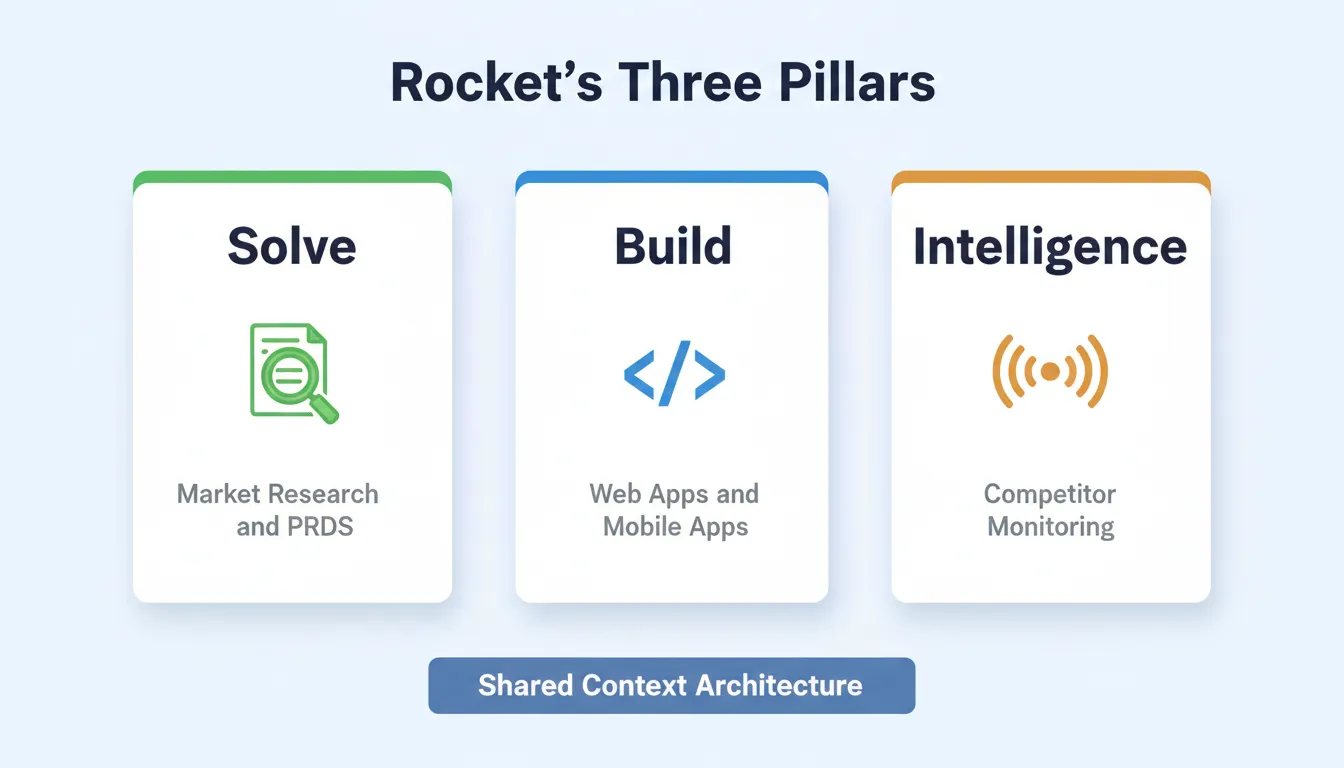
Rocket's three pillars work together. Solve validates your idea, runs market research, creates PRDs, and delivers structured reports before you write a single line of code. Any business question turns into a complete, structured output that is ready to act on, present, or build from.
Build generates production-ready web apps in Next.js and mobile apps in Flutter from natural language. Describe your app as casually or as precisely as you choose. Most apps generate in 1 to 3 minutes. Every app ships with SEO-ready structure, WCAG accessibility compliance, and GDPR coverage by default.
Intelligence monitors competitors continuously. Pricing changes, product updates, hiring signals, and ad strategy shifts are all surfaced automatically to a live dashboard. Set it up once, and it runs automatically.
What makes Rocket different from a simple vibe coding tool is its shared context architecture. Every project carries accumulated intelligence: Solve research, competitive data, brand guidelines, and technical decisions that inform every build. The thinking you did in Solve flows directly into Build. Nothing gets re-explained, and nothing gets lost.
1.5 million people have tried Rocket across 180 countries, from solo founders shipping MVPs to enterprise teams running strategy and execution on the same platform.
| Feature | Vibe Coding Support | Prompt Engineering Support |
|---|---|---|
| Natural language generation | Casual prompts generate full-stack apps | Structured prompts produce architecture-aware code |
| In-browser code editing | Iterate quickly without leaving the platform | Review and refine generated code precisely |
| Built-in authentication | Auto-generated without explicit specification | Customizable with explicit security requirements |
| API generation | Created automatically from app description | Configurable with explicit endpoint definitions |
| Database configuration | Inferred from app context | Definable with explicit schema specification |
| Version history | Roll back casual experiments safely | Track structured iterations with full history |
| Solve (pre-build research) | Validate idea before first prompt | Ground structured prompts in real market data |
| Intelligence monitoring | Track competitor moves post-launch | Inform prompt constraints with live market signals |
Vibe Coding vs Prompt Engineering: The Definitive Answer
When comparing vibe coding vs prompt engineering, the right choice depends entirely on context. Choose vibe coding when you need speed, are exploring an idea, or are building something small and short-lived. Choose prompt engineering when you need quality, consistency, security, or are building for production.
Combine both when you need the speed of vibe coding at the start and the quality of prompt engineering at the end. Add the pre-build layer when you need to know whether the direction is right before either approach begins.
The most effective AI-assisted developers are not loyal to one approach. They are fluent in all of them.
Which Approach Wins In AI-Assisted Development?
Vibe coding and prompt engineering are not competing methods. They are complementary stages. Vibe coding gets you to a working idea fast. Prompt engineering gets that idea to production quality. As AI models grow more capable, knowing when to apply each approach will define the developers and teams who consistently ship products that work.
The real question is not which approach is better. It is whether you are starting from the right foundation before either approach begins. Start building on Rocket and see what happens when the thinking and the build happen in the same place.
Table of contents
- -What is Vibe Coding?
- -How Vibe Coding Works in Practice
- -What Vibe Coding Is Best For
- -The Limitations of Vibe Coding
- -What Is Prompt Engineering?
- -Real Prompt Engineering Examples
- -Core Techniques in Prompt Engineering
- -What Prompt Engineering Is Best For
- -Vibe Coding vs Prompt Engineering: Side-By-Side
- -Workflow Comparison: Building The Same App Two Ways
- -The Vibe Coding Workflow
- -The Prompt Engineering Workflow
- -The AI Development Workflow: Where Each Approach Fits
- -When To Use Vibe Coding
- -When To Use Prompt Engineering
- -Can You Combine Both Approaches?
- -Context Engineering: The Layer Above Both
- -The Role Of Context In Both Approaches
- -Prompt Engineering Best Practices For AI Development
- -The Risk Of Over-Reliance On AI
- -Vibe Coding vs Prompt Engineering Across Developer Profiles
- -Startups And Early-Stage Products
- -Enterprise Development Teams
- -Non-Technical Builders
- -What Both Approaches Miss: The Pre-Build Layer
- -How Rocket Supports Both Approaches
- -Vibe Coding vs Prompt Engineering: The Definitive Answer
- -Which Approach Wins In AI-Assisted Development?