
Traditional website builders are great for landing pages, portfolios, and simple business websites. Rocket.new is built for full-stack products with backend logic, databases, AI agents, and native mobile apps. In 2026, the real choice is not just building a website; it is deciding whether you need a page or a scalable product.
What are you actually building: a page or a product? That question cuts right to the heart of the website builders vs Rocket.new debate in 2026.
The short answer: traditional website builders are great for getting something online fast. Rocket.new is for building something that actually works, scales, and runs business logic behind the scenes.
By 2026, the no-code and low-code market will have hit $65 billion, and the tools are no longer all equal. Gartner now reports that 70% of new apps are built with no-code or low-code tools. The category has grown up. So has the gap between a website builder and an AI app builder.
Why the Old Way of Picking a Builder No Longer Cuts It
Not long ago, picking a builder was simple. You wanted a website, you picked Wix, Squarespace, or Webflow. You wanted a custom app you hired developers. Those were the two lanes, and they rarely crossed.
That split has collapsed. AI tools have changed the game so much that non-technical users can now build fully working web apps, dashboards, internal tools, and native mobile apps without touching a single line of code. The question is no longer "can I build it?" It's "which platform gives me the right kind of control?"
That shift matters because most people searching for a builder today are not just looking for a homepage. They want to build something with backend logic, user flows, databases, and real deployment. Website builders were not built for that. And that's where the trade-offs start to become very clear.
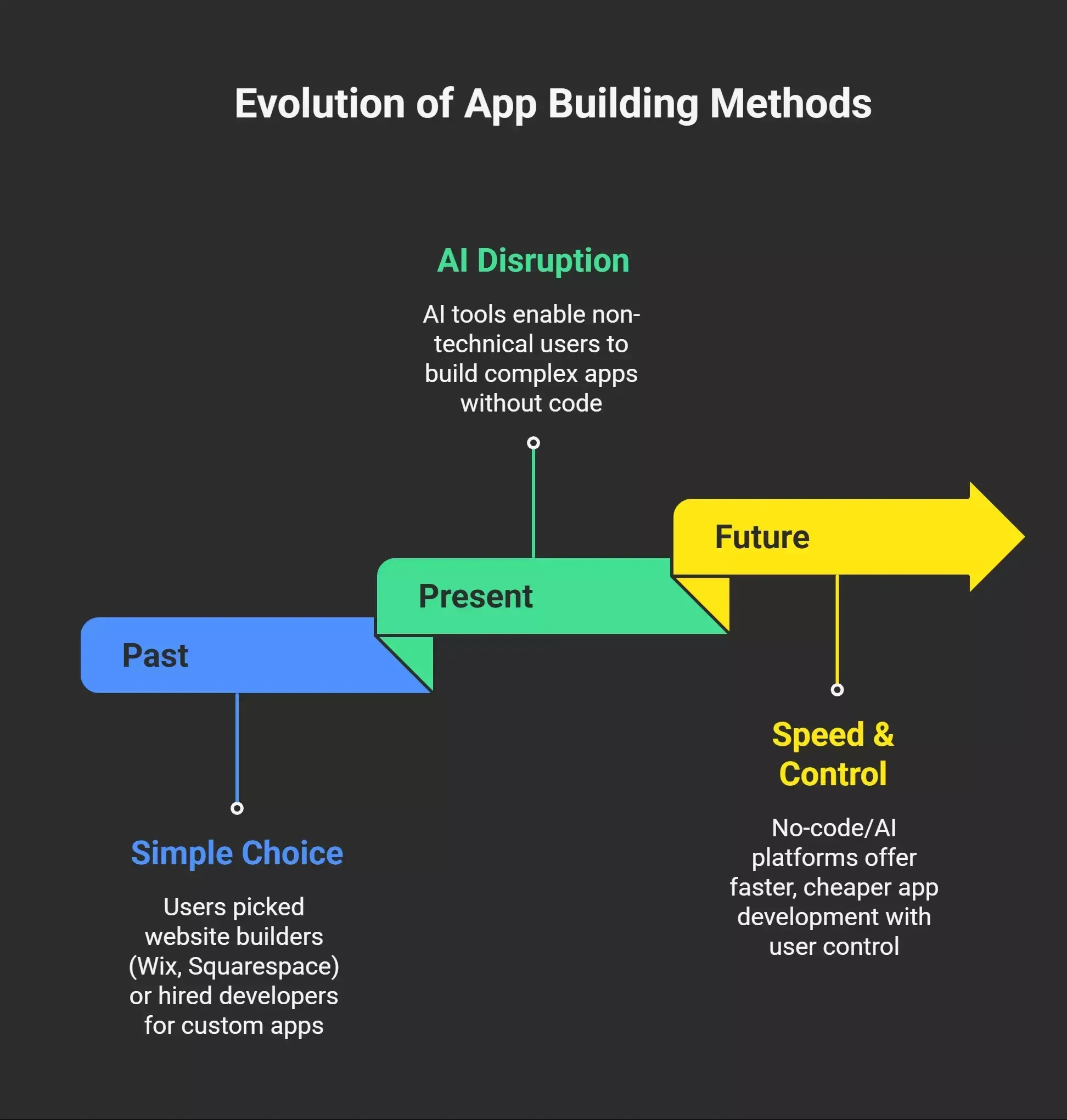 There's also the time factor. According to Forrester's TEI research, no-code development is 74% faster than traditional development and cuts costs by 62% on average. The average no-code project wraps up in 3.2 weeks, versus 14.8 weeks with a traditional dev team. For founders, small teams, and operators trying to move fast, that kind of speed difference is not a nice-to-have - it's the whole point.
So when you're comparing website builders to AI app builders like Rocket.new, you're really comparing two different ideas about what "building" means.
The Traditional Website Builder: What it Does Well
Let's give credit where it's due. Builders like Wix, Squarespace, and Webflow are genuinely good at what they set out to do.
-
Drag and drop editors that require zero technical knowledge
-
Beautiful templates out of the box
-
Fast deployment to custom domains
-
Built-in tools for SEO, content delivery, and e-commerce
-
Great for building landing pages, portfolios, and simple business websites
For beginners who need a landing page, a portfolio, or a small business site, these platforms work well. Squarespace, in particular, is praised for design quality. Webflow goes a step further and gives designers deep control over layout and visual structure - it's closer to a design tool than a traditional website builder.
But here is where things get narrow. Most builders hit a ceiling quickly. The moment you want users to log in, store data, run business logic, receive notifications, or interact with other systems, most builders run out of road. You start patching things together with Zapier, Airtable, and third-party services. Costs go up. Complexity goes up. Full control goes away.
And that ceiling is a known problem in the industry. According to Hostinger's 2026 low-code trends research, 39% of business leaders report limited customization as a significant challenge with their current platforms. That is not a niche complaint; it's the core limitation of the template-first model baked into most traditional builders.
| What You Need | Traditional Builder | Result |
|---|---|---|
| Static content site | Yes | Works well |
| Custom user flows | Limited | Workarounds needed |
| Databases + backend | No | Not supported |
| Native mobile apps | No | Not possible |
| Business logic + APIs | No | Requires third-party tools |
| AI agents or automation | No | Out of scope |
| Code export | Varies | Limited or locked in |
| Working app at scale | No | Platform limits kick in |
The structural problem with websites built on traditional builders is vendor lock-in. Your design, your content, and your workflows live inside someone else's system. Moving to a different platform means rebuilding. That's a hidden cost most people don't account for when they pick a builder.
A Deep Dive Into the AI App Builder Category
The rise of AI builders is not just a trend, it is a category shift. Gartner predicts that 75% of new applications will use low-code or no-code platforms by 2026, and a growing share of those are AI-powered app builders that go far beyond drag and drop.
These are tools that take your description using natural language and generate a working app frontend, backend, databases, and deployment, all at once. You describe what you want. The AI handles architecture decisions, writes code, sets up the data model, and builds the interface. No templates. No drag and drop. Just describe the app in plain language and let the system do the heavy lifting.
The productivity numbers back this up clearly. According to Forrester's TEI research:
-
Development is 74% faster with no-code/low-code vs traditional dev
-
Costs are 62% lower on average
-
Average project wraps in 3.2 weeks vs. 14.8 weeks the traditional way
That's not a marginal improvement. That's a different order of magnitude.
AI builders don't just speed up the process. They change who can participate in app building entirely. The Hostinger 2026 low-code research notes that by 2026, 80% of low-code users will be people outside of IT departments, founders, operators, designers, and product thinkers who have an idea and want to ship it without writing code or waiting for a dev team.
That's 16.2 million citizen developers worldwide, according to Forrester, a number that has grown 38% year over year. The citizen developer is no longer a curiosity. They are the majority of builders now.
Core Concepts: What Separates an App Builder from a Website Builder
This is worth getting clear before looking at Rocket.new specifically.
A website builder produces a site - a set of pages with visual layouts, text, images, and links. It handles content delivery well. It does not handle backend logic, user authentication, or data storage at any meaningful depth.
An AI app builder produces a system. It includes:
-
A frontend that the user interacts with
-
A backend that processes requests and runs business logic
-
Databases for storing and reading data
-
Authentication for managing users
-
File storage for uploads and documents
-
APIs for connecting to external services
-
Deployment infrastructure to run the app in production
These are core concepts that website builders simply don't address. When most builders try to stretch into this space, they do it through add-ons and external tools - which means you are no longer working in one platform. You're managing a stack of separate services and hoping they play nicely together.
For practical purposes, this means: if someone visits your website builder site and takes an action, there is nowhere for that action to go. You can't store what they did, react to it intelligently, trigger a follow-up, or use it to power something else. That's the wall. Most teams hit it around the time they want to build their first real feature.
Rocket.new: Built for the App Builder Era
Rocket.new sits in a different category entirely. It describes itself as "the world's first Vibe Solutioning platform," and that framing is intentional. It is not just a builder. It is a complete system for researching, deciding, building, and tracking your app in one shared context. You do not re-explain your decisions to it. It carries what it knows into every next step.
Over 1.5 million people across 180 countries have tried Rocket.new. That is not just curious tinkerers. That is, founders, small teams, solo operators, and developers who needed a faster way to ship working apps without rebuilding from scratch or assembling five different tools.
Here is what makes Rocket.new different when it comes to core features:
Natural Language App Creation with Full Backend Logic
You describe your app using natural language prompts. Rocket.new generates a complete application - database schema, backend logic, business rules, user authentication, and frontend. One prompt, one working app. No piecing together components from different services.
This is not a website generator. It is an AI app builder that understands intent and translates it into production-ready code using the best-fit frameworks automatically.
Native Mobile Apps Without the Usual Complexity
One of the biggest gaps with traditional website builders is that they stop at the browser. Rocket.new generates Flutter-based native mobile apps, meaning your app can go to the App Store or Google Play without rebuilding from scratch in a separate codebase.
For teams building mobile apps, this removes the usual trade-off between web and mobile. Everything stays in one system, one context, one deployment workflow.
AI Agents Built Right In
Most builders treat automation as an add-on - something you bolt on through Zapier or a third-party workflow tool. Rocket.new builds AI agents directly into the app creation workflow. These agents can handle repetitive tasks, process data, trigger notifications, and run backend logic automatically - without manual wiring between external services.
Staging and Production Environments
Rocket.new gives both developers and non-technical users access to proper staging and production environments. This is a gap that most AI builders skip. It matters when you're shipping real software - not just a demo or prototype that will eventually need a proper deployment setup.
One Shared Context Across the Entire Build
The most underrated feature: Rocket.new maintains a single shared context across your entire project. Your decisions, your data model, your business logic - all connected. You don't re-explain yourself every time you add something new. The system carries what it already knows into the next step.
This is the core reason Rocket.new behaves differently from other AI builders. Most tools treat each prompt as an isolated request. Rocket.new treats your entire project as one ongoing conversation.
AI Builders vs Website Builders: The 2026 Comparison
Here is how the two categories actually compare across the dimensions that matter most in 2026:
| Feature | Website Builders (Wix, Webflow, Squarespace) | Rocket.new |
|---|---|---|
| App type | Static websites, landing pages | Full web + native mobile apps |
| Backend logic | Not supported | Built in |
| Databases | Third-party tools required | Included |
| AI agents | Not available | Built in |
| Natural language input | Limited (template suggestions only) | Full natural language prompts |
| Mobile app output | Not available | Flutter-based native apps |
| User authentication | Basic (some platforms) | Full |
| Code export | Locked or limited | Accessible |
| Deployment | Simple hosting | Staging + production environments |
| Technical level required | Low | Low to none |
| Best for | Content, portfolios, small websites | Internal tools, SaaS, mobile apps, dashboards |
What the Community is Saying
The shift in how builders are being evaluated shows up clearly in real community conversations. On r/VibeCodeDevs (September 2025), a user shared their Rocket.new experience building a complex web app:
"I'm running through almost exactly the same process - started with ChatGPT for PRD, then moved to Rocket. Good connection with Supabase, clean through the setup of DB structures. It was interesting that it immediately suggested using Resend and asked for the API key." - r/VibeCodeDevs, Sep 2025 (source)
That workflow - idea to product requirements to AI builder to deployed app - is exactly what Rocket.new was designed around. The system holds context, so you don't have to keep feeding it background for the call.
Meanwhile, a separate thread on r/nocode from March 2026 noted: "what worked for me was Rocket.new since it can generate Flutter apps," pointing to the native mobile capability as a standout reason people choose it over other AI builders.
And the broader data support this. 21% of Y Combinator's Winter 2025 batch had codebases that were over 90% AI-generated, according to Rocket.new's research. Serious founders are shipping with AI tools. The question is which tools produce code and apps that can actually scale.
Where Traditional Builders Still Make Sense
This is not a case where one tool wins in every scenario. Traditional website builders are still the right call when:
-
You need a simple marketing site or portfolio up in under an hour
-
Design quality and visual templates are the priority
-
There are no backend requirements at all
-
Your team is entirely non-technical and just needs content pages
-
You're building a blog, a landing page, or a basic e-commerce store on a tight timeline
Squarespace, Webflow, and Wix are good tools for those cases. The problems start when people try to stretch these tools beyond their scope - adding more and more third-party services to compensate for what the platform doesn't do natively. At that point, the simplicity that made the builder appealing is long gone, and you're managing a patchwork of integrations that's harder to maintain than a properly built app would have been.
The Real Trade-Offs to Consider
Before picking either type of platform, the honest trade-offs look like this:
Website builders offer:
-
Simple setup for content-only websites
-
Predictable paid plans with clear feature tiers
-
Established ecosystems with templates and plugins
-
Shallow learning curve for beginners with no app-building goals
-
Fast to launch for pure content delivery
AI app builders like Rocket.new offer:
-
Speed to build full-stack apps with real backend logic
-
One system for web apps and native mobile apps
-
No need to assemble multiple tools and services
-
Full control without writing code manually
-
AI agents and databases without external services
-
Using natural language to describe and build complex functionality
For teams who are building anything with real product functionality - dashboards, internal tools, SaaS products, mobile apps - the website builder path leads to months of workarounds. The AI app builder path gets you to a working app in days.
The Right Pick in 2026 for Your Next Build
The website builders vs Rocket.new conversation is really a question of what you are building. If you need a set of pages and content delivery, a traditional builder works fine. If you need a product, something with users, data, business logic, and mobile access, you need an AI app builder built for that purpose.
The no-code/low-code market is now worth $65 billion and growing at 26% CAGR. The tools that will define the next wave are the ones that go end-to-end: from idea to backend to deployment, without asking you to stitch five platforms together. Rocket.new was built specifically for that moment, a single system that carries context, handles the heavy lifting, and ships apps that work in production.
Website builders served a generation of online presence. AI app builders like Rocket.new are serving the generation that wants to ship real, working products. The difference is not about technical skill level anymore; it's about what you want your build to actually do once it's live.
Sign up now and build your next web or mobile app faster with Rocket.new from idea to production using simple natural language prompts.
Table of contents
- -Why the Old Way of Picking a Builder No Longer Cuts It
- -The Traditional Website Builder: What it Does Well
- -A Deep Dive Into the AI App Builder Category
- -Core Concepts: What Separates an App Builder from a Website Builder
- -Rocket.new: Built for the App Builder Era
- -Natural Language App Creation with Full Backend Logic
- -Native Mobile Apps Without the Usual Complexity
- -AI Agents Built Right In
- -Staging and Production Environments
- -One Shared Context Across the Entire Build
- -AI Builders vs Website Builders: The 2026 Comparison
- -What the Community is Saying
- -Where Traditional Builders Still Make Sense
- -The Real Trade-Offs to Consider
- -The Right Pick in 2026 for Your Next Build