
Production-grade from the first generation means your very first user-facing release is built to last, not thrown away. Instead of shipping a fragile prototype and rewriting it six months later, you ship with SLOs, security, observability, and test coverage from day one. Check out Rocket.new to see how the platform makes this the default, not the exception.
So, What Does "Production Grade From The First Generation" Actually Mean?
Most teams ship a rough first version and promise to clean it up later. That later usually arrives as an emergency. Production-grade from the first generation means your initial release is already stable, secure, observable, and built to handle real users from the moment it goes live.
Research on startup failures shows that nearly 73% of funded startups end up needing major rewrites within 18 months of launch, typically due to scalability issues or architectural debt. The cost of these rewrites usually ranges from $150,000 to $300,000, depending on the complexity and team size. Most of that investment goes into fixing existing systems rather than delivering new features.
What is Production Grade Software?
Production-grade software is code built to serve real users reliably, not just to pass a demo. It is not a quality you add later. It is a set of properties your system either has or does not have when users first touch it.
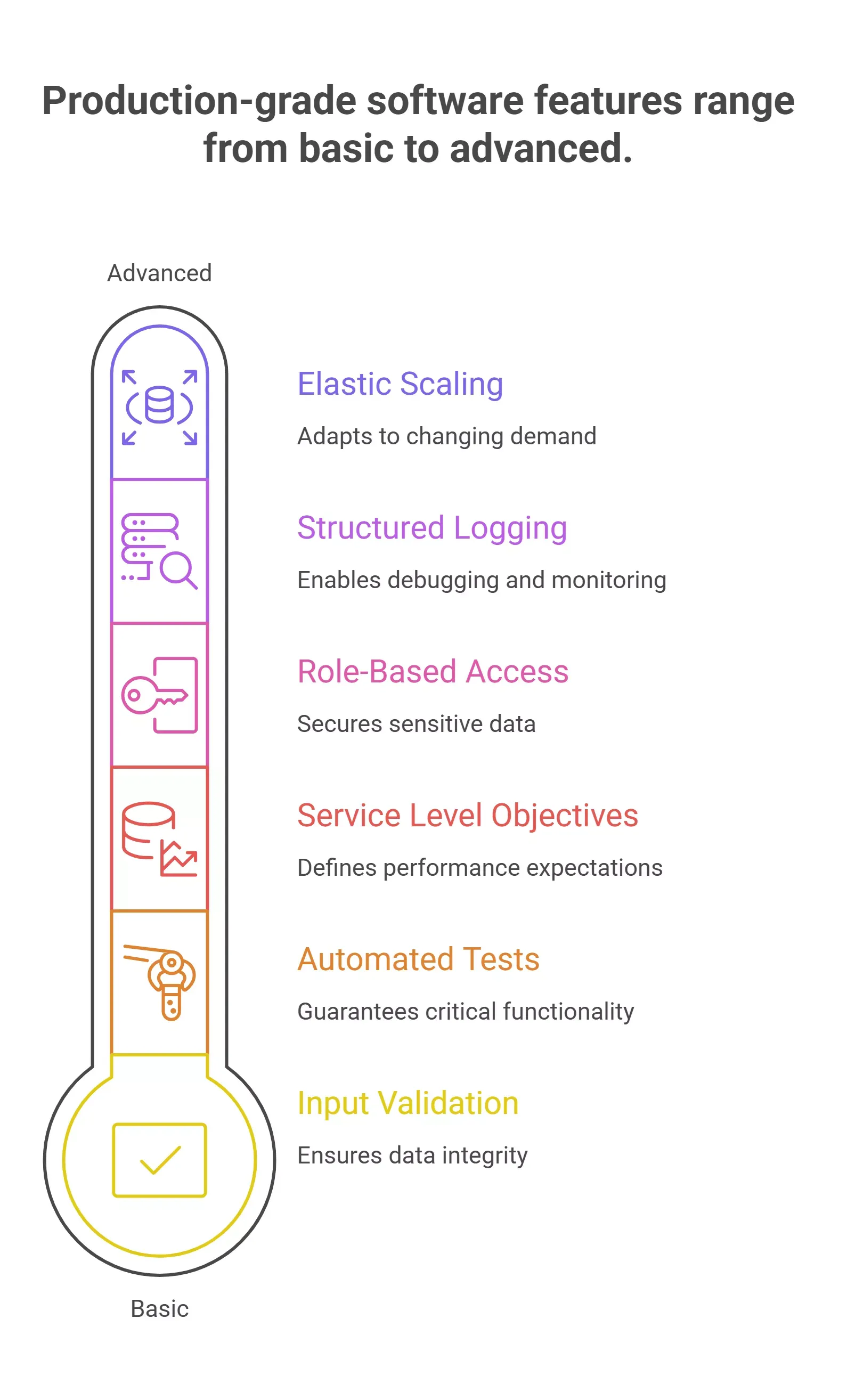
Production-grade software includes:
- Defined service level objectives with uptime targets
- Automated tests covering critical paths and edge cases
- Input validation and structured error handling
- Role-based access control and zero trust authentication
- Structured logging, distributed tracing, and alerting
- Elastic scaling with back pressure controls
Production-grade software must also meet strict SLAs for availability. The production-grade label signals that a system can handle mission-critical workloads, not just controlled demos. The production grade label shifts focus from experimental features to high-stakes stability and robustness.
How Does First-Generation Production-Grade Software Differ From a POC?
First-generation production-grade software is built for sustained real-world use from day one. A proof of concept is built to answer one question: Can this idea work at all?
That difference matters more than most teams admit.
| Aspect | POC | First Generation Production Grade |
|---|---|---|
| Purpose | Feasibility check on toy dataset | Real user value with SLO-backed metrics |
| Time Horizon | Weeks, disposable | Years, evolvable with test coverage |
| Quality Bar | No tests, manual fixes | Automated tests on 80%+ critical paths |
| Supported Users | 1 to 5 developers | 100+ concurrent users with elastic scaling |
| Blast Radius | Local crashes acceptable | Contained via circuit breakers, under 0.1% user impact |
The ground truth is simple. POC code leaking into production without transformation is one of the most common and costly mistakes in software development. A Jupyter notebook that worked beautifully in demos becomes a liability under real traffic.
Take a realistic scenario: a company builds an internal chatbot as a POC in 2024. It crashes under load, causing 20% query failure rates with no observability to debug the problem. If the team had targeted production-grade code from the start, implementation details like Pydantic validation, exponential backoff retries, dead letter queues, and canary deployments would have cut incident response from hours to minutes.
Why Do Teams Skip Production Grade Code in Early Releases?
Teams historically skipped production-grade software in early versions for understandable reasons. Time pressure pushed corners to be cut. Prototyping teams and operations teams were separated. Tools like Jupyter notebooks made exploration easy, but production hardening nearly impossible.
The ground truth from the data: 70% of MVPs needed major rewrites within 18 months. The cost of retrofitting performance, security, and observability is 3x higher than building them in from the start, according to a 2024 McKinsey study.
Several shifts since 2023 changed this calculus:
- Platform engineering adoption grew 40%, making production defaults easier to implement
- GitOps tools like ArgoCD standardize deployment and configuration management
- AI agents and multi-agent systems introduced complex failure modes that require observability from day one
- The "you build it, you run it" culture spread beyond elite engineering organizations
AI-generated code can lower the barrier to entry for less technical team members, allowing them to prototype ideas more effectively, but it may also introduce technical debt if not properly managed.
Moreover, AI-generated code specifically creates new risks. AI coding tools have made significant progress in automating boilerplate generation, writing tests, and debugging.
The concept of vibe coding suggests AI can write software quickly, but generated code can introduce technical debt if not guided by clear acceptance criteria and proper engineering discipline. Human review remains necessary.
The quality of AI-generated code can be assessed through test pass rates, code readability, modularity, and adherence to static analysis standards.
What Are the Core Characteristics of Production Grade Software From Day One?
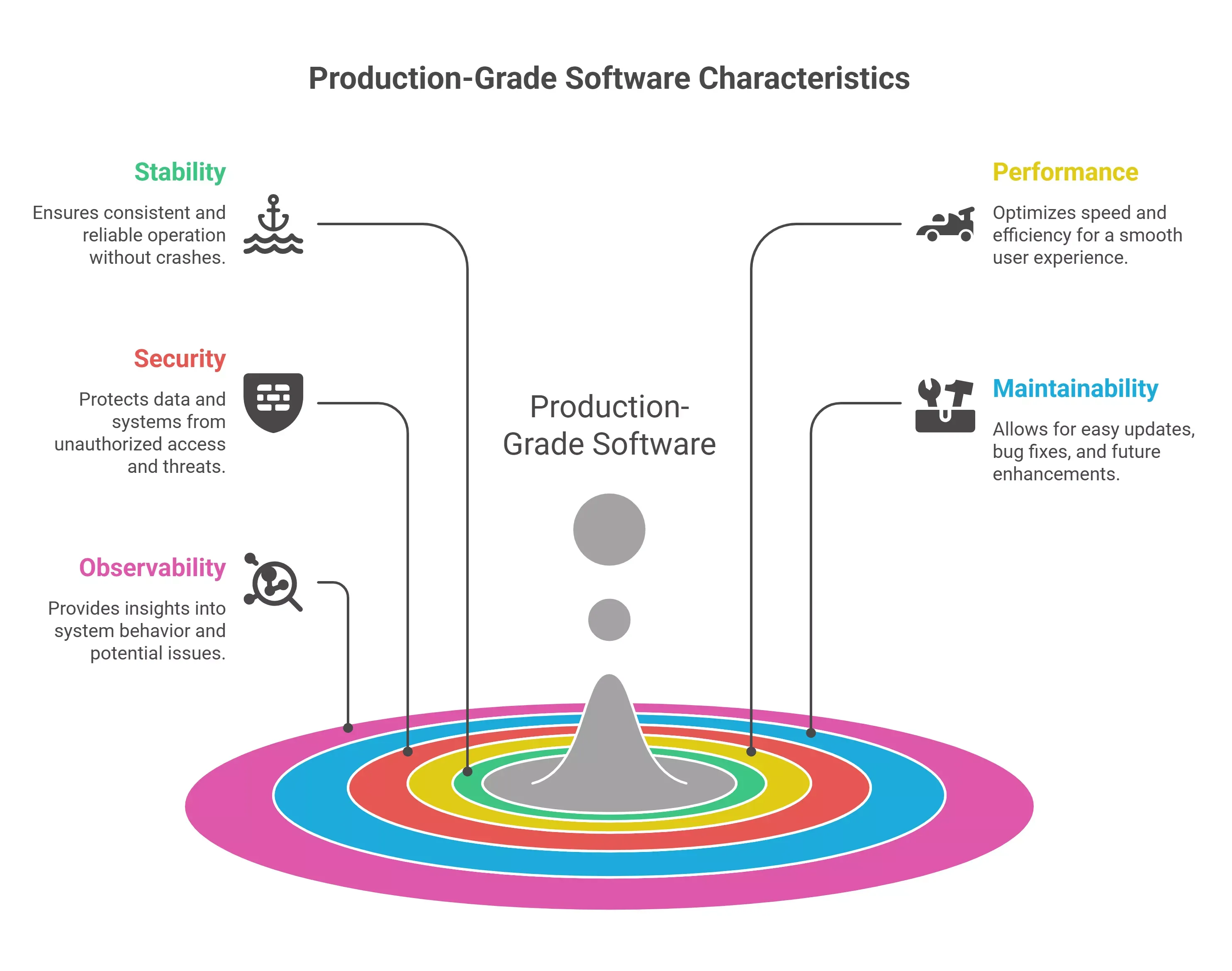
Production-grade software has five measurable characteristics: stability, performance, security, maintainability, and observability. Each one supports the others. Without observability, you cannot verify performance. Without stability, security becomes irrelevant when the system crashes.
Stability and Robustness
Production-grade code must handle real-world scenarios, not just the happy path. Concrete practices include:
- JSON Schema validation rejects malformed inputs before they reach business logic
- Idempotent handlers using UUID-based deduplication
- Jittered exponential backoff retry policies
- Dead letter queues route failed messages for replay instead of silently dropping them
Production-grade products are designed to handle edge cases and unexpected failures without breaking. High-quality test cases must cover these edge cases before going live.
Performance
Performance targets must be defined as acceptance criteria before launch, not after the first outage. For example, P95 latency under 300ms with 500 concurrent users. A customer support chatbot scaling to 10,000 sessions per hour during a product launch needs capacity planning done in v1.
Actionable steps for first-generation performance:
- Forecast load using existing analytics, planning for 2x peak traffic
- Load test to failure using tools like k6 or Locust
- Define SLOs with specific numbers tied to PagerDuty alerts
- Implement queue-based back pressure to prevent cascade failures
Security
Production-grade software requires real authentication, authorization, and data protection from the first user. Security controls that must be present from the start:
- TLS 1.3 enforcement on all traffic
- RBAC via providers like Auth0 controls access to every endpoint
- Secrets management with 90-day rotation schedules
- Audit logging with GDPR-compliant PII redaction
Zero-trust authentication from the first commit is non-negotiable. The cost of addressing security after users have data in your system grows exponentially.
Maintainability
Maintainability means engineers other than the original author can understand and safely modify the production code within months. Write software with clear module boundaries, architecture decision records, linting in CI, and versioned APIs from day one. Maintainability is a key aspect of production-grade software, emphasizing well-structured code that others can modify without archaeology.
Unit tests must be present and automated in CI. A realistic example: two weeks post-launch, product managers request a versioning feature. In a maintainable first generation, the team adds semantic API versioning without touching existing endpoints. Without these practices, the same request triggers a risky rewrite.
Observability
Observability is the first thing teams skip and the first thing they wish they had during an incident. Production-grade code requires:
- Structured logging with correlation IDs traceable across service boundaries
- Dashboards tracking P95 latency and error rates
- Alerts tied to SLO breaches
- Distributed tracing across all the steps of complex workflows
| Signal | Why Critical in V1 |
|---|---|
| Requests per Second | Detects saturation before users complain |
| P95 Latency | Flags regressions before they become incidents |
| Error Rate | Indicates SLO breaches requiring immediate action |
| Token Usage (AI) | Prevents cost overruns from runaway AI agents |
A team using Phoenix tracing on their first-generation RAG pipeline isolated a misconfigured retrieval step, causing 40% higher latency in 3 minutes. Without observability tools, MTTR averages 4 hours according to Honeycomb 2025 data.
What Does Production Grade Mean for AI Agents and Generated Code?
AI agents and multi-agent systems introduce failure modes that traditional software does not. Hallucinations, non-deterministic behavior, and token usage variability make evaluation and tracing necessary from the first release, not optional.
Guardrails in AI applications are mandatory for every production AI application. They prevent harmful outputs, protect user data, and keep generated code aligned with community guidelines. Responsible AI guardrails stop inappropriate content and make sure sensitive personal information is not used in training data.
Effective evaluations for AI agents rely on well-specified tasks, stable test environments, and thorough test cases for the generated code. Evaluating AI agents involves using code-based, model-based, and human graders to assess quality. Tracking regressions in model behavior requires the same observability infrastructure as any other production system.
Guardrails and evaluation results must be part of v1. Skipping them in AI systems is the equivalent of skipping schema validation in a data pipeline.
How Does Rocket.new Make Production Grade From the First Generation the Default?
Rocket 1.0 is the world's first Vibe Solutioning platform, built around three pillars: Solve, Build, and Intelligence.
| Pillar | What It Does | Production Grade Impact |
|---|---|---|
| Solve | Research, validate ideas, generate product strategy | Ensures teams build the right thing before writing the first line of code |
| Build | Generate production-ready Next.js and Flutter apps | Ships GDPR compliant, WCAG accessible, SEO ready by default |
| Intelligence | Track competitors, website changes, and traffic trends | Keeps production systems aligned with market reality post-launch |
Rocket.new ships starter templates with structured logging, autoscaling policies, and security scans preconfigured. Environment promotion workflows prevent POC code from reaching production. Cross-task context using @mentions maintains continuity across the full development arc.
CEO Vishal Virani put it directly: "Code generation has become a commodity. The real differentiator is helping users decide what to build and how to maintain a competitive edge after launch."
1.5 million people have tried Rocket across 180 countries.
Practical Checklist: Is Your First Generation Production Grade?
Before any real user touches your system, run through this:
- Do automated tests cover 80% of critical paths, including edge cases?
- Are SLOs defined with dashboards and alerts configured?
- Is RBAC implemented for all endpoints and data access?
- Are dead letter queues configured for graceful failure handling?
- Has the system been load tested to 2x forecasted peak traffic?
- Are traces, logs, and metrics configured for golden signals monitoring?
- Is an on-call rotation assigned with clear escalation paths?
- Are prompts and responses logged with privacy controls for AI systems?
- Has a hallucination evaluation run against a fixed dataset with under 5% failure rate?
- Are secrets stored securely with rotation policies?
- Are APIs versioned with documented migration paths?
- Is PII redacted from logs according to compliance requirements?
- Does a runbook exist covering common operational scenarios?
Build V1 for Real Users
Production-grade from the first generation means your first release is built for real users, not treated as a throwaway prototype. Stability, security, observability, and performance are included from day one, so the system can scale without requiring costly rewrites later.
As software complexity and AI-generated code increase, skipping these foundations only leads to technical debt and expensive rebuilds. Modern teams are shifting toward shipping correctly from the start, not fixing later.
Rocket.new makes this practical by embedding production-ready defaults into the build process itself.
Avoid rewrite, build for scale from the first release.
Table of contents
- -What is Production Grade Software?
- -How Does First-Generation Production-Grade Software Differ From a POC?
- -Why Do Teams Skip Production Grade Code in Early Releases?
- -What Are the Core Characteristics of Production Grade Software From Day One?
- -Stability and Robustness
- -Performance
- -Security
- -Maintainability
- -Observability
- -What Does Production Grade Mean for AI Agents and Generated Code?
- -How Does Rocket.new Make Production Grade From the First Generation the Default?
- -Practical Checklist: Is Your First Generation Production Grade?
- -Build V1 for Real Users