
Rocket.new’s AI campaign strategy tool transforms live competitor activity into actionable marketing briefs, helping teams identify trends, refine messaging, and launch high-performing campaigns faster with data-backed insights.
What makes an AI tool capable of building marketing briefs from live competitor activity?
It comes down to speed, data access, and smart processing. The AI Campaign Strategy Tool on Rocket.new uses real-time competitor activity and turns it into clear marketing briefs within minutes. It scans the market, tracks changes, and supports product strategy with structured insights.
According to a report by McKinsey, over 50% of companies have already adopted AI in at least one business function, including marketing, showing how fast adoption is growing.
This blog will help readers understand how the tool works, how it fits into real workflows, and how it can support better product strategy and faster campaign decisions.
Why do marketing teams struggle today?
Your team wants to launch a campaign. You need market research, competitor insights, pricing ideas, and a clear product strategy. Sounds simple at first. But once you get into it, things start getting messy.
What actually goes wrong?
-
Teams rely on too many tools for different tasks
-
Data is scattered across platforms and sources
-
Market research takes longer than expected
-
Competitive intelligence is often outdated by the time it’s ready
-
Pricing models are hard to track across competitors
-
Decision making becomes slow and unclear
And here’s the real issue.
By the time everything is collected and analyzed, the market has already shifted. That delay makes it harder for teams to stay relevant and act fast.
So, what does this mean?
This is exactly why AI tools are gaining attention. They help reduce manual work, bring insights together, and support faster decisions without the usual chaos.
What is the AI Campaign Strategy Tool on Rocket.new?
The tool is an AI powered system built on the Rocket platform that turns live competitor activity into structured insights. It connects data, analysis, and execution so teams can move faster without relying on manual market research.
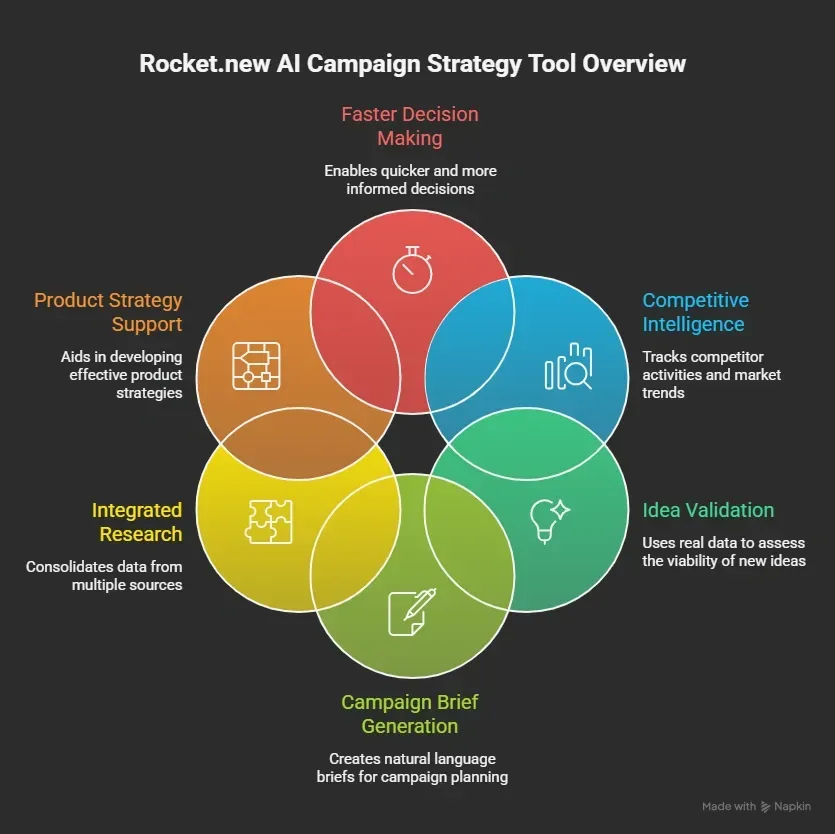 It works like a smart assistant that connects market research with execution. Teams can build faster, reduce time spent on analysis, and stay aligned with real time changes in the market.
How does it connect to product strategy?
Now let’s talk about something you care about if you're building anything. Product strategy. Good strategy needs real data. Not guesses.
This tool helps product teams:
-
Track shifts in the market
-
Understand pricing models
-
Spot new opportunities
-
Align campaigns with product direction
So instead of random decisions, teams make smarter choices backed by competitive intelligence. And honestly, that makes a huge difference.
How Solve on Rocket works?
So, here’s how everything comes together inside the rocket platform.
Solve is designed to take scattered inputs and turn them into structured outputs that teams can actually use without wasting time.
Step 1: Input and context
You start by adding a prompt, goal, or idea. You can also attach a doc, links, or notes to give better direction.
Step 2: Data gathering
The platform collects data from web apps, mobile apps, internal tools, and even third party sources. Everything is pulled into one place.
Step 3: Signal detection
It scans the data to find useful market signals like competitor moves, pricing changes, and campaign trends.
Step 4: AI analysis
Using AI models, the system processes the data and turns it into structured insights that support product strategy.
Step 5: Brief and output generation
It creates a clear output using natural language, including:
-
Target audience
-
Messaging
-
Positioning
-
Suggested campaigns
Step 6: Final output
You get everything organized in one place without jumping across tools.
By that, you spend less time collecting data and more time building campaigns and making decisions and the whole process works smoothly.
Key features
The platform is designed to bring research, insights, and execution together. It focuses on simplicity while covering multiple use cases for teams.
Core features include:
-
Context-based input system: Accepts prompts, docs, and links so outputs stay relevant and accurate.
-
Integrated research capability: Combines multiple data sources to reduce manual market research effort.
-
AI powered output generation: Creates structured briefs and insights that teams can act on quickly.
-
Analytics support: Tracks patterns and trends to support better decision making.
-
App builder functionality: Helps build web apps, mobile apps, and internal tools for product teams.
This setup replaces scattered workflows with a single platform. Teams spend less effort managing tools and more time building.
How do teams actually use it?
Different teams use the platform based on their roles and goals. The focus stays on faster execution and better clarity.
Marketing teams use it to:
-
Build campaign strategies
-
Analyze pricing models and trends
-
Improve overall product strategy
Product teams use it to:
-
Validate ideas early
-
Track competitors using competitive intelligence
-
Plan product launches with better insights
Founders and small teams use it to:
-
Build and test ideas quickly
-
Reduce time spent on research
-
Identify new opportunities in the market
The result is faster execution with better clarity. All required insights stay in one place, reducing delays.
Where it fits in your workflow
The platform acts as a central layer within existing workflows. It connects different tools and simplifies how teams operate.
It works by connecting:
-
Internal tools already used by teams
-
Third party tools for additional data
-
Analytics dashboards for insights
This reduces unnecessary switching between tools. Workflows become simpler and more focused on execution. Teams gain more time to build and act on insights. The overall process becomes cleaner and easier to manage
Why competitive intelligence matters now?
The market moves fast. Really fast. If your team is not tracking competitors, you’re already behind.
Competitive intelligence helps you:
-
Spot trends early
-
Adjust pricing models
-
Improve product strategy
-
Make better decisions
And the best part? You don’t need a full research team anymore. The platform handles it.
What experts are saying
Here’s something interesting from a real discussion.
“Everyone is using AI for marketing now… the smart teams aren’t just prompting ChatGPT, they’re feeding it competitive intelligence.” Linkedin
This highlights a clear shift in how teams approach marketing today. Instead of using AI just for content, teams are using it to analyze competitors, track market activity, and build smarter strategies.
The role of AI in building faster
AI changes how teams handle data and execution, reducing manual effort and helping them move from idea to action much faster. It removes unnecessary complexity and keeps the focus on results instead of process.
Here’s what that looks like in practice:
-
Less dependency on manual code work: Teams don’t need to write code just to analyze data or generate insights.
-
Faster strategy building: AI tools help teams build strategies without long research cycles.
-
Competitor analysis made simple: Insights on competitors are generated without heavy manual effort.
-
Quick brief creation: Campaign briefs are structured and ready to use in less time.
-
Flexibility for advanced users: Developers can still write code and customize workflows when needed.
This approach balances simplicity and control, making it useful for both beginners and experienced teams. It allows teams to build faster while still keeping flexibility where needed.
Rocket and app building
Rocket supports both planning and execution, making it more than just a strategy platform. It connects ideas directly to development so teams can move forward without delays.
What you can build:
-
Web apps for different use cases: Teams can build web apps aligned with their product strategy.
-
Mobile apps for broader reach: Helps create mobile apps that connect with users on different devices.
-
Internal tools for team workflows: Supports building internal tools to improve operations and processes.
-
End-to-end product development support: Moves from idea to execution without switching platforms.
This setup helps teams go from concept to launch without breaking their workflow. It keeps everything connected so product strategy and execution stay aligned.
Pricing and scalability
Pricing is designed to support teams as they grow, without forcing them to rely on multiple tools. Everything is grouped into one platform, which makes planning and scaling easier.
What is included:
-
Research capabilities: Access to market research without extra tools
-
Analytics features: Insights to track performance and trends
-
Campaign tools: Support for planning and execution in one place
Pricing usually depends on:
-
Team size: Plans scale based on how many people are using it
-
Data usage: Higher usage may affect pricing levels
-
Feature access: Different tiers unlock different capabilities
This model supports scalable growth without adding complexity. Teams can expand smoothly without constantly changing their setup.
Real time insights and faster decisions
Real time insights help teams act faster and reduce delays in execution. Instead of waiting for reports, teams can respond immediately to changes in the market.
With real time data, teams can:
-
Adjust campaigns quickly: Changes can be made based on live market activity.
-
React to competitors faster: Competitive intelligence keeps teams updated.
-
Improve decision making: Decisions are based on current data instead of outdated insights.
-
Reduce research time: Less time spent collecting data manually.
-
Focus more on execution: More effort goes into building and launching.
This improves how teams operate daily. More speed and clarity lead to better outcomes across projects.
From research to execution in one place
Workflows used to be scattered across different tools, which made things slow and disconnected. Teams had to manage separate systems for research, planning, and execution, which added unnecessary friction.
-
Research was handled separately, so teams depended on multiple tools for market research
-
Strategy was built in isolation, which made product strategy less connected to real data
-
Execution happened on different platforms, creating gaps between planning and action
-
Market research is now centralized, with data available in one place
-
Competitive intelligence is integrated directly into the workflow
-
Campaign planning stays connected with execution instead of being split
-
Analytics supports every step, helping teams track and adjust as they go
This shift brings everything together and removes delays between steps. Teams can now move smoothly from research to execution without breaking their workflow.
When should you use AI here?
AI works best when speed and clarity are needed, especially in tasks that involve large amounts of data or repetitive work. It helps teams simplify processes without losing control.
Use AI when:
-
Quick insights are required: Data needs to be processed without delays.
-
Ideas need testing: Validation can happen faster.
-
Campaigns need to be built quickly: Short timelines require faster execution.
-
Workflows need simplification: Less manual effort improves productivity.
-
Decisions need support: Data-backed insights guide better outcomes.
AI supports the process but does not replace human thinking. Teams still make the final decision based on context and goals.
How to get started?
Getting started is simple and does not require a long setup process. The platform is designed so teams can begin quickly and focus on building.
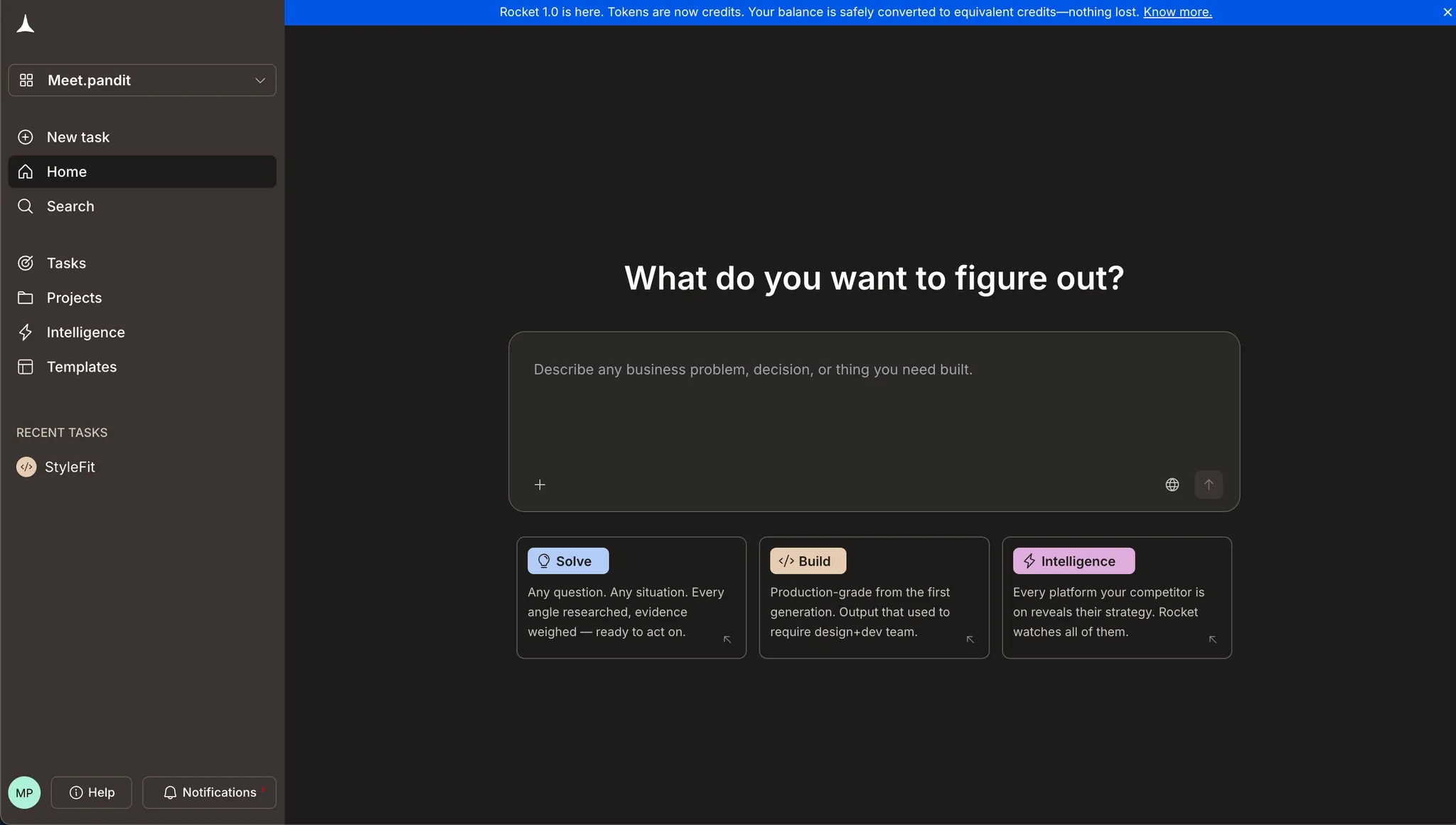
Basic steps:
-
Sign up on Rocket: Create your account and access the platform.
-
Connect your data sources: Link tools and systems to gather insights.
-
Start tracking competitors: Monitor market activity and trends.
-
Generate your first brief: Use Solve to create a structured output.
This approach helps teams start quickly without friction. It keeps the focus on action instead of setup.
Smarter Campaign Planning with AI
Teams often deal with scattered tools, slow market research, and unclear product strategy, which delays campaigns and creates confusion. The AI Campaign Strategy Tool on Rocket.new solves this by bringing everything into one platform. It uses real time data, competitive intelligence, and AI driven insights to generate structured marketing briefs quickly.
This means less time spent collecting data and more time building campaigns. Teams can make faster decisions and stay aligned with the market. Overall, it helps simplify workflows and keeps the focus on execution without adding unnecessary complexity.
If you want to plan smarter campaigns without delays, you can try the AI Campaign Strategy Tool on Rocket.new to generate briefs, test ideas, and align your strategy before execution.
Table of contents
- -Why do marketing teams struggle today?
- -What is the AI Campaign Strategy Tool on Rocket.new?
- -How does it connect to product strategy?
- -How Solve on Rocket works?
- -Key features
- -How do teams actually use it?
- -Where it fits in your workflow
- -Why competitive intelligence matters now?
- -What experts are saying
- -The role of AI in building faster
- -Rocket and app building
- -Pricing and scalability
- -Real time insights and faster decisions
- -From research to execution in one place
- -When should you use AI here?
- -How to get started?
- -Smarter Campaign Planning with AI