Compliance — Certified Construction Safety Landing Page Template
The Compliance landing page template is built for construction safety consultants who turn active job site risks into documented, inspection-ready programs. It features a credential-first logo bar, a four-phase modular card grid, and an inline five-question compliance assessment that scores visitor sites in under two minutes and gates a PDF gap analysis report behind a short lead form.
by Rocket studio
Quick summary
This is a single-page lead generation template for a construction safety consultant practice. It opens with a credential bar, moves through a phased card grid covering every stage of a safety program buildout, and closes with an inline compliance quiz that converts curious visitors into qualified leads. The design is authoritative, structured, and built to move fast on desktop and mobile alike.
Who this template is for
Construction safety consultants need a page that speaks directly to the people who sign the work orders. This template is designed for exactly that audience and context.
- General contractors managing multi-trade construction sites who need documented safety programs before an inspection arrives
- Project managers at commercial developers responding to a near-miss report and looking for immediate corrective actions
- Safety officers at mid-size firms who have inherited outdated job safety analyses and need to rebuild site safety from the ground up
What problem this template solves
Construction site safety documentation is often fragmented, reactive, and inconsistent. Site managers and safety officers face real pressure to ensure compliance with safety regulations before a citation lands, not after. This template gives consultants a page that mirrors that urgency and builds trust immediately.
- Visitors arrive with unresolved risks and hazards and no clear path to outside help; this page gives them one structured entry point
- The quiz-first flow lets them identify potential hazards and measure their own exposure before committing to a call
- Without a structured lead flow, consultants lose high-intent visitors who would rather self-assess than fill out a generic contact form
What you get with this template
The template delivers a complete, single-page lead generation system built around a compliance self-assessment. Every section earns its place and moves the visitor closer to a decision.
- A credentials-first logo bar, a four-phase modular card grid, an inline five-question quiz with a live compliance score gauge, a gated PDF lead form, a social proof stats bar, and a linear single-row footer
- Two distinct call-to-action paths: the primary "Score Your Site in 2 Minutes" quiz and a secondary "Request Site Walk" button for visitors ready to skip straight to contact
- DM Sans headings, JetBrains Mono stat displays, card flip animations, scroll reveal, staggered card entrances, and a persistent mobile bottom bar for the primary call to action
Feature list
This template is built around four functional layers that work together to turn site visits into qualified leads.
Credential-First Logo Bar
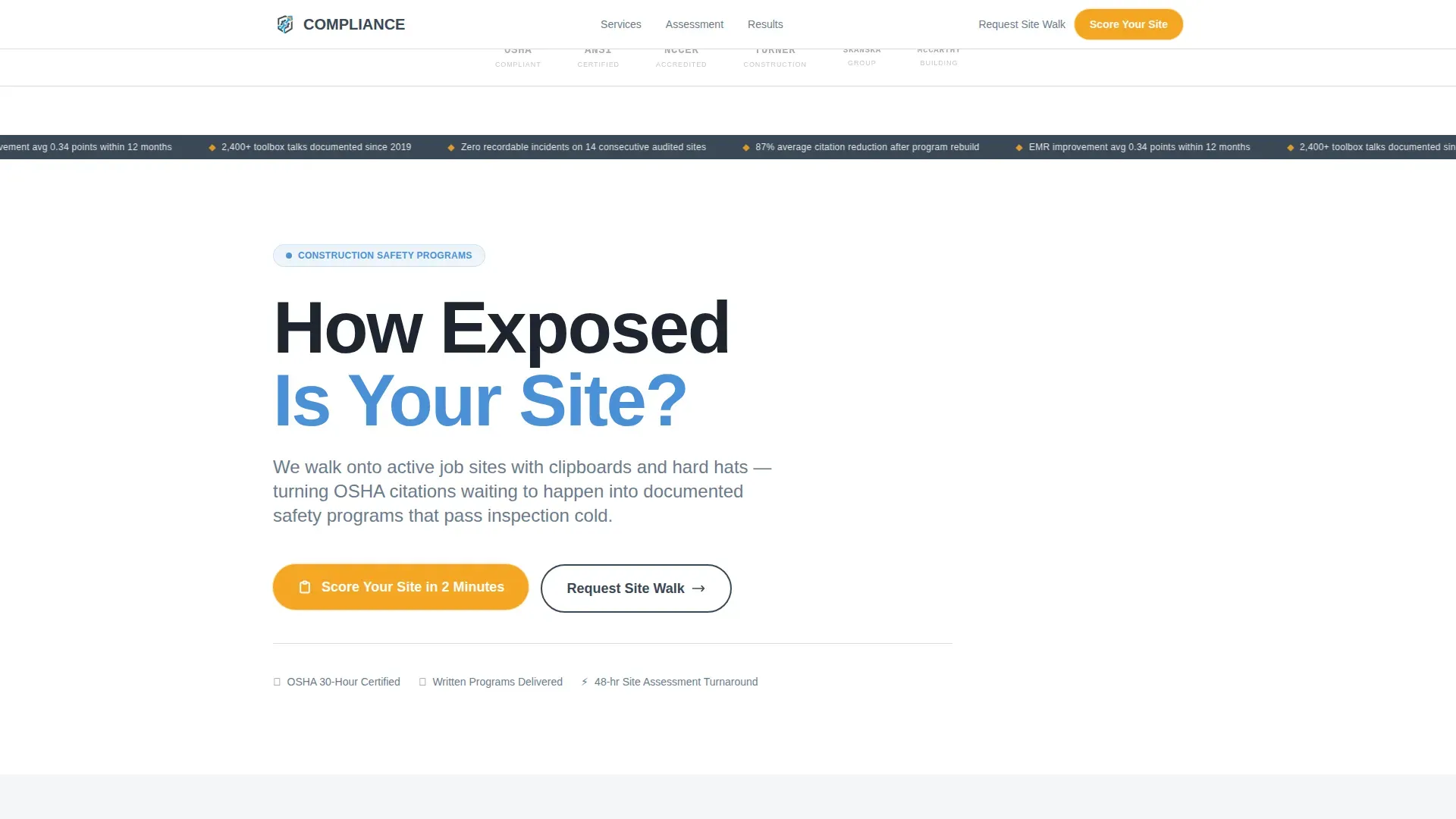
The header opens with a horizontal band of trusted marks rendered in monochrome slate on white. No hero image, no stock photography. The restraint communicates that this consultant leads with proof. Below the bar, a single bold line reads: "How Exposed Is Your Site?" This framing immediately frames site safety as the visitor's active concern, not an abstract topic.
Four-Phase Modular Card Grid
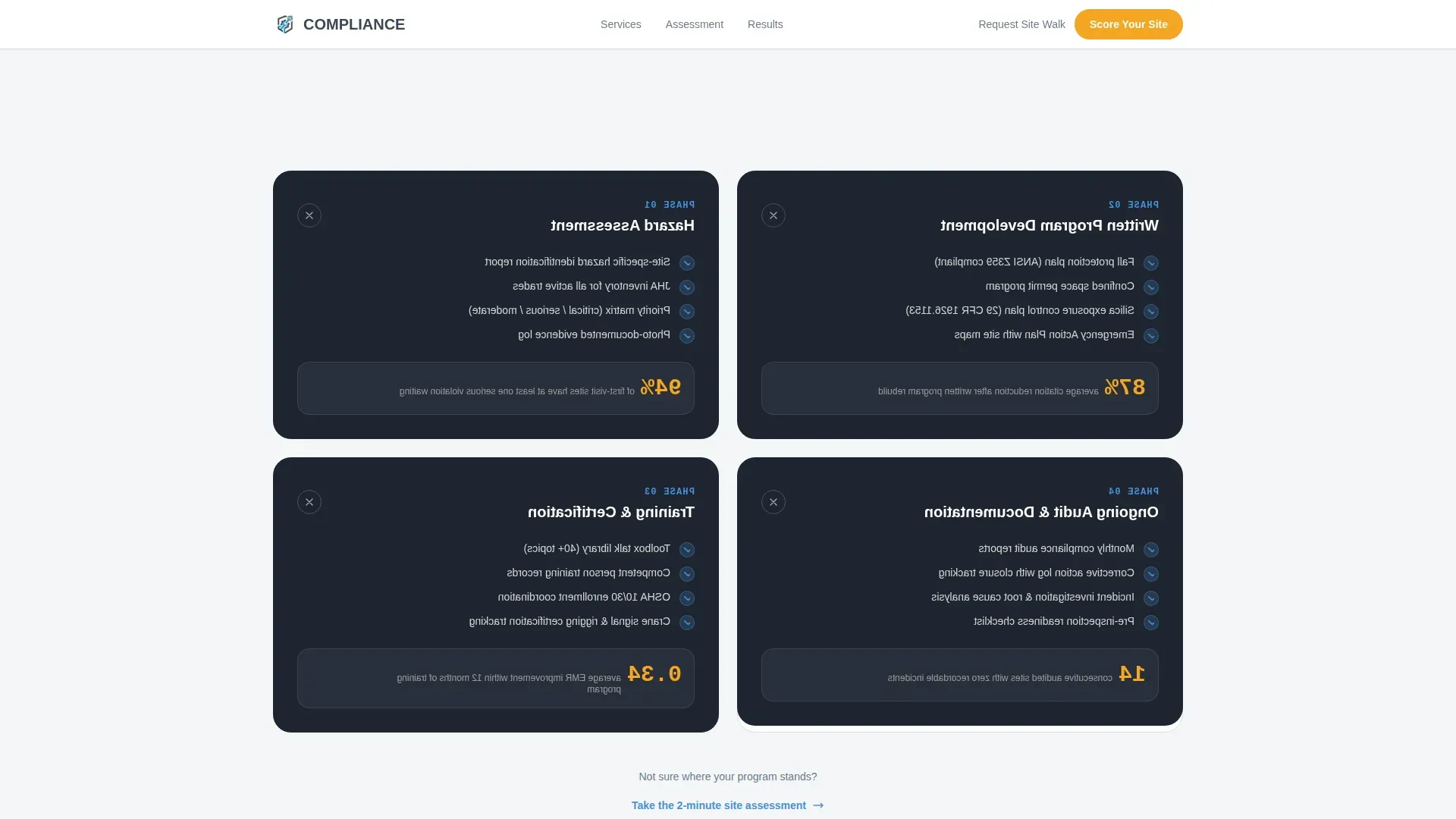
Each of the four cards represents one phase of a full safety program buildout: Hazard Assessment, Written Program Development, Training and Certification, and Ongoing Audit and Documentation. Cards flip or expand on click to reveal scope details, deliverables, and real performance statistics including citation reduction percentages and Experience Modification Rate (EMR) impact numbers. The scroll experience mirrors the process of watching disorganized construction sites get brought into systematic compliance, card by card.
Inline Compliance Quiz with Live Score Gauge
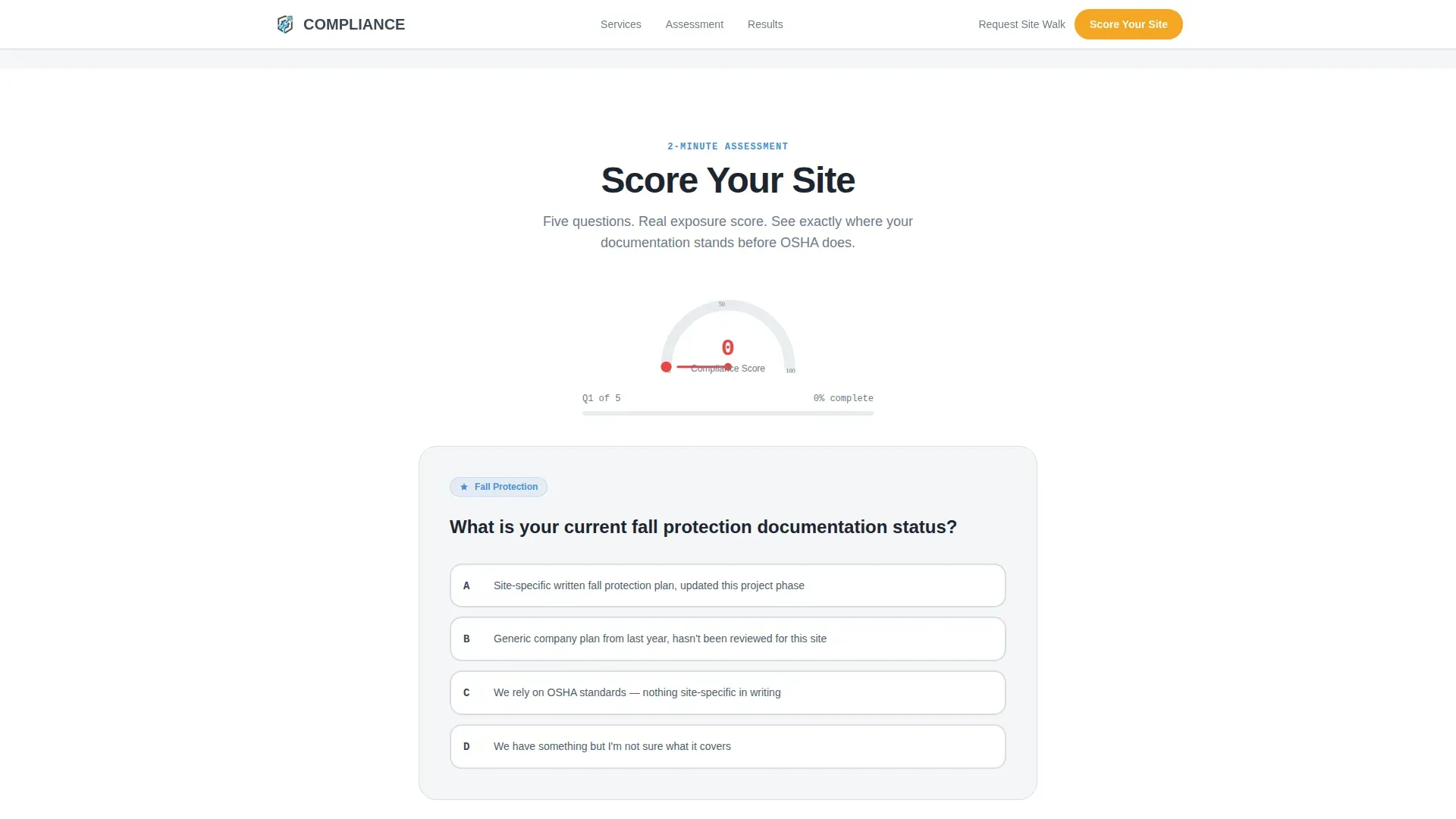
The five-question assessment covers fall protection documentation, confined space permitting, silica exposure programs, crane signal protocols, and emergency action plan currency. Each answer visibly adjusts a compliance score gauge in real time. A compliance score is a numerical metric, typically expressed as a percentage, that measures how well an organization meets its regulatory, safety, and operational obligations. Scores at 95 percent or above indicate excellent audit readiness, while scores below 80 percent flag the organization as at risk.
Gated PDF Lead Form
On quiz completion, the visitor sees a letter grade and a one-paragraph risk summary. To unlock the full PDF gap analysis, they submit their company name, project type (commercial, industrial, residential, or infrastructure), and email address. This gate converts safety data interest into a captured, qualified lead without friction before the visitor has demonstrated intent.
Social Proof Stats Bar and Testimonials
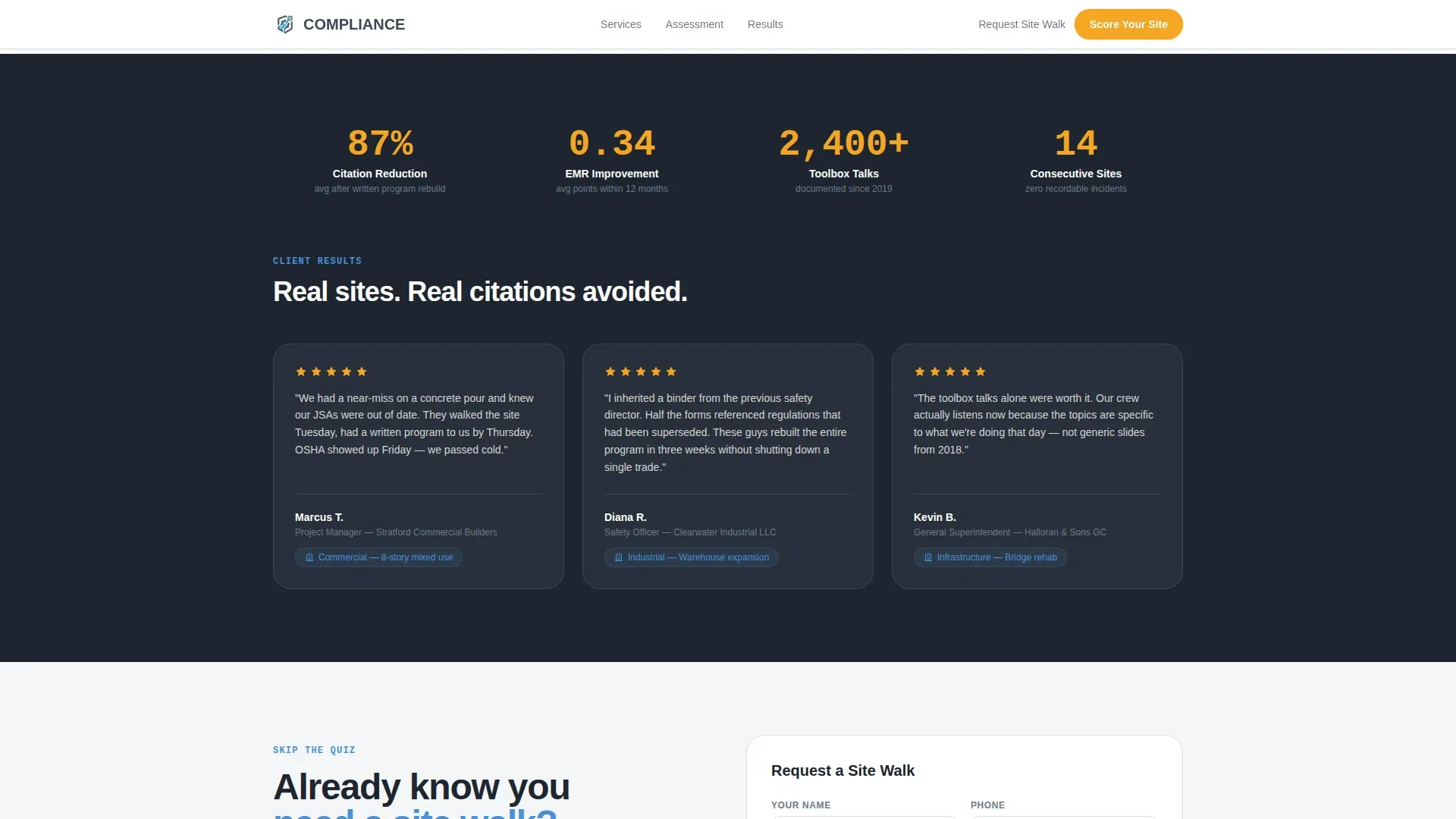
A dedicated stats section displays EMR reduction numbers, citation reduction percentages, and short testimonial quotes from general contractor clients. Displaying a high compliance score and verified client outcomes on a landing page acts as social proof and differentiates the consultant from competitors who only make promises.
Page sections overview
| Section | Purpose |
|---|---|
| Credential logo bar | Open with trusted marks |
| Hero call to action | Frame site exposure risk |
| Phase card grid | Show program buildout phases |
| Card flip reveal | Surface deliverables and stats |
| Inline quiz assessment | Score visitor site live |
| Compliance score gauge | Visualize risk in real time |
| Results and grade | Summarize exposure level |
| PDF lead gate form | Capture qualified lead data |
| Social proof bar | Display EMR and citation stats |
| Client testimonials | Reinforce consultant credibility |
| Linear footer row | Close with contact options |
Design & branding system
The visual identity follows a Corporate Precision theme. Every element is structural and purposeful, with no decoration that does not earn its place. The palette feels like looking up from a steel frame on a clear morning: hard gray below, calm authority above, and one unmissable flash of safety orange reserved exclusively for calls to action.
- Colors: structural slate (#3B4856) as the primary base, poured-concrete mid-gray (#6B7B8D) for supporting text, open-sky blue (#4A90D9) for secondary elements, and high-visibility orange (#F5A623) used only for call-to-action buttons and warning-state indicators
- Typography: DM Sans for all headings and body copy, JetBrains Mono for all statistics, compliance scores, numeric grades, and data readouts to give numbers a technical authority
Mobile & speed optimization
The template is built desktop-first, with a dedicated persistent mobile experience for the primary call to action. The design keeps interactive components scoped to only the sections that require them, keeping the rest of the page static and lightweight.
- A persistent bottom bar on mobile keeps "Score Your Site in 2 Minutes" visible at all times, so visitors on phones and tablets never lose the primary entry point
- Card flip animations, scroll reveal, staggered card entrances, and the live gauge animation use CSS and scoped client components, keeping the static frame fast while enabling the high-interactivity quiz flow
How this template helps you convert
The page is structured to reduce hesitation and move visitors from passive reading to active engagement at two distinct decision speeds.
- The inline quiz creates a low-commitment first step: five questions, a live score gauge, and a letter grade give the visitor something of immediate value before any personal information is requested, making the lead gate feel like a fair exchange rather than a barrier.
- The "Request Site Walk" secondary button gives high-intent visitors, those who already know they need help, a direct path that bypasses the quiz entirely, so no qualified lead is lost because the primary flow felt like extra work.
Other information about this template
This template is purpose-built for the construction safety consulting niche, where consistent reporting, thorough documentation, and clear communication are the difference between a smooth inspection and a serious citation.
- The daily site safety report model is baked into the template's value narrative. A daily site safety report is a structured document used to record all safety-related observations and activities on site. A proper daily safety report covers basic information such as project details, manpower count, work activities, personal protective equipment usage (PPE usage), hazards observed, fire safety checks, weather conditions, first aid kits and aid kits status, fire extinguishers condition, and incident reports. Users can add comments and attach photos to support clear documentation and the reporting process.
- The daily safety report template approach is referenced throughout the template's phase cards and results content. Using a consistent daily safety report template helps site teams save time, reduce errors, and ensure compliance across all construction projects.
- Maintaining a proper daily safety report helps in preventing accidents, tracking safety performance, and improving communication between site managers and management. Consistent reporting creates a safer work environment and builds trust between workers and clients.
- The template's compliance score logic reflects how scores are calculated in practice. Leading indicators, which make up roughly 45 percent of a compliance score, include safety programs, management systems, and proactive initiatives. Lagging indicators account for approximately 55 percent and include the Total Recordable Incident Rate (TRIR), Days Away, Restricted or Transferred (DART) rate, and EMR.
- High compliance scores help contractors win more bids, reduce insurance premiums, and attract better talent. For enhanced credibility, construction safety consultant pages should prominently display active licenses, certifications, and trade organization memberships, as this template does through its logo bar.
- Safety audits help identify potential hazards and ensure compliance with safety regulations. Conducting a safety audit involves reviewing safety policies, identifying key personnel, and evaluating safety equipment. Regular safety audits improve safety culture across commercial and industrial sites.
- Contractor Safety Plan Templates provide clarity, compliance, and action for safety management. These templates help create thorough plans that include ways to reduce risk and emergency response routines. They also ensure that contractors follow the same safety rules as internal staff, supporting proactive risk management across all operations.
- Non compliance issues on construction sites can result in regulatory citations, increased EMR, and project delays. This template gives consultants a structured way to surface those risks before they become workplace incidents.
- Environmental compliance and emergency preparedness are addressed within the phase card content areas. Safety protocols for confined spaces, crane operations, and silica exposure are part of the quiz question set, reflecting real regulatory requirements on active construction sites.
- The page supports compliance assessments across project types: commercial, industrial, residential, and infrastructure. Risk assessments, corrective actions, and safe operation standards are embedded in the phase card deliverables and quiz result summaries.
Theme
Corporate Precision
Creative direction
Step-by-Step Guide
Color system
Slate & Sky
Style
Card Grid (Modular)
Direction
Quiz/Assessment
Page Sections
Credential-first Logo Bar Header
Four-phase Modular Card Grid
Inline Compliance Quiz with Live Gauge
Gated PDF Gap Analysis Lead Form
Social Proof Stats Bar and Testimonials
Related questions
What is the primary call to action on this landing page?
Who is the target audience for this landing page template?
What sections are included in this landing page template?
Can this template be used for different construction project types?
What makes the compliance score feature credible to site visitors?