AI Voice Order Management Landing Page Template
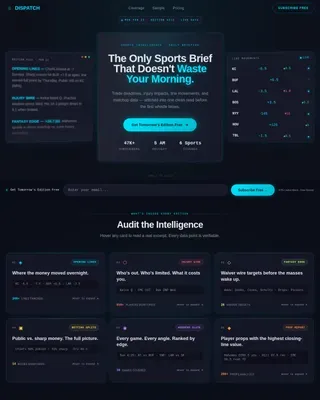
Dispatch is a dark-themed, dashboard-style landing page template built for AI voice order management tools in the food and beverage space. It pairs a living metrics wall, a twelve-metric comparison grid, flip-card case studies, and a savings calculator into one high-impact, single-page flow. Restaurant operators see the numbers before they read a single headline.
by Rocket studio
Quick summary
Dispatch is a single-page, dashboard-style landing page template for AI voice agents handling restaurant order management. It opens with real-time ticking counters, moves through a head-to-head comparison grid, and closes with a personalized savings calculator. Every section adds a new data point. By the final scroll, the business case builds itself.
Who this template is for
This template is purpose-built for teams selling or launching an AI voice order management platform in food and beverage. It speaks directly to operators who lose revenue on unanswered calls and need proof, not promises.
- Multi-unit franchise operators running five to fifty locations who need to scale call handling without adding staff
- Independent restaurant owners who lose customers after 9 PM because no one is available to answer the phone
- Ghost kitchen networks running multiple brands from a single number who need efficient, always-on voice agents
What problem this template solves
Missed calls during dinner rush are silent revenue leaks. Standard website pages cannot show that loss in real time, and operators are skeptical of claims without data. This template replaces generic copy with live-state metrics that make the problem immediate and the solution arithmetic.
- Operators cannot visualize how much revenue AI agents recover until a side-by-side comparison shows it in one grid
- Visitors leave landing pages without acting because they never connect abstract features to their specific call volume and costs
- Generic templates cannot communicate the speed and accuracy that voice AI delivers in a high-pressure kitchen environment
What you get with this template
You get a complete, ready-to-customize single-page layout that turns skeptical operators into trial sign-ups. Every section is structured to move a visitor from awareness to a clear request for more information.
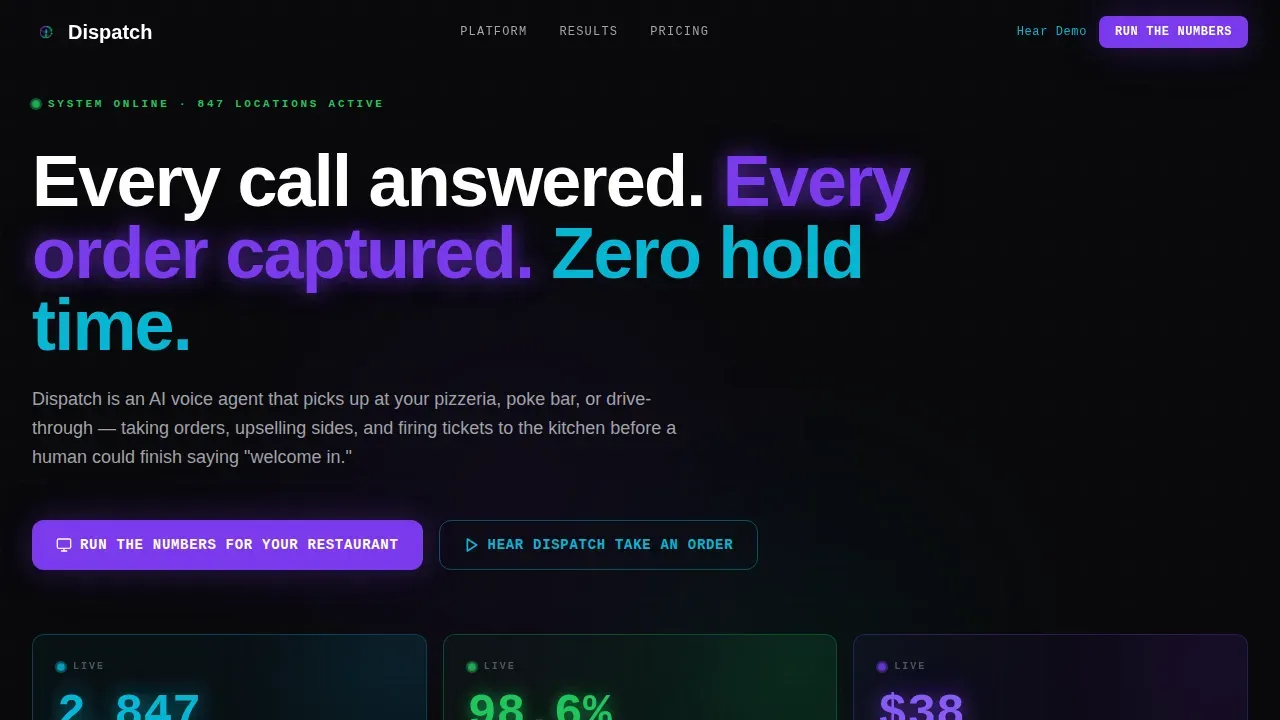
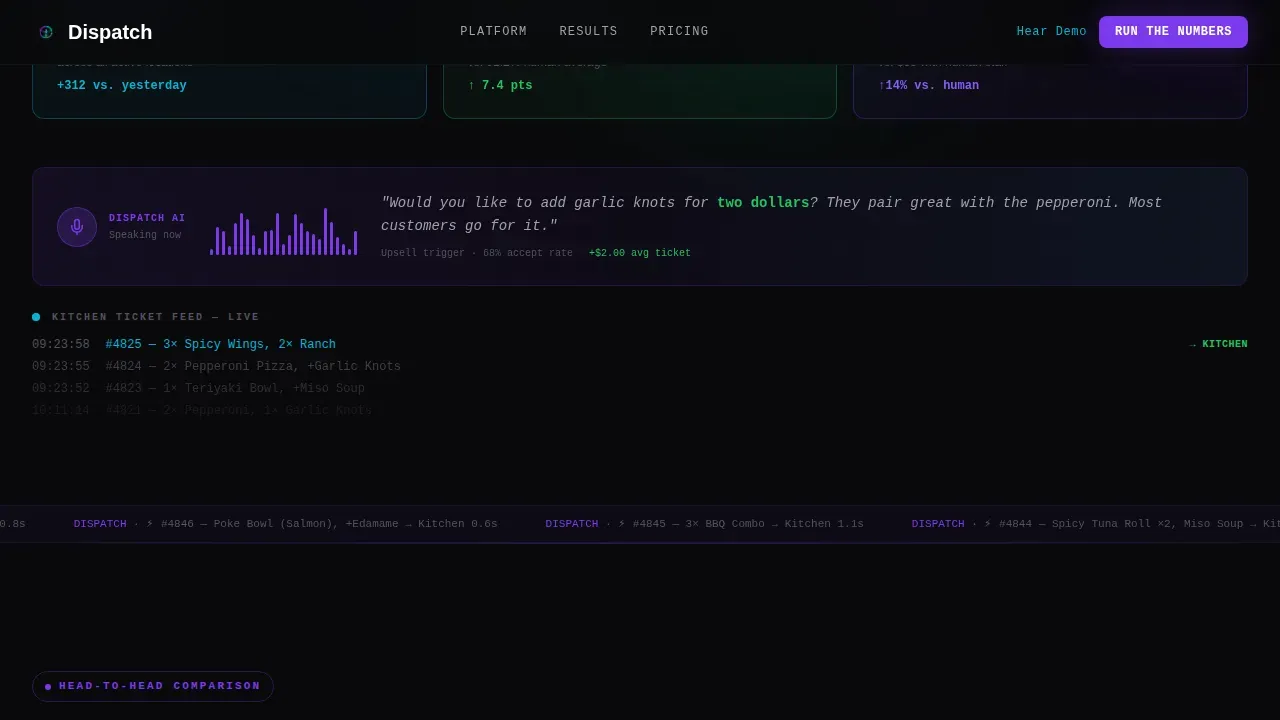
- A living metrics wall with three ticking stat cards and a waveform audio demo in the hero section
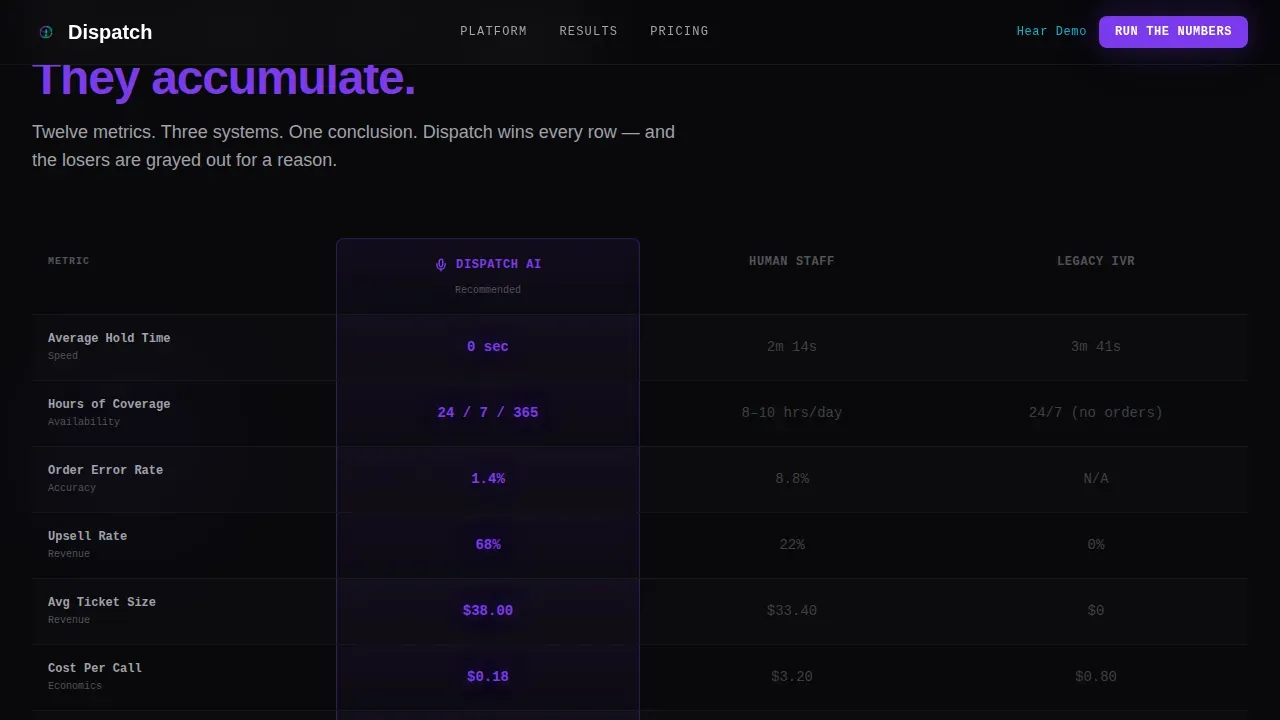
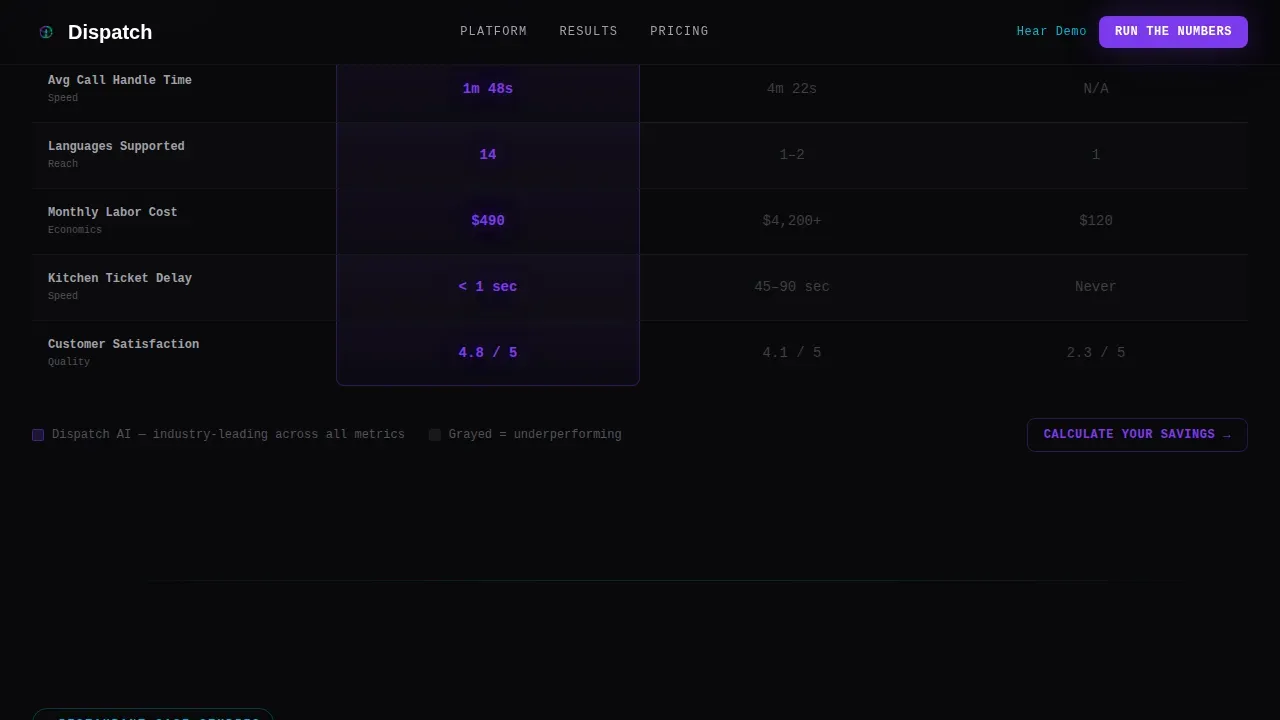
- A twelve-metric comparison grid pitting the AI agent against human staff and legacy interactive voice response systems
- Flip-card case study panels showing revenue lift, labor savings, and call volume data for individual restaurants
- A calculator modal where users enter call volume, average order size, and staffing cost to receive a projected savings estimate
- A social proof section with a logo wall and operator testimonials that include quantifiable results
Feature list
This template ships with purpose-designed components that reflect how voice AI actually sells. Each block is built for the specific use cases operators care about most.
Living Metrics Wall with Real-Time Counters
The hero section opens with three oversized stat cards rendered in monospaced type on void black. Numbers tick upward in real time, showing orders taken, accuracy rate, and average ticket lift. A waveform visualizer plays a real AI voice snippet so visitors hear the agent before they read a single word.
Twelve-Metric Comparison Grid
The core comparison section presents the AI agent alongside human staff and legacy interactive voice response systems across twelve performance dimensions. Metrics include average hold time, upsell rate, order error percentage, cost per call, and hours of availability. Losing columns are visually grayed out; the AI agent column glows in holographic violet so the winner is unmistakable.
Flip-Card Case Study Panels
Individual restaurant stories are presented as mini-dashboard cards. The front of each card shows a headline metric. Flipping the card reveals the full data story: revenue lift, labor savings, and call volume handled. This format keeps the page clean while rewarding visitors who want deeper details before submitting a request.
Savings Calculator Modal
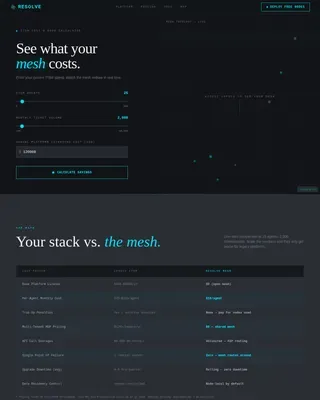
The primary call to action opens a modal where operators enter their specific data. They input monthly call volume, average order size, and current staffing cost. The system returns a projected savings estimate, making the business case personal and concrete. This is how the template transforms a general pitch into a specific number a user can take to their team.
Audio Demo Trigger
A secondary call to action labeled "Hear Dispatch Take an Order" plays a one-tap audio demo with zero form fill required. Visitors experience the voice agent responding naturally to a real order request. This single interaction does more to build trust than several paragraphs of feature copy.
Social Proof Section with Logo Wall
Operator testimonials with specific revenue metrics sit alongside a logo wall of recognizable brand names. Testimonials that include quantifiable outcomes, such as labor cost reductions or call volume increases, build credibility in ways that generic quotes cannot. The section is structured to support training new visitors on real outcomes without overpromising.
Page sections overview
| Section | Purpose |
|---|---|
| Hero Metrics Wall | Opens with live-ticking stats and waveform audio demo |
| Comparison Data Grid | Benchmarks AI agent versus. human staff versus. legacy IVR |
| Case Study Cards | Flip-card panels with per-restaurant revenue data |
| Calculator Modal call to action | Personalizes ROI estimate from user inputs |
| Social Proof Row | Logo wall plus quantified operator testimonials |
| Footer | Single-row linear layout with secondary navigation |
Design & branding system
The visual identity channels a dark POS terminal aesthetic. Every color carries a specific meaning, like a live status display, so visitors read the interface as a system that is already running.
- Void black (#09090B) as the background makes every data point feel like a live feed on a kitchen screen
- Holographic violet (#7C3AED) anchors headlines, the agent comparison column, and interactive elements to reinforce brand identity
- Electric cyan (#06B6D4) marks data in motion; signal green (#22C55E) pulses on conversion metrics and live-state indicators
- JetBrains Mono handles all numbers and data displays; Manrope handles body copy and headlines for a clean contrast between precision and readability
Mobile & speed optimization
The template is desktop-first, reflecting that franchise operators and multi-location business teams typically evaluate tools from a workstation during business hours. Full mobile support is included so the page renders correctly when staff or customers access it on the go.
- Scroll-reveal animations use IntersectionObserver so elements load only when they enter the viewport, keeping the page responsive
- Counter animations use optimized request animation frame loops to keep ticking numbers smooth without degrading performance
- The layout adapts to smaller screens without losing the comparison grid or calculator modal functionality
How this template helps you convert
This template is built as a comparison and versus engine. Every scroll adds evidence. By the time a visitor reaches the call to action, the decision feels like arithmetic rather than a leap of faith.
- The metrics wall opens with immediate proof, showing live order counts and accuracy rates before a visitor has scrolled once, eliminating the need for waiting through a slow brand introduction
- The comparison grid does the convincing by placing all twelve metrics in one view, so operators can focus on the numbers most relevant to their processes without hunting for details
- The calculator modal makes the pitch personal, converting a general value proposition into a specific monthly saving tied to each user's actual call volume and staffing cost
Other information about this template
This template is flexible enough to support a range of use cases beyond pizzerias and poke bars. Developers can customize the code to tailor the agent persona, swap in different voice snippets, and adjust scheduling or reminders copy to match a specific brand. The platform this template represents uses large language models to enable the agent to understand context and conversational language, not just rigid pre-set commands.
- The agent can actively access order history and user preferences to personalize responses, reducing errors and improving the customer experience
- Agentic AI represents a new generation of autonomous AI agents that can interact with APIs, analyze data, and make decisions in real time, handling multi-step workflows without manual data entry
- Teams can start building from this template free of charge and sign up to access the full platform, with pricing, billing, and refund details available on the main website pages
- The template supports integration context for POS systems and delivery apps, and the comparison grid can be updated to reflect two-way sync with popular dispatch tools
- Customer support and follow-up workflows can be added as additional landing pages within the same visual system, extending the platform without maintaining a separate design language
- Free templates like this one accelerate the development of AI agents by providing a proven blueprint, so your team spends less time on layout and more time on the processes that drive revenue
Theme
Startup Velocity
Creative direction
Stats-First Impact
Color system
AI Iridescent
Style
Dashboard/Data Grid
Direction
Comparison/Versus
Page Sections
Living Metrics Wall with Audio Demo
Twelve-metric Comparison Grid
Flip-card Case Study Panels
Personalized Savings Calculator Modal
One-tap Audio Demo
Quantified Social Proof Section
Related questions
Can I customize the metrics and copy in the comparison grid?
Does the calculator modal require a backend to function?
How does the audio demo work on mobile devices?
Is this template suitable for a ghost kitchen running multiple brands?
What skills do I need to edit and launch this template?