DNA Data Storage Open Source Landing Page Template
Encode is a dashboard-style landing page template built for open-source DNA data storage projects. It combines dark glass panel headers, a masonry module grid, animated benchmark charts, a contributor wall, and a roadmap timeline into one high-energy single-page layout. The Void & Violet color system gives it a bioluminescent, terminal-at-midnight visual identity that feels alive and technically credible.
by Rocket studio
Quick summary
Encode is a single-page dashboard template designed for open-source DNA data storage projects. It pairs a dark, void-black canvas with deep violet and phosphor lilac accents to create a look that feels both scientific and electric. Live-formatted metric panels, a masonry module grid, animated benchmarks, and a sticky call-to-action bar make the page feel active from the first scroll.
Who this template is for
This template is built for technically minded builders who want their open-source project to look as serious as the science behind it. It speaks directly to contributors, collaborators, and curious engineers who judge a project by how alive it feels.
- Computational biologists and bioinformatics contributors launching an open-source DNA encoding toolchain
- Storage infrastructure engineers and systems developers showcasing codec performance and project health
- Graduate researchers and open-source maintainers who need a credible project page without writing one from scratch
What problem this template solves
Open-source scientific projects often struggle with first impressions. A plain readme or a generic project page fails to communicate momentum, credibility, or technical depth. Encode solves that gap by presenting the project as a living, data-rich dashboard rather than a static brochure.
- Visitors leave too quickly when a page shows no proof of activity, contributor energy, or real benchmarks
- Most templates built for software projects are generic and do not reflect the visual language of deep-tech or life-science tooling
- The friction between "curious visitor" and "first git clone" is usually too high when the page buries its primary action
What you get with this template
You get a fully structured single-page layout with every section purpose-built for a DNA data storage open-source project. The template includes interactive and animated components that reward exploration without requiring any navigation away from the page.
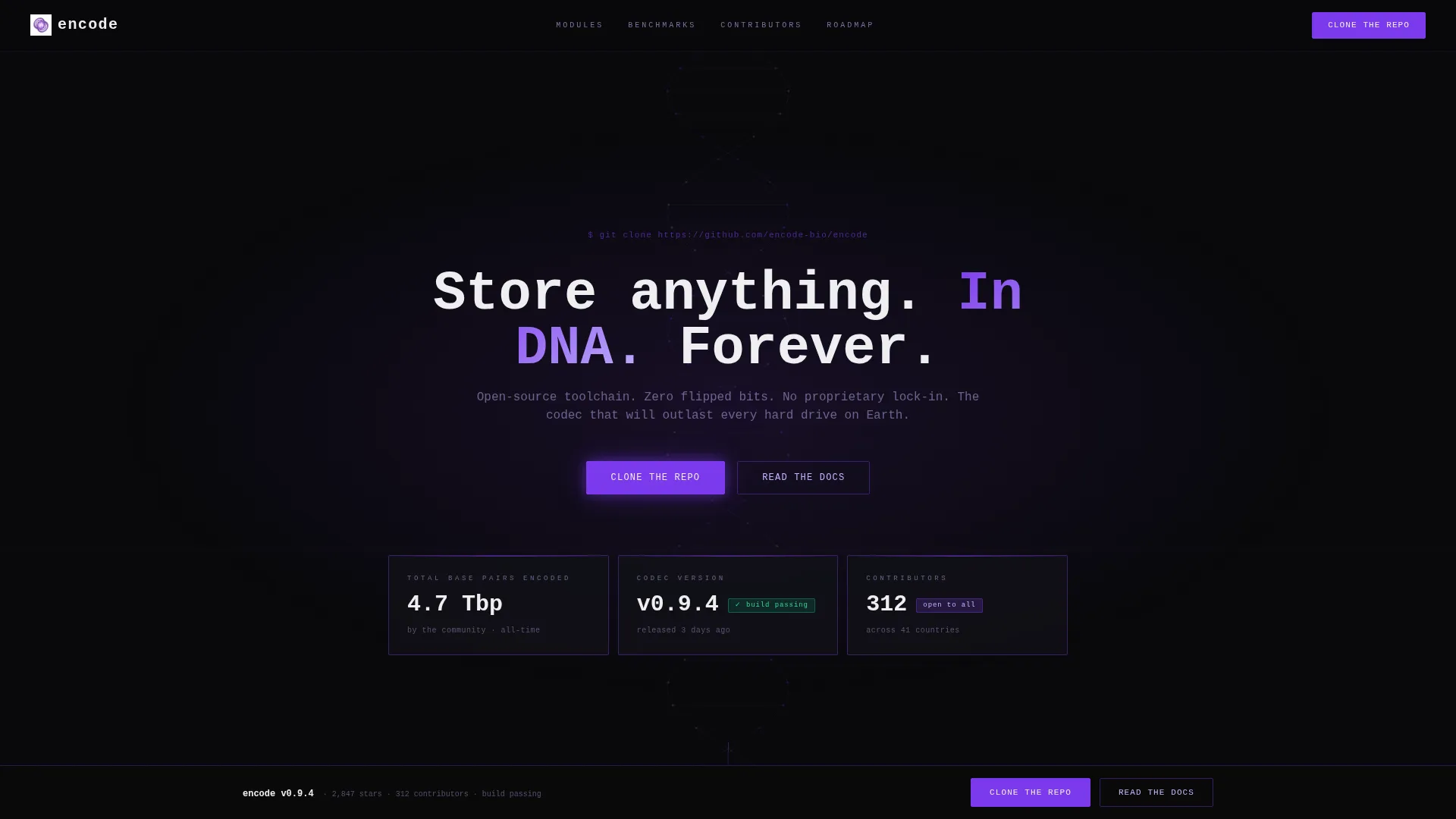
- A dark glass panel header with three live-formatted metric cards, a double-helix particle animation, and a primary "Clone the Repo" call-to-action
- A masonry data grid of project modules, each with language, stars, last commit, and an expandable inline detail pane showing architecture diagrams and dependency graphs
- An animated benchmarks section, a contributor avatar wall, a pulsing roadmap timeline, and a sticky bottom call-to-action bar that slides up after the second scroll fold
Feature list
This template is built around seven purpose-driven components. Each one is described below.
Dark Glass Panel Header Metrics
Three translucent, frosted-glass cards float above the void-black background. Each card displays a live-formatted metric: total base pairs encoded, current codec version with a build-passing badge, and contributor count. A faint violet edge glow and a slow double-helix particle animation run behind the panels.
Masonry Module Data Grid
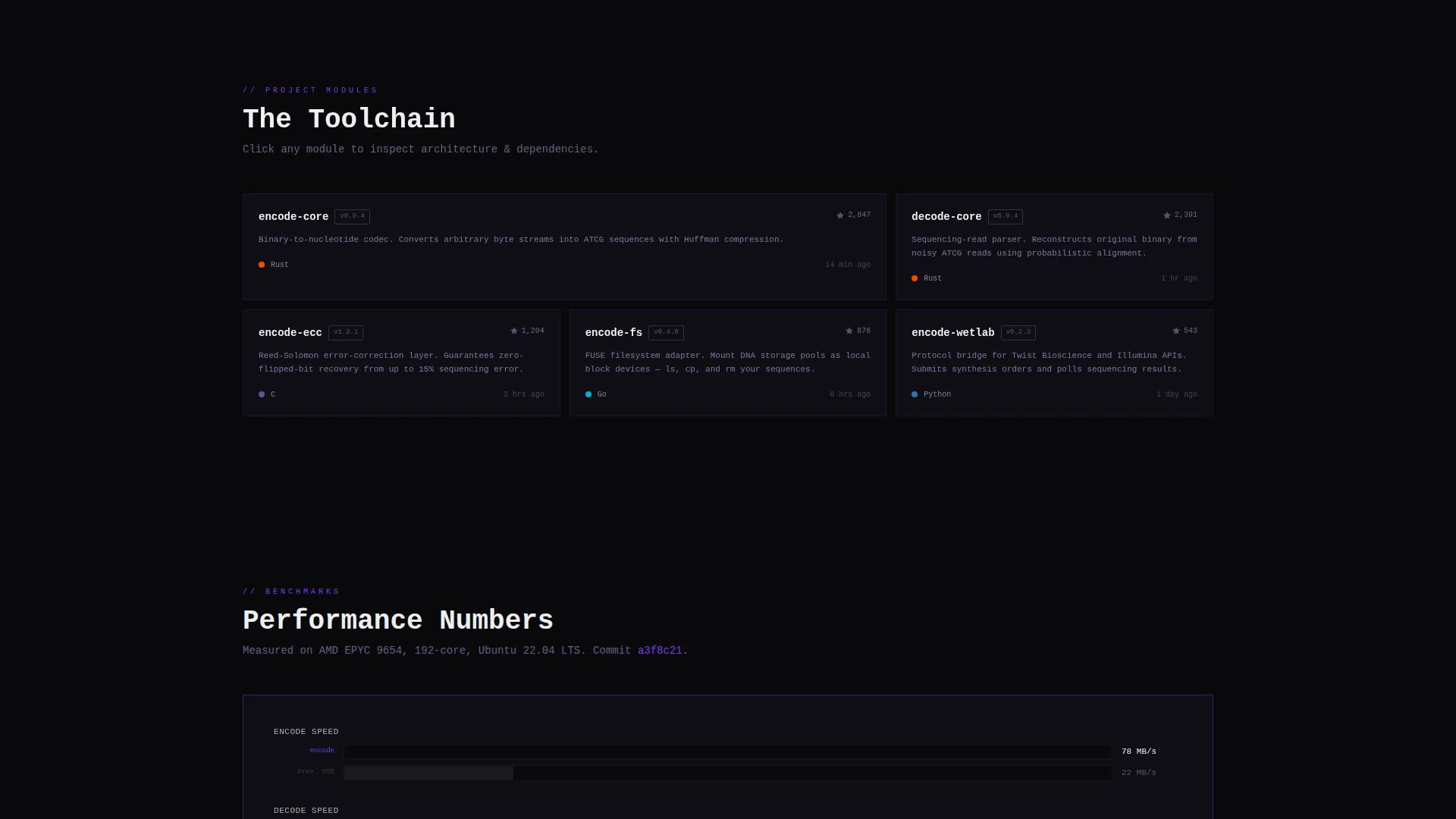
Project modules tile out in a masonry layout below the header. Each tile shows the programming language, star count, last commit timestamp, and a one-line description. Clicking a tile expands an inline detail pane with architecture diagrams and dependency graphs without navigating away from the page.
Animated Benchmark Charts
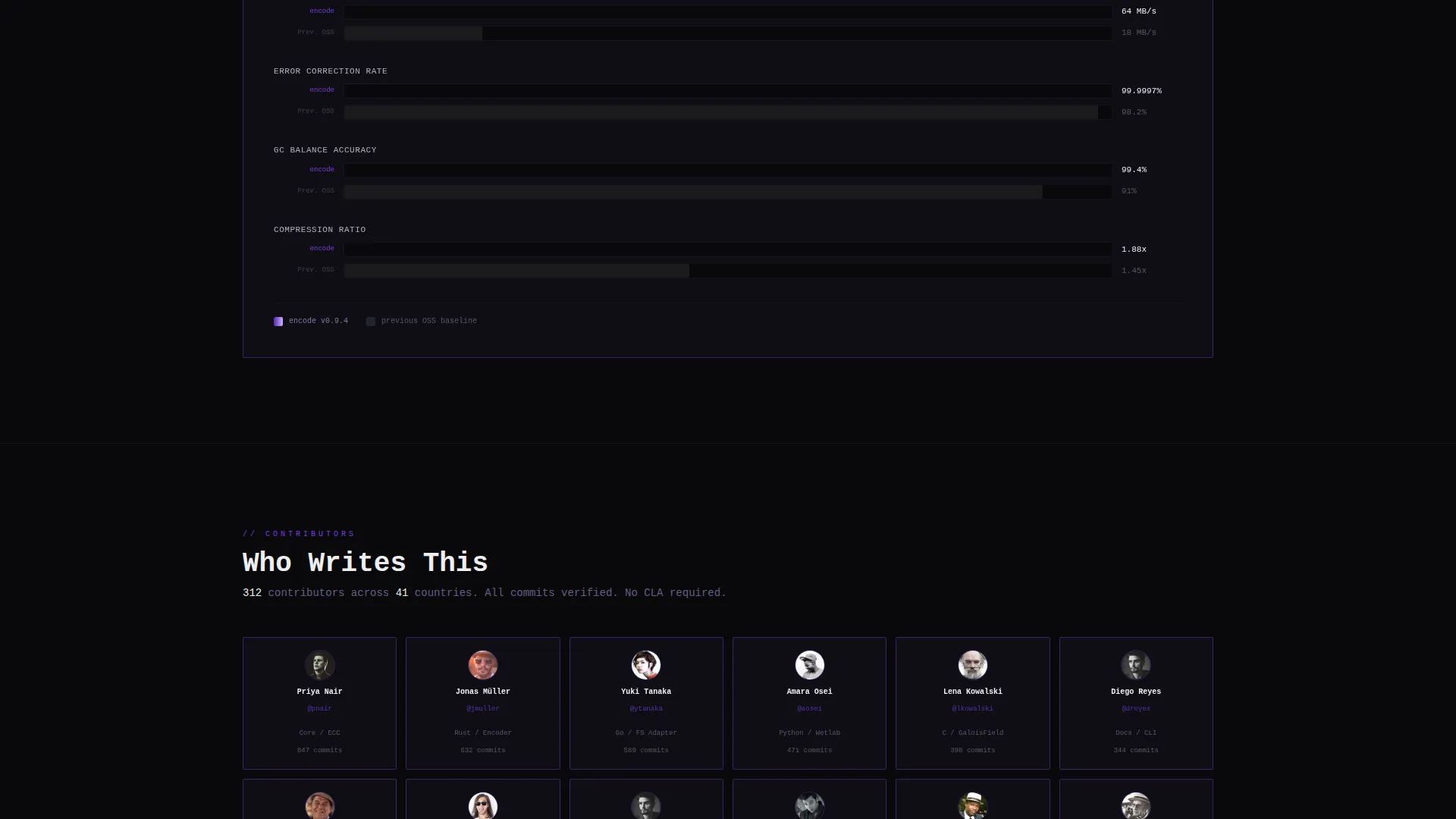
A dedicated benchmarks section displays animated bar charts that race to show encode and decode speeds against conventional storage methods. The animation conveys performance data in a way that feels visceral and immediate rather than static.
Contributor Avatar Wall
A full contributor wall pulls real avatar images from the repository. It signals community health and project momentum at a glance, showing visitors that real people are actively maintaining the codebase.
Pulsing Roadmap Timeline
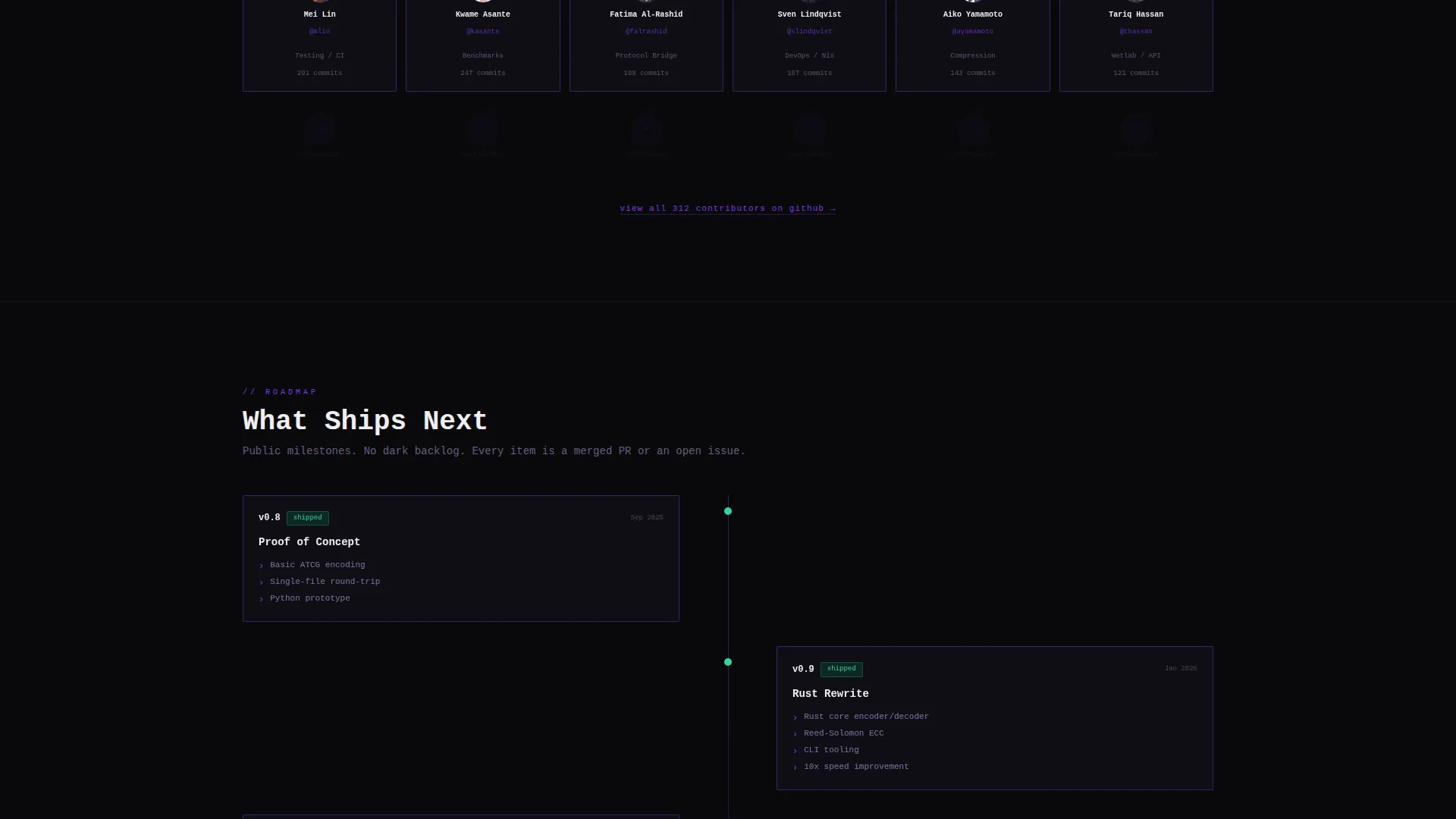
A roadmap section visualizes current and upcoming milestones on an animated timeline. The current milestone pulses to draw attention and communicate that the project is in active development.
Sticky Click-Through Call-to-Action Bar
After the second scroll fold, a bottom bar slides up and stays fixed. It presents the primary "Clone the Repo" button alongside a ghost-outlined "Read the Docs" button. The bar removes every barrier between a curious visitor and their first interaction with the project.
Page sections overview
| Section | Purpose |
|---|---|
| Header Metric Panels | Display live community stats and primary call-to-action above the fold |
| Helix Particle Background | Set the visual tone with a subtle animated DNA motif |
| Module Masonry Grid | Showcase all project components with key metadata at a glance |
| Inline Detail Panes | Expand architecture and dependency context without leaving the page |
| Benchmarks Chart Section | Prove encode and decode performance through animated bar charts |
| Contributor Avatar Wall | Show real community activity and build trust through visible contributors |
| Roadmap Timeline | Communicate active development progress and upcoming milestones |
| Sticky call to action Bar | Re-engage visitors at every scroll depth with persistent action buttons |
Design & branding system
The Void & Violet color system is the backbone of the entire visual identity. It draws on the look of a scanning electron microscope image colorized in ultraviolet, translating clinical darkness and bioluminescent signal into a usable design language.
- Four-color palette: absolute void black (#09090B) for backgrounds, deep helix violet (#7C3AED) for interactive borders and hover states, phosphor lilac (#C4B5FD) for secondary labels and graph lines, and cold cathode white (#EEEEF0) for monospaced data text and headlines
- Frosted glass panel treatment applied to the header metric cards, with violet edge lighting that mimics screens glowing in a darkened lab
- Monospaced typography for data readouts and terminal-style content, reinforcing the computational identity of the project throughout the layout
Mobile & speed optimization
The layout is designed with scroll behavior and responsive stacking in mind. The masonry module grid and sticky call-to-action bar adapt across screen sizes so the most important actions remain reachable on any device.
- The masonry grid reflows cleanly so module tiles remain readable and tappable on smaller screens
- The sticky bottom call-to-action bar is always visible after the second scroll fold, regardless of viewport size
- Animations such as the particle background and benchmark chart sequences are kept subtle and purposeful to avoid visual overload on mobile
How this template helps you convert
This template is built around one conversion goal: turning a curious visitor into someone who clones the repository or reads the documentation. Every design and layout decision supports that outcome.
- The primary "Clone the Repo" call-to-action appears above the fold in the header, then reappears in the sticky bar that activates after the second scroll fold, keeping the action visible at every depth without interrupting the reading experience.
- The inline module detail panes, benchmark charts, contributor wall, and roadmap timeline collectively build proof before the ask. By the time a visitor reaches the sticky bar, the page has already shown that the project is real, fast, and actively maintained.
- The ghost-outlined "Read the Docs" secondary button gives technically cautious visitors an immediate next step. This removes the drop-off that occurs when curious visitors have no lower-commitment option available.
Other information about this template
Encode is categorized under Technology, with a subcategory focus on DNA data storage technology and a niche focus on open-source DNA data storage project infrastructure. The template style is Dashboard and Data Grid, the theme is Directory and Discovery, and the creative direction is Launch Energy. These intersecting signals make it a strong fit for deep-tech open-source projects that need to communicate velocity and scientific credibility simultaneously.
- The header concept is Dark Glass Panels, a design approach that pairs translucent frosted surfaces with void-black backgrounds and violet accent lighting
- The landing page direction is Click-Through, meaning every layout choice is optimized to reduce friction and move visitors toward a single primary action
- The color system is Void & Violet, a four-tone palette chosen specifically to evoke the aesthetic of ultraviolet-lit scientific instrumentation
Theme
Directory & Discovery
Creative direction
Launch Energy
Color system
Void & Violet
Style
Dashboard/Data Grid
Direction
Click-Through
Page Sections
Dark Glass Panel Header with Live Metrics
Masonry Module Grid with Inline Panes
Animated Encode and Decode Benchmark Charts
Contributor Avatar Wall
Pulsing Roadmap Timeline
Sticky Two-button Call-to-action Bar
Related questions
Can I change the project metrics shown in the header panels?
Does the masonry module grid require a fixed number of tiles?
Do the inline detail panes navigate away from the landing page?
Is this template suitable for an early-stage project?
Can I adapt this template for a commercial deep-tech product?