Home Services Payment Processing Landing Page
Swipe is a dashboard-style landing page template built for home services payment platforms. It targets business owners running fleets of field technicians who lose revenue to uncollected invoices and declined cards. The design uses a Tech Glass visual system with a dark obsidian base, frosted glass panels, iridescent violet, and signal green to make payment data feel live and immediate.
by Rocket studio
Quick summary
Swipe is a single-page, dashboard-driven landing page template designed for home services payment processing platforms. It opens with a live-styled API code snippet, escalates through an industry-report scroll, and closes with a freemium signup form. The Tech Glass visual identity makes financial data feel operational, urgent, and trustworthy from the first scroll.
Who this template is for
This template is built for founders and product teams launching payment platforms aimed at the home services trades. It speaks directly to the operators those platforms serve: owners running five to fifty trucks across plumbing, HVAC, and electrical businesses.
- Payment platform teams targeting field service companies
- Home service company owners evaluating modern payment tools for their fleet
- Marketers promoting field-capture or mobile payment processing products
What problem this template solves
Field service businesses lose significant revenue every month. Invoices go uncollected, cards get declined at the door, and technicians forget to collect before driving away. No single dashboard view ties job completion to payment capture in real time. This template addresses that gap head-on.
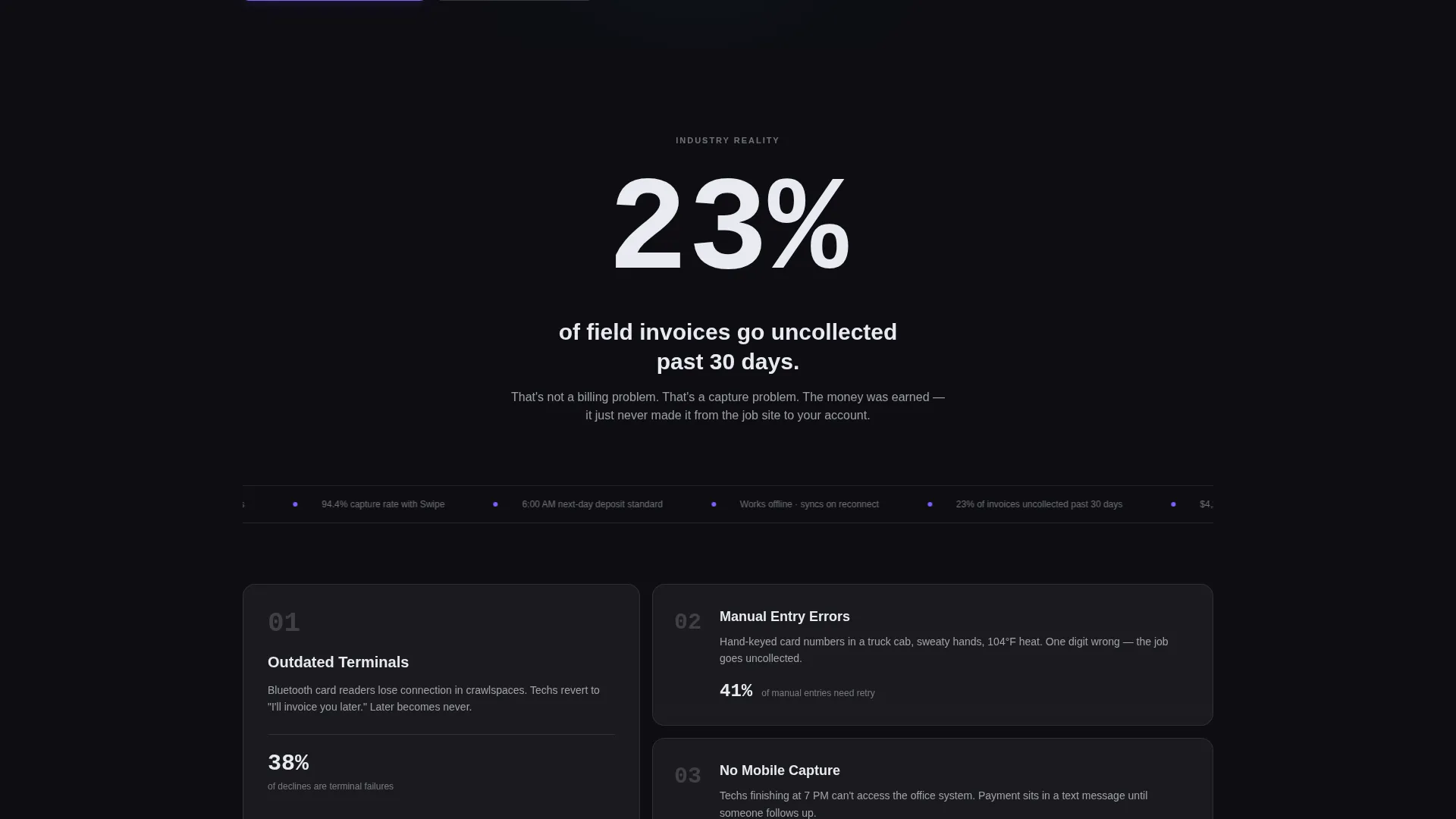
- 23% of field invoices go uncollected past 30 days, a stat surfaced directly in the page scroll
- Manual entry errors and outdated terminals cause silent revenue leaks that owners rarely track
- There is no clear visual proof of how a modern platform fixes these problems until this page shows it
What you get with this template
You get a complete, conversion-focused landing page built around a data briefing narrative. Every section escalates from industry problem to granular proof, guiding the visitor toward a no-friction freemium signup.
- A live-styled API code snippet header showing a real field payment call with animated response status
- A three-section industry report scroll covering failure stats, root causes, and a full dashboard demo grid
- Two conversion paths: a primary freemium call to action and a secondary diagnostic lead-capture tool
Feature list
This template is packed with purposeful components drawn directly from the brief. Each one serves the payment platform narrative.
Live API Code Snippet Header
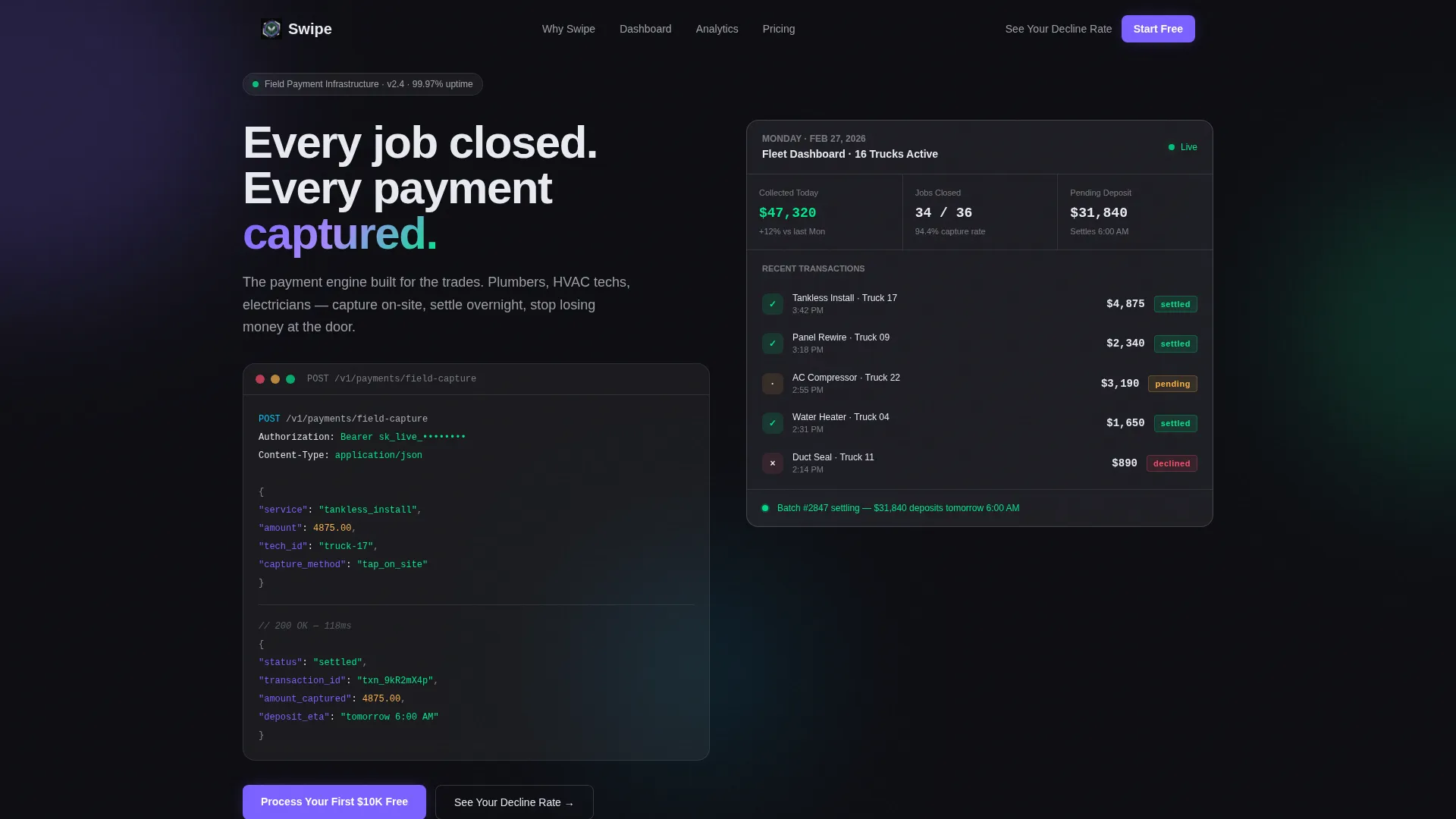
The header opens with a monospace code block styled against a frosted glass panel. It shows a POST request to /v1/payments/field-capture with a realistic JSON payload including service type, amount, technician identifier, and capture method. A response object then animates in showing settled status and a next-morning deposit timeline. This makes abstract infrastructure feel immediate and credible.
Interactive Dashboard Data Grid
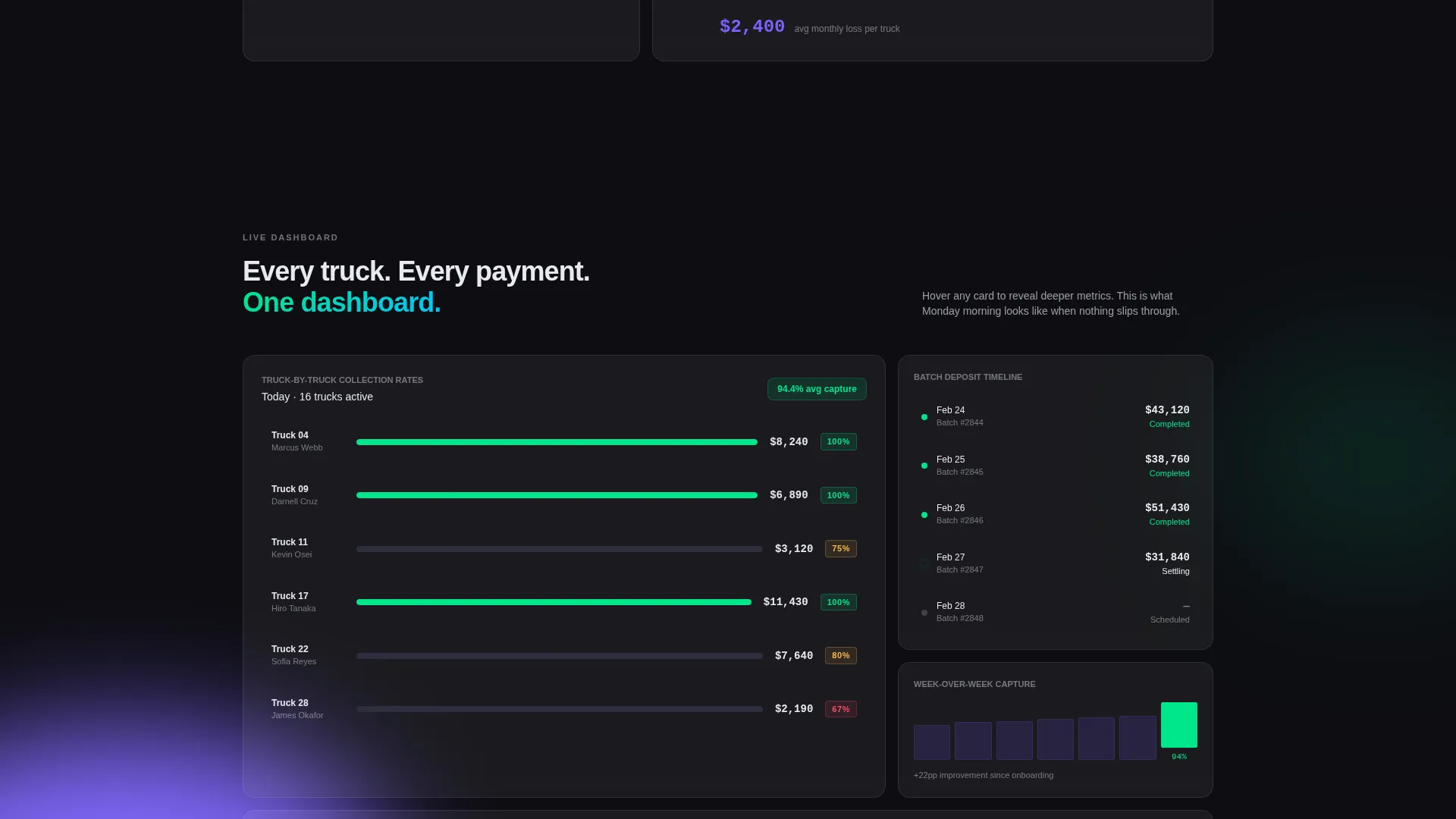
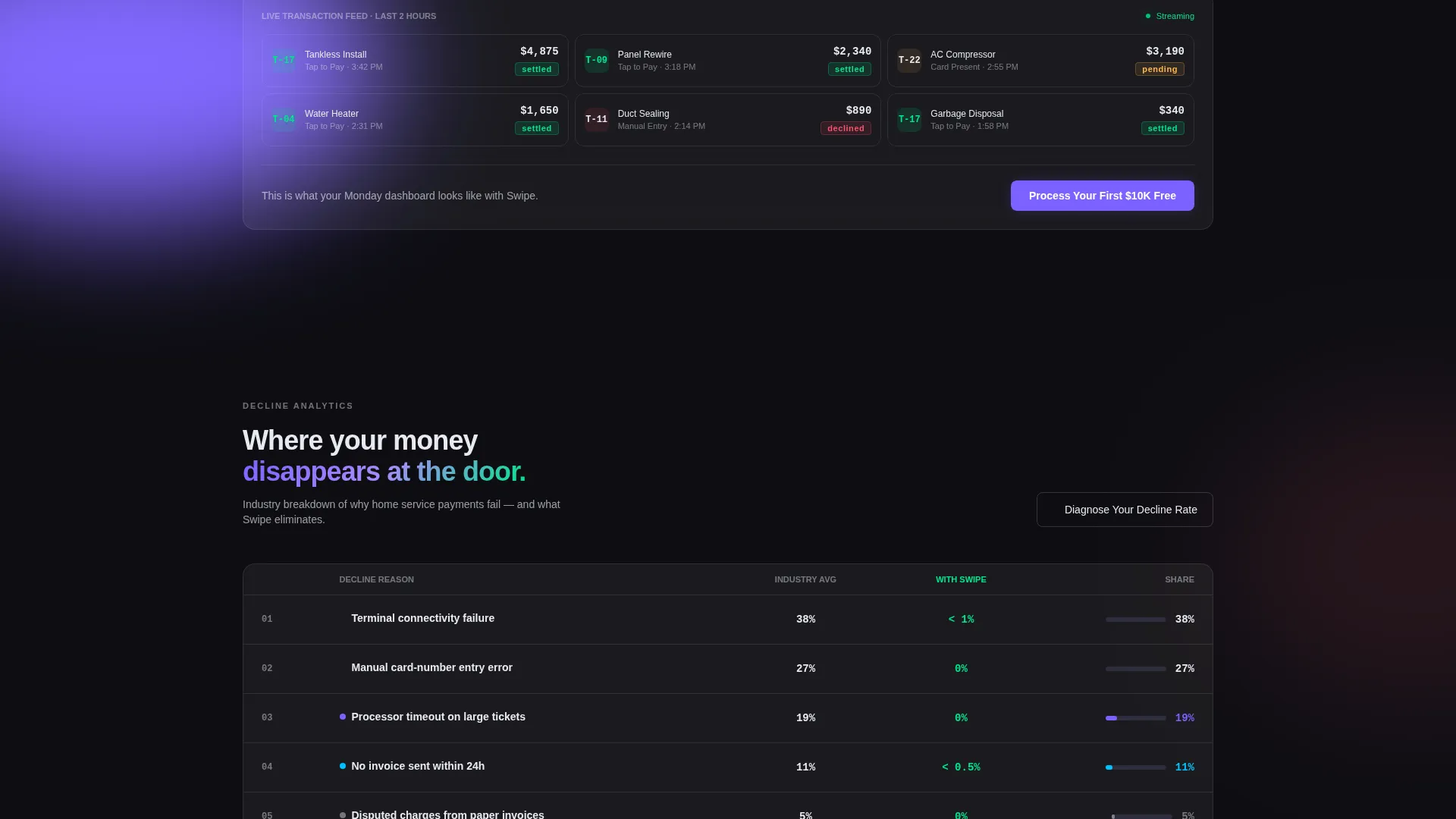
The core of the page is a dashboard grid presenting live transaction feeds, truck-by-truck collection rates, batch deposit timelines, and decline reason analytics. Each data module responds to hover interactions by revealing deeper metrics. Visitors experience the product before they sign up.
Industry Report Scroll Narrative
The page scrolls like a data briefing. Section one surfaces the 23% uncollected invoice statistic. Section two breaks down the root causes. Section three presents the platform dashboard as the solution. The narrative builds tension and resolution across three logical beats.
Freemium Signup Form
The primary conversion form asks for three fields only: company name, number of trucks via a dropdown with four fleet-size ranges, and a work email address. No credit card is required. This removes friction at the moment of highest intent.
Secondary Diagnostic Lead Capture
A secondary call to action labeled "See Your Decline Rate" links to a diagnostic tool. It analyzes the visitor's current processor's failure patterns. This path captures leads through demonstrated value before asking for any commitment.
Tech Glass Visual System
The interface uses deep obsidian backgrounds, frosted white card surfaces, iridescent violet for interactive elements and hover states, and signal green for every confirmation state. The palette is cohesive and purposeful, making numbers feel alive without visual noise.
Page sections overview
| Section | Purpose |
|---|---|
| API Code Header | Opens with live-styled field payment call and animated settled response |
| Industry Stat Block | Surfaces the 23% uncollected invoice statistic to establish urgency |
| Root Cause Breakdown | Explains declined cards, manual errors, and missing mobile capture |
| Dashboard Demo Grid | Shows live feeds, truck collection rates, deposits, and decline analytics |
| Freemium Signup Form | Converts visitors with a three-field, no-credit-card signup form |
| Diagnostic Lead Tool | Secondary path capturing leads via a decline-rate analysis offer |
| Floating call to action Bar | Anchors the "Process Your First $10K Free" offer at the bottom of the demo |
Design & branding system
The visual identity follows a Tech Glass theme powered by an AI Iridescent color system. It is engineered to make financial data feel operational and alive rather than sterile or generic.
- Deep obsidian (#0D0D12) dominates all backgrounds, creating contrast that makes data pop
- Frosted glass panel white (#E8EAF0) holds card surfaces and data cells, while iridescent violet (#7B61FF) marks every interactive element and hover state
- Signal green (#00E68A) pulses on every confirmation state including payment received, deposit cleared, and batch settled
Mobile & speed optimization
The template is structured for field-facing buyers who may encounter it on a phone between jobs. The layout adapts to smaller screens without losing the dashboard data grid's impact.
- The three-field signup form is thumb-friendly and works cleanly on mobile viewports
- Dashboard grid modules are designed to stack and remain legible at smaller breakpoints
- The floating call-to-action bar stays accessible without obscuring content on mobile
How this template helps you convert
The page is architected around a freemium trial goal. Every design and content decision moves visitors from problem-aware to ready-to-sign-up.
- The API code snippet in the header establishes technical credibility immediately, reducing early bounce from skeptical buyers.
- The industry report scroll builds urgency with real data before showing the solution, priming visitors to see value before the ask.
- Two distinct conversion paths let high-intent visitors sign up directly while lower-intent visitors enter the funnel through the diagnostic tool.
Other information about this template
This template is a strong fit for home services software platforms looking to stand out in a crowded payment processing market. It positions the product through proof rather than claims.
- The template style is Dashboard and Data Grid, suited for platforms with data-rich value propositions
- The creative direction follows an Industry Report format, which works well for B2B software products targeting skeptical operators
- The header concept is a Code Snippet, signaling technical depth to buyers who evaluate platforms on infrastructure quality
- The freemium and trial landing page direction is ideal for platforms with a self-serve onboarding model
- This template can support a home services payment processing platform at any stage, from early launch to scaling past fifty trucks in the fleet
Theme
Tech Glass
Creative direction
Industry Report
Color system
AI Iridescent
Style
Dashboard/Data Grid
Direction
Freemium/Trial
Page Sections
Live API Code Snippet Header
Interactive Dashboard Data Grid
Industry Report Scroll Narrative
Three-field Freemium Signup Form
Decline Rate Diagnostic Tool Link
Tech Glass Visual Identity
Related questions
Who is this landing page template designed for?
Does this template require a developer to customize?
What does the freemium signup form collect?
Can the dashboard data grid be adapted to show real platform data?
What makes this different from a generic software landing page template?