Freelance & Gig Marketplace Reviews Website Template
This single-column freelance marketplace landing page is built for businesses that need contract talent fast. A navy search field opens the experience, a testimonial mosaic builds trust through scroll, and a three-step inline brief form closes the deal. The layout covers Design, Development, Writing, Finance, and Marketing, all in one authoritative, tool-first page.
by Rocket studio
Quick summary
This landing page template is a B2B freelance marketplace built for speed and credibility. Businesses post project briefs and receive vetted freelancer proposals within hours. The single-column flow moves from a navy search header through a testimonial mosaic to a streamlined brief submission form, designed to convert confident, task-ready visitors into clients.
Who this template is for
This template serves businesses that need contract talent without the friction of agency retainers or long hiring cycles. It suits operators who already know what they need and want a platform that proves its depth before asking for a click.
- Startup founders hiring their first contract designer or developer
- Procurement managers at mid-size firms replacing agency retainers with on-demand talent
- Solo operators who need a specialist, such as a bookkeeper, for a defined short-term engagement
What problem this template solves
Finding reliable freelance talent quickly is a real operational challenge. Most hiring pages either overwhelm visitors with too many options or fail to prove that qualified people are actually available. This template solves both problems at once.
- It surfaces proof of volume and speed before asking visitors to commit
- It removes category confusion with a visual project-type picker upfront
- It replaces vague value claims with specific social proof, quotes, roles, durations, and company logos
What you get with this template
You get a complete, single-column freelance marketplace landing page with every section purpose-built for the Recruitment and Hiring conversion goal. The layout is designed to feel like a well-organized professional tool, not a brochure.
- A navy search header with ghost-text prompts and clickable popular-category micro-tags
- A staggered testimonial mosaic with stat interruptions and pull quotes
- A three-step inline brief submission form with a visual category picker
Feature list
This template includes six purpose-built sections that work together as a persuasion sequence. Each section earns the next click.
Navy Search Header with Micro-Tags
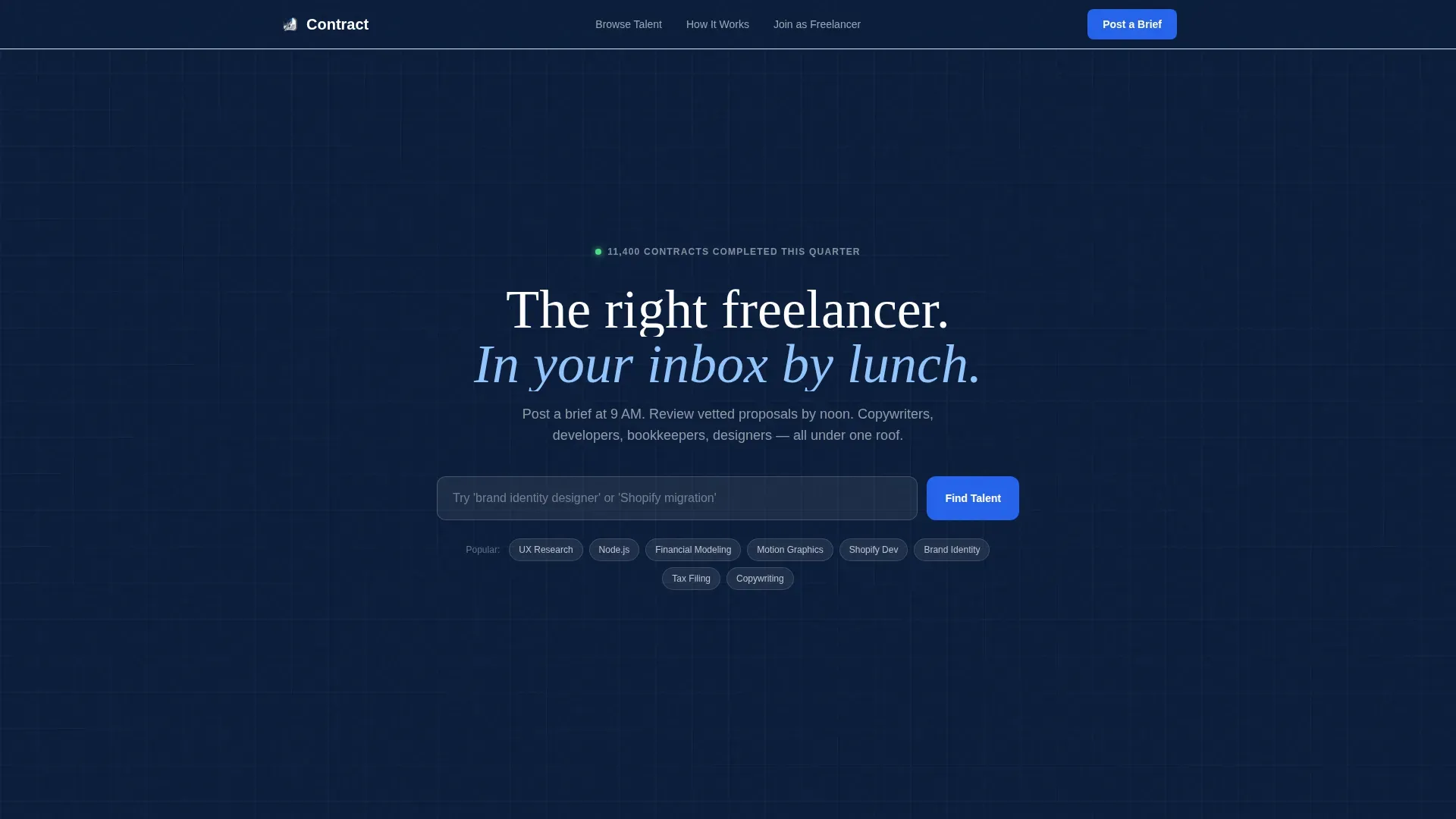
The header centers a single search input on a deep navy background. Ghost text reads "Try 'brand identity designer' or 'Shopify migration'" to prompt specific intent. A cobalt "Find Talent" button sits beside the input. Below it, a row of clickable micro-tags, Popular: user experience Research, Node.js, Financial Modeling, Motion Graphics, proves platform depth before a visitor types a single character.
Staggered Testimonial Mosaic
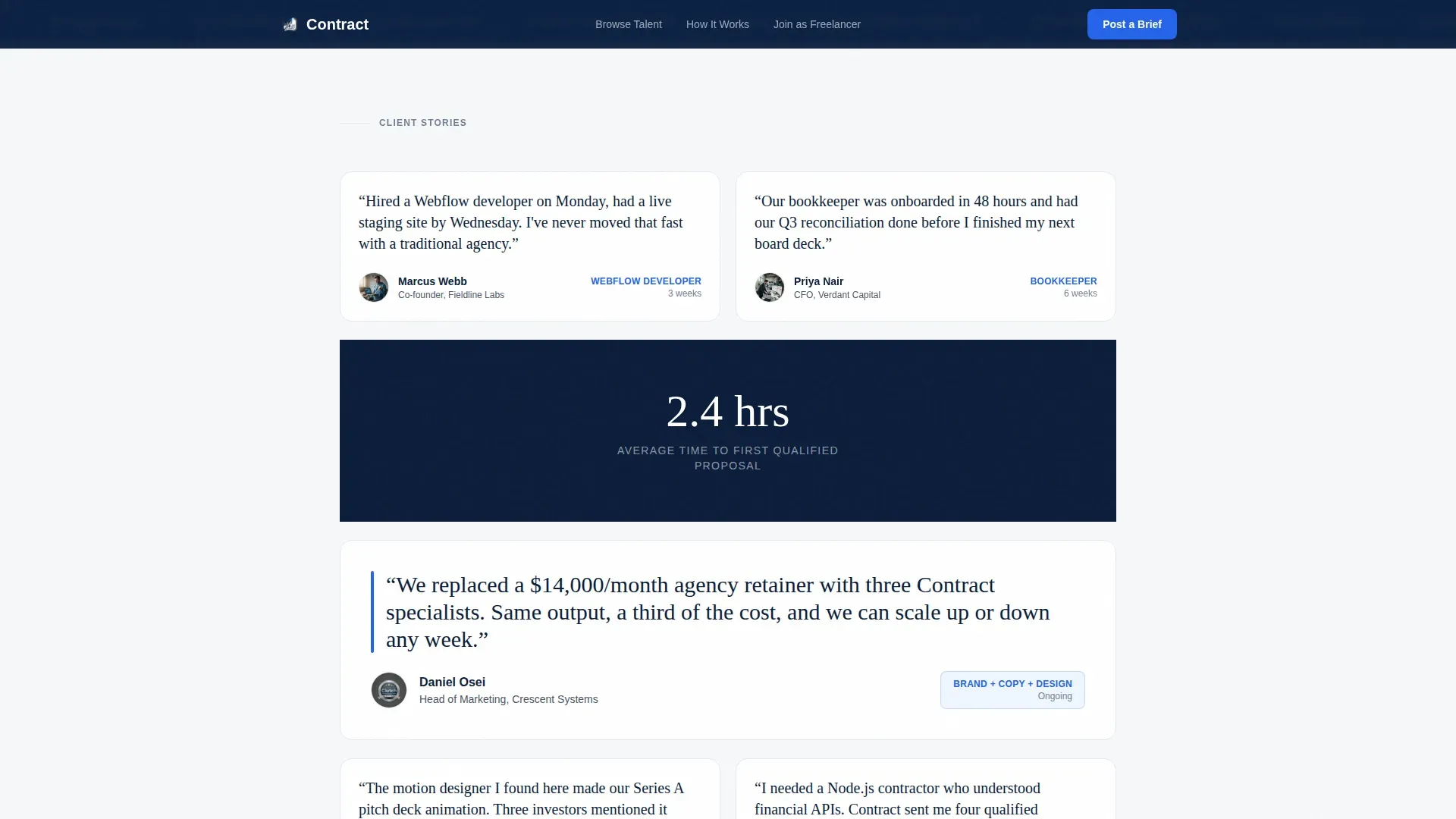
Scrolling past the header reveals a staggered grid of real client testimonials. Each card pairs a one-sentence quote with the freelancer's role, project duration, and a company logo. The mosaic starts with two compact cards, then widens to full-width pull quotes from recognizable brands. The sequence builds social proof systematically, each card more specific and credible than the last.
Stat Interruption Callouts
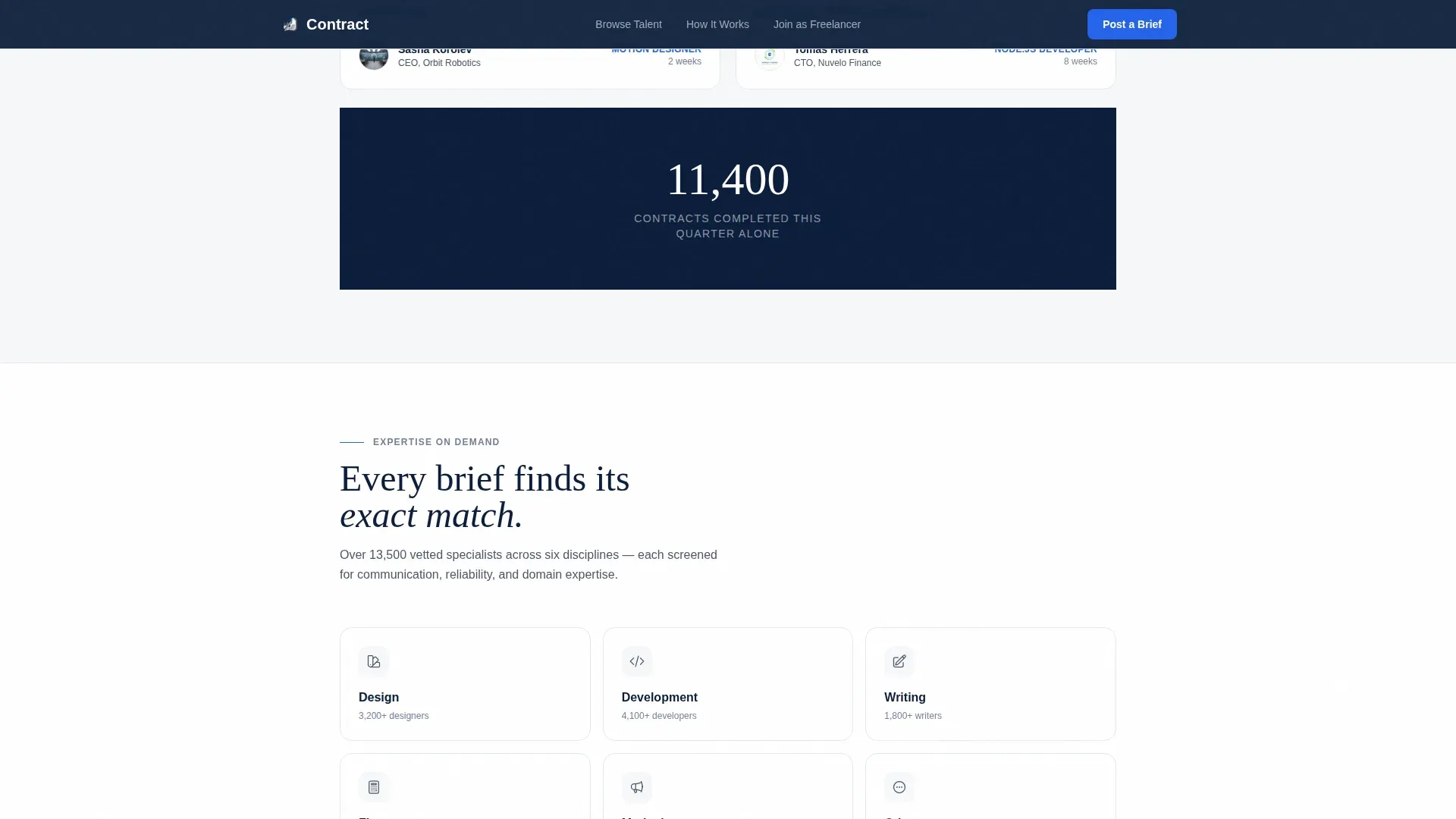
Between mosaic clusters, single-stat callouts break the scroll rhythm. Examples built into the template include figures like "11,400 contracts completed this quarter" and "Average time to first proposal: 2.4 hours." These interruptions convert abstract trust into concrete evidence of platform velocity.
Visual Category Picker
A category showcase section presents a visual grid of project types: Design, Development, Writing, Finance, Marketing, and Other. This picker doubles as the first step of the brief submission form, making the transition from browsing to posting feel immediate and low-effort.
Three-Step Inline Brief Form
The brief submission form is embedded inline, removing the friction of a separate page. Step one is the category picker. Step two is a plain-text field asking "Describe what you need in one sentence." Step three collects email and company name. The form is the primary conversion action and is triggered by a "Post Your First Brief, Free" call-to-action button.
Sticky Mobile Call-to-Action Bar
On mobile, a persistent bottom bar keeps the primary call to action visible throughout the entire scroll. This ensures that visitors on smaller screens never lose access to the conversion prompt, regardless of how far down the page they have scrolled.
Page sections overview
| Section | Purpose |
|---|---|
| Navy Search Header | Entry point with search input, cobalt button, and micro-tag row |
| Testimonial Mosaic | Staggered social proof cards with role, duration, and company logo |
| Stat Interruption Callouts | Single-figure trust breaks between testimonial clusters |
| Category Showcase Grid | Visual category picker for Design, Development, Writing, Finance, Marketing |
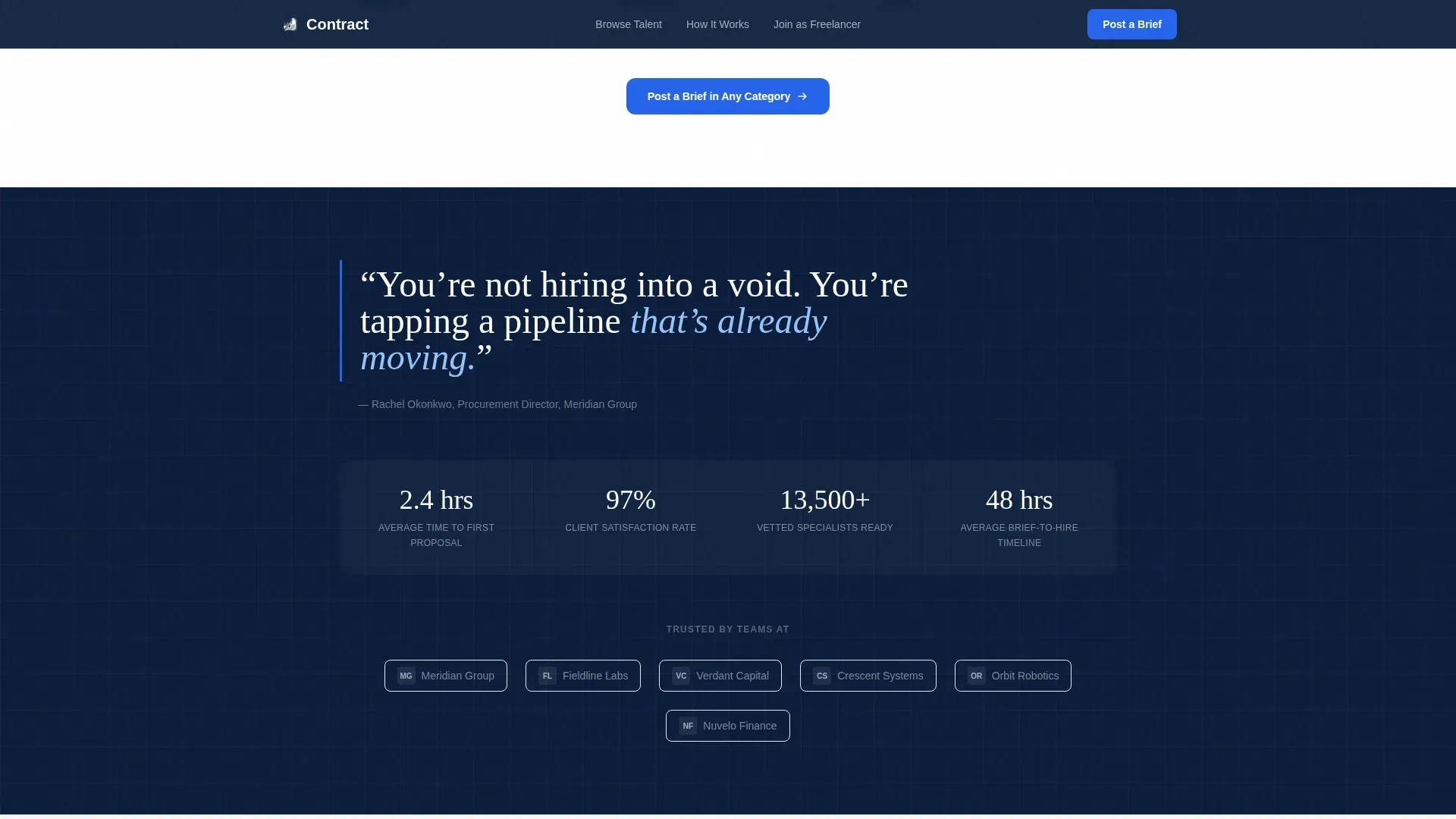
| Velocity Stats and Trust | Full-width proof section reinforcing platform speed and volume |
| Three-Step Brief Form | Inline brief submission with category picker, description field, and contact info |
| Footer with Freelancer call to action | Ghost-outlined "Join as a Freelancer" button routing to a separate application flow |
Design & branding system
The visual identity follows a Corporate Precision theme. The palette is authoritative without being cold, and every color has a deliberate role in the layout hierarchy.
- Navy (#0B1D3A) anchors the header and footer as structural bookends; white (#F7F8FA) carries the middle scroll panels; gunmetal (#4A5568) handles all body text for legibility
- Cobalt (#2563EB) appears only on buttons, links, and active states, used sparingly so every blue element reads as a direct instruction to act
- Typography pairs Fraunces (a serif display face) for headings with DM Sans (a clean sans-serif) for body text and interface elements, reinforcing the tool-first, corporate-precision aesthetic
Mobile & speed optimization
The template is built desktop-first but accounts fully for smaller screens through a purpose-designed mobile layer. Interactivity is high without sacrificing scroll performance.
- Scroll-triggered stagger animations and marquee elements use medium-weight animation, revealing content progressively rather than all at once
- Static content sections use server-rendered components; interactive elements such as the search input, category picker, and three-step form use client-side rendering only where required
- The sticky mobile bottom bar keeps the primary call to action accessible at all times, regardless of scroll position
How this template helps you convert
The page is structured as a deliberate persuasion sequence. Every section earns the next action before asking for it.
- The search header immediately positions the platform as a tool, not a pitch, visitors arrive with intent and find a direct input waiting for them, supported by micro-tags that prove category depth before any interaction.
- The testimonial mosaic accumulates credibility through scroll, using specific roles, durations, and recognizable company logos to replace generic trust signals with concrete evidence.
- The three-step inline form and the "Post Your First Brief, Free" call-to-action button reduce commitment friction at the exact moment trust is highest, after the mosaic and stat callouts have done their work.
Other information about this template
This template is well-suited for teams evaluating general freelance platform options and comparing structured marketplace layouts against simpler job-board formats.
- The page is localized for English-language markets with USD pricing context and US date formatting built into placeholder content
- The footer includes a dual conversion path: a primary client brief submission flow and a secondary ghost-outlined "Join as a Freelancer" button, routing to a separate application flow without competing with the main call to action
- The Arc Browser Split footer pattern (Pattern 7) is used to give the page a clean, structured close that separates client and freelancer journeys visually
Theme
Corporate Precision
Creative direction
Testimonial Mosaic
Color system
Navy Authority
Style
Single Column Flow
Direction
Recruitment/Hiring
Page Sections
Navy Search Header with Micro-tags
Staggered Testimonial Mosaic
Stat Interruption Callouts
Three-step Inline Brief Form
Visual Category Picker Grid
Sticky Mobile Call-to-action Bar
Related questions
What types of businesses is this landing page template designed for?
Can this template support multiple freelance service categories?
How does the testimonial mosaic section work?
Is there a conversion path for freelancers as well as clients?
What does the three-step brief form include?