AI for product managers now means building working prototypes, not just writing docs. Seven workflows covering PRD-to-prototype, internal tools, feature validation, and competitive research can save PM teams 10+ hours weekly.
AI for product managers is shifting from writing documents to building working prototypes. Seven workflows show product leaders how to reclaim 10+ hours weekly by turning specs directly into clickable products, internal tools, and feedback dashboards that stakeholders can actually use and react to.
What AI Already Does for Product Teams Today
What actually slows a PM down? It is rarely a lack of ideas. The real bottleneck sits between having a plan and putting something clickable in front of stakeholders. According to a 2026 product management survey, 72.2% of product managers spend 25% or less of their time on strategy, and the rest goes to coordination, documentation, and waiting.
AI tools are starting to reclaim those hours, but the biggest gains are not in writing faster PRDs. They come from building faster artifacts.
Most PM teams have already adopted AI for the obvious tasks. The pattern is clear from recent survey data, and it tells a story about where product leaders stand today versus where they could be.
-
Drafting PRDs and specs is a common use case, with 21.5% of PMs citing document writing as their primary AI workflow
-
Summarizing user feedback and synthesizing research briefs is a leading use, with 47.1% of teams using AI to condense raw feedback into themes
-
Communication support across emails, presentations, and stakeholder updates accounts for 18.5% of daily AI use among PMs
-
Competitive analysis and market research are gaining traction, though most teams still treat these as occasional tasks rather than continuous workflows
A large-scale AI productivity survey found that 55% of respondents said AI has exceeded their expectations, and 63% of PMs report saving 4+ hours per week. As one researcher noted: "PMs have cracked how to use AI for the last mile of getting ideas out of their head, but they still have a big opportunity to apply it upstream."
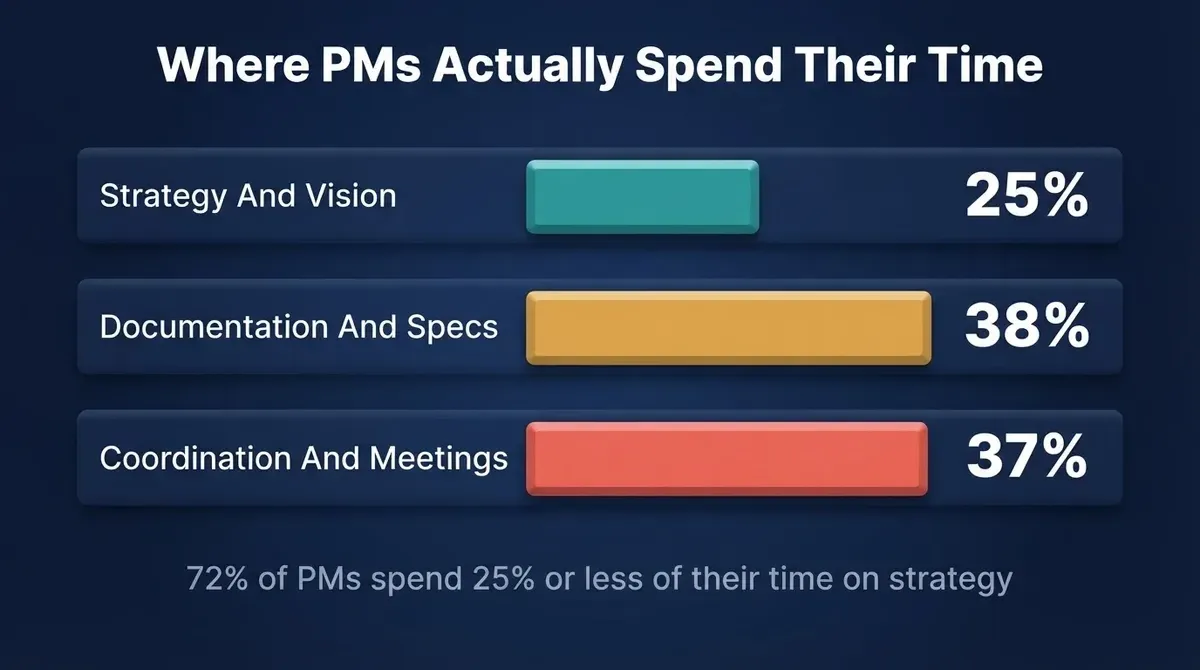
72% of product managers spend a quarter or less of their time on strategy. The rest goes to coordination and documentation.
What Can AI Handle for Product Managers Right Now?
The gap between "AI helps me write" and "AI helps me build" is where the next wave of productivity lives. Here is a quick view of current AI task categories for PM teams, matched against the time typically saved and the human judgment still required.
| AI Task | Typical Time Saved | Human Input Still Needed |
|---|---|---|
| PRD and spec drafting | 2-3 hrs/week | Strategy framing, trade-off decisions |
| User feedback synthesis | 1-2 hrs/week | Problem selection, prioritization calls |
| Competitive analysis | 1-2 hrs/week | Positioning judgment, pricing context |
| Prototype generation | 3-5 hrs/week | Product direction, design review |
| Internal tool building | 4-6 hrs/week | Workflow design, data source selection |
| Roadmap scenario modeling | 1 hr/week | Stakeholder alignment, resource calls |
| Presentation and comms | 1 hr/week | Narrative framing, audience context |
Prototype generation and internal tool building deliver the largest time savings because they replace entire process steps, not just the writing inside them. Teams that move beyond document generation into structured research and decision support see the largest return on their AI investment.
Why Documents Alone No Longer Close the Gap
Product leaders have written great specs for decades. The problem is not the quality of the document. It is the distance between a written plan and something a stakeholder can react to.
-
A ten-page PRD takes days to produce and hours to read. Most stakeholders skim the summary and form an opinion without testing the assumptions behind it.
-
Alignment meetings multiply. When the only artifact is a document, every round of feedback requires another meeting to discuss what the words should look like in practice.
-
User testing starts late. By the time a spec becomes a prototype, the team has already committed weeks of engineering time based on untested hypotheses.
According to Airtable's 2026 product leadership report, 92% of product leaders now own revenue outcomes. That kind of accountability demands speed, not more documentation.
Writing tools save an hour or two per week. Building tools can save five or more. The gap is where transformation happens.
A clickable prototype changes the conversation entirely. People can point at real UI elements and say "this flow confuses me" instead of debating abstract wireframes in a conference room.
How Do Clickable Prototypes Speed Up Alignment?
The shift from documents to working artifacts compresses PM cycles dramatically. Here is the old flow compared with the new one.
Old flow: weeks. New flow: a single afternoon.
Product teams that prototype faster get earlier feedback, test assumptions with real users sooner, and course-correct before committing engineering capacity. That is not just a speed improvement. It is a confidence improvement.
Seven AI Tools and Workflows That Give PM Teams Hours Back
Here are seven workflows that product teams are running right now. Each one targets a specific bottleneck and replaces it with a faster, AI-assisted approach.

Seven workflows, each targeting a different PM bottleneck.
1. Turn A PRD Into A Working Prototype
The first and highest-impact workflow is converting written specs directly into clickable products. Start with your existing PRD or feature brief, paste the description into an AI app builder, and let it generate a working app with navigation, forms, and sample data.
Instead of waiting for mockups, the PM can build prototypes directly from plain-language descriptions, testing the core interaction pattern within hours. Real user reactions to a working product reveal issues that documents never surface.
2. Build Internal Tools Without An Engineering Ticket
PM teams spend a surprising number of hours on internal workflows that nobody has prioritized for engineering. A simple data-connected internal tool can go from description to deployed in a day using an AI app builder.
-
Feedback dashboards that pull NPS scores, support tickets, and feature requests into a single view
-
Roadmap viewers that stakeholders can filter by theme, quarter, or business objective
-
Launch trackers that connect release status to marketing readiness and sales enablement tasks
-
Sprint review tools that generate summary reports automatically from completed tickets
Of course, the design still needs human input for usability. But the time savings are measured in days, not minutes. See the internal tool recipe in Rocket.new docs for a step-by-step walkthrough.
3. Validate A Feature Before Requesting Dev Time
This workflow directly addresses one of the most expensive mistakes in product management: committing engineering time to something users do not actually want.
Describe the feature concept and generate a working prototype in under an hour, including real-looking sample data, navigation, and interactive elements. Put the prototype in front of five to eight target users, watch where they click, where they hesitate, and where they drop off. Use the session recordings and feedback to refine the concept or kill it entirely before a single sprint starts.
Product judgment still drives the decision. AI just makes the testing loop faster and cheaper. The research-to-launch workflow in Rocket.new covers this end-to-end.
4. Run Competitive Research Continuously
Most PMs do competitive analysis manually, checking competitor websites, reading reviews, and scanning for product updates every few weeks. Continuous monitoring tools can handle this automatically across website changes, social posts, hiring moves, product releases, and review shifts.
Leading PM teams use dedicated monitoring tools to handle the repetitive scanning work. This workflow alone can save one to two hours per week that PMs currently spend on manual research, freeing that time for the strategic analysis only a human can do. The competitive response workflow shows how to connect monitoring signals directly to build decisions.
5. Build Ticket-Connected Prototypes From Jira Or Linear
One of the most underused PM workflows is building directly from existing tickets rather than rewriting specs from scratch. Connect your project management tool so the AI builder can read ticket descriptions, acceptance criteria, and sprint data.
Reference a ticket in your build prompt to generate a prototype that already reflects the agreed scope. Write follow-up tickets back from the prototype, closing the loop between discovery and delivery. This eliminates the translation layer between what was written in the ticket and what gets built.
6. Export Research Into Stakeholder-Ready Deliverables
Research that lives in a chat thread rarely reaches the people who need it. AI research tools can turn structured findings into shareable formats: PDF, PPT, or HTML slide decks for board presentations, sprint planning, or investor updates.
Run a competitive teardown or market analysis and receive a structured report with an executive summary, supporting evidence, and actionable recommendations. Share a link so stakeholders can read the findings without needing access to the underlying tool. This replaces the hours PMs spend reformatting research into presentation decks.
7. Use AI As A Roadmap Thinking Partner
The final workflow is the most strategic. AI can serve as a thinking partner for roadmap planning, not by making decisions, but by pressure-testing them. Feed your current roadmap, user research, business goals, and metrics into an AI prompt and ask it to identify gaps, conflicting priorities, or missing perspectives.
Generate multiple scenario plans and compare them side by side. Use prompt starters designed for PM workflows to structure your roadmap thinking sessions. The mind shift from "AI writes my docs" to "AI stress-tests my strategy" is where the real momentum lives, especially as 2026 planning approaches and PMs need a broader perspective.
How Rocket.new Covers The Full PM Arc
Most AI tools help PMs write about what to build. Rocket.new is the vibe solutioning platform that helps PMs actually build it, with three capabilities that work together: Solve for research, Build for app generation, and Intelligence for competitive monitoring.

Solve, Build, and Intelligence work as a connected arc, not three separate tools.
Solve: Research Before You Build
Rocket's Solve capability turns complex business questions into structured, evidence-backed reports. Before committing to a roadmap item, a PM can run a Solve task covering market analysis, competitive teardowns, pricing strategy, and product direction.
Results come back as a structured report with an executive summary, supporting evidence, and recommendations. You can export as PDF, PPT, or HTML, or share a link with stakeholders. Light Solve is available on the free plan for fast, conversational research. Full Solve, available on Rocket and Booster plans, runs deeper multi-source analysis and typically takes around 45 minutes.
Build: From Description To Production-Ready App
Describe your prototype in plain language. Rocket generates a production-ready Next.js web app or Flutter mobile app, complete with real navigation, design hierarchy, and interactive elements. Not a wireframe. A working product you can share with users.
Starting points for PM teams include building from an idea, from a Figma file, from an uploaded PDF or spreadsheet, or from a connected GitHub repository. Once built, you can connect Jira, Linear, Notion, or Confluence so Rocket reads your tickets and acceptance criteria directly. Every build includes version history and rollback, built-in analytics, Netlify deployment, and custom domain support.
Intelligence: Continuous Competitor Monitoring
Rocket Intelligence watches competitors across nine signal pillars: website, social media, news, GTM, product and technology, people and hiring, business and finance, reviews and community, and traffic. Rather than sending raw alerts, it delivers Intel cards, structured reads that connect signals into meaning and rank them based on your role and strategic focus.
Each user has a personalized feed. When a competitor changes their pricing page, shifts their messaging, or accelerates hiring in a specific function, the relevant Intel surfaces in your Following or For You feed without you having to hunt for it.
Note:* New Intelligence sessions are temporarily paused while the team works on improvements. Existing data and sessions are safe. Check the Rocket status page for the latest availability.*
Other code-generation tools like Lovable, Bolt, and v0 focus primarily on generating code from prompts. Rocket adds an upstream research layer in Solve and a continuous monitoring layer in Intelligence, so the context that informs what you build carries forward into how you build it.
Where AI Still Needs A Human PM At The Wheel
AI is fast. But fast and right are two different things. The most effective PM teams use AI for speed and keep human judgment for the decisions that shape the product's direction.
-
Strategy and vision remain human. AI can generate roadmap scenarios and surface data. It cannot tell you which market to enter or which customer segment deserves your team's attention this quarter.
-
Trade-offs require context AI does not have. The choices between shipping faster and shipping better, between saying yes to an enterprise customer and staying true to your product vision: these depend on organizational knowledge, relationships, and timing.
-
Stakeholder management is a human skill. No AI tool can read the room in a leadership review, sense political risk, or build the trust needed to protect a bold product bet.
Which Product Decisions Should Stay Human?
-
Problem selection and framing: Which problem deserves your team's next sprint? AI can show you data. The person making the call weighs factors that data alone cannot capture.
-
Pricing and packaging: AI can model scenarios. But the economics of a pricing change depend on competitive dynamics, brand positioning, and customer psychology that shift in ways models cannot fully predict.
-
Saying no: The hardest PM skill is not building the right thing. It is choosing not to build the wrong thing. A great PM knows which requests to decline, and that judgment comes from deep customer experience.
-
Team dynamics: Understanding which designer needs creative latitude, which developer thrives with clear specs, which designers and stakeholders need to feel heard before they commit, a lesson experienced PMs learn from years of working with people, not from prompts.

Knowing which decisions to delegate to AI and which to keep is the mark of a mature PM team.
The PM who uses AI to handle repetitive tasks while keeping hands on the strategic wheel is the PM who ships products people actually want.
The PM Who Ships Wins The Argument
The world of product management is moving faster than any single person can keep up with manually. The gap between good thinking and tested artifacts has shrunk from weeks to hours. Product teams that treat this speed as a competitive advantage, while keeping their judgment sharp, will build products with real impact.
The work still starts with great product thinking. AI just makes sure that thinking reaches users faster than a Google Doc ever could. The momentum is already here. The question is whether you join it now or catch up later.
Ready to turn your next feature idea into a working prototype? Sign up for Rocket and build the product your stakeholders have been waiting to click.
Table of contents
- -What AI Already Does for Product Teams Today
- -What Can AI Handle for Product Managers Right Now?
- -Why Documents Alone No Longer Close the Gap
- -How Do Clickable Prototypes Speed Up Alignment?
- -Seven AI Tools and Workflows That Give PM Teams Hours Back
- -1. Turn A PRD Into A Working Prototype
- -2. Build Internal Tools Without An Engineering Ticket
- -3. Validate A Feature Before Requesting Dev Time
- -4. Run Competitive Research Continuously
- -5. Build Ticket-Connected Prototypes From Jira Or Linear
- -6. Export Research Into Stakeholder-Ready Deliverables
- -7. Use AI As A Roadmap Thinking Partner
- -How Rocket.new Covers The Full PM Arc
- -Solve: Research Before You Build
- -Build: From Description To Production-Ready App
- -Intelligence: Continuous Competitor Monitoring
- -Where AI Still Needs A Human PM At The Wheel
- -Which Product Decisions Should Stay Human?
- -The PM Who Ships Wins The Argument