
Explore how Rocket.new transforms AI market entry from initial analysis to board-ready strategy. Leverage structured research, competitive intelligence, and execution workflows to move faster with data-backed decisions and scalable outcomes.
What enables turning a raw idea into a board-ready report in one session?
It comes down to using the right AI tools on a structured platform like Rocket. A single solve session can turn scattered data into a clear strategy, pricing direction, and go-to-market recommendations. Instead of jumping between tools, your entire workflow stays connected, so nothing gets lost and every step builds on the previous one.
According to Statista, the global AI market is projected to reach over $1.8 trillion by 2030, showing how fast artificial intelligence is shaping business decisions and productivity worldwide.
So, the shift is simple. Better data and smarter systems lead to faster decisions and cleaner outputs. This blog will show you how to structure that process and get board-ready results from a single session.
What Does “Board-Ready Output” Really Mean?
A board-ready output is not just a report. It is a clean structure of insights, backed by data, that helps leadership take action.
It usually includes:
-
Market research and demand signals
-
Competitive intelligence and competitor mapping
-
Pricing models and unit economics
-
Strategic insights with a clear direction
-
Go to market recommendations
Now here’s the problem. Most teams gather this across 10 different tools. Data gets messy. Research gets repeated. Decision-making slows down. That’s where a full platform like Rocket 1.0 changes the game.
The Problem With Traditional Market Entry Research
Most teams still rely on multiple tools to get things done, but that setup quietly creates more problems than it solves.
Well, most teams still work like this:
-
One tool for research
-
One for tracking competitors
-
Another for pricing
-
Another for writing product requirement documents
-
And something else for code generation
It sounds manageable. But it breaks the system.
You lose context. You repeat repetitive tasks. Your team spends more time organizing data than actually thinking.
And when users encounter issues, they rely heavily on human support to fix gaps between tools.
This leads to:
-
Poor data quality
-
Weak insights
-
Slower development
-
Confused business decisions
Instead of helping the business move forward, this scattered setup slows everything down and makes it harder to launch with confidence.
So, What Is Rocket 1.0?
Rocket 1.0 is a full platform designed to bring research, product building, and decision-making into one connected system.
Instead of switching between multiple AI tools, everything happens inside a single environment where your idea grows step by step.
It combines:
-
AI tools for research and analysis
-
Code generation to write code and support development
-
Data connections like SimilarWeb's API and Meta's ad libraries
-
Structured outputs such as reports in PDF format
The goal is simple. Keep the entire workflow connected so your idea moves from concept to launch-ready plan without losing context.
Rocket raised support from investors like Salesforce Ventures and Together Fund, showing strong interest in this kind of AI platform.
How Rocket Powers Market Entry Analysis
When you run AI market entry analysis on Rocket.new, the platform works across multiple layers at the same time instead of treating them as separate tasks.
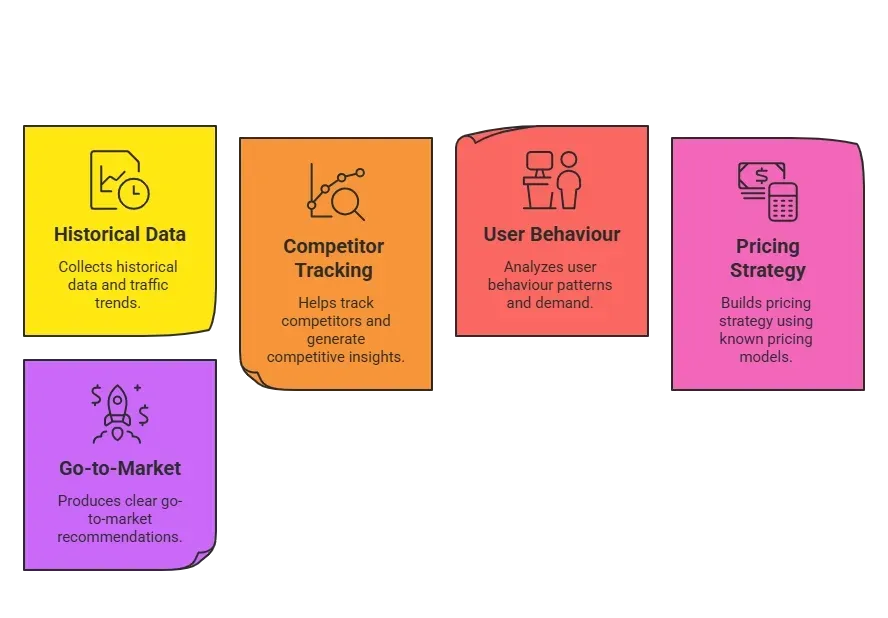 All of this happens in one continuous flow.
So instead of switching tools, your system builds a structured output where each insight connects to the next. That’s what leads to better outcomes and faster decisions.
How Rocket Work?
This is where things come together, turning a simple idea into a structured system that handles research, strategy, and product development in a single continuous flow.
Let’s break it down based on the platformis design.
Step 1: Start With Simple Prompts
You begin with an idea using simple prompts.
For example: “Analyze market entry for an AI startup in fitness tech.”
Rocket uses artificial intelligence to expand this into a structured problem-solving session.
Step 2: Intelligence Layer
The platform gathers and processes data through its intelligence layer.
It pulls:
-
Market trends
-
Competitor activity
-
Customer signals
-
Traffic trends
-
Historical data
This layer connects multiple data sources to generate insights that are grounded in real signals and independently verifiable information.
Step 3: Solve Layer
Next, the solve layer organizes everything into a clear structure.
It builds:
-
Market overview
-
Competitive intelligence
-
Pricing models
-
Unit economics
-
Strategy and direction
This is where raw data turns into decision-ready insights. The system creates a clean structure that supports strong decision making.
Step 4: Build Layer
After that, development begins.
Rocket allows you to:
-
Write code using AI powered coding tools
-
Generate product features
-
Create product requirement documents
-
Move directly into product building
So while your research is ready, your product starts taking shape at the same time.
Step 5: Output Generation
Finally, the platform produces structured outputs.
You get:
-
Board-ready reports
-
Launch plans
-
Product requirement documents
-
Export options in pdf format
Everything is aligned with your idea, strategy, and business goals.
This flow shows how Rocket keeps the entire process connected, helping teams move from idea to output without breaking structure or losing context.
Key Features That Make Rocket Stand Out
Here’s a simple breakdown:
| Feature | What It Does | Why It Matters |
|---|---|---|
| Competitive intelligence | Helps track competitors and analyze positioning | Clear market direction |
| Code generation | Lets you write code directly from prompts | Faster development |
| Intelligence layer | Connects real data sources and insights | Strong research foundation |
| Solve layer | Structures strategy and insights | Better decision making |
| Build layer | Turns ideas into product features | Faster product building |
| Structured output | Creates reports and plans in pdf format | Easy presentation and action |
| Full platform approach | Keeps everything in one system | No loss of context |
This table shows how each feature connects back to one goal, helping teams move faster with clear structure, stronger insights, and smoother decision making.
From Idea to Launch in One Flow
This is where the process feels smooth, moving from a simple idea to a ready-to-launch plan without breaking the flow.
So, how does the journey actually look?
You start with an idea.
Then:
-
The system builds research
-
You track competitors
-
You analyze demand
-
You define pricing
-
You generate insights
-
You build product features
-
You prepare launch
All of this happens inside one platform.
That’s the power of vibe coding with AI. You guide the direction while the system handles the heavy lifting, keeping everything connected from start to finish.
The Role of Data and Decision Making
At the core of every strong strategy is one thing, reliable data that supports clear thinking and action.
Rocket 1.0 uses:
-
Historical data
-
Traffic trends
-
User behaviour patterns
-
Independently verifiable information
This improves decision making at every stage.
Instead of guessing, your business decisions are backed by real signals. This helps teams move faster, stay confident in their direction, and avoid unnecessary backtracking.
Pricing, Revenue, and Business Metrics
Once the structure is ready, the focus shifts to numbers that shape your business plan and long-term growth.
Rocket helps you calculate:
-
Pricing
-
Known pricing models
-
Annualized average revenue
-
Gross margins
-
Unit economics
So your business plan is not just built on ideas. It is supported by numbers that make sense and help present a clear picture to stakeholders.
Where Human Expertise Still Matters
Even with strong AI systems, the human side of thinking still plays a key role in shaping outcomes.
You still need:
-
Direction
-
Judgment
-
Final validation
The system helps you build faster and organize better, but your thinking defines the strategy. This balance between AI and human input leads to better outcomes and more confident decisions.
Why This Matters for AI Startups
For an AI startup, speed and clarity decide how far your idea goes, especially when the market is moving fast.
You need to:
-
Validate your idea: test demand early and avoid wasting time on the wrong direction
-
Build fast: move from concept to product without delays
-
Launch quickly: enter the market before competitors take the lead
-
Adjust based on feedback: refine your product using real customer responses
Using multiple AI platforms slows you down and breaks your flow. A standalone tool won’t handle everything.
But a full platform like Rocket 1.0 supports:
-
Research: gather insights and understand the market clearly
-
Development: turn ideas into working features without delays
-
Operations: manage workflows and keep processes connected
-
Launch: prepare and execute a structured go to market plan
This is how modern teams stay focused, reduce friction, and move from idea to execution with better control.
AI, Tools, and the Shift in Product Building
The way teams build products has changed, and artificial intelligence is at the center of that shift.
Earlier:
-
Separate tools: teams relied on different tools for each task, leading to scattered workflows
-
Manual work: more time was spent on repetitive tasks instead of thinking and strategy
-
Slower output: disconnected systems delayed progress and decision making
Now:
-
AI tools for research: data collection and analysis happen faster and more accurately
-
Code generation: teams can write code quickly and move into development without delays
-
Connected systems: the entire workflow stays in one place, reducing confusion and rework
This shift allows teams to focus more on strategy and less on managing tools, making the overall process smoother and more effective.
AI Market Entry Analysis on Rocket.new
Teams often rely on disconnected tools, which leads to scattered data, repeated research, and slower decision making. This lack of structure makes it harder to produce clear, board-ready outputs, especially when multiple systems fail to stay connected throughout the process.
A single platform like Rocket 1.0 solves this by bringing research, code, pricing, and strategy into one flow. AI Market Entry Analysis on Rocket.new removes fragmentation, giving you structured insights, strong data, and faster decisions, so your idea moves smoothly from research to launch with clarity.
Table of contents
- -What Does “Board-Ready Output” Really Mean?
- -The Problem With Traditional Market Entry Research
- -So, What Is Rocket 1.0?
- -How Rocket Powers Market Entry Analysis
- -How Rocket Work?
- -Step 1: Start With Simple Prompts
- -Step 2: Intelligence Layer
- -Step 3: Solve Layer
- -Step 4: Build Layer
- -Step 5: Output Generation
- -Key Features That Make Rocket Stand Out
- -From Idea to Launch in One Flow
- -The Role of Data and Decision Making
- -Pricing, Revenue, and Business Metrics
- -Where Human Expertise Still Matters
- -Why This Matters for AI Startups
- -AI, Tools, and the Shift in Product Building
- -AI Market Entry Analysis on Rocket.new