
Rocket.new is a three-pillar AI platform for founders: Solve validates ideas with structured research, Build ships Next.js and Flutter apps from plain language, and Intelligence monitors competitors across nine signal types. Free to start, no credit card needed.
An AI platform for founders removes the biggest early-stage bottlenecks: uncertain markets, slow product development, and blind spots about competitors. Rocket.new combines idea validation, production-ready app building, and continuous competitor monitoring in one platform, so founders move from research to live product without switching tools. Start free, no credit card needed.
Key Takeaways
- Rocket.new is a three-pillar platform: Solve (research), Build (Next.js + Flutter apps), and Intelligence (competitor monitoring)
- Non-technical founders describe an idea in plain language and get a production-ready app with no code required
- Solve reports export as PDF, HTML, or PowerPoint; Build produces real code downloadable or synced to GitHub
- Intelligence watches competitors across nine signal types continuously: pricing, hiring, product, GTM, and more
- Free to start with no credit card required
What Is an AI Platform for Founders?
An AI platform for founders is a tool that combines strategic research, production-ready app building, and competitive intelligence to help entrepreneurs validate ideas, ship products, and stay ahead of the market without requiring a technical team or switching between multiple tools.
The best platforms help founders think through the problem first, build the right thing second, and monitor what competitors do next.
What Founders Really Face
Turning a startup idea into a real business means making high-stakes decisions with limited data. Research shows that the top reasons startups fail include no market need, running out of cash, and poor team dynamics. An AI platform for founders provides data-driven support in each of these areas before it is too late.
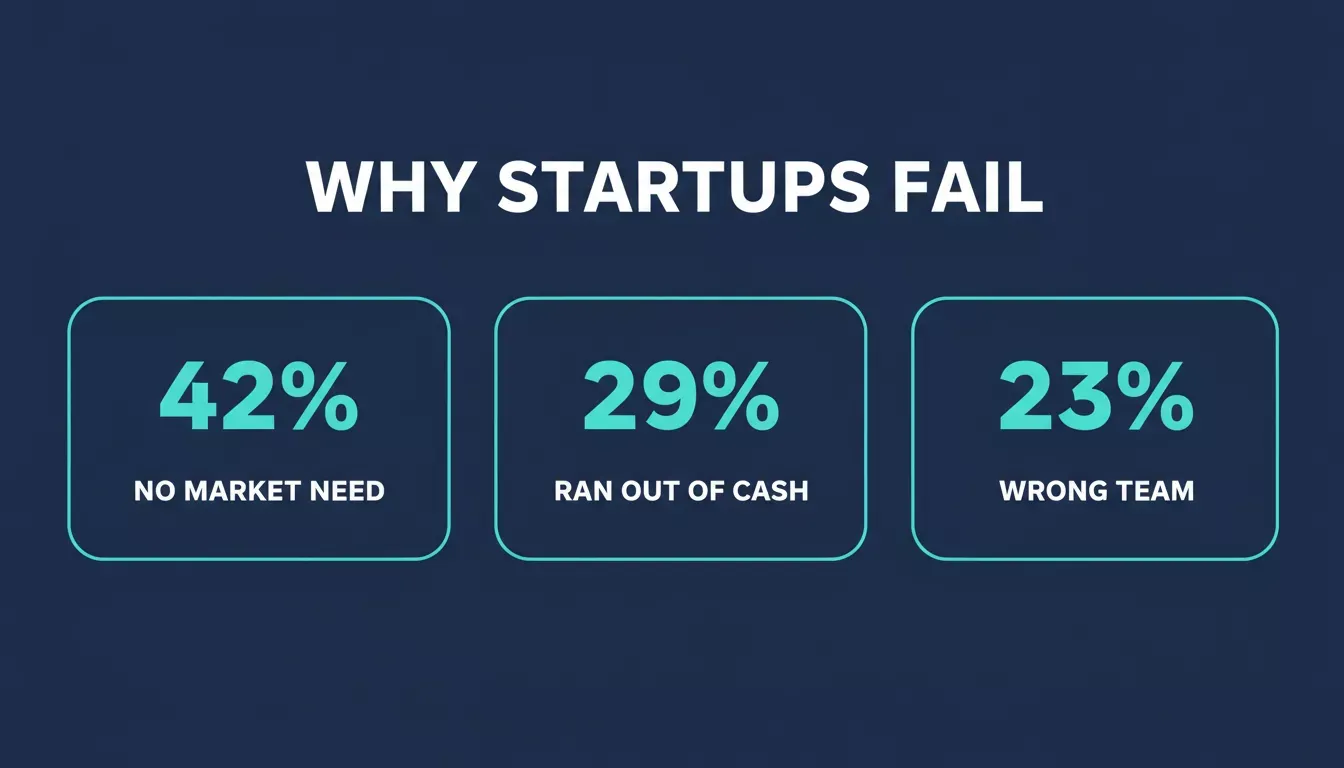
The three biggest startup killers are all addressable with the right AI platform from day one.
The core challenges every founder faces:
- Validating the idea with real market data before building the wrong thing
- Designing product features people actually want
- Preparing a compelling pitch deck for investors
- Knowing what competitors are shipping before it affects your growth
What Does an AI Platform for Founders Actually Do?
An AI platform for founders acts like a digital co-founder: a tool that supports you at key stages of your startup journey without taking over your vision. These platforms help with:
- Idea validation: Analyze market demand, spot trends, and get data-backed feedback on what customers are searching for
- Real-time insights: Deliver actionable research in minutes instead of weeks
- Pitch deck creation: Draft professional, investor-ready decks from your notes and available data
- Strategy guidance: Map go-to-market plans, suggest product roadmaps, and recommend features based on user behavior
- Competitor monitoring: Track pricing changes, hiring signals, product launches, and messaging shifts automatically
Rocket.new: The Three-Pillar AI Platform Built for Founders
Most AI tools do one thing. Rocket.new is built around three connected pillars that cover the full founder journey.
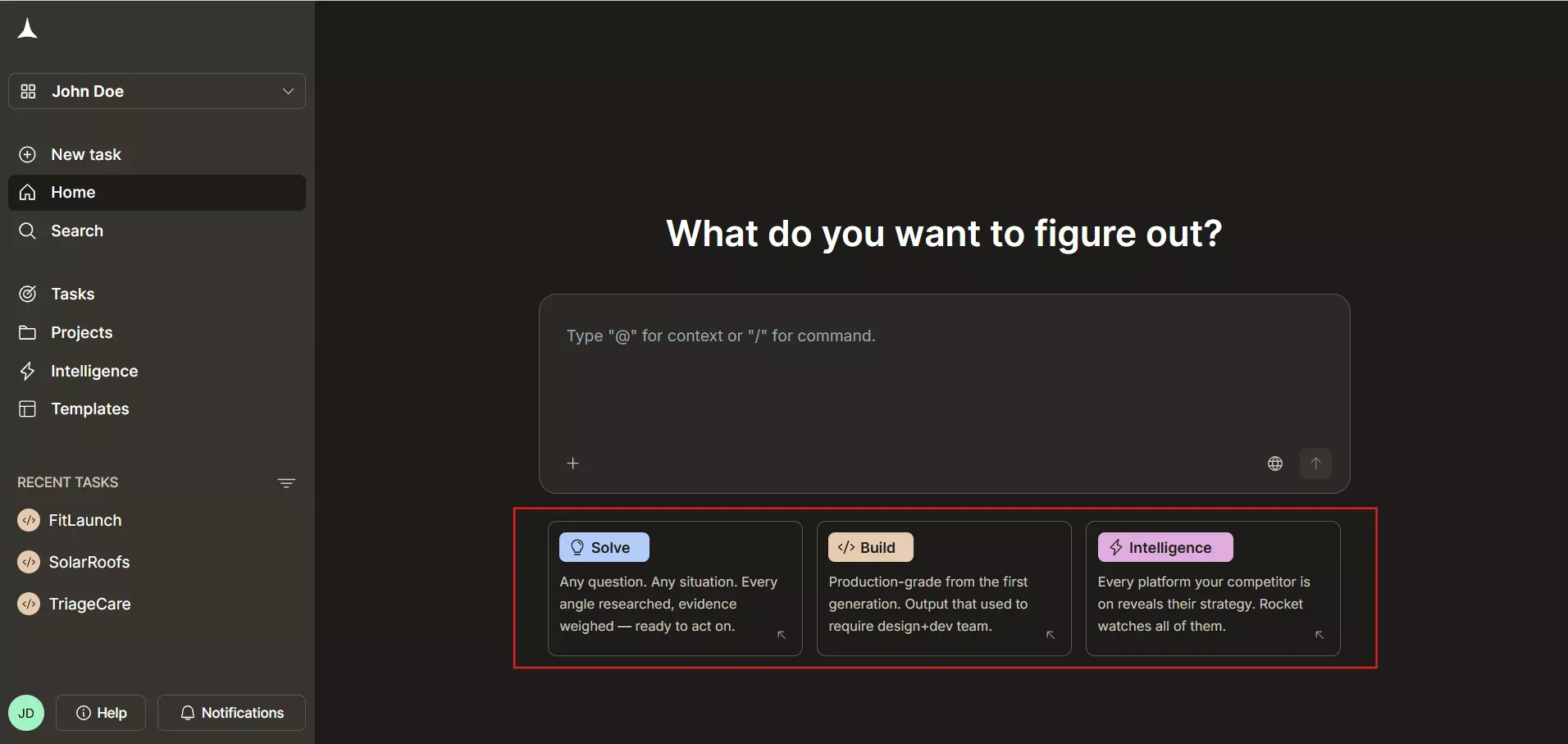
Solve, Build, and Intelligence work independently or together, use one, two, or all three.
Solve: Validate Before You Build
Solve is Rocket.new's research engine. Type a business question in plain language and get back a structured, evidence-backed report with an executive summary, supporting evidence, and actionable recommendations. Results export as PDF, HTML, or PowerPoint, ready to share with co-founders or investors.
What Solve covers:
- market sizing
- competitive teardowns
- pricing strategy benchmarking
- feature prioritization
- investment analysis.
Build: Ship Production-Ready Apps Without Code
Describe what you want, and Rocket generates production-ready Next.js web apps or Flutter mobile apps with Build. No code, no terminal, no developer needed.
- Build handles the full stack, including frontend, backend, database, auth, and deployment.
- You can also import Figma designs and convert them directly into production-ready code.
- Finished apps produce real code you can download or connect to GitHub.
What Build produces:
- Next.js web apps: SaaS dashboards, internal tools, marketplaces, customer portals
- Flutter mobile apps: iOS and Android, submittable to the App Store and Google Play
- Landing pages with custom domains
- E-commerce stores with payment integrations
Intelligence: Monitor Competitors Continuously
Intelligence watches companies you care about across nine signal types and delivers personalized Intel to your dashboard. It tells you not just what changed, but what it means for your business specifically.
Intelligence detects absence (when something stops happening) and cross-pillar patterns (when several signals together imply a strategy), replacing the manual work of checking competitor sites, LinkedIn, G2, and social feeds across multiple tools. See how Intelligence works.
Intelligence in action: What gets monitored
Nine signal types: website, social, news, GTM, traffic, product, people, business, and reviews.
- Website: Messaging changes, pricing page updates, new feature announcements
- People and Hiring: Leadership moves, hiring velocity, team growth signals
- Product and Technology: Release velocity, feature launches, tech stack changes
- GTM: Paid campaigns, SEO moves, content strategy shifts
- Reviews and Community: G2 ratings, Reddit sentiment, app store feedback
Research shows that companies acting on competitive intelligence faster than rivals consistently outperform on growth metrics. Intelligence makes that speed possible without adding headcount.
How the Three Pillars Connect
| Stage | Pillar | What It Produces |
|---|---|---|
| Before you build | Solve | Structured research report, exportable as PDF, HTML, or PPTX |
| While you build | Build | Next.js web app or Flutter mobile app, real code, downloadable or GitHub-synced |
| After you launch | Intelligence | Continuous competitor signals across nine pillars, personalized to your role |
Early Stage Startups and Why They Need AI the Most
For early-stage startups, resources are limited. No full team, limited feedback data, and simultaneous time and money pressure. Studies show that startups with strong market validation are significantly more likely to reach Series A than those that skip it.
Y Combinator's essential startup advice consistently emphasizes talking to customers early. An AI platform for founders automates the research and drafting work so that time is available for real customer conversations.
Real Benefits Founders Report
| Area | What AI Does | Result |
|---|---|---|
| Idea validation | Analyze trends and demand data | Faster confidence in strategy |
| Product decisions | Suggest feature prioritization | Better roadmap shaping |
| Pitch deck | Draft, edit, and structure content | Saves hours of work |
| Market insights | Break down competitor moves | Smarter positioning |
| Competitor monitoring | Track pricing, hiring, and product signals | No strategic blind spots |
Voice of Founders in the Community
"You don't need a co-founder anymore, you need an AI stack. These are the exact tools solo founders are using to hit $1M ARR in 2025. AI replaces tasks, not taste. The tools are the leverage. You are still the competitive edge." LinkedIn
This reflects a broader shift. Many founders are adopting AI tools early because they want to spend more time on vision and growth, and less on repetitive tasks.
Rocket.new vs. Other AI Tools for Founders
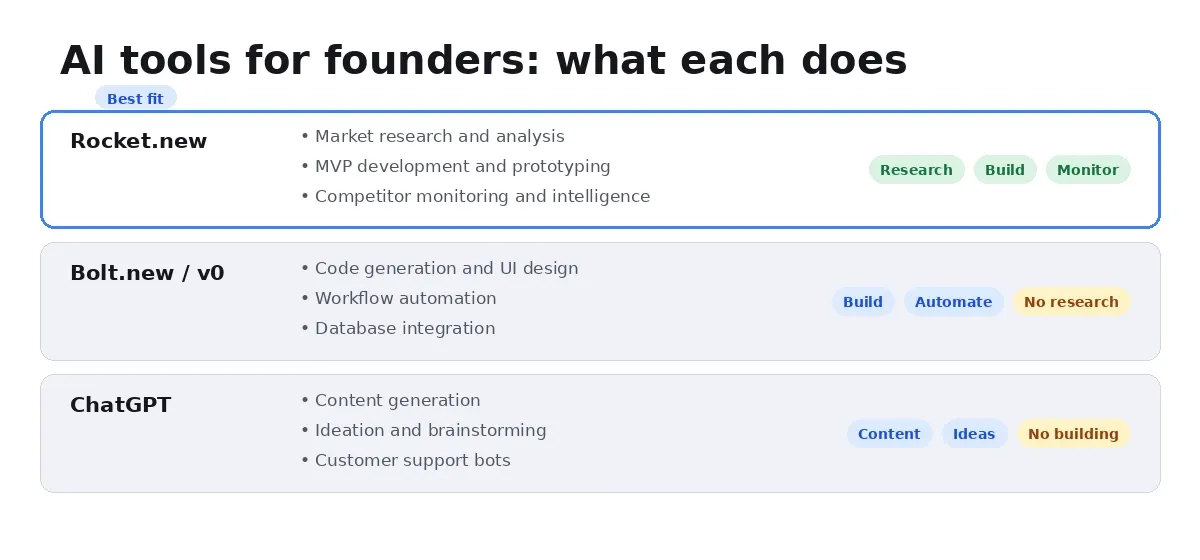
Rocket.new is the only platform that combines research, building, and competitor monitoring in one product.
| Tool | Capabilities | What's Missing |
|---|---|---|
| Rocket.new | Research + Build + Monitor | Nothing, full stack |
| Bolt.new / v0 | UI prototypes and components | No research, no monitoring |
| Bubble | Visual no-code app builder | No AI research, no intelligence |
| ChatGPT / Perplexity | Conversational answers | No app building, no monitoring |
See a detailed comparison of Rocket.new against other AI builders to understand the full difference.
How Teams Use AI Tools Together
Once founders build a team, AI keeps work structured and focused. Projects in Rocket.new group related Solve and Build tasks with shared context, uploaded files, and connected services so the whole team works from the same research.
- Project management: Organize tasks and timelines so nothing falls through the cracks
- Versioned product decisions: Track iterations and decisions without confusion
- Feedback summaries: Quickly digest customer or team feedback for actionable next steps
Explore how rapid prototyping with AI keeps early-stage teams moving fast without sacrificing quality.
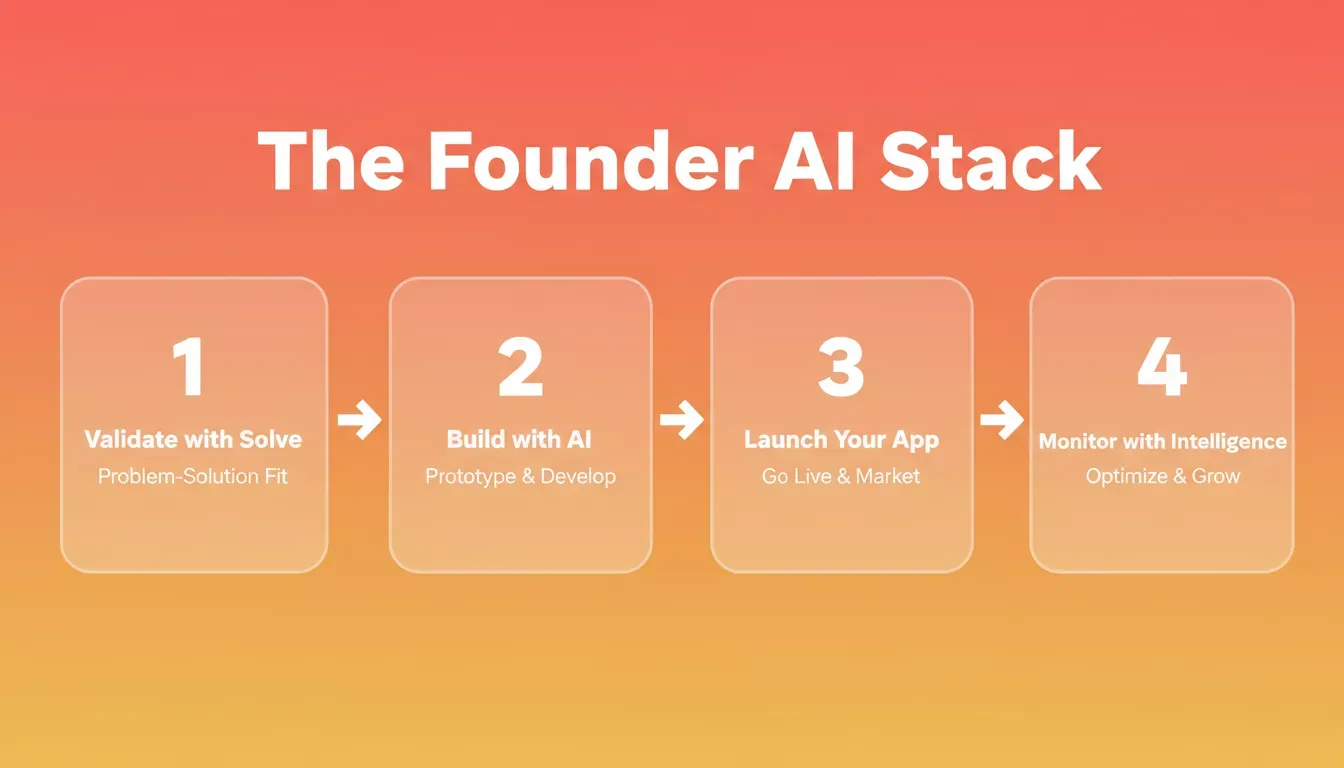
The complete AI workflow for founders: validate, build, launch, and monitor in one continuous loop.
Challenges Founders Should Be Aware Of
AI tools are helpers, not truth machines. Generated ideas sometimes need refinement, and data is not always perfectly accurate. Using AI insights alongside real-world customer feedback remains the strongest approach.
Rocket.new is designed with this in mind. Solve produces evidence-backed reports with cited sources rather than hallucinated summaries. Build generates real, downloadable code rather than locked-in visual builders. Intelligence surfaces signals with context rather than raw noise.
AI app builders have matured significantly, but founders who combine AI output with direct customer validation consistently outperform those who rely on AI alone.
Are You Ready? Stop Guessing and Start Building
The founders who win aren't the ones with the most resources; they're the ones who move faster with better information. Validate your idea with Solve before writing a single line of code.
Ship a production-ready app with Build without needing a technical co-founder. Stay ahead of every competitor move with Intelligence running automatically in the background.
Most founders spend months bouncing between research docs, no-code tools, and manual competitor tracking. Rocket.new collapses all of that into one platform, one workflow, one place.
Validate your idea, build your product, and monitor your competitors in one place.
Start building with Rocket free today, no credit card required.
Table of contents
- -Key Takeaways
- -What Is an AI Platform for Founders?
- -What Founders Really Face
- -What Does an AI Platform for Founders Actually Do?
- -Rocket.new: The Three-Pillar AI Platform Built for Founders
- -Solve: Validate Before You Build
- -Build: Ship Production-Ready Apps Without Code
- -Intelligence: Monitor Competitors Continuously
- -How the Three Pillars Connect
- -Early Stage Startups and Why They Need AI the Most
- -Real Benefits Founders Report
- -Voice of Founders in the Community
- -Rocket.new vs. Other AI Tools for Founders
- -How Teams Use AI Tools Together
- -Challenges Founders Should Be Aware Of
- -Are You Ready? Stop Guessing and Start Building