
AI-powered PRD generator on Rocket.new that transforms customer research and competitive insights into structured product documents, enabling teams to make faster decisions and build products backed by real-world evidence.
Why build a PRD from real customer input instead of assumptions?
Because it leads to better and faster product decisions.
A report by McKinsey & Company shows that companies using strong data and market research can improve product outcomes and speed up by up to 30%.
That means one thing. When research, evidence, and customers guide your product, you stop guessing and start building with clarity.
This blog will help you understand how to use research, data, and customer insights to build stronger, more reliable product decisions step by step.
Why Traditional PRDs Often Miss the Mark
So, let’s be honest.
Many PRDs are written in a room with a table, a few teams, and a lot of opinions. It feels productive on the surface, but the real problem stays hidden and shows up later in the product.
Where Things Go Wrong
-
Teams rely on internal beliefs instead of proper market research
-
Assumptions replace real customer input
-
Important data is ignored or not analyzed properly
-
Industry trends are not studied in detail
-
The competitive landscape is overlooked
-
Money is spent building something that doesn’t match actual demand
-
The process becomes repetitive and time-consuming
This creates stress and slows down decision-making. For a small business, the impact is even bigger since resources are limited and every step affects growth, brand value, and long-term direction.
What Changes When You Start with Research
Now, flip the approach. Instead of starting with assumptions, you begin with real research, and that changes how your entire product takes shape from the very first step.
What Actually Changes
-
Customer Understanding Improves: You talk to customers, study demographics, and track online behavior to see what they actually need.
-
Stronger Market Awareness: You analyze industry trends and compare competitor offerings to understand where your product fits.
-
Data-Driven Decisions: Features are defined using real data instead of guesses, which makes your PRD more reliable.
-
Clear Patterns and Insights: You start noticing patterns across different groups and identify what services are working in the market.
-
Faster and Smarter Process: AI tools help in analyzing large amounts of data quickly and reduce manual effort.
-
Evidence-Based Output: You generate answers that are backed by solid evidence, not opinions.
When you start with research, your PRD becomes grounded in reality. It reflects real customer needs, reduces risk, and helps your business move forward with clarity and confidence.
The Shift Toward Evidence-Based Product Building
Well, this is where things get interesting.
Companies across industries are shifting toward evidence-based product development. Instead of guessing, they rely on structured research methods.
Here’s what that looks like in simple terms:
| Old Approach | New Approach |
|---|---|
| Opinion-based decisions | Data-driven decision making |
| Internal team beliefs | Customer-focused insights |
| Limited research | Continuous market research |
| One-time planning | Ongoing analyzing |
| High risk of failure | Better chance to win |
This difference changes everything.
When your business uses real evidence, you build products that fit the market. You don’t just hope things will work. You actually understand why they should.
How Rocket Brings Everything Together?
Next, let’s talk about Rocket.new.
It is a platform that connects your research, your data, and your product building process into one smooth flow. Instead of switching between different tools, you can manage everything in one place, which keeps your work simple and organized.
Rocket helps teams begin with research and move toward production without losing context. Your data stays connected at every step, so your ideas don’t get lost along the way.
This approach works for both small business owners and larger organizations. No matter the size, the goal stays the same. Build products that customers actually want, using clear research and structured steps.
How Rocket Works in Simple Terms?
So, how does it actually work?
Rocket follows a clear flow built around three core parts: Intelligence, Solve, and Build. Each step connects your research, decisions, and product output in one system.
Step-by-Step Flow
-
Start with Intelligence: You bring in market research, customer insights, and online data. The platform helps in analyzing patterns, trends, and customer behavior across industries.
-
Move to Solve: Next, Rocket turns that research into structured thinking. It helps you define problems, compare competitor data, and shape clear answers based on evidence.
-
Shift to Build: After that, you generate outputs like product ideas, feature lists, and PRDs. Everything is structured and ready for production.
-
Connected System: Each step builds on the last one. Your data, research, and outputs stay linked across the entire process.
This means your product is not built from guesses. It is built from connected research, clear insights, and real evidence.
Features That Make It Stand Out
Let’s break down a few features in a simple way so you can understand what makes this system different.
Core Features
-
Intelligence Layer: Collects and analyzes market research, customer data, and industry trends in one place.
-
Structured Problem Solving: Helps you define problems, compare competitor insights, and build logical answers.
-
Data-Driven Output: Uses real data and evidence to generate structured results like PRDs and feature sets.
-
Customer Insight Focus: Keeps customer behavior and feedback at the center of every decision.
-
Scalable Workflow: Works for a small business and also for larger organization-level projects.
-
Automation Support: Reduces manual effort by handling repetitive research and analysis tasks.
-
Security Layer: Keeps your data protected, which matters when working with sensitive business information.
These features work together to create a system where research, thinking, and building stay connected from start to finish.
How Rocket Turns Research into Real Product Decisions?
Now, let’s bring it back to the main idea of this blog.
What the System Actually Uses
-
Customer data
-
Market demand
-
Industry trends
-
Competitor performance
-
Real usage patterns
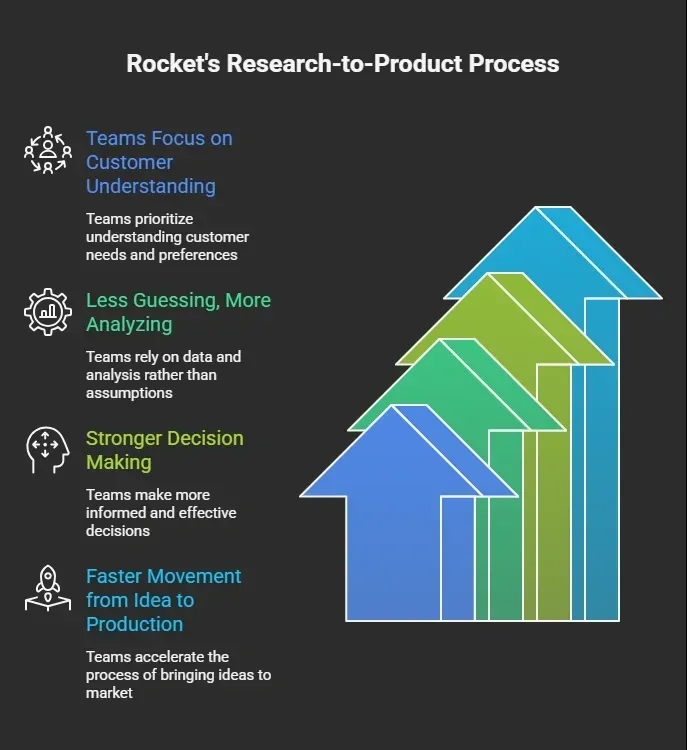 This approach directly supports building PRDs from real customer research and competitive evidence instead of internal assumptions.
A Simple Flow You Can Follow
If you want to apply this approach, here’s a simple flow you can follow step by step.
Step-by-Step Process
-
Begin with Research: Gather market research from online sources. Talk to customers and study demographics.
-
Analyze Insights with Intelligence: Use the system to organize data, track trends, and understand customer behavior.
-
Solve the Core Problem: Define the problem clearly. Compare competitor offerings and identify gaps in the market.
-
Define Your Product: Use insights to shape your product idea and key features.
-
Generate Your PRD in Build: Create a structured PRD based on real data and evidence.
-
Test and Improve: Use customer feedback and keep refining your product over time.
This process is simple, practical, and works across industries. It helps you move from research to production with clarity and confidence.
Why This Approach Works for Small Businesses
Small business owners often work with limited resources, so every decision carries weight from the very beginning.
Key Points
-
Limited resources mean you can’t afford to waste money
-
Spending months on the wrong idea can slow your growth
-
Research gives you clarity from the start
-
Understanding customers early helps reduce risk
-
It improves your chances to win in the market
-
You make smarter and more confident decisions
-
You can start small and focus only on what matters
-
You can scale step by step as you grow
This approach helps small businesses stay focused, reduce mistakes, and build in a way that supports steady and sustainable growth.
The Role of AI in All This
Let’s talk about AI and how it fits into this process.
Key Points
-
AI helps process large amounts of data quickly
-
It supports analyzing patterns across customers and markets
-
It helps generate insights faster
-
It reduces manual effort in research tasks
-
It makes the process less time consuming
-
It allows you to focus more on strategy
With AI supporting your workflow, you can move faster, think clearer, and spend more time on building the right product.
What You Should Keep in Mind
Before you move forward, keep these simple points in mind. They may look basic, but they shape how your product turns out in the real market. Small adjustments here can save time, money, and effort later.
Key Points
-
Always focus on customers
-
Keep your research updated
-
Don’t ignore competitor insights
-
Use data to guide your decisions
-
Stay flexible and ready to adapt
These points may seem simple, but they matter in every step of your process. When you follow them consistently, your decisions become clearer and your chances of building something that actually works increase.
Building Smarter with AI PRD Generator on Rocket.new
The problem is simple. Many teams still build products based on assumptions instead of real research. They miss what customers actually need, which leads to wasted time, money, and effort. For any business, especially a small business, this can slow growth and create unnecessary stress during the product building process.
The solution is to use a system that connects research, data, and product building in one place. When you use an AI PRD generator on Rocket.new, your product is shaped by real insights and evidence. This helps you move faster, reduce risk, and build something that truly fits the market.
Table of contents
- -Why Traditional PRDs Often Miss the Mark
- -What Changes When You Start with Research
- -The Shift Toward Evidence-Based Product Building
- -How Rocket Brings Everything Together?
- -How Rocket Works in Simple Terms?
- -Features That Make It Stand Out
- -How Rocket Turns Research into Real Product Decisions?
- -A Simple Flow You Can Follow
- -Why This Approach Works for Small Businesses
- -The Role of AI in All This
- -What You Should Keep in Mind
- -Building Smarter with AI PRD Generator on Rocket.new