Automated market research for builders does not have to be slow or expensive. This guide covers the Rocket.new fast-track method a connected system that combines AI-powered market research, daily competitive monitoring, and production-ready app building to help builders ship products the market actually needs.
What would change about the way you build if the research was done before you wrote a single line of code?
For most builders, market research is a late-stage afterthought something that happens after weeks of writing code, not before.
The result is predictable.
According to CB Insights data, 42% of startups fail because they build products with no market need. Not because the code was bad. Not because the team was wrong. Because nobody needed what they built.
Rocket.new exists to close that gap. As the world's first vibe solutioning platform, it puts automated market research, competitive intelligence, and production-grade app building into one connected system so you know what to build before you build it.
Why Builders Skip Market Research (and Pay for It Later)
The Real Cost of Skipping Research
There is a mental shortcut almost every builder uses at some point.
It sounds logical:
"I'll validate after I build a quick MVP. Talking to customers can wait."
The problem is that a quick MVP tends to take 3 to 6 months. By the time you launch, you have sunk $150,000 to $300,000 in development costs into a direction you have not tested. And when you do test it - by showing it to real users - you discover the thing they actually needed was slightly (or significantly) different.
This is not a failure of execution. It is a failure that happens upstream, before a single line of code is written.
A founder on r/YCombinator described this tension clearly:
"I can put money into marketing but I don't want to spend money on a product that isn't viable. I'm more comfortable writing code than writing tweets, but I know hiding behind the keyboard isn't a strategy." - r/YCombinator, Solo founder, product is done, terrified of marketing
That post resonates because almost every solo founder has been in that exact spot. Product done. Market unknown. Next step unclear.
Why Traditional Market Research Does Not Work for Builders
The alternative most builders consider is traditional market research. The math on that is also discouraging.
| Research Method | Time Required | Typical Cost | Output Quality |
|---|---|---|---|
| Consulting firm report | 2-4 weeks | $2,000-$10,000+ | Generic, slow to act on |
| Manual desk research | 1-2 weeks | Time-intensive | Medium - scattered |
| Customer interviews | 1-2 months | $300-$1,000 | High but slow |
| AI-powered automated research | Under 2 hours | Free plan or low paid plans | High - structured decisions |
The no-code AI platform market tells you where this is all heading. It was valued at $6.56 billion in 2025 and is projected to reach $75.14 billion by 2034, growing at a CAGR of 31.13%. Builders and startups everywhere are moving toward tools that reduce manual effort without compromising on output quality.
The "Build First, Validate Later" Spiral
Here is what the typical un-researched product launch cycle looks like for most early stage startup teams. The idea arrives, writing code begins almost immediately, and months of development follow before anyone asks whether the market actually needs what is being built.
When the MVP launches and user feedback arrives, the answer is sometimes positive - but often the signal is weak, traction is missing, and the only options left are a costly pivot or a shutdown.
This cycle is expensive and completely avoidable when market research happens before building, not after.
The data on this is consistent. Among startups that conducted structured customer interviews, willingness-to-pay testing, and proper market sizing before building, failure rates from no market need drop below 15%. The research is not the bottleneck - the speed and structure of that research is.
That is the exact problem automated market research for builders solves. A significant portion of early stage companies skip validation not because they think it is unimportant but because the process of doing it properly felt too slow and too separate from the act of building.
What Automated Market Research Actually Looks Like
Automated market research is not a smarter Google search. It is a different category of output entirely.
When you describe your idea in plain English, a well-built AI research system runs that question across hundreds of sources simultaneously. It maps competitor positioning by name, identifies gaps in the current market, scores confidence levels for each finding, cross-references evidence, and returns a structured decision - not a pile of raw data.
The difference is simple: traditional research gives you data. Automated market research gives you a direction.
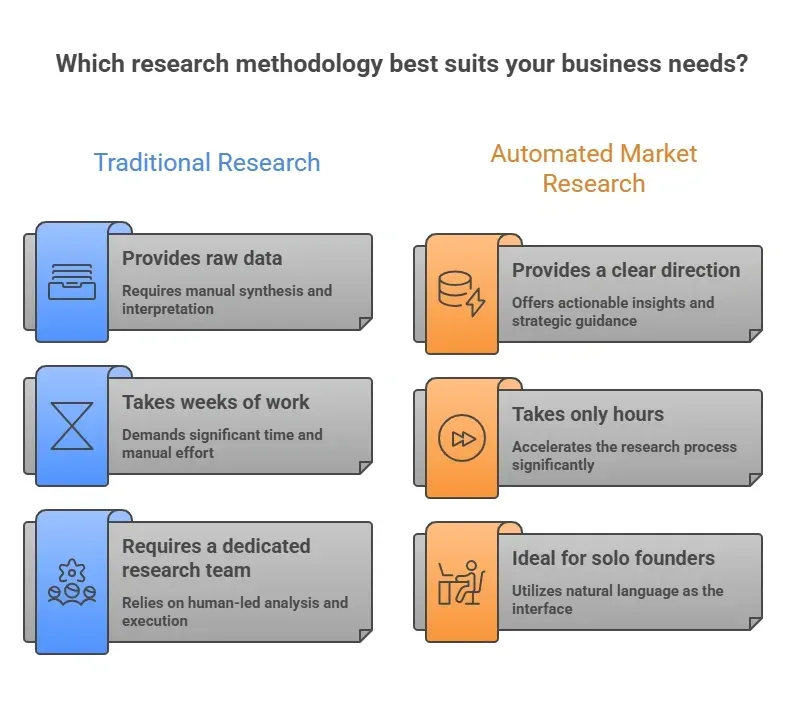 Natural language is the interface. You describe what you are trying to figure out. The system handles the rest. For startup founders and solo founders who do not have a research team, this shifts the dynamic completely. Surveys, competitive analysis, addressable market sizing, customer interviews these are no longer weeks of work. They are hours.
The Rocket.new Fast-Track Method: How It Works
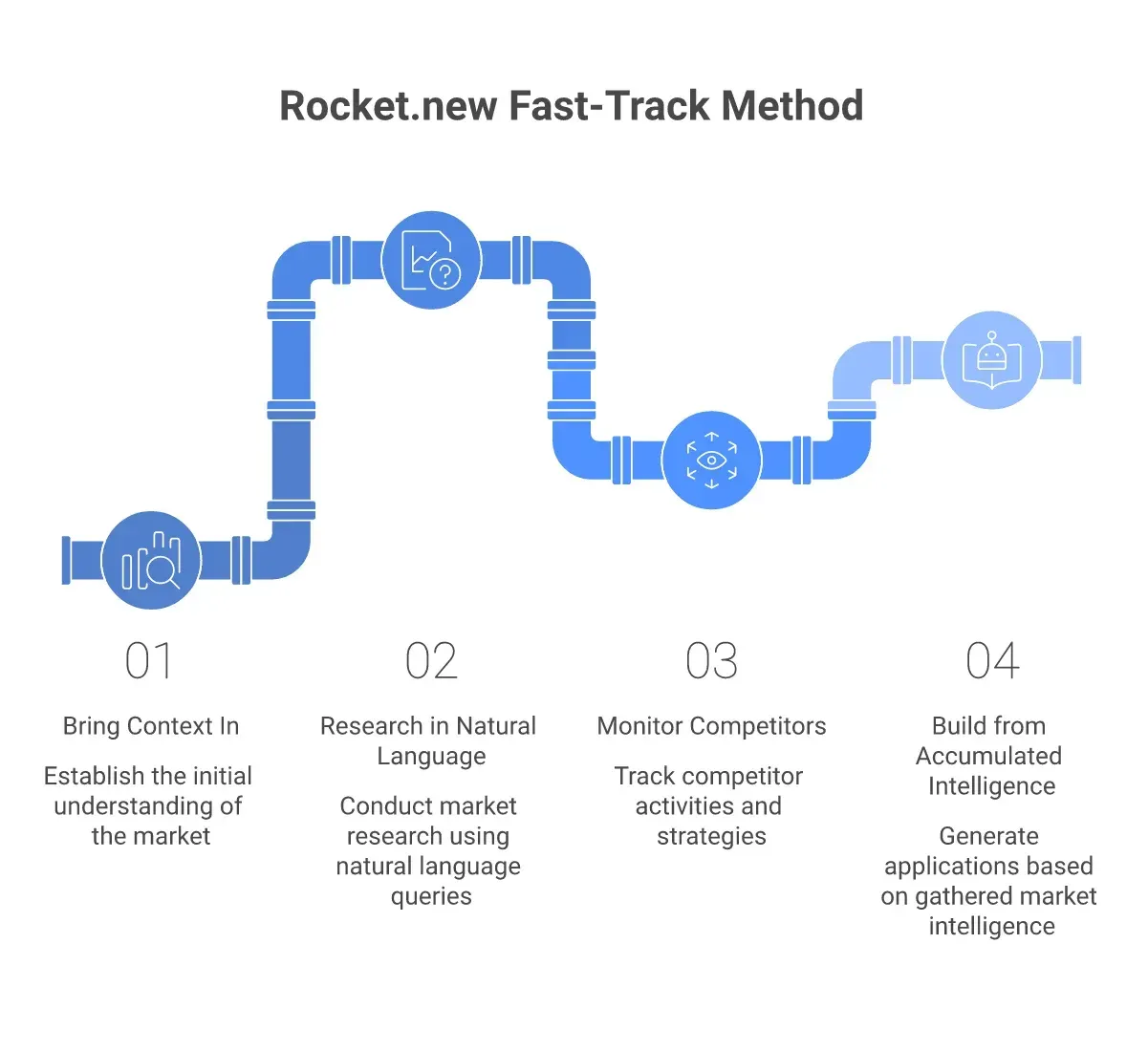
This is the automated market research for builders method that Rocket.new makes possible. It is not a checklist you move through one step at a time. It is a connected system where every step feeds into the next, and the intelligence compounds as you go.
 Section - The Rocket.new Fast-Track Process
Step 1 - Bring Your Context In Once
Create a project and add everything you already know. Strategy documents, financial models, customer notes, past research, brand guidelines. Rocket.new reads files structurally - not just the text, but the formulas in spreadsheets, the cross-sheet dependencies, the conclusions inside strategy briefs.
Connect Notion, Google Docs, or Google Sheets and your existing thinking flows in live. The first task you open already knows everything you loaded. The team member who joins six weeks later starts from the full accumulated intelligence - not from a catch-up document someone forgot to update. This shared context makes every build task that follows sharper and more targeted.
Step 2 - Ask Any Business Question in Plain English
Type your question in natural language. It can be broad or specific:
-
"I want to build a tool that negotiates contracts, not just reviews them. Is this a real business and what should I build first?"
-
"Our conversion rate dropped 18% over two months. Here are four hypotheses. Give me a prioritized root cause analysis."
-
"Competitive deal against Company A and Company B. Give me their gaps and our strongest positioning."
Within 60 to 90 minutes, Rocket.new runs thousands of queries across 150+ sources at the same time. What comes back is a complete structured output: market analysis, competitors identified by name, competitive gaps, a validation path, a 90-day product roadmap with owners and timelines, and findings scored by confidence level. This is the deliverable a strategy firm takes a week to produce.
Step 3 - Monitor Competitors Automatically, Every Day
Add your competitors. Rocket.new monitors every public surface they operate on: websites, LinkedIn, X, Instagram, G2, Glassdoor, job postings, ad activity, press coverage, pricing pages, product changelogs.
Every morning, a structured brief arrives before the workday starts. Not a feed of alerts. A three-part strategic document: what moved, what it means for your business specifically, and what you should do about it. Delivered inside Rocket.new, to your email, or to WhatsApp.
Your sales team starts every week knowing what changed. Your product team plans the roadmap against what competitors are building next, based on hiring patterns and feature signals. Rocket handles the monitoring so your team stays focused on building and shipping.
Step 4 - Build From Everything, Not From a Blank Prompt
When you open a Build task, Rocket.new already knows the research that validated the direction, the competitive intelligence, the brand guidelines, and the customer problem the research identified. Build does not start from your single prompt. It starts from the accumulated intelligence of the entire project.
Before generating apps, Rocket.new surfaces the decisions that matter: target users, key interactions, data models, database schema, and design direction. Two minutes of specificity prevents two hours of revision. What comes back is not a mockup. It is a working, deployable production ready app without any coding required.
What the Generated App Outputs Cover
The generated app outputs from Rocket.new span the full range of what builders typically need. No coding required for any of it.
Web Apps and Mobile Apps
Full stack generation using Next.js for web apps and Flutter for mobile apps, with dark and light theming, staggered animations, and real design systems. Every build ships with SEO, WCAG accessibility, GDPR compliance, and performance optimization built in. Staging and production environments are included. Full version history with one-click rollback.
Internal Tools and Client Dashboards
Client dashboards connected to Mixpanel and Airtable. Operations tools. GDPR compliance dashboards. ROI calculators. Sales enablement platforms. The business logic is generated automatically you describe what the tool needs to do, and Rocket handles how it does it. A 90-person company built a leadership OKR dashboard in one session.
Landing Pages and Websites
Landing pages built for conversion, not just for looks. Multi-page websites where every page holds the same quality standard. Already have an existing site? Point Rocket.new at any live URL. Eight slash commands control what changes: redesign the layout while keeping content intact, fix conversion issues, upload a heatmap and Rocket.new rebuilds around the drop-off points.
Beyond the Standard Use Cases
Internal tools connected to APIs, customer onboarding portals, investor data rooms, working prototypes for user testing, and GDPR compliance tools built to the standards auditors review. A two-person marketing team built a complete campaign stack for two new verticals in two weeks. The code is production-grade. Typography is considered. Hierarchy is intentional.
Rocket.new vs Other AI Builders: The Difference That Matters
Most AI app builders today help you write code faster. Platforms like Lovable and Bolt.new are capable at code generation describe a UI and they produce a working generated app quickly. But they start from a blank prompt. There is no research layer, no competitive intelligence, no shared context across sessions. You still have to figure out what to build on your own. They just give you a faster way to execute once you have decided.
| Capability | Rocket.new | Lovable | Bolt.new |
|---|---|---|---|
| Automated market research | Yes | No | No |
| Competitive intelligence | Continuous daily monitoring | No | No |
| Production-ready apps | Yes | Yes | Yes |
| Mobile apps (Flutter) | Yes | No | Limited |
| Natural language research | Yes | No | No |
| Shared project context | Yes - compounds over time | Limited | No |
| Internal tools and dashboards | Yes | Limited | Limited |
| Full stack generation | Yes | Yes | Yes |
| Non-technical users supported | Yes | Yes | Yes |
| Free starter plan | Yes | Yes | Yes |
| Annual plans available | Yes | Yes | Yes |
The difference is not about which platform generates apps faster. It is about what you are building and why. Rocket.new sits in a different category from other tools - it is a vibe solutioning platform where the thinking and the building happen in the same place, with intelligence that compounds with every task.
Who Rocket.new Is Built For
Rocket.new is designed for builders and teams who need speed without losing direction.
-
Startup founders and solo founders who want to validate ideas before writing a single line of code
-
Early stage startup companies doing competitive analysis before quarterly planning
-
Agencies managing multiple client projects who need research and building in one platform
-
Non-technical users who want production ready apps without needing to write code
-
Small teams who need the output of a much larger team without the overhead
1.5 million people have tried Rocket.new across 180 countries. The pattern across every segment is consistent: the first thing they reach for is not Build. It is Solve - the research and intelligence layer. The demand for direction before the build was always there. It just did not have a product home.
Gartner projects that 70% of new enterprise applications will use low-code or no-code technologies. The shift is already underway. Rocket.new is built for the builders who want to gain traction from that shift - not just by building faster, but by building the right things.
Automated Market Research for Builders: The Smarter Path Forward
The problem is not that builders do not believe in market research. The problem is that doing it manually is too slow, too expensive, and too fragmented to fit into the way modern builders actually work.
Automated market research for builders the Rocket.new fast-track method - changes the math. Research, competitive intelligence, and building share one system with one shared context. The tenth project task is sharper than the first because the intelligence compounds. Builders stop guessing what to build and start shipping production ready apps the market actually needs.
If you are a builder ready to test the approach, Rocket.new offers a free plan and a free tier to start. Create a project, describe your idea in natural language, and see what the system tells you before you commit to a single line of code.
Table of contents
- -Why Builders Skip Market Research (and Pay for It Later)
- -The Real Cost of Skipping Research
- -Why Traditional Market Research Does Not Work for Builders
- -The "Build First, Validate Later" Spiral
- -What Automated Market Research Actually Looks Like
- -The Rocket.new Fast-Track Method: How It Works
- -Step 1 - Bring Your Context In Once
- -Step 2 - Ask Any Business Question in Plain English
- -Step 3 - Monitor Competitors Automatically, Every Day
- -Step 4 - Build From Everything, Not From a Blank Prompt
- -What the Generated App Outputs Cover
- -Web Apps and Mobile Apps
- -Internal Tools and Client Dashboards
- -Landing Pages and Websites
- -Beyond the Standard Use Cases
- -Rocket.new vs Other AI Builders: The Difference That Matters
- -Who Rocket.new Is Built For
- -Automated Market Research for Builders: The Smarter Path Forward