
RAM prices surged 50%+ in Q1 2026 as AI data centers consumed nearly half of global DRAM output. API, database, and GPU costs are up 37-52%. Cache queries, route models by complexity, and price by usage to protect margins.
The global RAM supply crunch is pushing cloud and API prices higher for every AI-powered product. Founders who cache responses, route to smaller models, and adopt usage-based pricing will protect their AI app infrastructure costs and margins through the memory shortage of 2026 and beyond.
What Is the Memory Shortage 'RAMmageddon' and Why Does It Matter for Software Teams?
RAMmageddon is the structural global memory shortage that began in early 2026, and for AI app founders it means infrastructure costs are rising fast: memory prices are surging, cloud and model-serving bills are following, and margins now depend on tactics like caching, model routing, and usage-based pricing.
Analysts expect this to last until at least 2028, not as a temporary supply hiccup but as a deliberate reallocation of chip manufacturing capacity toward AI data centers.
The term started circulating after memory chip prices surged by over 50% in a single quarter. Why did a 32GB RAM kit that cost $60 in January sell for $400 by July? In some categories, memory prices have risen roughly 500% over the past year, driven by hyperscaler buying. That price jump captures the scale of what Samsung calls an "unprecedented rise" in memory demand, driven by AI data centers consuming a disproportionate share of global chip supply.
For founders, software teams, and developers building AI-powered products, this is not a hardware story happening far away. It is a direct line to your cloud bill, your API pricing, your database costs, and your runway.
Hyperscalers and other high-volume buyers are getting priority access to memory, while startups and smaller enterprises are left at a pricing and procurement disadvantage.
The supply chain pressure started at memory chips, traveled through data centers and servers, reached cloud providers, and now sits inside your monthly invoice. DRAM supply growth in 2026 is projected at only 16% year over year, reinforcing that this is a structural shortage rather than a short-term spike. Here is how the cascade works, what it means for RAM, GPU, API, and database costs, and three decisions that can keep your product profitable through 2028.
Who Holds the Keys to the Global Memory Market Production?
Three companies in South Korea and the United States control nearly all memory manufacturing capacity worldwide. Their production decisions determine prices for consumers, enterprise markets, and cloud providers alike.
-
Samsung Electronics holds roughly a third of the global market share in both DRAM and NAND flash production. The company announced record revenues of 171.5 trillion won in Q2 2026, with operating profit rising more than nineteen times the year-ago figure. Samsung executives confirmed on the July earnings call that agentic AI added to demand already generated by model training.
-
SK Hynix secured buyer contracts for its entire 2026 production capacity back in October 2025. The South Korea-based company is considering a U.S. stock listing as its share price surges. SK Hynix and Micron, together with Samsung, represent nearly the full memory supply chain globally.
-
Micron Technology told analysts it can only meet two-thirds of customer requirements and confirmed it is "sold out for 2026." Micron is building new fabs in Boise, Idaho, and Clay, New York, but these production lines will not deliver meaningful output until 2027 through 2030.
These three major memory manufacturers together set chip prices for the entire industry. When they prioritize AI customers willing to sign multi-year contracts, everyone else faces constrained supply, longer lead times, and higher prices that persist for several years.
Why Does HBM Starve Standard DRAM Supply?
High bandwidth memory (HBM) is the specialized chip type that AI accelerators and AI chips require, and producing one bit of HBM capacity means forgoing three bits of conventional DRAM, a direct trade-off that drains the supply available to every other market.
-
Each bit of HBM production means forgoing three bits of conventional memory. Micron confirmed this three-to-one ratio in January, explaining why HBM production directly reduces the available supply of standard RAM for personal computers, smartphones, enterprise servers, and consumer electronics.
-
Nvidia's Rubin GPU ships with 288GB of HBM4 per chip. A single NVL72 server rack combines 72 of these GPUs, consuming enormous amounts of memory chips in a single deployment.
-
Memory suppliers are shifting wafer-allocated capacity toward high-margin AI products. TrendForce analysts confirmed that manufacturers favor server and HBM applications because high demand has pushed HBM from niche capacity allocation to a mainstream priority, and cloud providers and AI companies pay higher prices and are less price-sensitive than consumer device buyers.
The result is a structural shortage that compounds across the entire memory market. Higher memory configurations for AI servers drain the same wafer capacity that once produced chips for a diverse range of consumer devices, PCs, smartphones, and other consumer electronics.
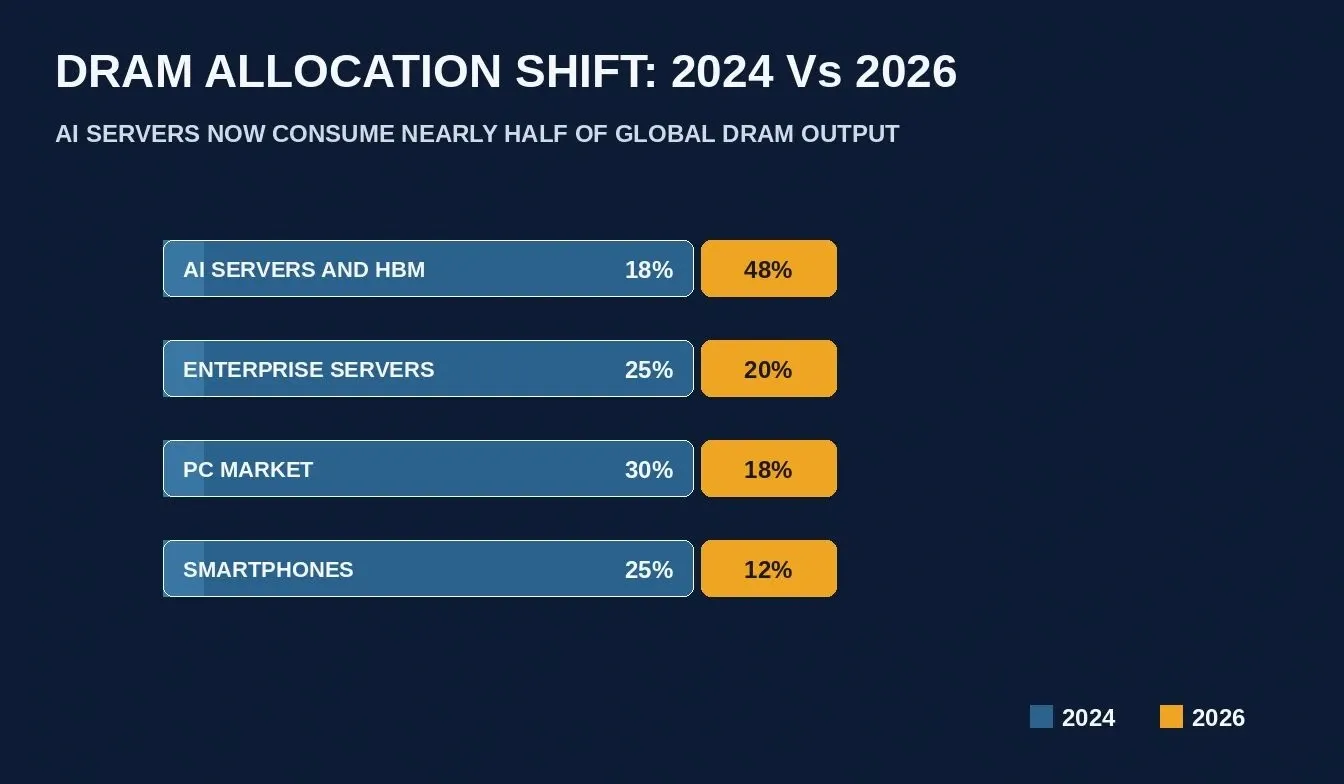
AI servers and HBM now consume nearly half of global DRAM output, up from under 20% in 2024.
| Segment | 2024 Share | 2026 Share | Change |
|---|---|---|---|
| AI Servers and HBM | 15-20% | 45-50% | +30pp |
| Enterprise Servers | 25% | 20% | -5pp |
| PC Market | 30% | 18% | -12pp |
| Smartphone Market | 25% | 12% | -13pp |
How Does the Supply Crisis Flow from Hardware to Your Cloud Bill?
The memory shortage reaches your invoice through a four-step cascade: chip prices rise at the factory, cloud providers absorb higher capex, GPU instance pricing climbs, and API providers pass per-token costs directly to developers.
Each link in the supply chain adds pressure and passes costs forward to the next buyer in line. Understanding the chain helps founders see exactly where their money goes and which levers they can pull.
From Chip Factory to API Invoice
-
Memory chip prices rise at the source. DRAM prices increased 50-55% in the first quarter of 2026 alone. TrendForce analyst Tom Hsu called that level of increase "unprecedented" in the memory market's history. These price hikes hit every hardware company buying components, from cloud providers to OEMs building servers.
-
Cloud providers absorb higher capital expenditure. AWS, Google Cloud, Microsoft Azure, and other services purchase thousands of AI servers packed with memory chips. When chip prices climb and lead times stretch from weeks to months, their infrastructure budgets expand by billions, and those costs surface in higher instance pricing.
-
GPU-backed AI inference gets expensive faster than other workloads. A single AI server uses 10-20x more memory than a standard web server, making AI workloads disproportionately affected by constrained supply and rising memory prices.
-
API providers pass costs to developers. OpenAI, Anthropic, Google, and similar AI services run on those same expensive GPU clusters. Higher infrastructure demand combined with rising memory costs translates into higher per-token pricing for every API call your app makes.
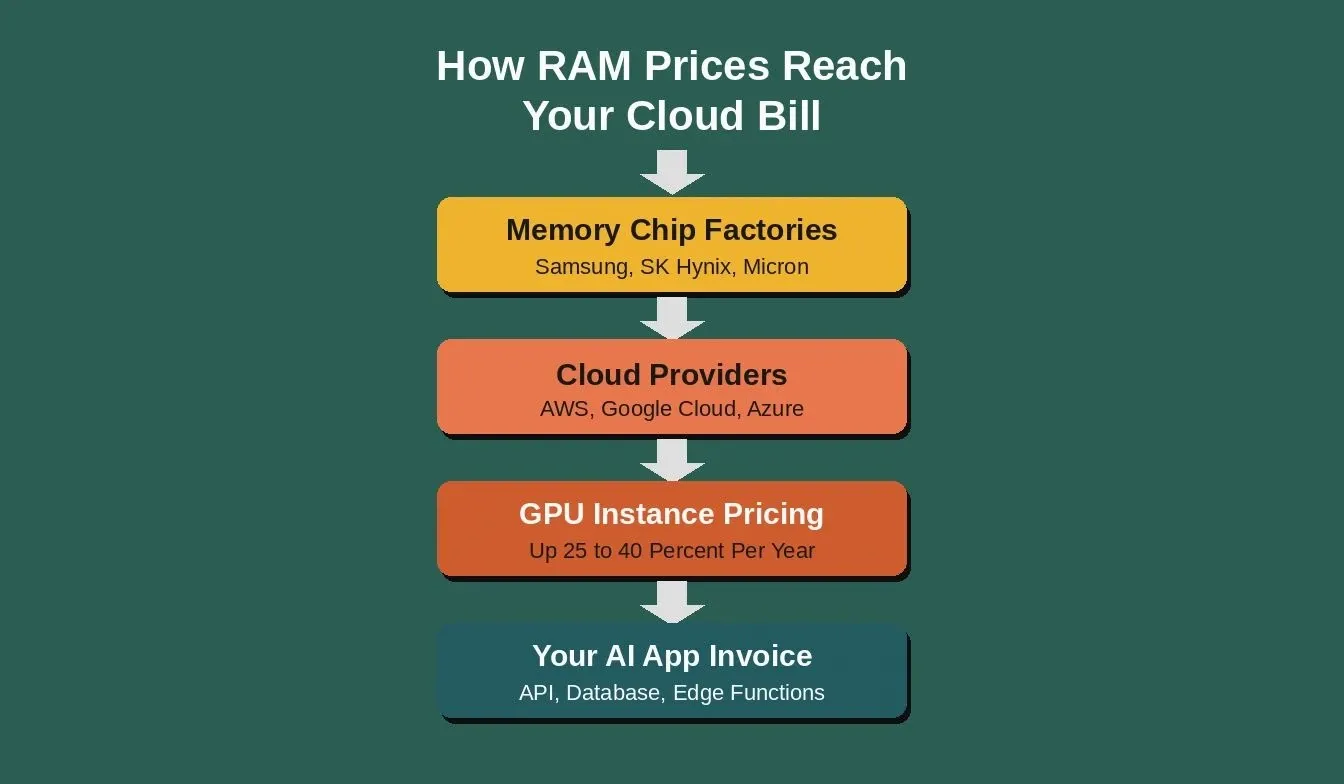
Every dollar increase at the chip factory eventually lands on your monthly API and cloud invoice.
The result is that founders who relied on "cheap API calls" as their AI strategy now face a different situation. Every token processed, every database query cached in RAM, and every edge function execution carries a higher price tag than twelve months ago.
If you are scaling a SaaS product built with AI tools, this cost chain matters more than feature debates right now. Understanding how AI app builders save development costs is equally critical when infrastructure spend is climbing on all fronts.
Which AI App Running Costs Are Rising Fastest Right Now?
Not all costs rise equally. API inference and managed database memory tiers are the two fastest-rising line items for AI apps in 2026 — both directly tied to the DRAM and HBM shortage.
What Makes AI Inference Calls So Expensive?
AI inference is expensive because loading large model weights into memory for every request requires the same scarce HBM chips driving the shortage, so every price increase at the chip level flows directly into your per-token cost.
-
OpenAI raised prices on GPT-4-class models twice in 2026. Anthropic's Claude pricing followed a similar trajectory. Per-token costs for complex reasoning tasks now run 30-40% higher than late 2025 rates.
-
Self-hosting does not escape the problem. Running your own inference means buying or leasing GPU servers with expensive HBM chips and standard DRAM. Memory costs hit you directly rather than through an API provider.
For founders thinking about how AI is changing product development, the inference cost curve is one of the most consequential shifts to plan around in 2026.
Are Database Memory Tiers the Hidden Budget Killer?
Yes, managed database hot-tier pricing is the most commonly overlooked cost increase for AI apps in 2026, rising 52% since late 2025 as providers reprice tiers directly tied to DRAM spot prices.
-
Supabase, PlanetScale, and Neon reprice hot storage tiers. The "performance" tier that keeps frequently accessed data in memory is directly tied to DRAM spot prices and the constrained supply of memory chips.
-
GPU instance reservations now require longer commitments. Cloud providers push 1-3-year reserved contracts because their own memory suppliers demand long-term arrangements.
-
Edge function memory limits are tightening. Vercel, Cloudflare Workers, and similar platforms cap memory per execution, with several reducing free-tier allocations or raising prices for higher memory configurations in 2026.
| Cost Category | Late 2025 | Mid-2026 | Increase |
|---|---|---|---|
| GPT-4 Class API (per 1M tokens) | $30 | $42 | +40% |
| Managed DB Hot Tier (per GB/mo) | $0.25 | $0.38 | +52% |
| GPU Instance (A100 equiv, hourly) | $3.50 | $4.80 | +37% |
| Edge Function (256MB, per 1M calls) | $0.60 | $0.85 | +42% |
These numbers compound for AI apps with high call volume. A product making 500,000 API calls per day faces a monthly bill 30-40% higher than the same usage pattern twelve months ago.
Three Cost Decisions Every AI App Founder Should Make Today
The memory supply crisis will persist through 2027 at minimum. Samsung, SK Hynix, and Micron all forecast that supply constraints will last until at least 2028. Waiting for prices to drop is not a strategy. Founders should not rely on a single memory-dependent vendor, since supplier diversification reduces procurement and technical risk when supply is tight. Early engagement with cloud, hosting, or model partners can also help secure better pricing and capacity before shortages worsen.
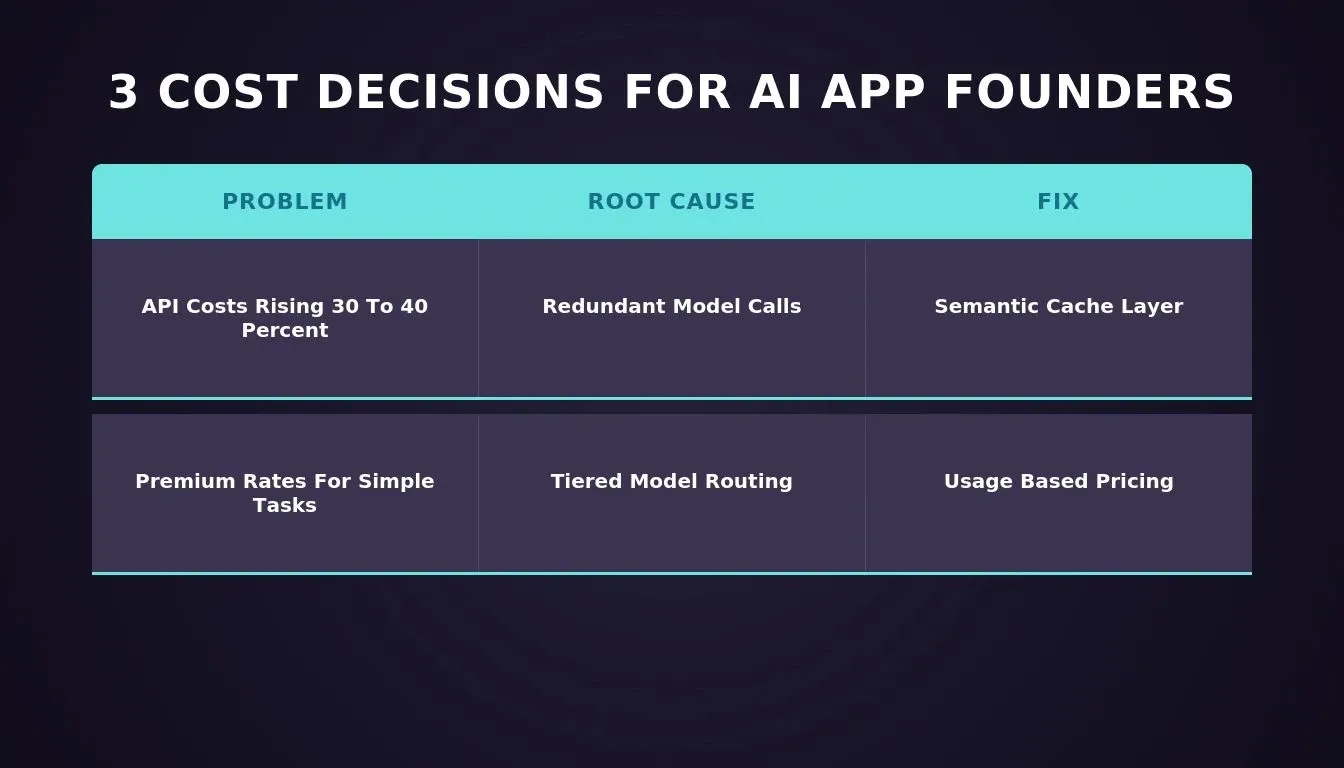
Three architecture decisions that protect margins as memory prices stay elevated through 2028.
| Problem | Root Cause | Fix |
|---|---|---|
| API costs are rising 30-40% | Redundant calls to expensive models | Semantic response cache (GPTCache / Redis) |
| Paying premium rates for simple tasks | No model routing logic | Tiered routing: small model for simple, large for complex |
| Costs outpacing revenue at scale | Flat-rate pricing vs. variable infra | Usage-based pricing tied to AI call volume |
Cache AI Responses for Repeated Queries
Caching is the highest-ROI cost move available right now: analytics consistently show 20-40% of AI queries are functionally identical, meaning 20-40% of your API spend can be eliminated without any change to the user experience.
-
Identify your repeat patterns. Analytics on AI call logs typically show 20-40% of queries are functionally identical.
-
Implement a vector similarity cache. Tools like GPTCache or a Redis layer with embedding-based matching intercept queries that are 95%+ similar to previously answered requests.
-
Set an aggressive TTL for stable content. Queries about your product, pricing, or documentation can serve cached responses for hours or days without going stale.
Cutting 30% of redundant API calls directly reduces your fastest-growing cost line. This is one of the core tactics covered in the best AI tools for solo founders who need to stretch every dollar of infrastructure budget.
Route Simple Queries to Smaller, Cheaper Models
Model routing is the second-highest-leverage move: 60-70% of typical AI app interactions can run on models that cost 5-10x less per token, with no noticeable quality difference for the user.
-
Classify query complexity at the edge. A lightweight classifier or regex patterns can sort incoming requests before they reach any large language model.
-
Use smaller models for formatting, extraction, and short answers. GPT-4o-mini, Claude Haiku, or open-source models handle these tasks at a fraction of the price.
-
Reserve premium models for reasoning-heavy work. Multi-step analysis, code generation, and nuanced creative tasks justify higher per-token costs.
Founders building B2B SaaS products with AI find that 60-70% of their app's interactions safely run on smaller models with no noticeable quality drop.
Build Usage-Based Pricing into the App from Day One
Usage-based pricing is the structural fix: when your infrastructure costs scale with usage, your revenue model must do the same; flat-rate pricing creates a compounding margin gap as memory prices keep climbing.
-
Tie AI-heavy features to metered plans. If a user triggers 10x more API calls than average, their plan should reflect that consumption.
-
Set per-action or per-token budgets per tier. Give users visibility into their own usage while protecting your margins from power users.
-
Connect billing to your database layer. Use a Supabase-powered backend to log AI calls per user and bill accordingly with Stripe metered billing.
Founders exploring app monetization strategies will find that usage-based models are increasingly the default for AI-heavy products.
Why Rocket Keeps Your Build Costs Low While Infra Prices Climb
"Who knew that would end up being ~$3,000 of RAM just a few months later." — Dean Beeler, co-founder of Juice Labs, on 256GB of RAM jumping from $300 to $3,000 in just months (CNBC, January 2026)
When infrastructure gets expensive, the platform you build on matters more than it did a year ago. Rocket addresses the cost pressure from a different angle: reducing development overhead that compounds on top of rising cloud bills.
Before you build, validate with Solve. As memory prices shift the competitive landscape, every founder should pressure-test their product thesis before committing to infrastructure spend. Rocket's Solve turns a business question into a structured, evidence-backed research report, market sizing, competitor pricing analysis, and product direction, so you are not building on an assumption that rising costs have already invalidated.
While you build, ship faster with Build. Traditional AI app development requires 3-5 engineers at $40-80K per month in salary alone. Rocket's Build generates production-ready Next.js and Flutter code from a single prompt, cutting build-phase costs to near zero. Every app ships with Supabase databases and Vercel hosting already configured; you skip weeks of DevOps work that self-hosted alternatives demand when GPU and memory hardware remain in limited supply.
When your caching strategy needs rework or model routing logic needs an update, you do not rebuild from scratch. Rocket's Visual Edit lets you click any element and update it directly; slash and @ commands target specific files and components for precise changes; and the Versions system saves every build state so you can roll back, compare diffs, and redeploy any previous version from chat.
After you launch, track competitors with Intelligence. As memory prices rise, your competitors face the same cost pressure. Some will raise prices, others will cut features, and some will pivot their model. Rocket's Intelligence watches competitors across nine signal pillars, pricing changes, product updates, hiring moves, GTM shifts, and delivers structured Intel cards so you can respond before the market moves against you.
Rocket's three-pillar workflow: validate before you spend, ship without a dev team, track competitors as the market shifts.
The cost of building the app should not compound on top of the cost of running it. Self-hosting AI models sounds appealing in theory, but when memory costs rise, you absorb every price increase directly. GPU server leases, HBM-heavy inference hardware, and the engineering time to maintain production systems all become more expensive in a constrained supply environment. That is the gap Rocket closes.
Your AI Infrastructure Budget Is a Product Decision Now
The memory shortage reshaping AI infrastructure pricing is structural, not cyclical. Samsung and its competitors project constrained supply through 2028. Every industry forecast confirms that memory prices, chip prices, and DRAM prices will stay elevated for the coming years. Founders who treat infrastructure costs as a product architecture variable rather than a fixed expense line will protect their runway while others watch margins decline.
Start building with the cost structure in mind from day one. Cache aggressively, route intelligently, price based on usage, and choose platforms that minimize fixed overhead so rising variable costs do not consume your budget.
Rising infrastructure costs are squeezing AI app margins fast. Rocket.new lets you go from idea to deployed AI app in minutes, validate the idea first with Solve, ship production-grade code with Build, and track how competitors respond with Intelligence. Start building for free and keep your infrastructure budget under control while memory prices stay elevated.
Table of contents
- -What Is the Memory Shortage 'RAMmageddon' and Why Does It Matter for Software Teams?
- -Who Holds the Keys to the Global Memory Market Production?
- -Why Does HBM Starve Standard DRAM Supply?
- -How Does the Supply Crisis Flow from Hardware to Your Cloud Bill?
- -From Chip Factory to API Invoice
- -Which AI App Running Costs Are Rising Fastest Right Now?
- -What Makes AI Inference Calls So Expensive?
- -Are Database Memory Tiers the Hidden Budget Killer?
- -Three Cost Decisions Every AI App Founder Should Make Today
- -Cache AI Responses for Repeated Queries
- -Route Simple Queries to Smaller, Cheaper Models
- -Build Usage-Based Pricing into the App from Day One
- -Why Rocket Keeps Your Build Costs Low While Infra Prices Climb
- -Your AI Infrastructure Budget Is a Product Decision Now