
Curious how no-code builders transform app creation? They enable fast, accessible, flexible development, letting individuals and businesses build functional apps in days while expanding opportunities beyond traditional coding barriers significantly.
What are the real benefits of a no-code app builder?
It is speed, accessibility, and flexibility. You can build apps without writing long lines of code, and that changes how individuals and businesses approach app development. Instead of waiting months, you can turn ideas into working apps in days.
In fact, Gartner predicts that by 2025, 70% of new applications developed by enterprises will use low-code or no-code technologies, up from less than 25% in 2020. That shows how fast this shift is happening.
So, if you’ve ever wanted to get into app development but felt limited by coding skills, this space makes it possible. It opens the door for creators, founders, and teams to build faster.
What is a No-Code App Builder?
A no-code app builder is a tool that allows you to create apps without writing traditional code. Instead of complex programming, you use simple visual methods to design and build your app.
This makes app development more accessible and faster for beginners and professionals alike.
Here’s how it works:
- You just give a prompt, and it gives you ready-to-use prototypes
- You use drag and drop tools to place elements on your app screen
- You configure features using simple settings instead of code
- You choose from ready-made components and pre built templates
- You design using visual interfaces that show how your app will look
- You can quickly test and launch no code apps without deep technical expertise
Think of it as building with Lego blocks rather than carving everything from scratch.
With a no-code platform, even business users and non-technical staff can design and launch no-code apps. That’s why these code platforms are becoming popular across industries.
👉Worth a Quick Read: Main Features of a Great No Code App Builder
Why No Code is Gaining So Much Attention?
So, why is everyone talking about no-code right now? It comes down to speed, cost, and simplicity.
Traditional development often takes a lot of time, money, and technical expertise. You usually need specialized developers, and the development time can stretch for months. For many businesses, that slows down progress.
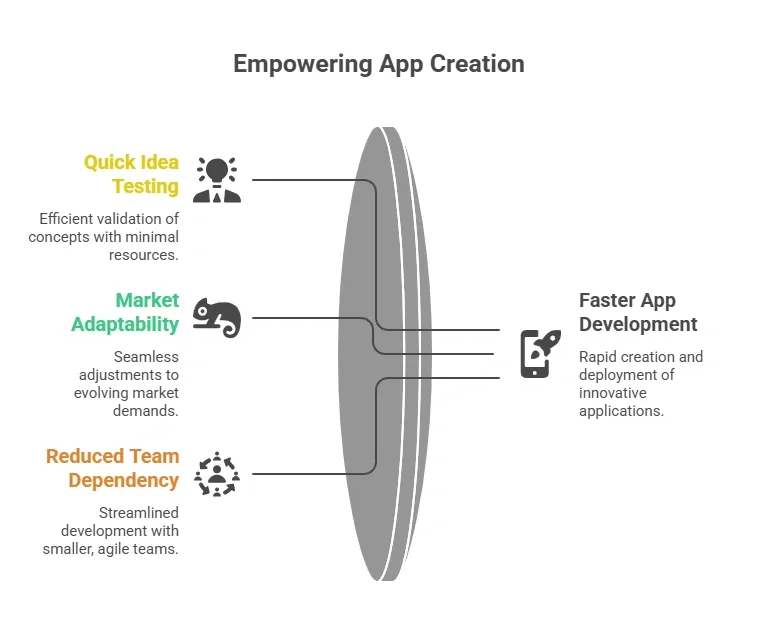
Also, many companies still rely on legacy systems that are hard to update. A no-code platform helps them modernize step by step, without rebuilding everything from scratch.
That’s exactly why no code is getting so much attention across industries.
Key Benefits of a No-Code App Builder
No code is not just about building apps without coding. It’s about making app development faster, simpler, and more accessible for everyone.
Whether you’re a beginner, a creator, or part of a business team, a no-code app builder gives you practical advantages that make a real difference.
Let’s break it down clearly.
1. Faster App Development
Speed is one of the biggest advantages.
With a no-code app builder, you can go from idea to working app in days instead of months. No need for long cycles in software development.
You just use drag-and-drop interfaces and visual tools to build apps.
So, instead of waiting for professional developers, you can create applications on your own.
2. No Need for Coding Skills
This is where things get interesting.
You don’t need deep coding knowledge to start. Even beginners can create simple apps using a no-code app builder.
That means more people can participate in app building. These are often called citizen developers.
Business users can now handle their own business processes and routine tasks without depending on tech teams.
3. Cost Effectiveness
Let’s talk money.
Hiring developers, maintaining systems, and managing traditional coding can get expensive. A no-code platform cuts those costs.
You save money on development, updates, and testing.
This cost-effectiveness makes no-code software attractive for startups and small businesses.
4. User-Friendly Interfaces
Most no-code platforms provide user-friendly interfaces. You get clear dashboards, easy controls, and step-by-step guidance.
Even if you’re new to app development, the learning curve is manageable. That’s why no-code tools are widely used by business users and creators.
5. Flexibility with Low-Code Options
Now here’s a cool part.
Many code platforms combine no-code and low-code features. If needed, you can add custom code for more control.
So, you can start simple and move into low-code development for more complex apps. This mix of no-code and low-code software gives you flexibility.
6. Quick Iteration and Updates
Apps are never perfect on day one. With a no-code app builder, you can make changes quickly. No need to rewrite everything.
You can test ideas, fix issues, and deploy applications faster. That’s helpful when dealing with changing business needs or business challenges.
7. Easy Integration with Tools
Most no-code platforms support third-party integrations. You can connect tools such as Google Sheets, payment systems, and CRMs.
This makes no-code app development practical for real business use.
8. Built-in Security and Reliability
Many no-code platforms include built-in security features. You don’t have to worry about every detail. The platform handles most of it.
This helps business users focus on building the app instead of managing risks.
9. Scalability for Growth
No-code apps are not just for small ideas. You can scale them as your business grows.
From simple apps to more complex projects, a good code app builder can handle a range of app development needs.
So, when you look at all these points together, it becomes clear why so many individuals and businesses are turning to no-code. It simplifies the process, reduces barriers, and helps you move from idea to execution much faster.
No Code vs Low Code vs Traditional Development
Here’s a simple comparison:
| Feature | No Code | Low Code | Traditional Coding |
|---|---|---|---|
| Coding Skills Needed | None | Basic | High |
| Speed | Very fast | Fast | Slow |
| Flexibility | Medium | High | Very high |
| Cost | Low | Medium | High |
| Best For | Business users | Mixed teams | Professional developers |
So, if you want speed and simplicity, go with a no-code platform. If you want more control, low code application development works well.
Common Use Cases of No-Code Apps
No-code apps are not limited to one specific use. They can be used across different industries and for different goals.
Whether you’re solving small problems or building something bigger, a no code app builder gives you the flexibility to turn ideas into working solutions quickly.
So, what can you actually build?
- Internal tools for business processes
- Landing pages for marketing
- Mobile applications for customers
- Dashboards connected to Google Sheets
- Simple apps for tracking and reporting
You can even create professional apps without hiring a full team.
So, from everyday tasks to business-focused solutions, no-code apps make it easier to build what you need without getting stuck in complex development steps.
Rocket.new for the day
Rocket.new is not just another no-code platform. It positions itself a vibe solutioning platform that helps you go from idea to working app much faster. Instead of getting stuck in long app development cycles, you can describe what you want and start building instantly.
It also focuses on making no-code app development feel natural. With smart suggestions, guided workflows, and clean visual tools, it reduces the need for deep technical expertise while still giving you control over your app.
Top Features of Rocket.new
- Prompt-to-App Creation: Builds apps directly from a single prompt. No coding required just describe your idea, and it comes to life instantly.
- Figma Import: Converts design files into live, editable layouts. Keeps all your visuals, styles, and components intact for seamless integration.
- AI-Powered Backend: Automatically handles logic, data, and workflows. Saves time by managing servers, databases, and automation behind the scenes.
- Custom Domain Support: Publishes projects with a branded domain. Makes your app look professional and easy for users to find online.
- Code Export: Allows developers to extend or customize later. Provides full flexibility to tweak, scale, or integrate with other systems.
- Live Preview: Shows instant updates while editing. Lets you see changes in real-time, ensuring your app looks and works perfectly.
- Collaboration Tools: Enables real-time teamwork and feedback. Multiple team members can edit, comment, and track progress together seamlessly.
What Users Are Saying?
Here’s how the experience usually feels when working with a no code app builder like Rocket.new:
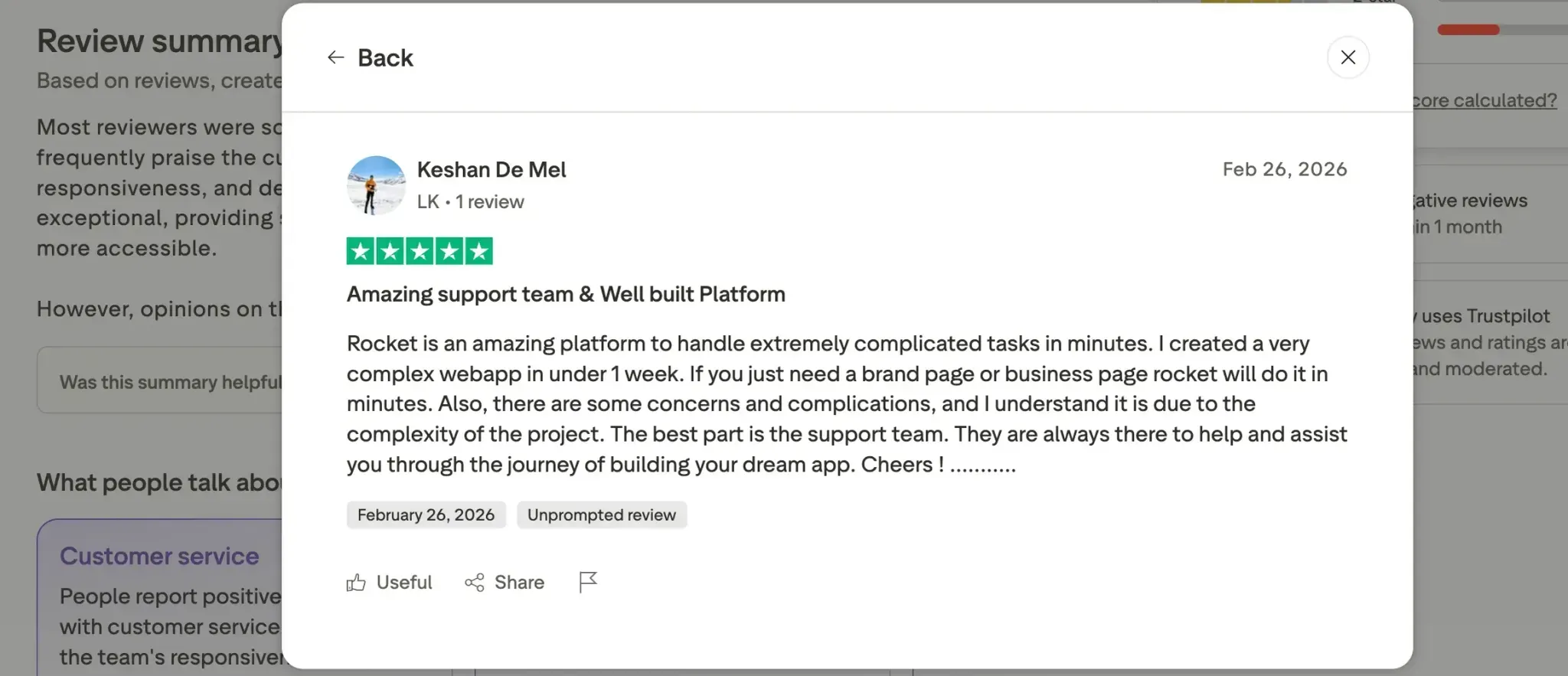
Users often highlight how quickly they can move from idea to execution. The combination of AI guidance and just prompting tools makes the process smooth, even for beginners.
A common pattern is this: users start with a simple idea, use the platform’s visual interfaces, and end up with a working app in a short time. That’s where the real value shows up.
Use Cases
1. Internal Business Tools
Teams use Rocket.new to build apps for managing business processes like tracking tasks, handling internal requests, and organizing data. This reduces dependency on long development cycles.
2. Customer-Facing Applications
You can build mobile or web apps that let users interact with your business. These apps help reach more users and provide services directly.
3. Marketing and Landing Pages
Rocket.new helps create landing pages quickly for campaigns. This is useful when you want to respond fast to market changes without waiting for developers.
Rocket.new has launched more than 25,000 ready to use templates.
4. Data-Driven Apps with Google Sheets
You can connect Google Sheets and turn raw data into working apps. This is helpful for dashboards, reporting tools, and tracking systems.
Rocket.new keeps the focus on simplicity while still supporting real-world app development needs. It fits perfectly with the idea of no-code by making app building faster, more accessible, and practical for everyday use.
Challenges You Should Know
No-code apps make app development easier, but they are not the perfect fit for every situation. It’s good to understand the limitations before you jump in.
Here are a few things to keep in mind:
- No-code apps may not handle very complex apps or highly custom systems
- Some platforms have limits when it comes to advanced features
- You might still need traditional development for very specific requirements
- Performance can vary depending on the no-code platform you choose
- Scaling very large or more complex projects can sometimes be challenging
That’s where low-code software comes in. It gives you a middle ground where you can still use no-code tools while adding flexibility when needed.
The Future of App Development
App development is shifting, and no-code is playing a big role in that change. Businesses want faster results without heavy delays.
Here’s what’s happening:
- More companies are focusing on digital transformation
- Businesses want faster solutions with lower costs
- Teams are looking for flexibility in building and updating apps
- No code platforms are helping reduce reliance on large developer teams
- Even big companies are using code platforms for routine tasks and internal tools
So, the direction is clear. No-code and low-code platforms are becoming a normal part of how apps are built.
It’s not about replacing developers. It’s about making app development more accessible, faster, and practical for different kinds of users.
Why No-Code App Builders Are Changing the Game
Traditional app development can be slow, expensive, and heavily dependent on technical skills. It often holds back great ideas and limits who gets to build and innovate. For many, this means great concepts never even get the chance to become real products.
That’s where tools like Rocket.new come in. As a no-code app builder, it lets you turn ideas into working apps using simple prompts and visual workflows no deep coding required. You can build faster, test ideas quickly, and adapt on the go, making it a powerful solution for creators and businesses who want to move without limits. It’s a smarter, faster way to bring your vision to life.
Table of contents
- -What is a No-Code App Builder?
- -Why No Code is Gaining So Much Attention?
- -Key Benefits of a No-Code App Builder
- -1. Faster App Development
- -2. No Need for Coding Skills
- -3. Cost Effectiveness
- -4. User-Friendly Interfaces
- -5. Flexibility with Low-Code Options
- -6. Quick Iteration and Updates
- -7. Easy Integration with Tools
- -8. Built-in Security and Reliability
- -9. Scalability for Growth
- -No Code vs Low Code vs Traditional Development
- -Common Use Cases of No-Code Apps
- -Rocket.new for the day
- -Top Features of Rocket.new
- -What Users Are Saying?
- -Use Cases
- -Challenges You Should Know
- -The Future of App Development
- -Why No-Code App Builders Are Changing the Game