
blockchain app builder helps founders ship the product layer of a blockchain startup without deep coding skills. Pair it with dedicated smart contract tools, and you have a complete, launch-ready stack.
A blockchain app builder helps founders ship the product layer of a blockchain startup- the web app, mobile interface, investor portal, and admin dashboard- without deep coding skills. Pair it with dedicated smart contract tools, and you have a complete, launch-ready stack.
Why Blockchain Apps Are Everywhere
Things are changing fast. Traditional apps rely on a central authority, which means one system controls everything and users have to trust it completely.
A blockchain app works differently. It runs on blockchain networks where data is shared across network nodes, making the system more open and reliable.
Here's why more industries and startups are shifting toward blockchain applications:
- No single point of failure, making systems more stable
- More secure transactions and transparent financial transactions
- Better trust between users without relying on a central authority
- Strong use cases in online banking, gaming, and supply chain management
- Improved tracking and visibility across the supply chain
- Easy handling of digital assets like tokens and NFTs
- Useful blockchain solutions for businesses in enterprise settings
- Smoother and more transparent business processes
Users today want control, privacy, and trust in the apps they use. That is exactly where blockchain technology fits in, and that is why blockchain apps are growing so quickly.
The Two Layers Every Blockchain App Needs
Before choosing a blockchain app builder, it helps to understand what you are actually building. A blockchain startup app has two distinct layers, and confusing them is the most common reason founders get stuck. Smart contracts in blockchain apps automate business processes, reduce the need for intermediaries, and ensure transparent execution of agreements.
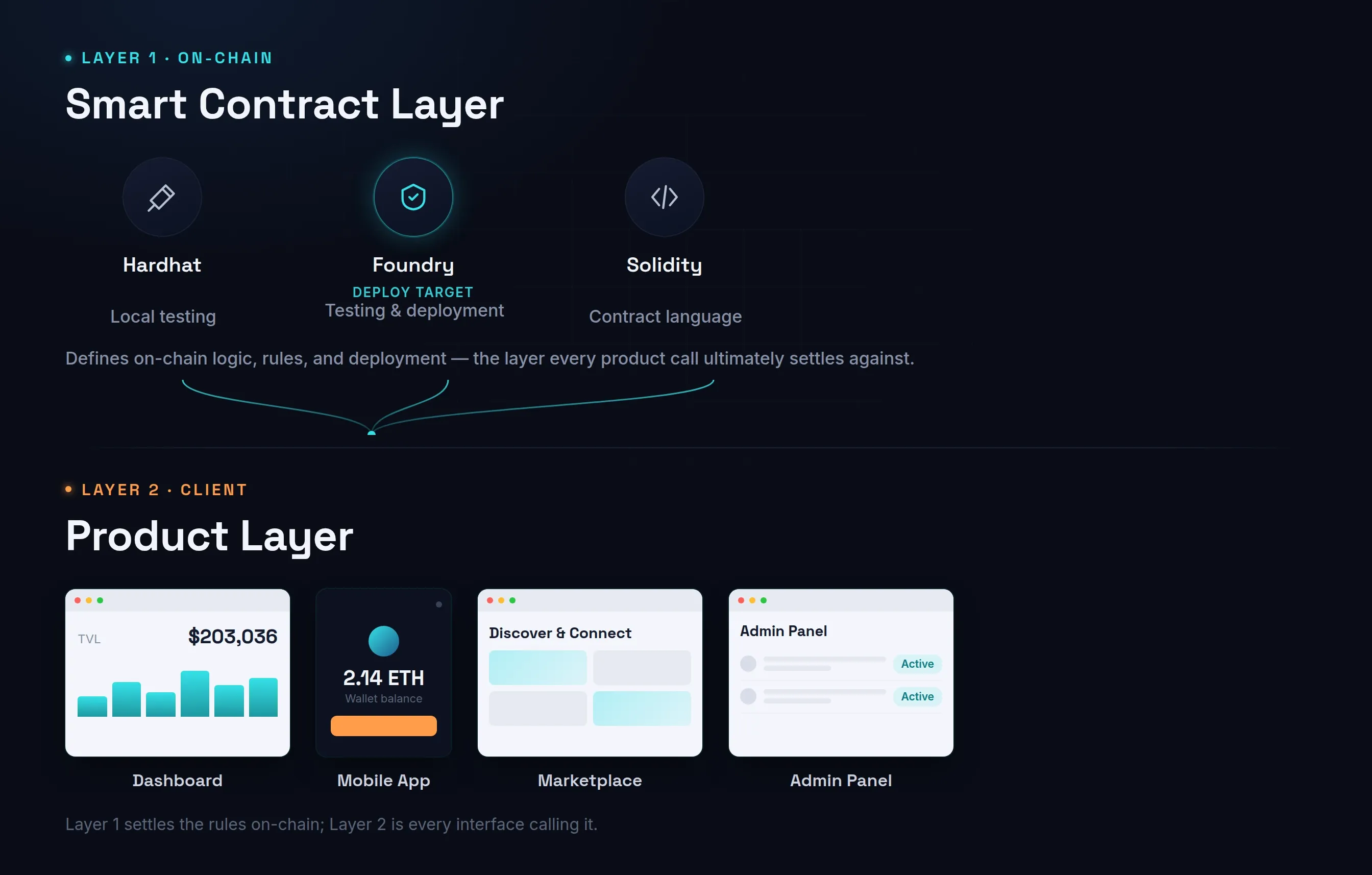
Every blockchain startup needs both layers: the on-chain smart contract layer and the product layer users actually interact with
Layer 1: The smart contract layer. This is the on-chain logic: the rules encoded in Solidity or Rust, deployed to a network like Ethereum, Solana, or Binance Smart Chain. Tools like Hardhat, Foundry, and Anchor help specialists develop smart contracts for this layer. They require developer expertise and cannot be replaced by a no-code builder.
Layer 2: The product layer. This is everything users actually see and interact with: the web app frontend, the mobile app, the landing page, the admin dashboard, the investor portal, the wallet-connect UI. This layer can be built rapidly with an AI app builder with no blockchain expertise required.
Most founders underestimate how much work lives in Layer 2. A DeFi platform needs a trading dashboard. An NFT marketplace needs a browsable storefront and a minting flow. These are standard web and mobile development problems, and a blockchain app builder solves them fast.
Blockchain Market: The Numbers Behind the Growth
The blockchain market is not a niche trend. It is a rapidly expanding category attracting serious investment and enterprise adoption. According to MarketsandMarkets, the global blockchain technology market is projected to reach $94 billion by 2027, growing at a CAGR of 66.2%.
Enterprise blockchain adoption is accelerating across financial services, supply chain, and healthcare. Deloitte's Global Blockchain Survey found that 55% of senior executives ranked blockchain as a top-five strategic priority. The World Economic Forum projects that 10% of global GDP will be stored on blockchain technology by 2027.
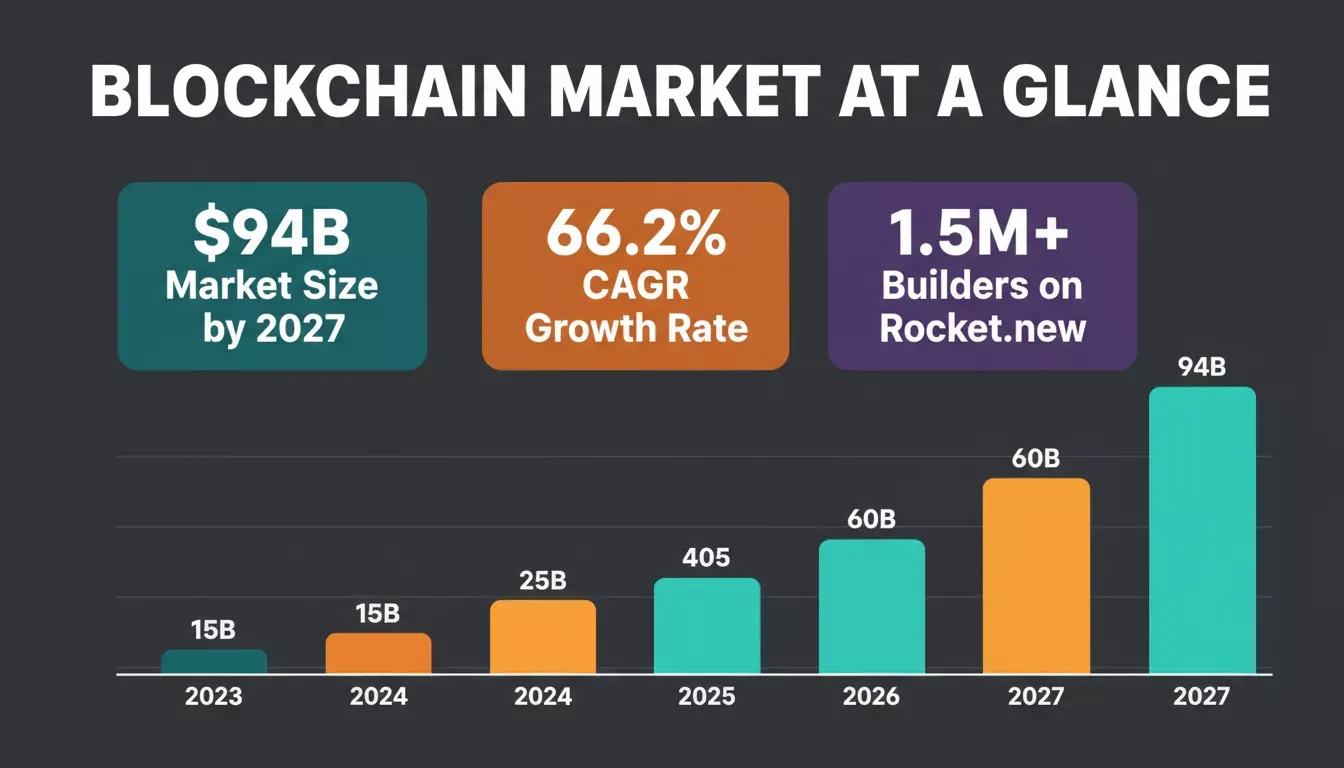
Key blockchain market statistics: the opportunity is large, and the growth rate is accelerating
These numbers signal one thing clearly: startups entering the blockchain market now are building on a foundation that is still early enough to differentiate but large enough to sustain real businesses.
From Idea to Reality
Every strong blockchain app begins with a clear business idea. It might be a trading platform, a gaming app with unique in-game assets, or a tool built for compliance reporting. What matters is how well your idea connects with your target audience and solves a real problem for users.
Here is how that journey naturally flows:
- Idea Foundation: Define the purpose of your blockchain project, clarify business requirements, and outline the problem it solves.
- User Experience Thinking: Map how users will interact with your app, define project requirements, and shape the product layer.
- Platform Selection: Choose a blockchain network based on speed, cost, and the consensus mechanisms behind it.
- Smart Contract Design: Use Hardhat or Foundry to build the on-chain logic with a Solidity developer.
- Product Layer Build: Use an AI app builder to generate the frontend, mobile app, and admin dashboard in a way that makes future new features easier to add cleanly.
- Integration and Launch: Connect the product layer to deployed contracts via a wallet-connect library, then ship.
The Core Engine Behind Every Blockchain App
Every strong blockchain app depends on a few key components working together. Understanding which layer each component belongs to helps you allocate your team and budget correctly.
| Component | Role | Who Builds It |
|---|---|---|
| Smart Contracts | On-chain rules and automation that can automate processes | Solidity developer or dedicated tool |
| Blockchain Networks | Data storage and validation | Chosen at platform selection |
| Wallet-Connect Library | User blockchain wallet or crypto wallet connection in the frontend | Frontend developer or AI builder |
| RPC Provider | Node infrastructure (Alchemy, Infura) | Third-party service |
| Web App Frontend | Trading UI, dashboard, marketplace | AI app builder |
| Mobile App | iOS and Android user access | AI app builder |
| Admin Dashboard | Operator controls and reporting | AI app builder |
Smart contracts define the on-chain logic. But the product layer is what users actually experience. A strong process also keeps the stack highly secure with security and auditing, especially rigorous smart contract audits to catch bugs and vulnerabilities. Both layers matter equally, and each has the right tool for the job.
Builder vs Custom Development: What Should You Choose?
Now comes a big decision. Do you go with a blockchain app builder for the product layer, or build everything custom from scratch?
A blockchain app builder provides templates, ready-made modules, and faster setup for the product layer. This helps teams iterate quickly, test ideas with real users, and ship an MVP without a large frontend team. Custom development gives full control over every layer but requires more time, more people, and significantly higher cost, and that cost also depends on how the development process is structured across the contract and product layers.
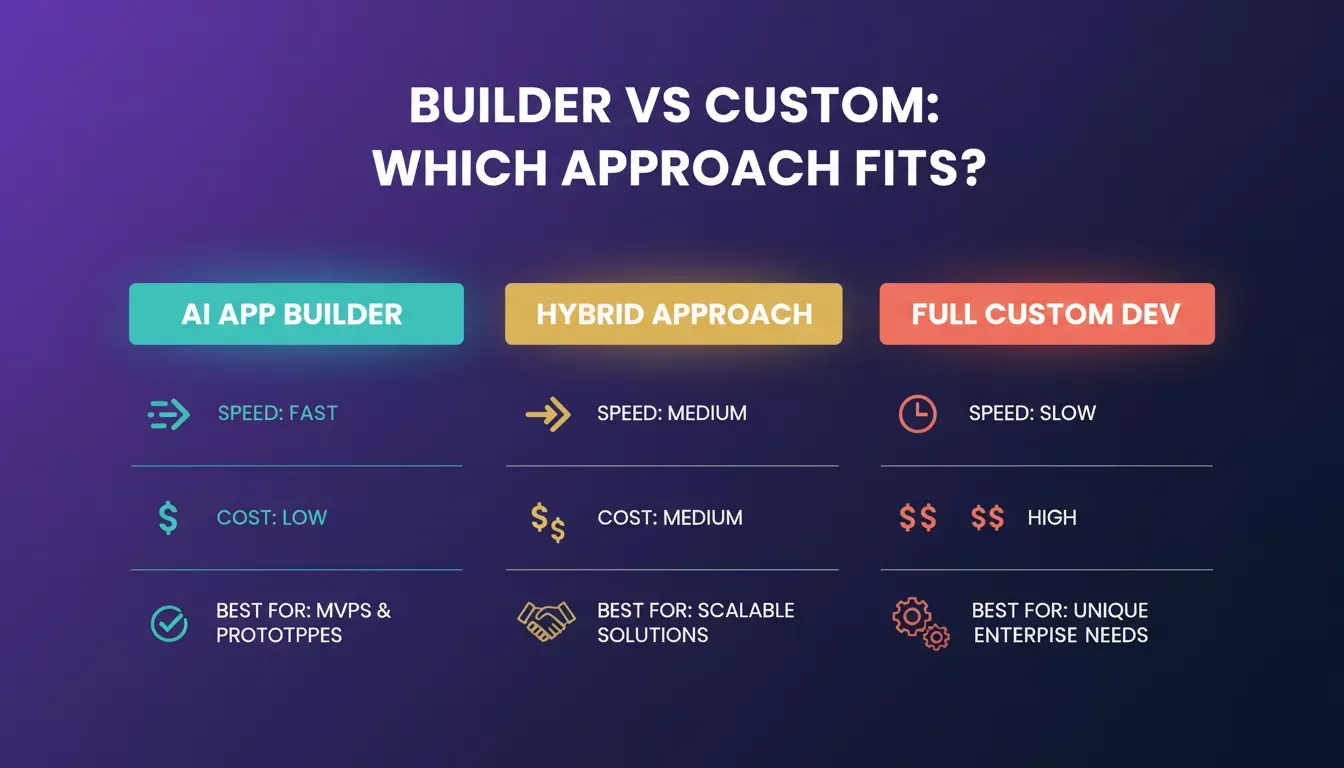
Choosing the right approach depends on your stage, budget, and how much control you need over the product layer
| Approach | Speed | Cost | Best For |
|---|---|---|---|
| AI app builder + contract tools | Fast | Lower | MVP, early-stage founders |
| Hybrid (builder for UI, custom for contracts) | Medium | Medium | Most growing startups |
| Full custom development | Slower | Higher | Complex, highly customized products |
Many startups start with a blockchain app builder for the product layer and later customize or replace individual components as they scale. Average blockchain app costs typically range from $20,000 for MVPs to over $200,000 for complex enterprise builds, depending on features and compliance needs. The average cost is about $93,000 based on project analysis and development requirements. Starting lean and iterating is almost always faster than trying to build everything perfectly from day one.
Real-World Use Cases That Actually Work
Here is where a blockchain app is actually making an impact today. The product layer requirements for each use case are significant, and this is exactly where a builder adds the most value.
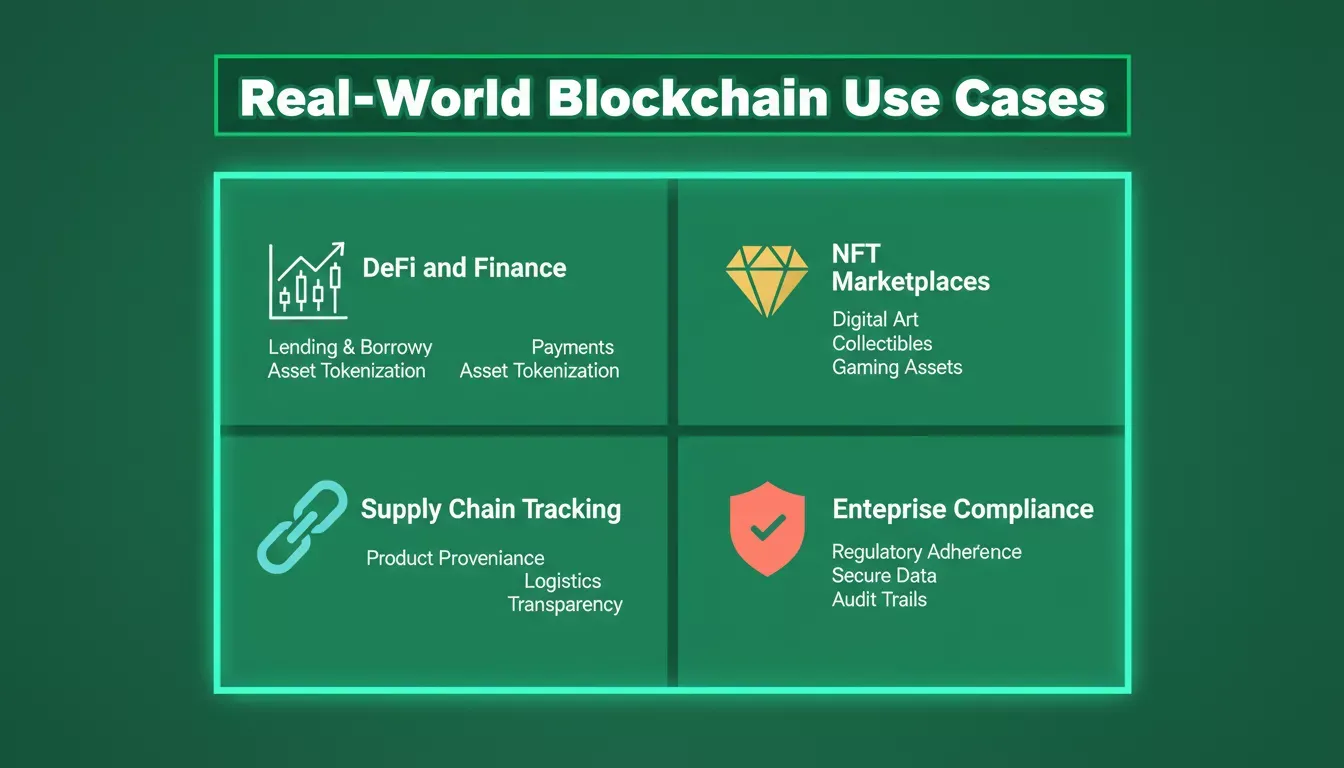
Four industries where blockchain apps are creating real value: each requires a polished product layer to succeed
- Finance and DeFi: Apps in decentralized finance let users trade, lend, and earn without a central authority, and provide users with transparent, self-directed access to services. Founders in this space may build tools like decentralized exchanges, along with products for non-custodial lending and yield aggregation, and can validate the market with Solve before writing a single line of code.
- Gaming and NFTs: Modern games use blockchain games and non-fungible tokens, allowing players to own and trade unique in-game assets. The storefront, minting UI, and inventory screens are standard web app surfaces.
- Supply Chain Systems: In supply chain management, blockchain apps track products across the supply chain with immutable birth-to-sale provenance that helps combat counterfeits and streamline recalls. Teams building these apps often start with a no-code app builder to ship a working prototype quickly.
- Enterprise Use: Businesses use private blockchain systems for internal tools like compliance reporting and audit-ready trackers, while also reducing operational costs by removing intermediaries and third parties from business processes. These are exactly the kind of internal dashboards an AI app builder generates quickly.
A blockchain app is not just a trend. It is being used in real industries where trust, transparency, and control matter, and the product layer is what makes those apps usable.
What It Really Costs
The blockchain app development cost depends on several factors. Blockchain application development planning should account for architecture, security, and deployment choices alongside budget. The smart contract layer and the product layer have very different cost profiles, and treating them separately helps you budget accurately.
- Complexity of the app and number of screens
- Smart contract audit requirements (a high cost for production DeFi)
- Size of the development team
- Choice of blockchain platforms and RPC providers, including transaction costs
- Whether you use an AI app builder for the product layer or build custom
Apps with advanced features, artificial intelligence integrations, and zero knowledge proofs cost more. Using a blockchain app builder for the product layer significantly helps with reducing costs in frontend development and timeline, letting you allocate more budget to the smart contract work that genuinely requires specialist expertise. According to 2026 benchmarks, blockchain app development costs range from $20,000 for MVPs to over $200,000 for complex enterprise solutions, depending on features, team, and compliance needs. Deloitte found a 30% efficiency improvement, and 55% of respondents reported cost savings averaging 29%.
What Founders Are Saying
Here is a real insight from a builder in the blockchain space:
"When I started my blockchain journey, I honestly thought the hardest part would be the tech. Turns out it wasn't. Real challenges were around focus, community, and building something with utility rather than hype." — Chris Arakelian, blockchain founder, via LinkedIn
This reflects what most blockchain founders discover: the on-chain logic is only part of the challenge. Shipping a product that users can actually navigate, trust, and return to is the other half, and that is where a fast product layer matters most.
Build the Product Layer of Your Blockchain App with Rocket.new
Rocket.new is an AI app builder designed to support the product layer within broader blockchain app development services, helping founders ship startup experiences including blockchain projects without deep technical knowledge.
It generates production-ready Next.js web apps and Flutter mobile apps from a plain-language description or a Figma design, and fits naturally into workflows that may also involve a blockchain app development company for contracts, audits, or protocol-specific infrastructure.
For blockchain founders, Rocket.new handles the surfaces your users interact with: the web app frontend, the mobile app, the landing page, the admin dashboard, and the investor portal. That makes it a fast way to launch decentralized apps with polished user-facing experiences, while your smart contracts and wallet-connect integration are wired in separately using the appropriate Web3 tooling. Rocket.new generates clean, exportable code you can extend.
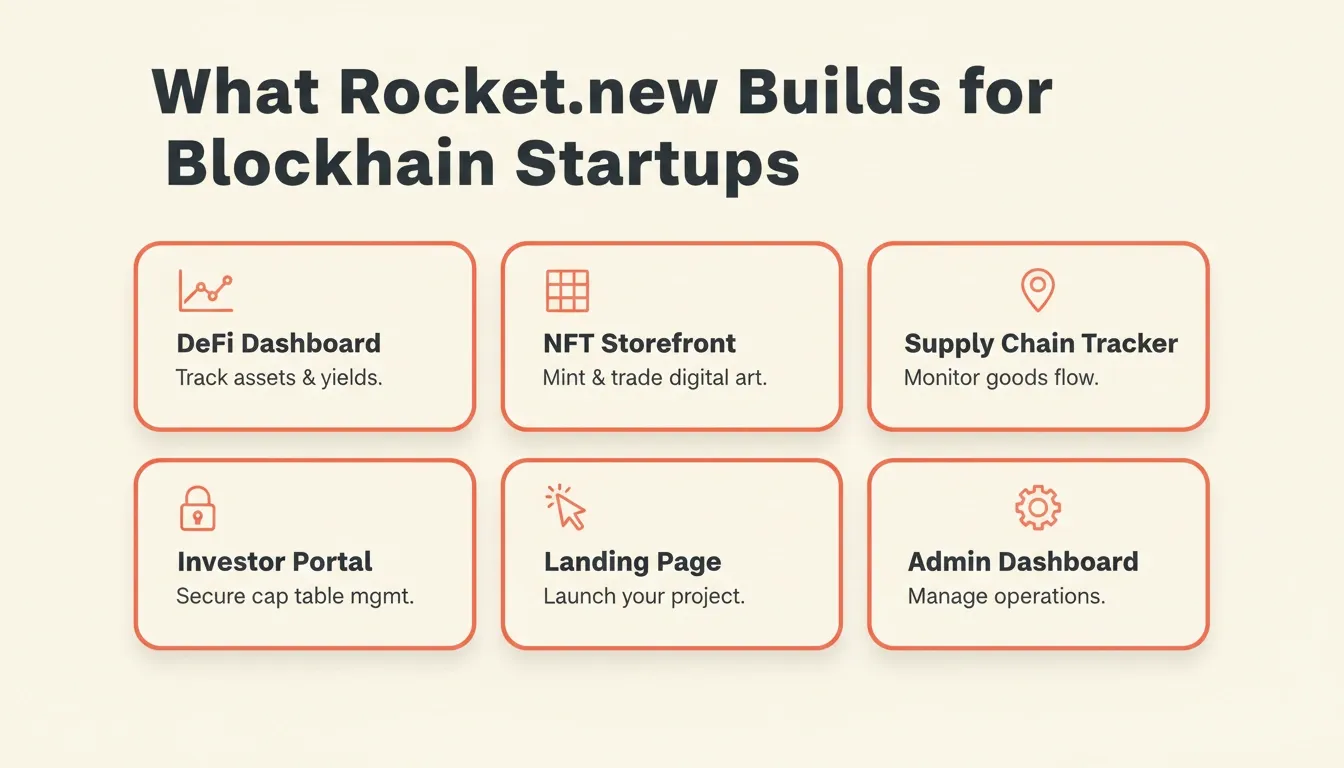
Rocket.new builds the six core product surfaces every blockchain startup needs, all from a plain-language prompt
What Rocket.new Builds for Blockchain Startups
- DeFi trading dashboard: A web app with portfolio views, transaction history, market data displays, and real-time price charts with customizable alerts, connected to your own data sources, APIs, and crypto wallets.
- NFT marketplace storefront: A browsable, filterable product catalog for blockchain products with minting flows and user profiles.
- Supply chain tracking interface: A real-time tracking dashboard with status updates, operator controls, reporting panels, and enhanced privacy for sensitive operational data.
- Investor portal and data room: A password-protected portal with metrics, documents, and team updates for your backers.
- Marketing and waitlist page: A conversion-focused site to capture early users before you launch. Founders can also explore Rocket.new's landing page builder for fast, high-converting pages.
- Admin dashboard: Internal tooling for your team including user management, analytics, and compliance tracking.
How It Works
- Describe your app in plain language, for example: "Build a DeFi portfolio dashboard with wallet address input, token balance display, transaction history table, and a dark theme."
- Rocket.new uses advanced technologies to generate a production-ready Next.js web app or Flutter mobile app in minutes.
- Refine through chat, visual edit, or direct code editing.
- Export the code, extend it with your preferred programming languages, and wire in your wallet-connect library, smart contract calls, and blockchain infrastructure running on a peer-to-peer network.
- Deploy to a live URL, launch to your target mainnet or platform after successful quality assurance testing, or submit to the App Store and Google Play.
Key Features
- Prompt to App: Generate a complete web or mobile app from a single description with no templates required.
- Figma Import: Convert your Figma designs into production-ready React or Flutter code with pixel accuracy.
- Live Preview: See your app update in real time as you iterate through chat or visual edits.
- Code Export: Download the full source code and extend it with your own Web3 integrations.
- 25+ Integrations: Connect Stripe, Supabase, Google Analytics, and more directly from the builder. See the full connector library for details.
- App Store Ready: Submit Flutter mobile apps directly to the Apple App Store and Google Play.
Depending on workflow, founders, in-house teams, or a blockchain developer extending the generated product layer may also pair Rocket.new with other tools for dapp development, and many blockchain app developers do exactly that. Replit is excellent for beginners, with browser-based AI coding assistance that helps scaffold blockchain functionality.
Replit AI Agent is useful for learning AI-assisted development and building full-stack decentralized applications from natural-language prompts. thirdweb makes smart contracts easier to use with an extensive library of pre-built, audited contracts that lower the barrier to launching NFT marketplace functionality.
Adalo fits native mobile blockchain apps with visual database and authentication integration, while Bubble is better for complex web workflows and database management. Moralis abstracts backend infrastructure and makes blockchain data queryable, which helps Web2 teams move into Web3 faster.
Founders who want to validate their blockchain idea before building can also use Rocket.new's Solve feature to run structured market research and competitive analysis before writing a single line of code.
What's Changing in Blockchain
The space keeps growing with new ideas and real adoption.
- AI and blockchain technology working together to automate compliance and fraud detection
- More focus on privacy with zero knowledge proofs in consumer applications
- Growth of decentralized applications across gaming, finance, and enterprise
- Increased institutional adoption tracked by the World Economic Forum and major financial institutions
These emerging trends are shaping the future of blockchain development. Founders who build the product layer well will have a significant advantage as the market matures. Building a mobile app alongside the web app is increasingly expected, not optional.
Building Smart with a Blockchain App Builder
Many founders face hurdles when diving into blockchain app development. The technology can feel complex, costs can spiral quickly, and not every team has experienced blockchain developers. These challenges often slow down progress, making it hard to bring a blockchain project from idea to reality.
A blockchain app builder solves the product layer problem. It allows startups to ship a polished, functional frontend and mobile app quickly, reduce team size, and focus on users instead of technical hurdles. The smart contract work still requires the right specialist tools, but with the product layer handled, you can allocate your engineering resources where they matter most.
With a clear idea, the right tech stack, and steady execution, you can turn your concept into a functional, reliable blockchain app that truly delivers value.
Ready to ship the product layer of your blockchain startup without spending months on frontend development? Rocket.new generates production-ready web apps and mobile apps from a plain-language prompt so you can focus your engineering time on the smart contracts that actually need it. Start building for free and go from idea to live product in days.
Table of contents
- -Why Blockchain Apps Are Everywhere
- -The Two Layers Every Blockchain App Needs
- -Blockchain Market: The Numbers Behind the Growth
- -From Idea to Reality
- -The Core Engine Behind Every Blockchain App
- -Builder vs Custom Development: What Should You Choose?
- -Real-World Use Cases That Actually Work
- -What It Really Costs
- -What Founders Are Saying
- -Build the Product Layer of Your Blockchain App with Rocket.new
- -What Rocket.new Builds for Blockchain Startups
- -How It Works
- -Key Features
- -What's Changing in Blockchain
- -Building Smart with a Blockchain App Builder