
Products built on Rocket.new iterate faster because research, building, and monitoring share one persistent context. Every decision is retained, every task compounds, and nothing is re-explained across cycles. This is the architectural difference that changes iteration speed.
1.5 million people have tried Rocket across 180 countries. The ones who build on it repeatedly say the same thing: each version of their product is sharper than the last, without starting from scratch. That happens for one specific reason. Rocket retains every research decision, connects it to the build, and carries it forward into every task that follows.
This article explains exactly how that works, why it changes iteration speed, and what it means for founders, product teams, and builders who are tired of repeating the same work across every cycle.
What "Products Built on Rocket.new" Actually Means
Before getting into how iteration works, it helps to be precise about what building on Rocket actually means.
Most AI tools serve one moment. You arrive with a question, get an answer, and leave. The tool does its job and hands the rest back to you. You carry context between tools, re-explain decisions at every handoff, and manage the coordination yourself.
Rocket is built on the opposite architecture. When you build on Rocket, you work inside a persistent project workspace. Every piece of thinking, from market research and competitive analysis to product direction and customer briefs, is stored and inherited by every task that follows.
The tenth task in a project knows everything the first nine established. The PRD generated by Solve is present when the developer opens the Build task. The competitive brief is present when the landing page is written. That is what "built on Rocket" means. Not just generated by AI. Built from accumulated intelligence.
The Root Cause of Slow Iteration
Most teams do not iterate slowly because they lack effort. They iterate slowly because their tools do not remember anything.
Here is the pattern that plays out in almost every product team. Strategy does research in one tool, produces a brief, and hands it to product in a document. Product reads 60% of it and writes a PRD from memory. Engineering misses two nuances from the original research. Three handoffs. Three context compressions. One product that reflects a fraction of the original thinking.
According to McKinsey, developers using generative AI can see productivity gains of 35 to 45% on coding tasks. That kind of gain only compounds when the platform also retains what was decided before the first line of code. Most tools do not.
The most expensive mistake in product development is not bad execution. It is good execution of the wrong thing. A product nobody wanted. A feature that moved no metric. A market entered without understanding what was already there. Every one of those outcomes shares the same cause: not enough thinking before the work began, and no system to carry that thinking forward.
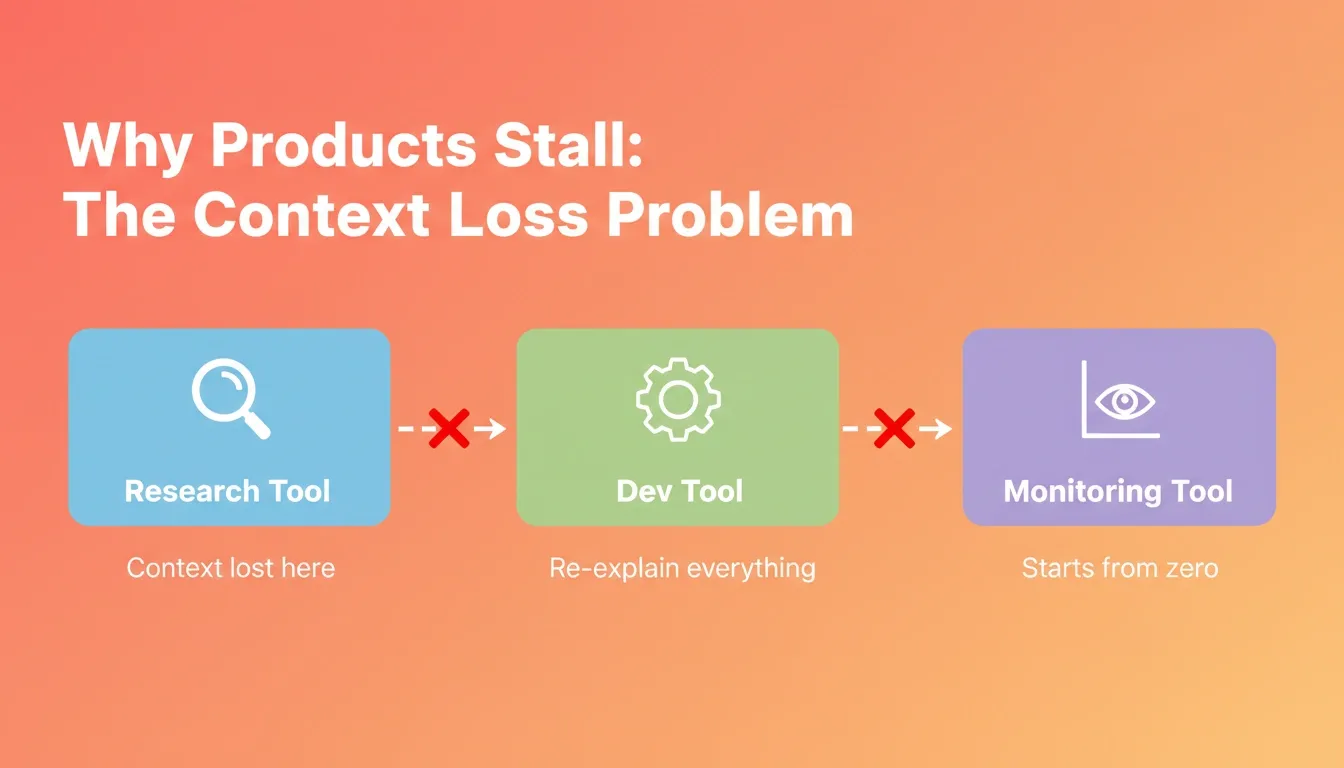
The context loss problem: research, building, and monitoring in separate tools means context is compressed or lost at every handoff.
Why Traditional App Building Fails at Iteration
The traditional build process has a structural flaw that compounds with every cycle. So let's break it down clearly.
- Research gets lost at the handoff. Insights from earlier stages do not carry forward. Teams start from scratch instead of building on past knowledge.
- The same problems get solved twice. Code is rewritten, bugs are re-introduced, and decisions are re-made. Progress stalls not because the team is slow, but because the system has no memory.
- Tool overload creates coordination overhead. Separate platforms for research, design, development, and deployment each require re-explanation. The team becomes the integration layer.
- Context compresses at every handoff. What was decided in full detail in a strategy session arrives at engineering as a two-line ticket. The nuance is gone before the first line of code is written.
This is not a people problem. It is an architecture problem. And it is exactly what Rocket's compound context architecture is built to solve.
The Three Pillars That Make Products Iterate Faster
Rocket is the world's first Vibe Solutioning platform. It is built across three connected pillars that address the complete arc from strategic intelligence to execution to ongoing business operation.
Vibe Solutioning is the practice of using AI to address the full journey of building a product or running a business. It starts with the intelligence that answers what to build and why, moves through the build itself, and continues into monitoring, improving, and growing what was built. Unlike vibe coding, which starts at execution and assumes the direction is already decided, Vibe Solutioning starts before the first line of code with strategic and competitive intelligence, then connects that intelligence to the build in a single platform.
The Rocket iteration loop: Solve informs Build, Build ships to production, and Intelligence feeds back into Solve. No context is lost between steps.
Pillar 1: Solve — Decision Intelligence Before the First Line of Code
Solve takes any business question described in plain language and delivers a complete, structured solution. It is ready to act on, present, or build from.
You describe your situation the way you would explain it to a smart colleague. Rocket then frames the problem before research begins. It identifies every dimension, including market dynamics, competitive landscape, risks, opportunities, and financial implications. From there, it runs thousands of queries across 150+ sources simultaneously. Within 60 to 90 minutes, what would have taken a research team days is complete.
The output is a structured analytical deliverable covering 8 to 12 sections. Each finding is tagged by signal strength (HIGH, MEDIUM, or LOW). Conflicting signals are called out explicitly rather than smoothed over. The report includes the verdict, key findings with evidence, competitive landscape, risk matrix, and an execution path with owners and timelines.
What makes Solve different from search or general AI:
| Search | General AI | Solve | |
|---|---|---|---|
| What you get | Links | Summary from training data | Structured multi-source report |
| Research effort | You do the work | None, but shallow | Done for you, in depth |
| Live data | Yes, unstructured | No | Yes, synthesized |
| Output format | Ten blue links | Paragraph answer | Executive summary, analysis, evidence, and recommendations |
| What happens next | You figure it out | You figure it out | Output becomes the foundation of your Build |
Here is the critical difference: the Solve output does not disappear after you read it. It becomes the foundation of everything that follows in the project. The PRD is present when the developer opens the Build task. The competitive brief is present when the landing page is written.
Solve addresses a wide range of needs, including strategic decisions (market entry, competitive assessment, pricing strategy), product direction (PRD generation, feature scoping, build-vs-buy analysis), competitive preparation (deal briefs, positioning responses), board and investor materials, M&A assessment, and regulatory research.
Pillar 2: Build — Production-Grade Generation from Accumulated Intelligence
Build generates production-grade products from natural language descriptions, Figma files, or existing GitHub repositories. Crucially, it works inside a Rocket project, so every build starts from the accumulated intelligence of that project.
Before generating, Rocket surfaces the decisions that matter: target users, key interactions, data model, and design direction. The first generation reflects genuine product thinking, not a generic template. What comes back is not a wireframe or mockup. It is a working, deployable product.
Web applications are built in Next.js. Mobile applications are built in Flutter with real design systems, dark/light theming, fluid navigation, staggered animations, and domain-specific data density.
To understand why these frameworks were chosen over all others, see why Rocket generates Next.js and Flutter. Every product ships with SEO-ready structure, WCAG 2.1 AA accessibility compliance, GDPR coverage, and performance optimization by default.
What you can build:
- Web apps: SaaS, dashboards, internal tools, marketplaces, customer portals
- Mobile apps: iOS and Android from a single Flutter codebase
- Landing pages: conversion-focused, built from project context so the hero speaks to the specific customer problem
- Multi-page websites: every page at the same quality standard as the hero
- Internal tools: OKR trackers, GDPR DSAR management tools, investor data rooms, ROI calculators
- Working interactive prototypes for user testing
After you ship, you can deploy to a live URL with one action. Staging and production environments are included. Full version history and one-click rollback come standard. Built-in analytics track visitors, conversions, accessibility, and Core Web Vitals.
25+ integrations connect directly into generation: Stripe, Google Analytics, Supabase, Notion, Linear, Airtable, Mailchimp, Mixpanel, OpenAI, Anthropic, Gemini, Perplexity, PayPal, Typeform, Twilio, SendGrid, and more. Authenticate once and they flow into every build.
For teams with existing work, Rocket also supports Figma import (preserving typography, spacing, visual hierarchy, and color system), GitHub codebase pickup (Next.js and TypeScript), and Redesign via eight slash commands for any live website.
Pillar 3: Intelligence — Continuous Monitoring After Launch
Intelligence monitors every public platform a competitor operates on, continuously, and interprets what signals mean for your business specifically.
Add any competitor by name or URL. Rocket identifies and maps every public surface they operate on across six signal categories.
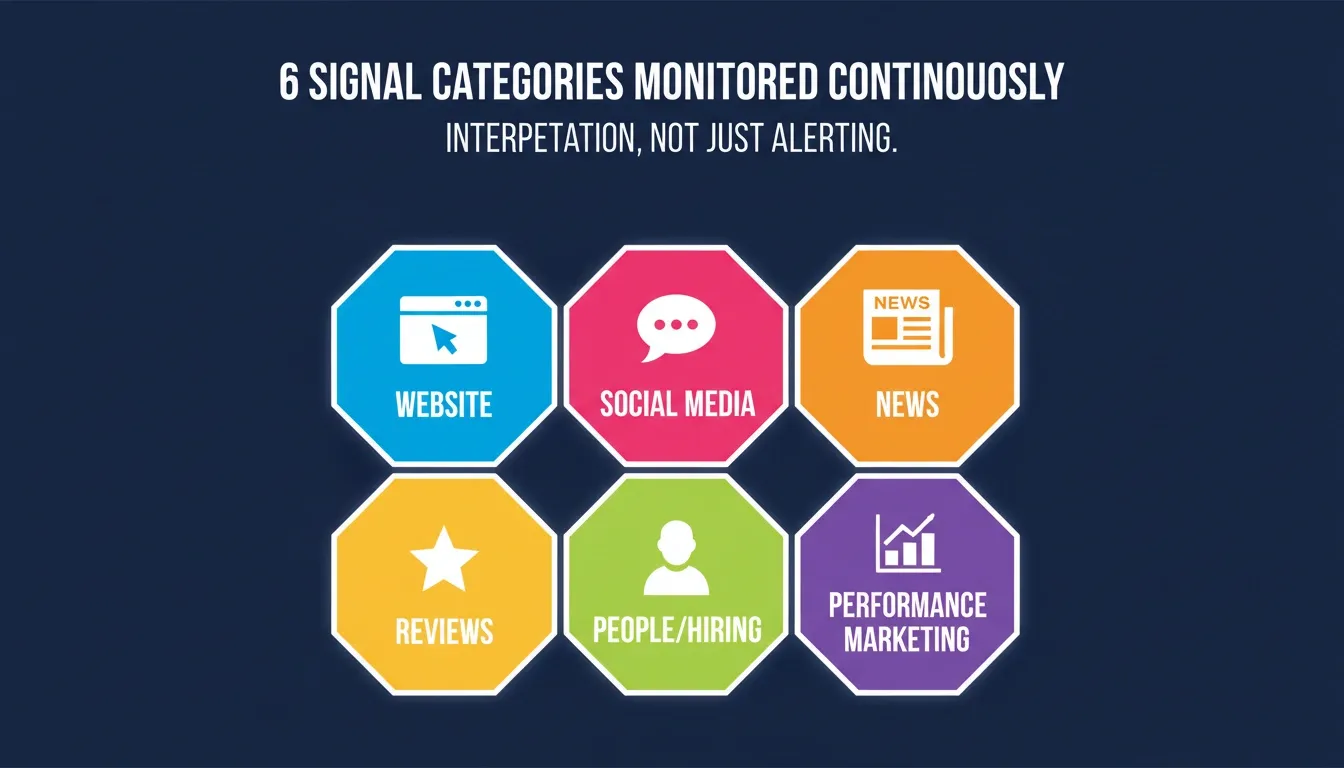 Intelligence monitors six signal categories across every public platform a competitor operates on and interprets what signal clusters mean, not just what changed.
- Website: every page change, messaging shift, pricing update, new feature announcement, and positioning pivot, with full before/after strategic delta interpretation
- Social Media: every post, campaign, and engagement pattern across LinkedIn, X, Instagram, Facebook, YouTube, TikTok, and Reddit
- News and Web Presence: press coverage, blog posts, partnership announcements, executive interviews, and media mentions
- Reviews and Reputation: G2, Glassdoor, Capterra, and other review platforms, with sentiment shifts tracked over time
- People: employee count, new hires, exits, hiring velocity, and open position breakdown by department. Hiring concentration reveals where competitors are investing before any product announcement confirms it
- Performance Marketing: ad activity across LinkedIn, Meta, and TikTok
Every day, Intelligence produces a structured brief for every competitor. It covers three things: signals and insight (a synthesized paragraph connecting everything that moved), what to watch (emerging patterns), and a recommendation (what your business should do, consider, or watch).
Intelligence is not an alerting system. It is an interpretation system. A pricing page update in isolation is noise. That same update, combined with enterprise-focused social posts, defensive G2 responses about security, and new enterprise sales job openings, is a single clear strategic signal. Intelligence reads signal clusters, not individual changes.
Intelligence lives inside a Rocket project. The competitor signal from Monday's brief is present when a PM opens Solve on Wednesday. The pricing move from last week is present when marketing writes the landing page. Intelligence compounds and does not reset between sessions, team members, or capabilities. To see how this works in practice, read about how Rocket Intelligence informs pricing decisions.
The Compound Context Architecture: Why This Is the Structural Difference
The architecture connecting all three pillars is called compound context. It is the specific reason products built on Rocket iterate faster than products built on any other platform.
Every other AI tool starts from zero each session. You explain the context, get an output, and the output disappears. The next session starts from zero again.
Rocket is built on the opposite architecture. Add your context once, and every task that follows already knows everything.
A Project is a persistent workspace holding everything relevant to a body of work, whether that is a product, a client, a campaign, or a deal. Add files and context once: pitch decks, financial models, market research, strategy documents, product briefs, customer interview transcripts, technical architecture docs, brand guidelines, competitive analyses, and spreadsheets.
Rocket understands files structurally, not as flat text. Spreadsheet formulas, multi-sheet workbooks, cross-references, and embedded data are read the way they were built. A financial model is understood as a financial model. Connect Notion, Google Docs, or Google Sheets and existing team knowledge flows in without re-uploading, staying current as the source updates.
Automatic inheritance means the first task opened inside a project already knows everything that has been shared. The tenth task knows everything the first nine established, plus everything brought in at the project level. This inheritance is automatic. There is no re-explaining, no re-uploading, and no briefing each new task from scratch.
Cross-task context means that when you reference any previous task in a new one, Rocket picks up exactly where the thinking left off. A decision made in one task becomes the foundation for the next.
Why competitors cannot replicate this: Competitors can match individual features. They cannot replicate accumulated context. The compound intelligence architecture is the moat, not because it is technically impossible to copy, but because it requires every capability to be built for shared memory from the start. You cannot bolt shared memory onto a tool designed for individual sessions.
What Iteration Speed Looks Like in Practice
So what does this actually look like when you are building something real? Here is the concrete difference compound context makes across a product's lifecycle.
For a Solo Founder
Without a compound context system, a solo founder validates an idea in one tool, writes notes somewhere else, starts building in another tool, re-explains the context, and ships something that reflects 40% of the original thinking.
With Rocket, the Solve output, including competitive landscape, market sizing, and product direction, is already present when the Build task opens. The founder ships a production-grade web app or mobile app. Intelligence monitors the competitive landscape continuously. When a competitor shifts pricing, the founder sees it in the dashboard and can respond, not react.
A solo founder preparing for a Series A can build a complete investor data room portal, a competitive teardown, a market sizing brief, and personalized investor landing pages, all from the same accumulated project context, without re-explaining the business to each tool.
To see how this works in practice, read about building a startup with vibe coding.
For a Product Manager
Consider a PM at a growth-stage company facing a conversion drop of 18% over two months. Without a research system, they spend a week researching hypotheses, write a PRD from memory, and engineering misses two nuances.
With Rocket, Solve diagnoses the conversion drop, evaluates four competing hypotheses, and delivers a recommendation with evidence. An engineering-ready PRD is then built from accumulated project context, including product architecture, user research, and competitive analysis, in under an hour instead of a week. Meanwhile, Intelligence surfaces competitor feature releases and pricing changes before they hit the sales floor.
For a Growth-Stage Team
At a 30-person SaaS company, strategy gets decided in leadership meetings but what actually gets built reflects 60% of it at best. The handoff between thinking and doing is where value is being lost.
With Rocket, one shared project holds the strategy memo, competitive analysis, and customer feedback. The VP of Product generates a PRD from that shared context. PMs open tasks from the same context. Engineering builds a prototype validated by users. The annual roadmap, including an integrated brief, five PRDs, competitive signal, OKR dashboard, and board presentation, is produced in one week instead of three.
For an Enterprise Team
A 350-person company spends $2M annually on strategy consultants. Reports are stale by the time they are read. Four separate competitive intelligence setups exist across sales, marketing, product, and strategy, each with its own data, tools, and version of the truth.
With Rocket, one Intelligence project serves four functions. M&A target evaluations happen in hours instead of weeks. A strategic intelligence function replaces external consultants, not because the AI is smarter than the consultants, but because it is continuous, connected, and compound. For more on building internal tools at scale, see what types of internal tools Rocket can build.
Traditional Workflow vs. Compound Context Workflow
When you put both approaches side by side, the difference is not incremental. It changes how you build, iterate, and scale.
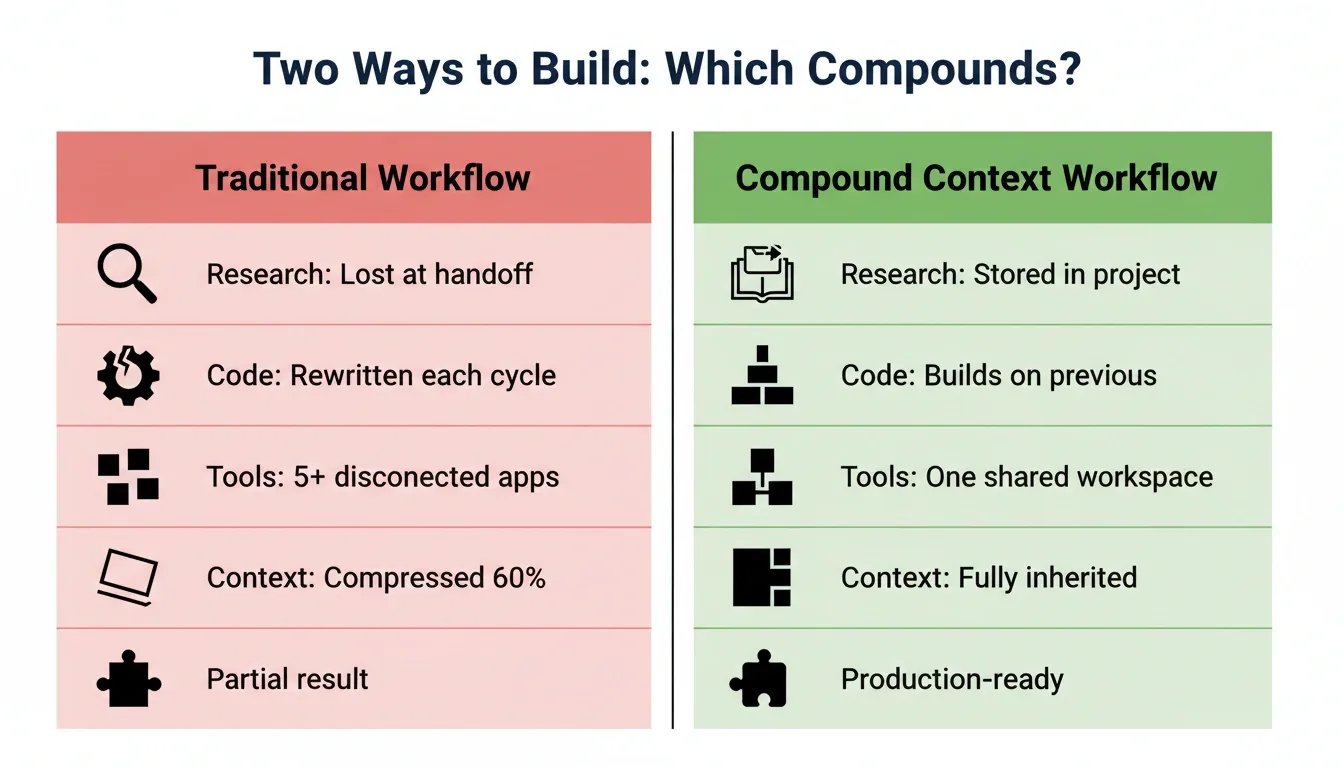
Traditional workflows lose context at every handoff. Compound context workflows inherit everything automatically. The handoff is not improved, it is eliminated.
| Aspect | Traditional Workflow | Compound Context Workflow |
|---|---|---|
| Research | Lost at every handoff | Stored in the project, inherited by every task |
| Code | Rewritten often, each cycle starts from partial context | Builds on previous code inside the same project |
| Tools | Multiple disconnected platforms | One platform with shared compound context |
| Iteration cycle | Restarts from partial information | Starts from accumulated intelligence |
| Context at handoff | Compressed, 60% of original thinking survives | Inherited automatically, nothing is re-explained |
| Output quality | Reflects a fraction of the original thinking | Reflects the full accumulated context of the project |
| Competitive awareness | Quarterly reports, often stale | Continuous daily briefs, always current |
| Team alignment | Each function has its own version of the truth | One shared project, one source of truth |
The handoff is not improved in Rocket. It is eliminated. The market research, the strategy brief, the PRD, and the build task are all in the same project. Every step inherits the full context of every prior step.
How the Iteration Loop Works Step by Step
Now let's walk through exactly how this plays out in practice.
Step 1: Create a project and add context. A project is a persistent workspace. Add your pitch deck, market research, product brief, customer interview transcripts, or financial model once. Connect Notion, Google Docs, or Google Sheets and existing team knowledge flows in without re-uploading, staying current as the source updates.
Step 2: Run Solve before writing a line of code. Ask Solve a business question in plain language. Rocket runs thousands of queries across 150+ sources simultaneously and delivers a structured report in 60 to 90 minutes. The output includes the verdict, key findings with evidence, competitive landscape, risk matrix, and execution path. This output does not disappear. It becomes the foundation of everything that follows.
Step 3: Build from the accumulated intelligence. Open a Build task inside the same project. Rocket already knows the market context, the competitive picture, the product direction, and the customer problem. Describe what you want to build. Rocket generates a production-grade app, web in Next.js or mobile in Flutter, with intentional design that looks like a senior designer touched it from the first generation.
Refine through chat, visual editing, or direct code access. Every change is tracked through Build's Versions feature. Roll back, compare diffs, label milestones, and deploy any version directly from chat.
Step 4: Launch and let Intelligence take over. Deploy to a live URL with one action. Intelligence begins monitoring your competitive landscape continuously. Every day, a structured brief lands for every competitor: what moved, what it means, and what to do about it.
When a competitor shifts pricing or ships a new feature, you see it in your dashboard. Create a Solve task to analyze the impact, or create a Build task to respond. The loop closes. The next iteration starts from the full accumulated intelligence of everything that came before.
Who Builds on Rocket and Why
Rocket serves three distinct user types, and each one experiences faster iteration differently.
The Builder includes founders, developers, designers, and agencies shipping products. Builders use all three pillars. The first version of a product reflects genuine market thinking, not a guess. Each subsequent version starts from the full accumulated context of every decision made before it.
The Operator includes product managers, marketing leaders, sales teams, consultants, and investors who use Solve and Intelligence without necessarily building customer-facing products. Research that used to take a week takes 60 to 90 minutes. The competitive brief that used to arrive as a quarterly report now arrives as a daily brief.
The Platform Consolidator includes enterprise and scaled-stage teams replacing tool sprawl with one shared-context system. Four separate competitive intelligence setups become one. Strategy, product, marketing, and sales work from the same accumulated context. The coordination tax disappears.
Vibe Coding vs. Vibe Solutioning: The Upstream Distinction
To really understand why products built on Rocket iterate faster, you need to understand the distinction between vibe coding and Vibe Solutioning.
Vibe coding answers "how do I build this?" Vibe Solutioning answers "what should I build?" That distinction sounds simple. Its consequences are enormous.
Vibe coding is real and it matters. The ability to describe what you want to build and have AI generate a working product is a genuine shift. The cost of building dropped dramatically. The speed from idea to prototype compressed from months to hours.
Even so, vibe coding does not address three structural problems:
- No pre-build intelligence. The quality of what comes out depends entirely on what you brought to the tool. The tool has no opinion on whether what you asked it to build was worth building.
- No shared memory architecture. Every person starts their own session with their own context. Coordination still happens in Slack, docs, and meetings, outside the tool.
- You are the platform manager. API keys, provider configurations, error handling, and performance at scale are your operational responsibility.
The result is a generation of products built faster than ever before, failing for the same reasons they always failed. The build was fine. The foundation was not.
Vibe Solutioning is not a replacement for vibe coding. It is the upstream category that makes vibe coding worth doing. Vibe coding is Day 1. Vibe Solutioning is Day 0 through Day 2.
How Rocket Compares to Other AI Platforms
Every platform Rocket is compared against serves one part of the journey and stops there. Here is a balanced look at how they differ.
| Platform | What it does well | What it does not address |
|---|---|---|
| Lovable / Bolt / v0 | Fast generation from prompts | No pre-build intelligence, no shared memory, no continuous monitoring |
| Cursor | AI coding for developers who know what to build | No pre-build intelligence, no shared team memory |
| ChatGPT / Claude / Gemini | General-purpose AI assistance | No structured decisions, no connection to build |
| Perplexity / Deep Research | Finding information | Intelligence ends at the document, does not become the foundation of what gets built |
| Rocket | Research what to build, build it, monitor what matters | One platform, shared compound context |
The distinction is not a feature advantage. It is a category difference. Tools require you to be the system. You carry context between them, coordinate outside them, and manage configurations. Rocket is the system.
Rocket Pricing
Rocket uses a credit-based pricing model. One credit balance covers everything: Solve research, Build generation, and Intelligence monitoring. There are no per-seat fees. Unused credits roll over month to month on monthly plans.
| Plan | Monthly Price | Credits Included | Best For |
|---|---|---|---|
| Free | $0 | 20 credits (one-time) | Light, exploratory, and personal use |
| Pro | $25/month | 100 credits/month | Production-ready builds for individuals |
| Rocket | $50/month | 250 credits/month | Full suite for individuals and teams |
| Booster | $250/month | 1,500 credits/month | Power users and fast-moving teams |
| Intelligence add-on | $100/month per competitor | 500 credits/month per competitor | Continuous competitive monitoring |
All paid plans include unlimited team members. Additional credits can be purchased at any time and do not expire while a subscription is active. Yearly plans save 20%. Enterprise plans with SSO, data localization, and premium support are available via support@rocket.new.
Key Features That Make Iteration Faster
Shared Context Architecture Add files and background once: pitch decks, financial models, customer research, and brand guidelines. Every task in the project inherits this context automatically. The tenth task knows everything the first nine established.
Versions Built In Every change is tracked. Compare diffs, roll back changes, label milestones, and deploy any version directly from chat. Staging and production environments are included. One-click rollback means nothing built is ever gone.
Natural Language Control Describe changes in plain language. Rocket applies them in context without needing you to re-explain what already exists. There is no change limit.
25+ Integrations Stripe, Google Analytics, Supabase, Notion, Linear, Airtable, Mailchimp, Mixpanel, OpenAI, Anthropic, Gemini, Perplexity, PayPal, Typeform, Twilio, SendGrid, and more. Authenticate once and they flow into every build.
Built-in Analytics Visitors, conversions, accessibility, and Core Web Vitals are tracked after launch. Performance visibility comes without additional tools.
SEO, Accessibility, and Compliance by Default
Every build ships with SEO-ready structure, WCAG 2.1 AA accessibility compliance, and GDPR coverage as the baseline, not optional extras. Use /Generate SEO Report and /Fix SEO Issues to audit and apply fixes. Use /Generate GEO And AEO Report to optimize for AI search engines including Perplexity, ChatGPT, and Claude.
Human Help When AI Reaches Its Limit When the AI reaches a point where the next step requires human judgment, Rocket's Success team steps in inside the platform, with the user's permission and with full project context already present. No ticket system. No email chain. As the approved one-liner puts it: "AI gets you to 90 percent. Rocket gets you the rest."
Redesign Take any existing website and reimagine it via eight slash commands across three categories: Reimagine (layout, from scratch, mobile-first), Insight-Driven (from heatmap, fix conversion issues, fix visual hierarchy), and Brand and Consistency (redesign like competitor, generate brand-matched page).
The Context Switching Cost This Solves
Research from Asana's Anatomy of Work Index found that workers switch between apps and websites an average of 25 times per day. The cost is not just time. It is the quality of decisions made on incomplete context.
LinkedIn research puts it directly: "Every time your team has to jump from one app to another, their focus shatters... context switching is a silent productivity killer."
This is the specific problem Rocket's architecture addresses. When research lives in one tool, design in another, development in a third, and monitoring in a fourth, the team becomes the integration layer. They carry context between tools, re-explain decisions at every handoff, and manage the coordination that the tools should handle.
Rocket removes that burden. Research, building, and monitoring happen in one workspace. The team focuses on the product, not on managing the system.
Why Products Built on Rocket.new Will Keep Iterating Faster
The AI product development industry spent two years solving the second half of the problem: how to build faster. Rocket 1.0 solves the first half, which is what to build and why, and connects it to the build in a single platform with shared compound context.
That connection is what changes iteration speed. Not just the speed of generating code, but the quality of what gets generated, the accuracy of what gets built, and the continuity of intelligence that carries from one cycle to the next.
As AI capabilities continue to compound, the gap between platforms that retain context and platforms that reset it will widen. Products built on a compound context architecture will not just iterate faster in the current cycle. They will compound their advantage with every cycle that follows.
The work is only as good as the thinking before it. Rocket is where that thinking happens, and where it stays, connected to everything built from it.
Most teams build fast. Few teams build right. Rocket is built for the second kind.
If you are ready to build products that get sharper with every iteration, Rocket.new gives you research, building, and competitive intelligence in one platform, so nothing is ever lost between thinking and building.
Table of contents
- -What "Products Built on Rocket.new" Actually Means
- -The Root Cause of Slow Iteration
- -Why Traditional App Building Fails at Iteration
- -The Three Pillars That Make Products Iterate Faster
- -Pillar 1: Solve — Decision Intelligence Before the First Line of Code
- -Pillar 2: Build — Production-Grade Generation from Accumulated Intelligence
- -Pillar 3: Intelligence — Continuous Monitoring After Launch
- -The Compound Context Architecture: Why This Is the Structural Difference
- -What Iteration Speed Looks Like in Practice
- -For a Solo Founder
- -For a Product Manager
- -For a Growth-Stage Team
- -For an Enterprise Team
- -Traditional Workflow vs. Compound Context Workflow
- -How the Iteration Loop Works Step by Step
- -Who Builds on Rocket and Why
- -Vibe Coding vs. Vibe Solutioning: The Upstream Distinction
- -How Rocket Compares to Other AI Platforms
- -Rocket Pricing
- -Key Features That Make Iteration Faster
- -The Context Switching Cost This Solves
- -Why Products Built on Rocket.new Will Keep Iterating Faster