This blog covers the Rocket.new validation loop, a method for founders to combine free market research tools with a live MVP built in under 7 days, turning real user behavior into better validation than any survey could provide.
What's the Point of Research If You Never Find Out If Anyone Will Pay?
Traditional market research costs anywhere from $5,000 for a small online survey to well over $500,000 for a full multi-market study.
And yet, 42% of startups still collapse because they build products nobody wanted - research budgets included. The research isn't always the problem. The missing link is what comes after it.
This article covers a smarter approach: a cheap market research alternative that pairs fast, lightweight research with a live MVP - built and tested in under a week so that real user behavior does the hard validation work for you.
The Real Cost of Traditional Market Research
If you've ever gotten a quote from a traditional market research firm, the sticker shock is real. Firms like Luth Research, NielsenIQ, and others have built their services around enterprise clients who budget months for data collection and analysis. That's not a knock on Luth Research or similar market research firms - it's just the reality of what professional, full-service market research actually costs.
Here's what the numbers look like in 2025:
-
A basic online survey with 400-1,000 responses: $5,000 to $15,000
-
Focus groups (8-10 participants, one to three groups): $7,000 to $20,000 per group
-
In-depth interviews with consumer subjects: $5,000 to $40,000+
-
Full multi-market programs from firms like Luth Research: $150,000 to $500,000+
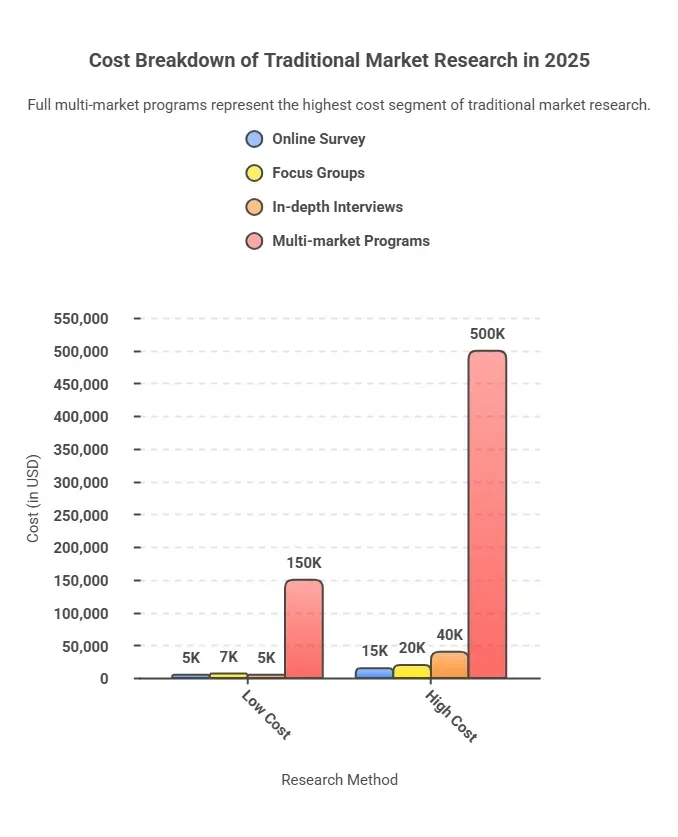 (Source: MainBrain Research, 2025)
Luth Research and similar market research firms serve brands with research budgets that most early-stage founders don't have and shouldn't spend before they've validated anything.
The other problem with this approach? Data collection takes weeks. By the time a detailed report comes back from a firm like Luth Research, the market may have shifted, a competitor may have launched, and your original research objectives may no longer match what you're actually building. Traditional research is built for organizations running at a slow, considered pace not for startups trying to find product-market fit in real time.
Free Market Research Tools: A Good Start, Not the Full Answer
Before paying anyone anything, smart founders tap into free market research tools to catch early demand signals, understand their target audience, and map what competitors are doing. These are genuine tools with real value they're just not the whole picture.
| Tool | What It's Good For | What It Can't Tell You |
|---|---|---|
| Google Trends | Tracking search demand over time | Who's searching or whether they'd pay |
| Reddit and X | Consumer sentiment and pain points | Whether sentiment converts to purchases |
| SurveyMonkey (free tier) | Quick survey responses | Survey responses from your actual target audience |
| Facebook Audience Insights | Target audience size estimates | Real behavioral data or buying intent |
| Google Analytics | Website audience insights | What a non-existent site's audience looks like |
Google Trends shows whether people are searching for your category. Social media platforms reveal what your target market complains about. Audience insights tools give rough demographic data.
But here's the gap all these free market research tools share: they capture what people say and search. They don't capture what people actually do when they have to pay, register, or commit to something real. Consumer behavior data from a live product is worth far more than any survey response rate could ever produce.
The Real Cost of Skipping Validation Entirely
Some founders skip research and go straight to building. A custom-coded MVP with a dev team costs between $30,000 and $150,000 and takes 3 to 4 months at minimum. (Source: American Chase, 2026)
The problem isn't the build. The problem is spending $50,000 to $150,000 before finding out whether anyone wants what you're building.
Most early-stage startups get caught in one of two traps:
-
Spend everything on market research and have no budget left to actually build
-
Build without any research and hope the product lands
Neither works consistently. And the failure data confirms it - 42% of startups fail from misreading market demand, not from poor execution or weak teams.
The Validation Loop: Research and MVP Running at the Same Time
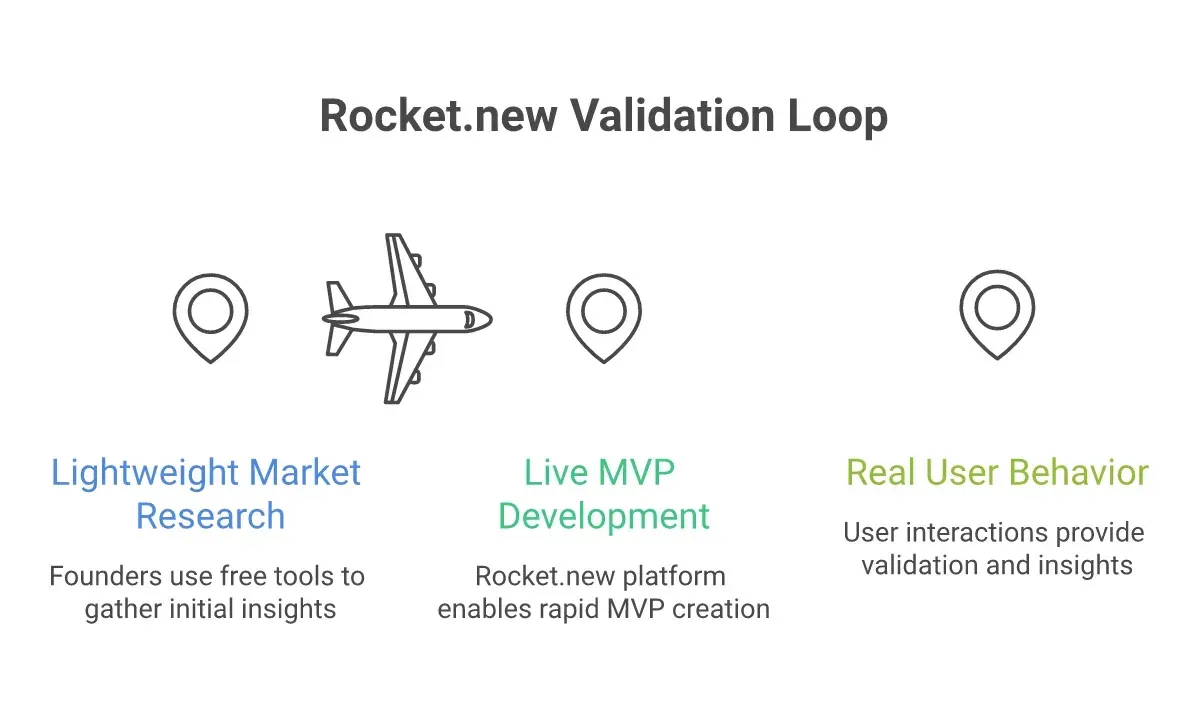
Rocket.new Validation Journey
The Rocket.new validation loop doesn't ask you to choose between research and building. You use lightweight research to shape what you build then use the live product to complete the research. Real user behavior from a real product closes the gap that surveys and focus groups always leave open.
The loop runs in about 7 days for most founders. Days 1 and 2 are research free market research tools, secondary research from industry reports, a handful of quick user conversations. Days 3 through 5 are the build. Days 6 and 7 are live testing with real users.
What you get at the end isn't a slide deck with survey responses. It's actual behavioral data from real people using a real product. That's the kind of audience insights market researchers spend months trying to collect.
How to Layer Research at Each Stage
The validation loop doesn't mean skipping research. It means layering research where it does the most good - and not over-investing in data collection before you have anything to test.
Stage 1 - Before You Build
Secondary research using existing data from industry reports, Pew Research Center, and social listening tools. Google Trends for demand signals. Social media platforms and Reddit for consumer behavior patterns and pain points. Budget: near zero. Time: 1 to 2 days.
Stage 2 - While You Build
Quick surveys with Google Forms or Typeform. Short user interviews with 5 to 10 people from your target audience. This is your primary research - it helps shape features and messaging before launch. Budget: a few hundred dollars at most. Time: runs in parallel with building.
Stage 3 - After You Launch Your MVP
Real user behavior. Drop-off rates. Click patterns. Return visits. Feature usage. Conversion actions. This is the best data collection you'll ever run - behavioral evidence of what customers actually want, not what they said they wanted. Traditional research teams spend months trying to approximate this kind of insight. A live product gives it to you in days.
This three-stage approach gives you data quality that scales with your actual needs - not the research needs of a Fortune 500 brand tracking consumer behavior across 30 markets.
What the Startup Community Is Saying
The move toward build-and-validate is gaining traction across founder communities, and people building with Rocket.new are showing up with results.
Markandey Sharma, a product builder, shared this on LinkedIn after building with Rocket.new:
"Rocket is not a drag-and-drop tool. It's an AI-powered builder that turns your idea into a real app with both frontend and backend - from just one prompt. Full UI and Backend auto-generated. Login, database, payments - all done. Clean, mobile-ready design."
That's not a mockup or a prototype sitting behind a waitlist. That's a live product - built in 15 minutes, not 15 weeks.
And from Santiago Valdarrama, a machine learning engineer and educator, writing about Rocket's growth on LinkedIn:
"In just 15 weeks, Rocket, a vibe-solutioning startup, grew to 400,000 users and 500,000 deployed applications! They just raised $15M in seed capital..."
That kind of growth doesn't happen unless founders are getting real validation results. The tool works because the validation loop works.
Launch the Validation Loop with Rocket.new
Rocket.new is an AI-powered product builder that generates a full-stack application from a single plain-English prompt. Frontend, backend, database, auth, payments, and deployment - all covered without writing a line of code.
How Rocket.new Powers Each Phase of the Loop
Research Phase
Rocket.new includes built-in competitor monitoring and market research tools. You can gather market data, track competitor products, and spot audience trends without switching to a separate tool. This is your research command center before you write a single product spec.
Build Phase
Describe your product in plain English. Rocket.new generates the full app. It connects to Supabase for database management, Stripe for payments, Netlify for deployment, Resend for email, Google Analytics for tracking, and Perplexity AI for smart search. Your MVP is production-ready from day one - not a prototype, not a mockup, a real working product.
Test Phase
Real users interact with your live product. You collect behavioral data directly analytics, usage patterns, drop-off points, conversion rates. This is the audience insights that no focus group has ever been able to give you at this speed or cost.
Why Rocket.new Beats Other AI Tools for Validation
Most AI builders focus on one thing: the code. Rocket.new covers the full validation stack. Here's how it sits against the main alternatives:
| Feature | Rocket.new | Bubble | Webflow | Lovable |
|---|---|---|---|---|
| Full-stack generation from prompt | Yes | No | No | Partial |
| Built-in market research tools | Yes | No | No | No |
| Stripe payments out of the box | Yes | Via plugin | No | No |
| Code ownership via GitHub | Yes | No | Partial | Yes |
| Google Analytics built in | Yes | No | Partial | No |
| Non-technical friendly | Yes | Steep curve | Yes | Yes |
| Competitor monitoring | Yes | No | No | No |
Bubble has a steep learning curve and produces no portable code. Webflow focuses on design and has limited backend capabilities. Lovable and similar AI tools handle the frontend well but don't give you the full stack needed for a real validation test auth, payments, database, and analytics all in one place from day one.
What used to take six months and $50,000 can now be done in a week for under $500. (Source: No Code MBA, 2026) With Rocket.new, that week also gives you real behavioral data that no amount of traditional market research could match for cost or speed.
The Cheap Market Research Alternative That Actually Works
The best cheap market research alternative isn't a cheaper survey tool or a more affordable focus group. It's a combination of lightweight secondary research, fast primary research from your target audience, and a live product that does the hardest validation work for you automatically.
Traditional research firms like Luth Research serve large organizations with large budgets and long timelines. That's not where early-stage startups live. If you're a founder with budget constraints and a product idea that needs validation, spending $20,000 on focus groups before you've built anything is the wrong move every time.
The Rocket.new validation loop gives you real consumer behavior data from real users in 7 days for under $500. For a startup trying to find product-market fit before the runway runs out, that's not just cheaper it's more accurate. Real behavior beats survey responses. Real products generate real insights. And real validation is the only kind that matters.
You don't need a market research firm. You need a week and Rocket.new.
Sign up to start now!
Table of contents
- -The Real Cost of Traditional Market Research
- -Free Market Research Tools: A Good Start, Not the Full Answer
- -The Real Cost of Skipping Validation Entirely
- -The Validation Loop: Research and MVP Running at the Same Time
- -How to Layer Research at Each Stage
- -Stage 1 - Before You Build
- -Stage 2 - While You Build
- -Stage 3 - After You Launch Your MVP
- -What the Startup Community Is Saying
- -Launch the Validation Loop with Rocket.new
- -How Rocket.new Powers Each Phase of the Loop
- -Why Rocket.new Beats Other AI Tools for Validation
- -The Cheap Market Research Alternative That Actually Works