
The cheapest way to build an MVP this weekend skips the dev team, the agency, and the $50K budget. Use Rocket.new's AI builder to go from idea to live product in 48 hours, validate with real users, and iterate fast without compromising quality.
What if you could have a live, working product in the hands of real users before Monday?
The cheapest way to build an MVP this weekend is not about cutting corners. It is about starting in the right order, with the right tool.
A minimum viable product does not need to be the full version of your idea. It just needs to be enough to prove your idea is worth building.
According to a 2026 MVP development cost report by DBB Software, hiring a professional team runs anywhere from $5,000 to $150,000 or more, not counting the months of waiting.
Most founders do not have that kind of runway. The good news? You do not need it.
What Is a Minimum Viable Product (And What It's Not)
The term gets thrown around so often it has lost some of its meaning. Founders nod along, then go build something that takes six months and costs $80,000.
-
A minimum viable product is the smallest thing you can build that lets you test your biggest assumption. Not a beta version, not a polished demo, not a "smaller full product."
-
Your MVP has one job: answer three questions. Is this a real problem, does your solution actually solve it, and will anyone pay for it?
-
Every feature that does not help answer one of those three questions is out of scope for now. Scope should be narrow enough to build in days, not months.
That is the definition. Everything else is scope creep dressed up as product development.
The Version Most Founders Build (And Why It Goes Wrong)
Most founders treat their minimum viable product as a "smaller full product," and that framing is where the problem starts.
-
They add features they assume users will want, without asking a single real user first.
-
They polish the interface before anyone has seen a single screen.
-
They build back end logic for edge cases that may never happen in the real world.
The result is months of development time, a depleted budget, and a product that still has not answered the core question.
A builder on r/SaaS captured the real value of moving fast in February 2026:
"I don't regret using AI tools for the initial build because getting to a prototype fast let me validate the idea before investing serious time."
That is exactly the shift that separates founders who learn fast from founders who build for months and find out late. Speed to real user feedback is the only metric that matters at the MVP stage.
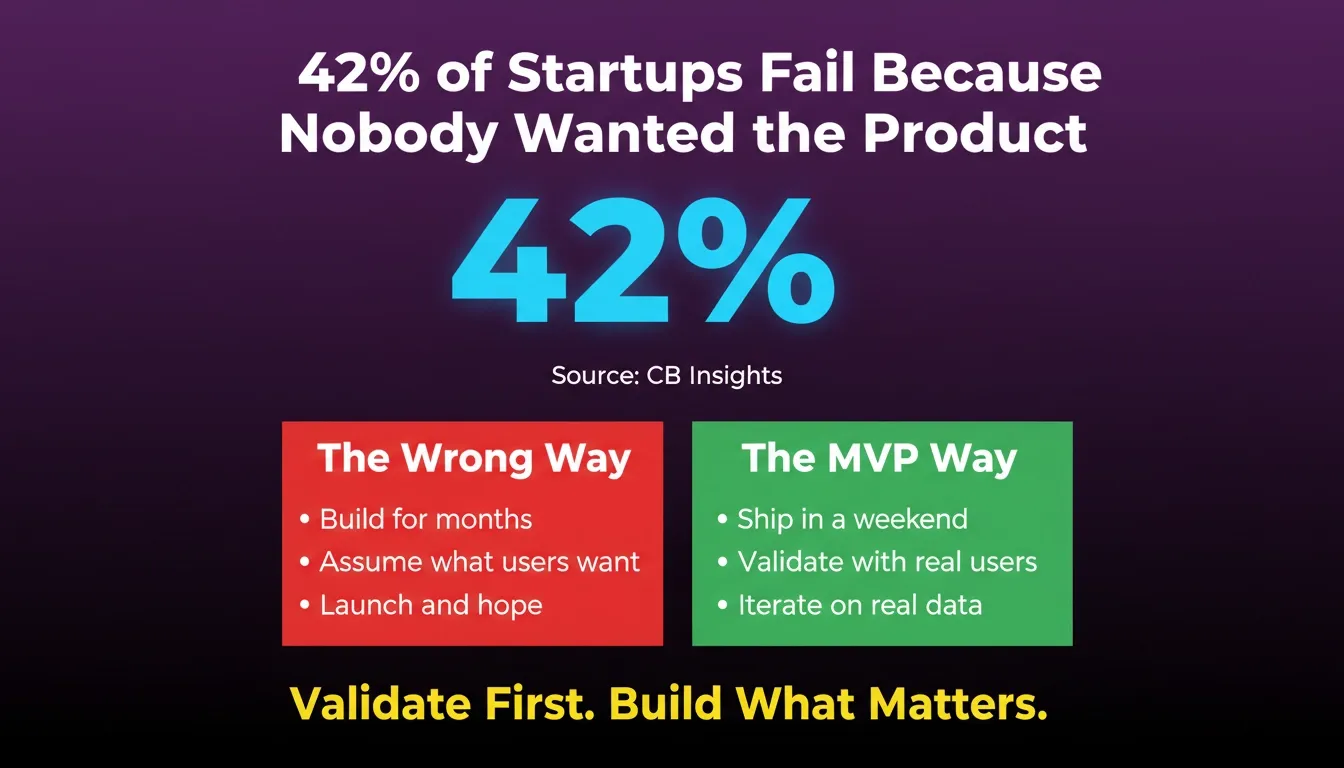 CB Insights data: 42% of startups fail because they built something the market did not need. The MVP method exists to prevent exactly that.
Why Most MVPs Cost Too Much (And Take Too Long)
The traditional MVP path was designed for building complex systems, not for validating ideas.
-
The standard process runs like this: define requirements, hire a development team or agency, spend weeks on planning, begin writing code, iterate, then launch.
-
Even the "fast" version of this takes 4 to 8 weeks and costs tens of thousands of dollars.
-
Applying a complex system build process to a minimum viable product means paying complex system prices to answer a question that did not need to cost that much.
According to a 2026 report by DBB Software, hiring a professional team runs $5,000 to $150,000 or more, before accounting for months of lead time. Most founders do not have that runway. And they should not need it.
The Real Numbers: MVP Development Cost Across Build Approaches
Here is what market research shows about MVP development costs across different build approaches:
| Build Approach | Typical Cost | Typical Timeline |
|---|---|---|
| Freelance software engineers | $10,000 to $40,000 | 4 to 12 weeks |
| Development agency | $30,000 to $150,000+ | 3 to 6 months |
| Hiring in-house (one engineer) | $80,000+ per year | 3 to 6 months minimum |
| AI-powered builder (Rocket.new) | Free to $300/month | Days to two weeks |
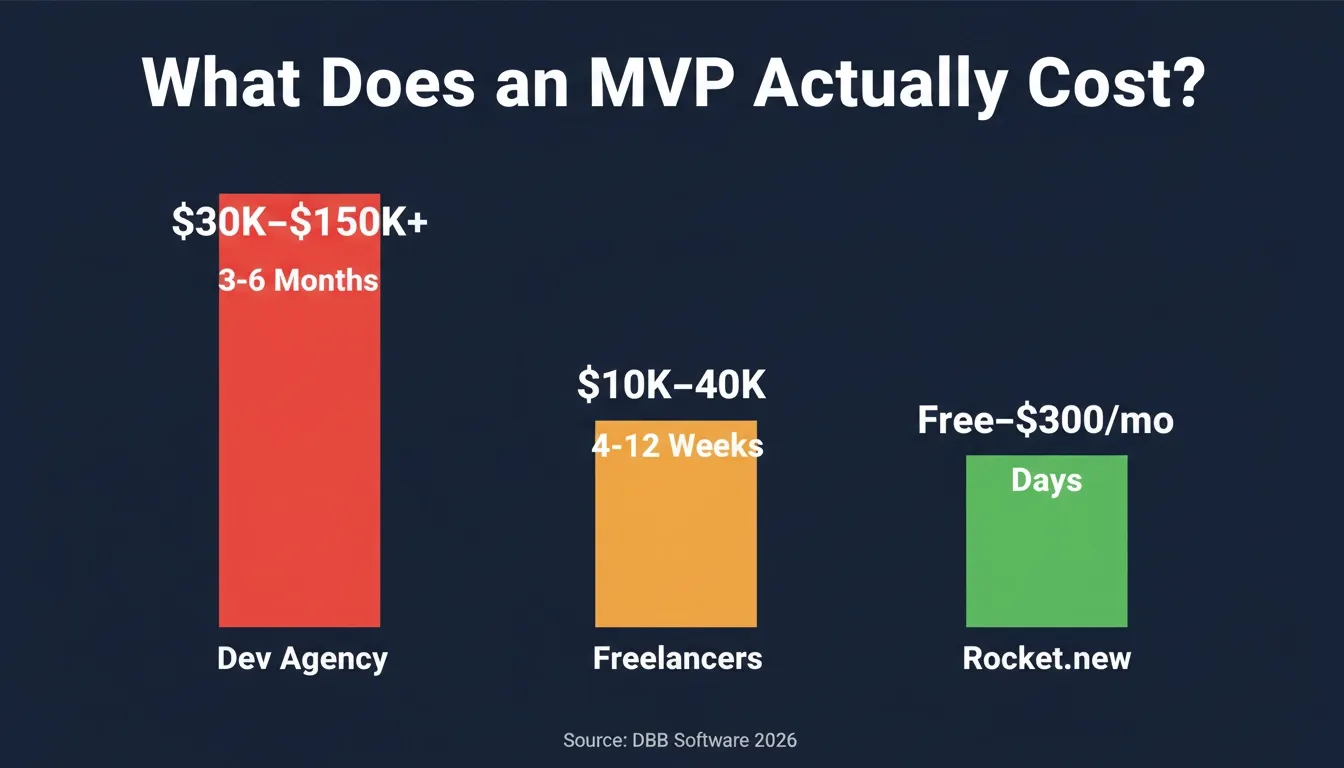 MVP development cost comparison. Rocket.new delivers production-ready apps at a fraction of what a dev agency or freelancer charges.
And it is not just the money. Time kills startups too. Research from the Startup Genome project shows that startups that pivot once or twice have 3.6x better user growth and raise 2.5x more money compared to those that never pivot. The 42% of startups that fail do so because they built something the market simply did not need. That is not a budget problem. It is a "building before thinking" problem.
What Actually Eats the Budget: Hidden Costs and Pre-Development Costs
The cost of an MVP is not really about writing code. It is about the decisions made, or not made, before the first line is ever written.
-
Scope creep adds features nobody asked for, bloating timelines and budgets before a single user has given feedback.
-
Over-engineering the back end before knowing what data you actually need burns days of expensive developer time on things that may never be used.
-
Hiring software engineers for validation work puts the most expensive resource on a job that should come after validation, not before it.
Pre-development costs and post-development costs both spiral when the MVP scope is not locked early. Paying for months of development time before a real user touches the product is the single most expensive mistake early-stage founders make. Cut those patterns and the cost drops dramatically. That is the core of the weekend MVP method.
The Weekend MVP Playbook: Build an MVP in 48 Hours
This is a practical 48-hour plan for founders with ideas, not for developers with months to spare.
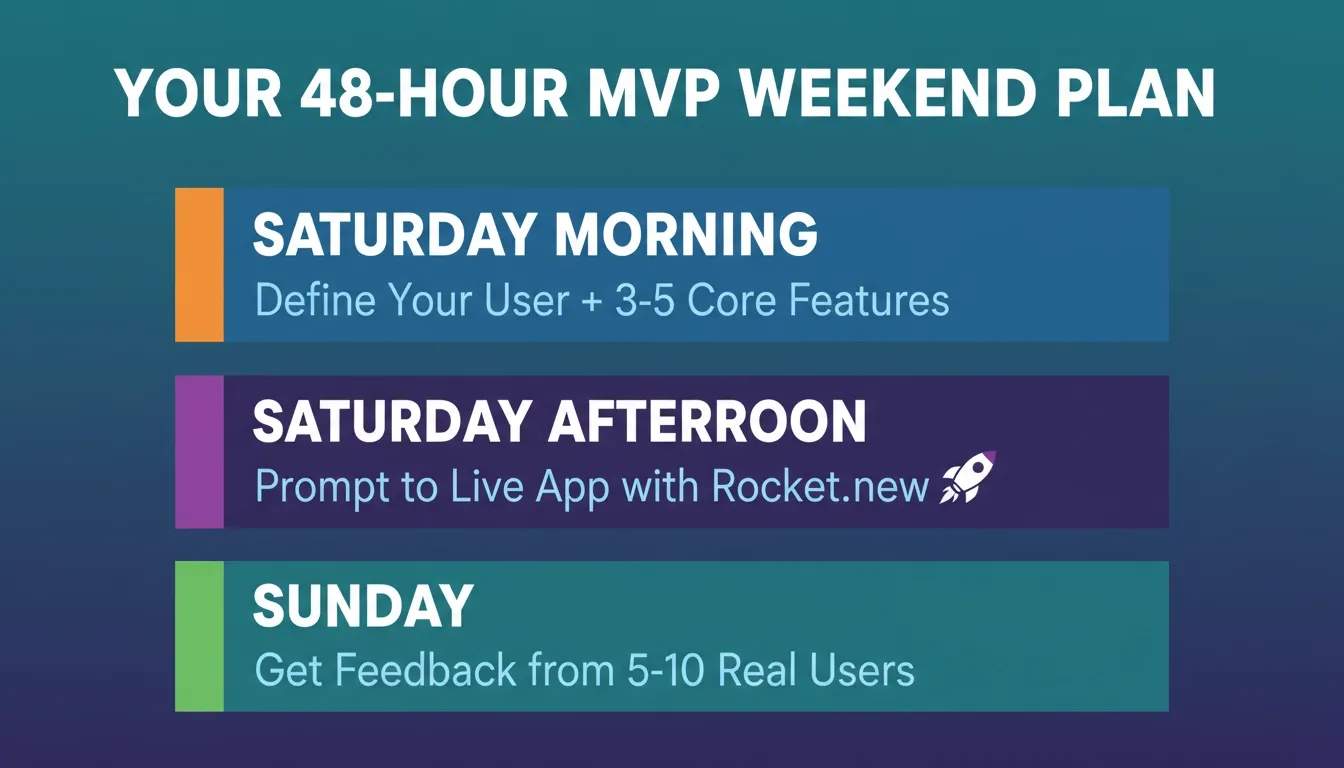 The 48-hour weekend MVP plan. Saturday morning is for clarity. Saturday afternoon is for building. Sunday is for learning.
-
Saturday morning is for clarity: define your exact user, the one core pain point, and only 3 to 5 core features.
-
Saturday afternoon is for building: use an AI-powered tool to generate a working prototype from your product brief.
-
Sunday is for learning: get the prototype in front of 5 to 10 real potential users and gather feedback through three focused questions.
The building step is the fastest part. Clarity and learning are where the real work is. Learn more about the Rocket.new MVP Playbook for a deeper framework on each stage.
Saturday Morning: Get Clear on Core Features
The quality of your Saturday afternoon build depends entirely on the clarity you create in the morning.
-
Define who the exact user is. Not "small businesses" but something specific enough that you could name or find ten of them today.
-
Identify the one pain point: the most painful problem they face, the one they would pay to fix right now.
-
List every feature you think you need, cut half, then cut half again. You should end with 3 to 5 core features.
Write it all down as a product brief. Everything you build this weekend should map directly back to it. Two to three hours here saves weeks of rebuilding later.
Saturday Afternoon: Build Your Prototype Using No Code and Low Code Tools
This is where the technology stack decision matters most, and where most non-technical founders used to hit a wall.
-
Traditional no code platforms like Bubble or Webflow have real capability, but learning data modeling, workflow logic, and design systems takes months, not a weekend.
-
AI coding tools like Cursor or Copilot help software engineers go faster, but they assume you already understand component architecture and write code regularly.
-
AI-powered builders changed this entirely. Describe your app in plain language and have a production-ready prototype generated in minutes.
The right tool handles the complete technology stack: front end, back end, database, and deployment, all from a single prompt. Today, a Saturday afternoon is long enough to have a live, shareable product. That was not true two years ago.
Sunday: Put It in Front of Early Users
Once you have a working prototype, the job shifts from building to learning.
-
Find 5 to 10 people from your actual target audience. Not friends, not family, but real potential users who match the profile in your product brief.
-
Share the prototype on a short video call so you can watch them use it in real time, not just hear what they say about it after.
-
Ask three questions: What did you expect to happen when you clicked that? What would stop you from using this week over week? What is the one thing you wish this did that it does not?
Real user feedback is the only signal that tells you what to build next. Everything else is assumption. Their answers will tell you more than three months of solo building alone.
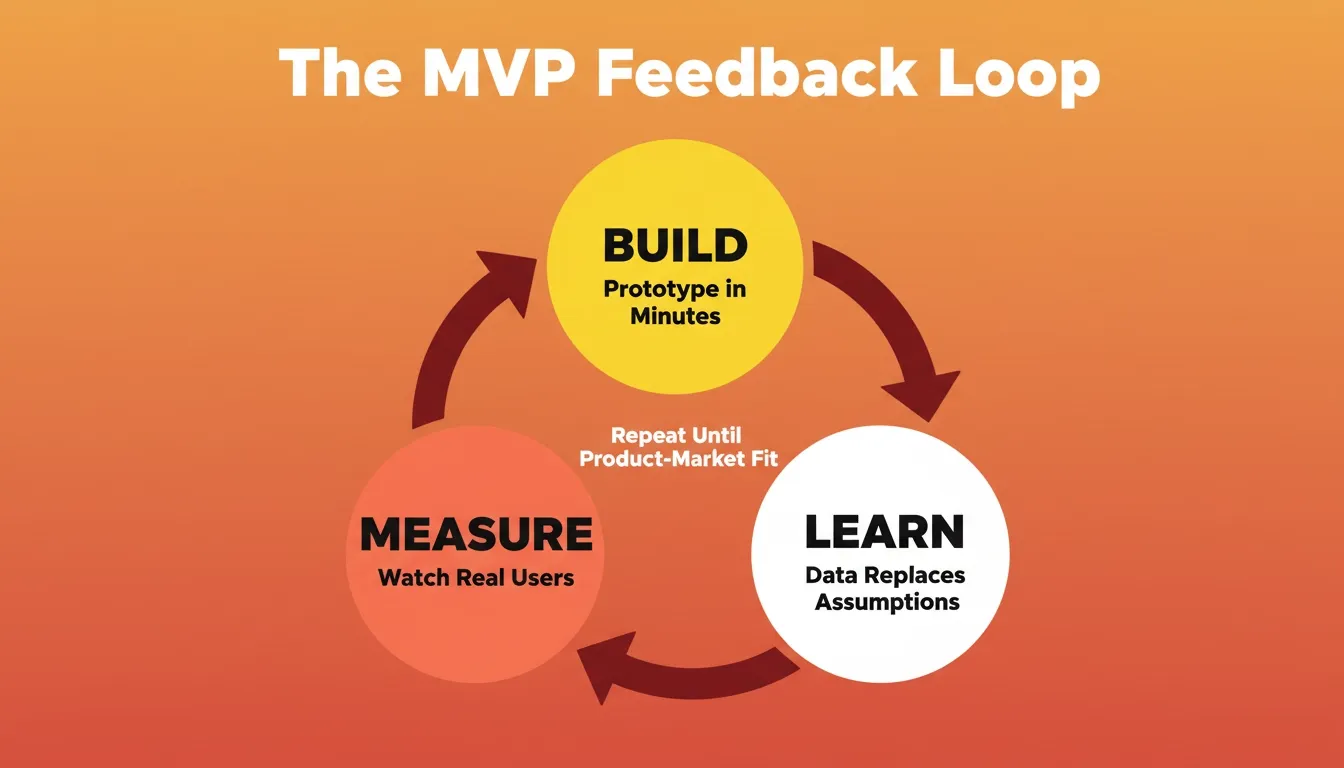 The build-measure-learn loop. Each cycle replaces assumptions with real data and moves you closer to product-market fit.
The Technology Stack Problem for Non-Technical Founders
Most discussions about the cheapest way to build an MVP skip the part where non-technical founders actually hit a wall.
-
Traditional no code tools require weeks or months to reach meaningful proficiency. They are powerful, but not weekend-ready for a first-time user.
-
AI coding assistants are built for developers and assume working knowledge of the codebase, framework, and component architecture.
-
The gap between "I have a product idea" and "I have a working app" used to require either months of personal learning or paying software engineers.
Today, AI-powered builders like Rocket.new close that gap entirely. No prior coding knowledge, no framework learning curve, no development agency needed. Explore how vibe coding is changing app development for non-technical founders.
Here is how the development journey looks with the traditional approach compared to the AI-powered approach:
The traditional loop takes months and burns significant budget before a single real user sees the product. The AI-powered path gets you to real user feedback within a weekend.
Ready for Liftoff: Build Your MVP on Rocket.new
Rocket.new is the world's first Vibe Solutioning platform, and for a weekend MVP build, that distinction matters more than it might first appear.
-
Where most AI builders start at the build step, Rocket.new starts before it, at the thinking step.
-
Market research, competitive analysis, and product decisions all happen inside the same platform as the build itself.
-
Shared context carries from one task to the next automatically. No re-explaining your product brief, no lost decisions between sessions.
1.5 million people across 180 countries have used the platform, from solo founders validating their first idea to enterprise teams running strategy and execution in the same place.
The biggest reason MVPs fail is not bad code. It is an idea that was not properly grounded before building started. Rocket.new is built to close that gap.
Describe, Generate, Launch: Here's the Exact Flow
Here is exactly how a weekend build works on Rocket.new, from first prompt to live product.
-
Describe your app in plain language. Mention the screens you need, the core features, and who it is for. "A booking app for yoga studios to manage classes and payments" beats "a booking app."
-
Rocket.new plans and generates. The platform selects the right technology stack automatically. React or Next.js for web apps, Flutter for mobile apps. Most apps are ready in 1 to 3 minutes.
-
Review your live preview. Interact with the app exactly as a real user would, testing every screen and every interaction before sharing it with anyone.
-
Iterate through chat. Change anything by describing it in plain English: "Move the sign-up button to the top of the page" or "Add a payment screen after booking confirmation." No writing code at any point.
-
Launch with one click. Your app goes live with a shareable URL. Connect a custom domain, download the source code, or submit to app stores when ready.
That is the complete path from idea to live product, and it fits in a weekend.
Features That Matter Most for MVP Builders
A few specific capabilities inside Rocket.new stand out when you are building under a tight timeline and a tight budget.
-
Solve before you build: Run competitive analysis and market research inside Rocket.new before generating a single screen, so what you ship is grounded in real market data rather than assumptions.
-
Context that compounds: Every decision carries into the next task automatically. The platform remembers everything already figured out, across every session and every team member.
-
25+ built-in connectors: Stripe for payment integration, Supabase for database setup and authentication, Mailchimp for email capture, Mixpanel for analytics. Authenticate once and they flow into every build.
-
Version history and rollback: Every change creates a new version, and one click restores any previous state. Iterate freely without fear of losing what already works.
-
Production-grade output by default: Real Next.js or Flutter code with SEO-ready structure, WCAG accessibility compliance, and performance standards built in from day one, not bolted on later.
For a weekend MVP, these are not nice-to-haves. They are what separate a prototype that dies on Sunday from a product ready for early users on Monday. Rocket.new is also SOC 2, ISO 27001, GDPR, and CCPA compliant by default, so your MVP is production-secure from the first generation.
How Rocket.new Compares to Other AI Builders
Other AI builders like Lovable, Bolt, and v0 are capable tools. They build fast. The gap shows up when you need more than speed.
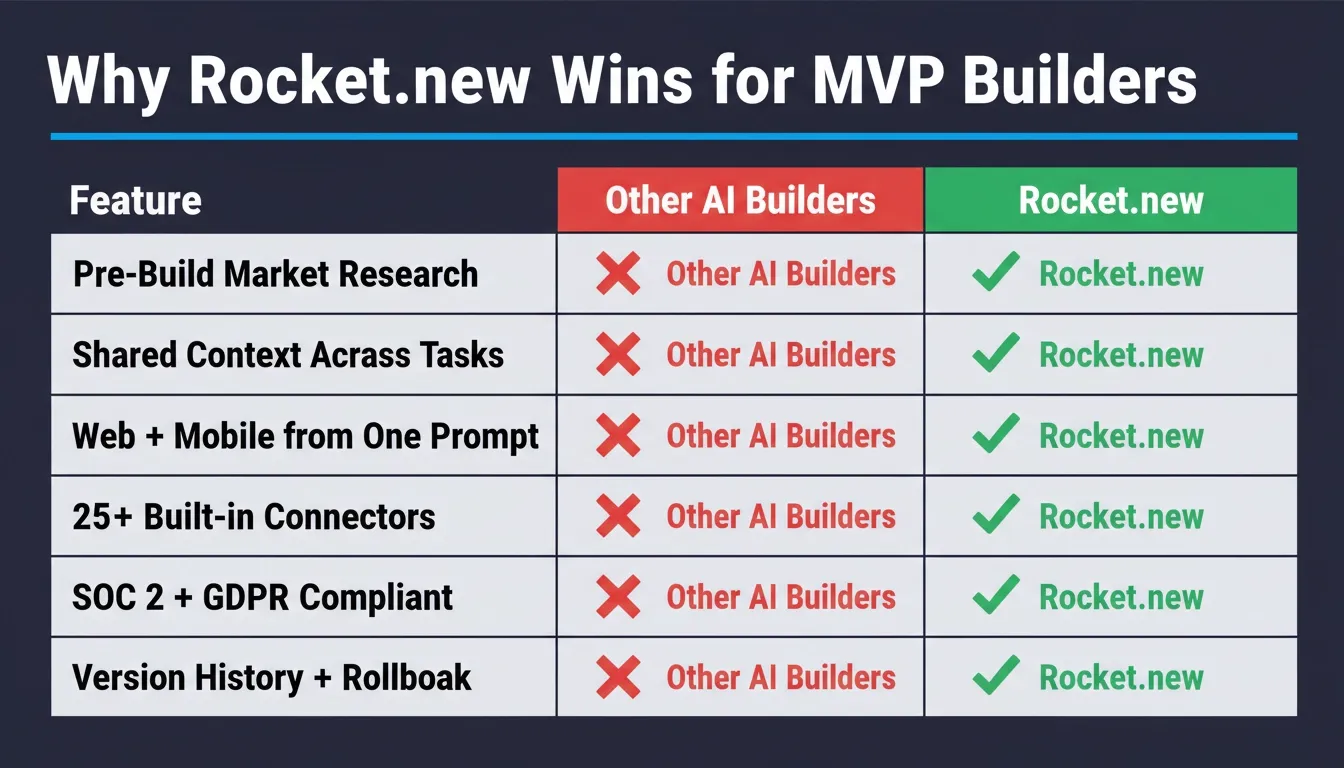 Rocket.new vs other AI builders across the features that matter most for MVP development.
| Capability | Lovable / Bolt / v0 | Rocket.new |
|---|---|---|
| Pre-build market research | No | Yes, Solve capability |
| Shared context across tasks | No | Yes, compounds automatically |
| Production-ready output | Varies | Yes, every build |
| Technology stack selection | Manual | Automatic (Next.js / Flutter) |
| Company and market intelligence | No | Yes, Intelligence capability |
| Human support inside platform | No | Yes, team steps in when AI reaches its limit |
| Redesign existing sites | No | Yes, slash command support |
| SOC 2 / GDPR compliance | Varies | Yes, built in by default |
Other builders build what you tell them to build. Rocket.new figures out what is worth building, then builds it.
See a full breakdown in the Rocket.new vs Lovable comparison to understand where each platform fits.
Build Your MVP This Weekend: What Actually Matters
Most founders overcomplicate the minimum viable product. They hire software engineers before talking to a single potential customer. They spend months writing code before testing their core assumptions. They build complex systems when all they needed was a prototype with three core features.
The cheapest way to build an MVP this weekend with Rocket.new is to skip all of that. Define your one user, your one problem, and your 3 to 5 core features. Use a platform that gets you from a plain language description to a live, production-ready app in minutes. Then put it in front of real users before the weekend is over, and let their feedback tell you what to build next.
The founders who win are not the ones who built the most. They are the ones who learned the fastest. If you want to go deeper on what to build and why, the Rocket.new Build page shows exactly what the platform produces from a single prompt. And if you are still in the idea stage, the Solve capability helps you validate your direction before writing a single line of code.
Ready to build an MVP this weekend without a development team or a five-figure budget? Start building on Rocket.new for free and go from idea to live product before Monday.
Table of contents
- -What Is a Minimum Viable Product (And What It's Not)
- -The Version Most Founders Build (And Why It Goes Wrong)
- -Why Most MVPs Cost Too Much (And Take Too Long)
- -The Real Numbers: MVP Development Cost Across Build Approaches
- -What Actually Eats the Budget: Hidden Costs and Pre-Development Costs
- -The Weekend MVP Playbook: Build an MVP in 48 Hours
- -Saturday Morning: Get Clear on Core Features
- -Saturday Afternoon: Build Your Prototype Using No Code and Low Code Tools
- -Sunday: Put It in Front of Early Users
- -The Technology Stack Problem for Non-Technical Founders
- -Ready for Liftoff: Build Your MVP on Rocket.new
- -Describe, Generate, Launch: Here's the Exact Flow
- -Features That Matter Most for MVP Builders
- -How Rocket.new Compares to Other AI Builders
- -Build Your MVP This Weekend: What Actually Matters