
Same.dev works for quick UI cloning, but falls short on backend, deployment, and mobile. This blog compares ten AI-powered development platforms to help developers and founders find the right fit for production-ready apps.
Why Are Developers Searching Beyond Same.dev?
Same.dev built a solid reputation for fast UI replication and generating clone websites from text prompts. However, when projects demand backend logic, database handling, authentication, and production deployment, the output often falls short.
According to the 2025 Stack Overflow Developer Survey, 84% of developers now use AI tools in their development workflow. With adoption at that level, the standard for what an AI builder must deliver has risen sharply.
The question is no longer "can AI build something?" It is "can it build the right thing, the right way, and ship it?" For developers and teams building full stack apps with real users, these gaps push them toward top-rated AI app builders that handle the complete lifecycle.
Why Do Developers Switch from Same.dev?
Same.dev works well for quick clone projects and frontend pages from screenshots. The friction starts when you need more than a starting point.
-
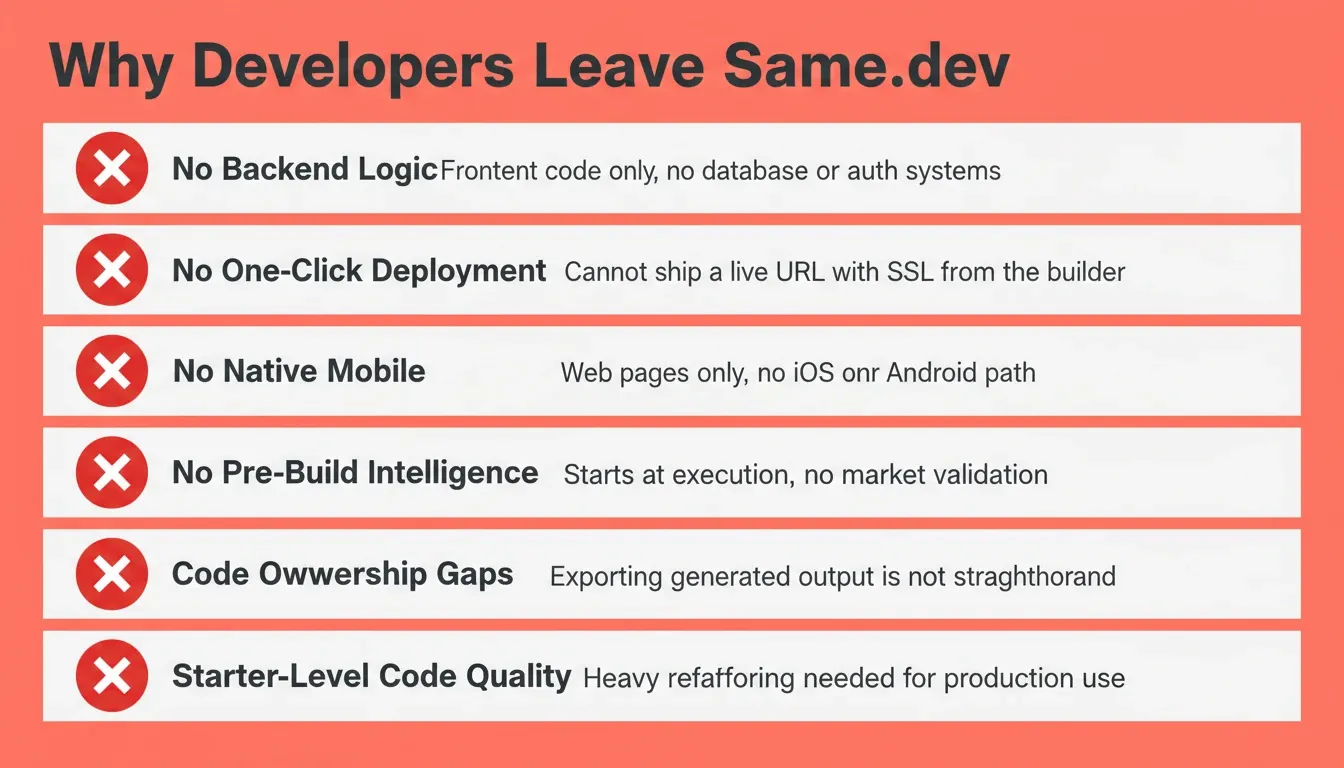
Limited backend logic: Frontend code only, with no database structure, auth systems, or API services
-
Code ownership concerns: Exporting and iterating on generated output is not straightforward for teams
-
No one-click deployment: No live URL with hosting, SSL, or custom domain from within the builder
-
Starter-level code quality: Generated code requires heavy refactoring for production use
-
No native mobile: Web pages only, with no path to iOS or Android applications
-
No pre-build intelligence: Same.dev starts at execution with no mechanism to validate whether what you are building is worth building
The Difference Between Vibe Coding and Vibe Solutioning
Before comparing platforms, one distinction separates the tools on this list into two fundamentally different categories.
Vibe coding tools such as Same.dev, Lovable, Bolt.new, and v0 answer "how do I build this?" You arrive with an idea and they execute it. They are fast and capable at the build step.
Vibe Solutioning answers "what should I build, and why?" It starts before the first prompt, with strategic intelligence that validates your idea, maps the competitive landscape, and informs what gets built. Then it executes the build. Then it monitors what happens after you ship.
Knowing which category you need is the most important decision before choosing a tool. Rocket is the only platform on this list that operates as a Vibe Solutioning platform. Every other tool here is a vibe coding tool, capable at execution but silent on strategy.
Which Are the Best AI-Powered Platforms to Consider?
Here are 10 platforms that stand stronger than Same.dev across code control, full stack output, deployment, and design quality. Your right choice depends on your technical experience, project scope, and speed requirements.
1. Rocket — Best for Full Stack Production Apps with Built-In Intelligence
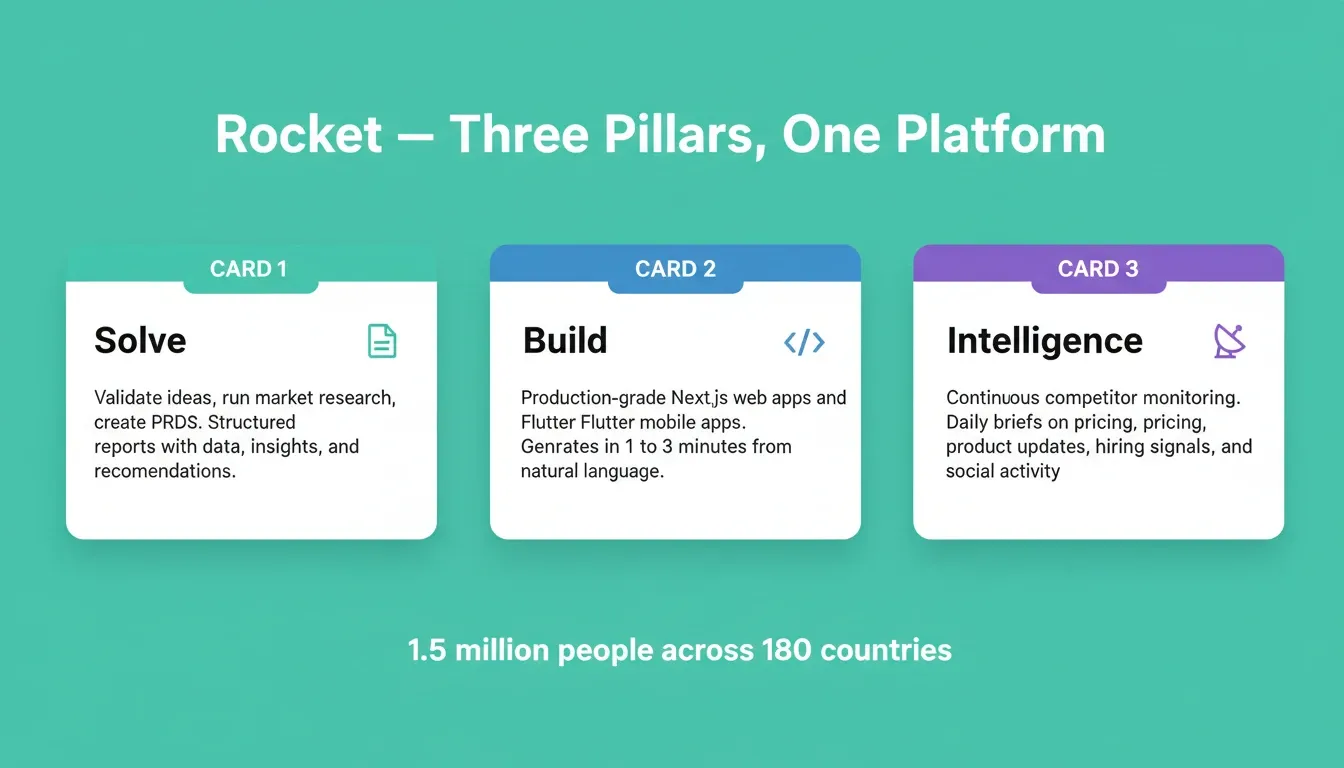
Rocket is the world's first Vibe Solutioning platform. It combines three pillars in one workspace: Solve (strategic research and market validation), Build (production-ready app generation), and Intelligence (continuous competitor monitoring). 1.5 million people across 180 countries have tried Rocket, backed by Salesforce Ventures and Accel.
Unlike every other tool on this list, Rocket does not start from a blank prompt. It begins by analyzing your market, competitors, and user needs through Solve before generating a single line of code. As a result, the product fits your audience from launch day, not after weeks of iteration.
What Rocket builds:
-
Web apps in Next.js (SaaS dashboards, internal tools, marketplaces, customer portals)
-
Mobile apps in Flutter (iOS and Android, submitted directly to App Store and Google Play)
-
Landing pages, multi-page websites, and e-commerce stores
-
Internal tools, compliance systems, investor data rooms, and business infrastructure
Key capabilities (verified from official docs):
-
Solve: Validate ideas, run market research, create PRDs, and get structured reports before building
-
Build: Production-grade Next.js and Flutter generation from natural language, Figma files, or existing GitHub repos
-
Intelligence: Continuous competitor monitoring across websites, social, news, reviews, and hiring signals
-
Redesign: Eight slash commands to reimagine any existing website without starting from scratch
-
26+ integrations: Stripe, Supabase, Google Analytics, Notion, Linear, Airtable, Mailchimp, Mixpanel, and more, authenticated once and flowing into every build
-
Built-in analytics: Visitors, conversions, Core Web Vitals, with zero setup required
-
Staging and production environments with full version history and one-click rollback
-
WCAG accessibility, GDPR coverage, and SEO-ready structure shipped as defaults, not extras
-
GitHub two-way sync for version control and team collaboration
-
Team collaboration: Three-level role-based access (Owner, Editor, Viewer), per-user credit allocation, unified billing
What makes Rocket different: The compound context architecture. Add your research, strategy docs, and competitive briefs to a Project once. Every task that follows, including every build, every Solve report, and every iteration, inherits that context automatically. Nothing is re-explained. Everything compounds.
You can build a full stack app from a single prompt and have it deployed with a live URL, auth, and database in minutes.
| Pricing | Credits | What's Included |
|---|---|---|
| Free | 20 (one-time) | Build production-ready web apps and mobile apps |
| Pro at $25/mo | 100/month | Build production-ready web apps and mobile apps |
| Rocket at $50/mo | 250/month | Build plus Solve plus Intelligence |
| Booster at $250/mo | 1,500/month | Build plus Solve plus Intelligence, SSO, and premium support |
-
Best for: Founders, product teams, and agencies who want to validate, build, and monitor from one platform
-
Limitation: More capable than most teams need on day one; free tier is a one-time credit grant, not ongoing
2. Lovable — Best for Non-Technical Founders Building MVPs Fast
Lovable generates React-based applications with a Supabase backend. It suits non-technical users building MVPs fast, with a clean chat-based interface and quick iteration speed. The platform offers code ownership with GitHub sync and handles authentication setup automatically.
Lovable is a vibe coding tool. It builds what you tell it to build. If you already have strong conviction about your idea and just need to ship fast, it is a strong choice.
| Pricing | Credits | What's Included |
|---|---|---|
| Free | 5 credits/day | Web app generation, Supabase backend |
| Pro at $25/mo | 250 credits/month | GitHub sync, full code ownership |
-
Best for: Non-tech founders validating SaaS ideas quickly
-
Limitation: Web-only; no mobile output; no pre-build intelligence layer
3. Bolt.new — Best for Developers Who Want Framework Flexibility
Bolt.new is a browser-based dev environment. It gives developers direct code access across multiple frameworks including React, Vue, Svelte, and Astro. It works well for technical teams who want AI assistance while keeping manual control over edits, styles, and architecture decisions.
| Pricing | Allocation | What's Included |
|---|---|---|
| Free | 300K tokens/day | Multi-framework browser IDE |
| Pro at $25/mo | 10M tokens/month | Extended usage, same features |
-
Best for: Developers needing framework flexibility with code control
-
Limitation: No deployment included; no backend generation; no mobile
4. Replit — Best for Scaling MVPs with an AI Agent
Replit is an AI coding agent inside a cloud IDE. It supports multiple languages including Python, JavaScript, and Go. Its Agent handles debugging, iterating, and background tasks autonomously. It works well for scaling MVPs into production apps with real users.
| Pricing | Credits | What's Included |
|---|---|---|
| Free | Limited agent credits | Cloud IDE, multi-language |
| Pro at $20/mo | Usage-based | Autonomous agent, deployment |
-
Best for: Developers scaling apps to production with AI agent help
-
Limitation: Requires more technical knowledge; no pre-build research layer
5. v0 by Vercel — Best for Frontend UI Generation
v0 is a generative AI tool by Vercel. It creates polished, production-ready React and Tailwind components from text prompts. It works best for frontend-focused generating of layouts, pages, and interactive UI, with excellent design output and fast deploy to Vercel hosting.
| Pricing | Credits | What's Included |
|---|---|---|
| Free | $5 credits/month | React/Tailwind component generation |
| Pro at $30/mo | Expanded usage | Vercel deployment, extended credits |
-
Best for: Frontend developers and designers prototyping UI fast
-
Limitation: Frontend only; no backend, no database, no mobile
6. Cursor — Best for Professional Developers in Their IDE
Cursor is an AI-powered IDE forked from VS Code. It embeds AI natively into the coding workflow, understands your entire codebase, and assists with refactoring, navigation, and generating code in context.
Cursor is excellent at coding. It is not a pre-build intelligence layer. If the thinking is already done, Cursor is powerful. If the direction is still uncertain, it is the wrong starting point.
| Pricing | Credits | What's Included |
|---|---|---|
| Free | Free tier | AI code completion, codebase understanding |
| Pro at $20/mo | Expanded usage | Advanced models, more completions |
-
Best for: Professional developers who want AI-assisted coding in their IDE
-
Limitation: No deployment, no hosting, no pre-build research, no mobile
7. Base44 — Best for Complete Beginners Who Want Zero Configuration
Base44 handles every aspect of app building out of the box, from database and authentication to hosting and deployment. It removes setup decisions entirely. Users go from prompt to working app with minimal friction. Its Discuss Mode helps brainstorm before generating.
| Pricing | Credits | What's Included |
|---|---|---|
| Free | 25 credits/month | Full-stack app generation, hosting |
| Pro at $25/mo | 100 credits/month | Extended usage, all features |
-
Best for: Complete beginners who want zero-config app creation
-
Limitation: Limited to simpler apps; no mobile; no competitive intelligence
8. FlutterFlow — Best for Native Mobile App Development
FlutterFlow is a visual app builder that generates native mobile applications using Flutter. It includes AI-generated UI, drag-and-drop editing, and direct deployment to app stores. It works well for teams building true native iOS and Android apps with visual control.
| Pricing | Allocation | What's Included |
|---|---|---|
| Free | Free tier | Visual builder, Flutter output |
| Pro at $30/mo | Full access | App Store deployment, advanced features |
-
Best for: Teams building native mobile applications with visual editors
-
Limitation: Mobile-focused; limited web output; no pre-build research
9. Emergent AI — Best for Complex Multi-Agent Workflows
Emergent AI uses a multi-agent orchestration layer to build, test, and refine software architectures. Powered by advanced LLMs, it handles complex workflows and backend logic for technical teams.
| Pricing | Credits | What's Included |
|---|---|---|
| Free | 10 credits/month | Multi-agent generation |
| Pro at $20/mo | 100 credits/month | Extended usage, complex workflows |
-
Best for: Technical teams building complex multi-agent workflows
-
Limitation: Steep learning curve; not suited for non-technical users
10. Dyad — Best for Privacy-First Local Development
Dyad is an open-source, local-first AI app builder for users who prioritize privacy and zero vendor lock-in. It runs on your machine (macOS or Windows) and lets you bring your own API key.
| Pricing | Allocation | What's Included |
|---|---|---|
| Free | BYO API key | Local-first, open-source, offline |
| Pro at $20/mo | Pro models | Access to premium AI models |
-
Best for: Privacy-focused builders who want local, open-source tooling
-
Limitation: No managed hosting; no built-in deployment; requires technical setup
One tester on Banani's 2026 AI builder comparison noted: "Lovable and Bolt stand out for iteration speed, while Rocket and Replit lead on full stack depth." That community reference point aligns with what many builders find when they actually ship projects end to end.
How Do Pricing and Paid Plans Compare?
Pricing structures vary by tokens, credits, or flat monthly fees. Knowing what includes deployment, database, and auth matters before choosing a platform.
| Platform | Free Tier | Paid Plans (Starting) | Key Inclusion |
|---|---|---|---|
| Same.dev | 500K tokens/mo | $10/mo (2M tokens) | No backend, no deploy |
| Rocket | 20 credits (one-time) | $25/mo (Pro) | Full stack, deploy, Solve, Intelligence |
| Lovable | 5 credits/day | $25/mo (250 credits) | Web-only, Supabase backend |
| Bolt.new | 300K tokens/day | $25/mo (10M tokens) | Multi-framework, no deploy |
| Replit | Limited agent credits | $20/mo usage-based | Multi-language IDE |
| v0 (Vercel) | $5 credits/mo | $30/mo | Frontend only, Vercel deploy |
| Cursor | Free tier | $20/mo | IDE only, no hosting |
| Base44 | 25 credits/mo | $25/mo (100 credits) | All-in-one, simple apps |
| FlutterFlow | Free tier | $30/mo | Native mobile, app stores |
| Emergent AI | 10 credits/mo | $20/mo (100 credits) | Complex workflows |
For no-code builders for startups who need a complete package at a good price point, Rocket's $50/mo plan includes Solve research, Intelligence monitoring, full stack generation, and deployment. These are features that competitors charge extra for or do not offer at all.
What Should You Consider Before Choosing a Platform?
Your choice depends on what kind of project you are building, your technical experience, and how fast you need to launch. No single tool is the right answer for every situation. Planning ahead saves time and avoids costly rebuilds.
Speed vs. control: If you want fast pages with minimal edits, tools like Same.dev or v0 work well enough. If you need full control over output and iterating flexibility, Rocket or Bolt.new are stronger options.
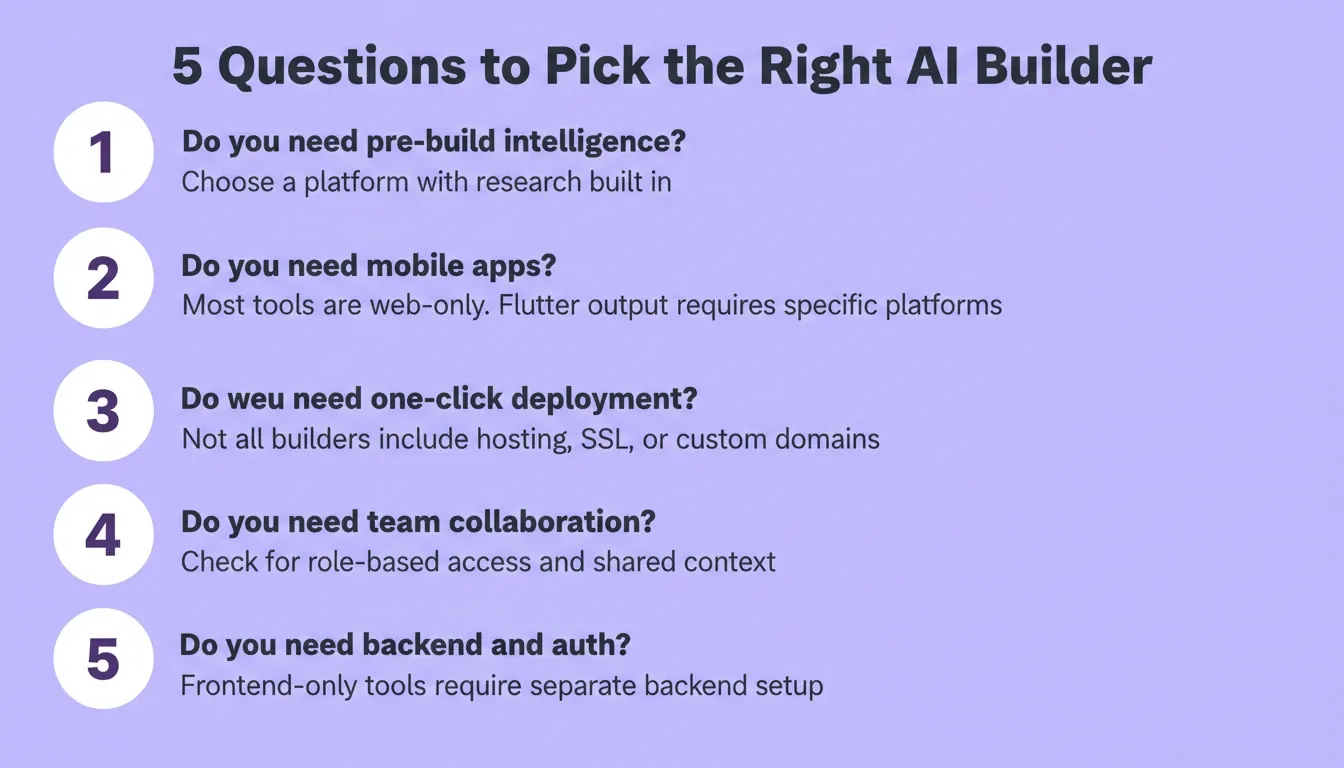
Do you need pre-build intelligence? If you are still figuring out what to build and whether the market is ready, you need a tool that starts before execution. Rocket's Solve pillar handles this. Every other tool on this list assumes you have already done that thinking.
Integrations and software support: Check whether the builder supports your database, auth provider, and payments gateway natively. Rocket connects 26+ services, including Stripe, Supabase, Google Analytics, Notion, Linear, and Airtable, authenticated once and flowing into every build.
Mobile and cross-platform: If your idea includes a mobile application, most web-only builders will not get you there. Learn how to build a mobile app with AI. Both Rocket and FlutterFlow generate native Flutter apps with direct App Store and Google Play submission.
Team collaboration: Check whether the platform supports shared workspaces, role-based access, and shared context. Rocket includes three-level role-based access, per-user credit allocation, and a compound context architecture. Every team member's work becomes available to every other task.
According to Flatlogic's 2026 comparison guide, nearly 70% of new applications will be built outside IT departments by 2026. Knowing your needs early helps you pick a platform suited to your workflow.
The Right Tool Starts with the Right Question
The best Same.dev alternatives in 2026 go well beyond UI cloning. Whether you need full stack generation, one-click deployment, native mobile apps, or pre-build market validation, the ten platforms in this guide cover the full range of what modern AI-powered development looks like.
As AI builders grow more capable, the gap between tools that only execute and platforms that also think before building will widen. The teams that ship products users actually want are the ones who start with the right question, not just the right prompt.
Start with Rocket.new — validate your idea with Solve, build a production-ready app, and monitor your market from day one.
Table of contents
- -Why Do Developers Switch from Same.dev?
- -The Difference Between Vibe Coding and Vibe Solutioning
- -Which Are the Best AI-Powered Platforms to Consider?
- -1\. Rocket — Best for Full Stack Production Apps with Built-In Intelligence
- -2\. Lovable — Best for Non-Technical Founders Building MVPs Fast
- -3\. Bolt.new — Best for Developers Who Want Framework Flexibility
- -4\. Replit — Best for Scaling MVPs with an AI Agent
- -5\. v0 by Vercel — Best for Frontend UI Generation
- -6\. Cursor — Best for Professional Developers in Their IDE
- -7\. Base44 — Best for Complete Beginners Who Want Zero Configuration
- -8\. FlutterFlow — Best for Native Mobile App Development
- -9\. Emergent AI — Best for Complex Multi-Agent Workflows
- -10\. Dyad — Best for Privacy-First Local Development
- -How Do Pricing and Paid Plans Compare?
- -What Should You Consider Before Choosing a Platform?
- -The Right Tool Starts with the Right Question