
This blog explores how Rocket.new leverages competitive intelligence as a foundation for building products, enabling sharper strategy, faster execution, and a distinct advantage in creating solutions that consistently outperform competitors.
What if your product build started with competitive intelligence, not guesswork?
You get sharper direction, faster decisions, and stronger results right from day one. Instead of building and then validating, you begin with clarity.
According to a report by McKinsey, companies that actively use data-driven insights are 23 times more likely to acquire customers and 19 times more likely to be profitable. That’s the power of combining competitive intelligence with smart execution.
This blog will help you understand how starting with competitive intelligence can shape better products, guide smarter decisions, and give you a real edge in your market.
Why Starting with Competitive Intelligence Changes Everything
Let’s keep it real. Most teams jump straight into building. They rely on instinct, a bit of market research, and some assumptions. Then they adjust later. That approach works sometimes, but it often leads to delays, rework, and missed opportunities.
But competitive intelligence flips that approach. Instead of guessing, you begin with clarity and direction.
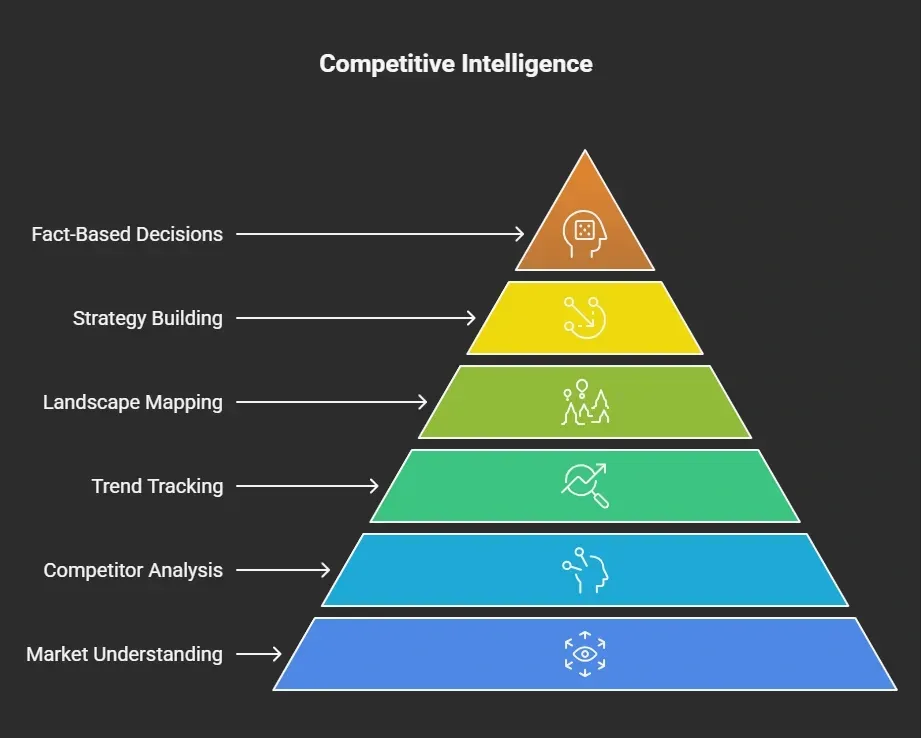 This approach helps competitive intelligence professionals and intelligence professionals build smarter systems. It supports better decision-making and gives teams the ability to stay ahead in a fast-moving market environment.
In simple terms, competitive intelligence is important for any company that wants real growth.
The Shift from Guesswork to Strategic Intelligence
Well, here’s where things get interesting.
Traditional market research focuses on customers. That’s useful. But it often misses what competitors are doing in real time.
Strategic intelligence and tactical intelligence bring a broader view. You’re not just collecting data. You’re analyzing data from multiple angles.
You look at:
-
Competitor websites
-
Press releases
-
Analyst reports
-
Industry reports
-
Social media monitoring
This mix gives you competitive intelligence data that leads to actionable insights.
And that’s where strategic competitive intelligence comes in. It connects everything. It helps inform strategic decisions that actually matter.
How Competitive Intelligence Supports Real Business Growth
So, what does this look like in action?
A solid competitive intelligence program helps teams:
-
Track market trends and industry trends
-
Understand competitor intelligence
-
Improve competitive positioning
-
Gain market share
It also helps the sales team perform better. They get relevant insights about products and services. They understand how competitors position their offers.
This means better pitches. Better conversations. Better results. And yes, competitive intelligence work directly impacts organizational performance.
Traditional vs Intelligence-First Build
There are two common ways teams approach building. One starts with assumptions, the other starts with competitive intelligence. The difference shows up pretty quickly.
| Approach | Starting Point | Result |
|---|---|---|
| Traditional Build | Idea + assumptions | Late corrections |
| Intelligence-First Build | Competitive intelligence + data analysis | Faster clarity |
You can see the difference. When you gather competitive intelligence early, your competitive strategy becomes sharper.
So the takeaway is simple. Start with the right information, and everything that follows becomes easier, faster, and more aligned with your goals.
What Makes Rocket.new Different?
Now let’s talk about Rocket.new.
Rocket.new takes this intelligence-first idea and makes it practical. It builds your product or workflow, starting with competitive intelligence analysis.
Instead of just coding or designing, it focuses on competitive intelligence research right at the start. That’s a big shift.
It means your product is shaped by:
-
Competitor analysis
-
Market insights
-
Customer data
-
Emerging technologies
This helps teams build with purpose. It also supports the overall business strategy and company's strategic planning.
How Rocket.new Works
So, how does it actually work?
Rocket.new follows a simple but powerful flow. It’s not just about building apps. It’s about turning ideas into working products using a structured system that fits perfectly with a competitive intelligence framework.
According to the official docs, the process follows a loop: describe → build → refine → ship .
Let’s break that down in a way that connects with how teams actually think and work.
Step 1: Describe
Everything starts with your idea.
You simply describe what you want to build. This can be:
-
A text prompt
-
A Figma design
-
Atemplate
-
Even a screenshot
Rcket.new then turns that input into a full app structure.
From a competitive intelligence point of view, this is where collecting data and shaping direction begins. You already bring in:
-
Insights from competitor websites
-
Ideas from press releases
-
Signals from social media monitoring
-
Inputs from industry experts
So your build doesn’t start empty. It starts informed.
Step 2: Build
Next, Rocket.new generates a complete app.
This includes:
-
UI screens
-
Backend logic
-
Database setup
-
Integrations
You don’t just get a mockup. You get a working product.
At this stage, your competitive intel and market understanding shape the structure. You’re not guessing features. You’re aligning them with:
-
Market trends
-
Competitor strategies
-
Market opportunities
Step 3: Refine
Now comes the iteration phase.
You can:
-
Tweak features
-
Fix issues
-
Adjust design
-
Add integrations
All through simple prompts or visual editing. This is where analyzing data plays a role.
You refine based on:
-
User feedback
-
Competitor analysis
-
Shifts in market dynamics
This step supports better strategic decisions and smarter decision making.
Step 4: Integrate
Then you connect your app to real tools and services.
Rocket.new can hook into:
-
Payment systems like Stripe
-
Databases like Supabase
-
APIs and AI tools
This step turns your app into something functional and scalable.
From a strategic intelligence angle, this is where your product starts aligning with real-world products and services and business needs.
Step 5: Ship
Finally, you publish.
You can:
-
Launch on the web
-
Connect a custom domain
-
Submit to app stores
And yes, this can happen in minutes instead of weeks.
This is where your competitive intelligence activities translate into actual output. Your product enters the market with clarity and purpose.
How It All Connects
Rocket.new doesn’t just help you build faster. It helps you build smarter.
It connects:
-
Tactical intelligence during building
-
Strategic insights during planning
-
Competitive intelligence activities throughout the process
So instead of building first and thinking later, you think first and build with direction. That’s the real difference between competitive intelligence (CI) and product execution.
Key Features of Rocket.new
Rocket.new is designed to support teams that want to build with clarity, not guesswork. Its features are built around competitive intelligence, helping teams stay informed, aligned, and ready to act.
Let’s break it down:
-
Built-in competitive intelligence tools
-
Continuous competitive intelligence efforts
-
Early warning systems for changes
-
Strong focus on market intelligence
-
Support for the competitive intelligence manager and teams
It also supports:
-
Primary research
-
Competitive benchmarking
-
Collecting data and analyzing data
This makes it useful for both startups and larger teams.
Rocket.new gives you the structure and support to turn insights into action, making your build process smarter, faster, and more aligned with real market needs.
Why Sales Teams Love This Approach
Your sales team benefits a lot here.
They get access to competitive information that helps them stay ahead. They can understand how competitors position products and services.
They also get insights from:
-
Competitor websites
-
Press releases
-
Social media monitoring
This helps them:
-
Close deals faster
-
Adapt marketing strategies
-
Improve competitive edge
A strong competitive intelligence program supports the sales team at every step.
Community Insight
Here’s something interesting from Reddit:
“We stopped building blindly and started tracking competitors weekly. It changed how we planned features and pricing.”
This shows how competitive intelligence activities can reshape a company’s operations.
Competitive Intelligence in Action
Let’s connect all of this. When companies invest in competitive intelligence work,
they:
-
Understand the competitive environment better
-
Identify emerging market opportunities
-
Track market share changes
-
Adapt faster to technological advancements
They also avoid ethical concerns by using proper methods like public data and primary research. This builds trust while still delivering relevant insights.
How It Connects Back to the Title
The idea of competitive intelligence is not just theoretical. It’s exactly how Rocket.new is designed to work.
Here’s how Rocket.new connects to that idea:
-
It treats competitive intelligence as the starting point, not an afterthought
-
It builds on strategic competitive intelligence instead of assumptions
-
It links insights directly to the product-building process
-
It turns competitive intel into real features and decisions
This approach changes how teams think. You’re not just building and then checking what competitors are doing. You’re building with that knowledge from the start.
It’s not just another tool. It’s a system built around competitive intel, helping you move with clarity and purpose right from the first step.
Competitive Intelligence as the Starting Point
Many teams still rely on assumptions. They build first and adjust later, which often leads to wasted time and missed market opportunities. This slows down progress and affects decision quality. Instead, starting with competitive intelligence gives clarity from the beginning. Using tools like Rocket.new helps you gather competitive intelligence, analyze it, and turn it into actionable insights before any real building starts.
When your process begins with the right information, your decisions improve naturally. Your sales team performs better, and your business growth becomes more stable. Keep it simple. Focus on clarity first, then execution. Let competitive intelligence guide the build.
Table of contents
- -Why Starting with Competitive Intelligence Changes Everything
- -The Shift from Guesswork to Strategic Intelligence
- -How Competitive Intelligence Supports Real Business Growth
- -Traditional vs Intelligence-First Build
- -What Makes Rocket.new Different?
- -How Rocket.new Works
- -Step 1: Describe
- -Step 2: Build
- -Step 3: Refine
- -Step 4: Integrate
- -Step 5: Ship
- -How It All Connects
- -Key Features of Rocket.new
- -Let’s break it down:
- -It also supports:
- -Why Sales Teams Love This Approach
- -Community Insight
- -Competitive Intelligence in Action
- -How It Connects Back to the Title
- -Here’s how Rocket.new connects to that idea:
- -Competitive Intelligence as the Starting Point