
Rocket.new ingests competitive intelligence from the past 7 days to reshape feature priorities in real time. It scores competitor moves and maps them directly to your product backlog for faster execution. This weekly cycle helps teams stay ahead by building what matters most in a rapidly changing market.
What happens when competitors ship something new on Tuesday, and your company does not find out until next quarter?
Companies that actively use data-driven insights are 23 times more likely to acquire customers and 19 times more likely to be profitable, highlighting the importance of competitive intelligence in business strategy.
Rocket.new ingests competitive intelligence every seven days and reorders which features get built that same cycle. It connects what happened in your competitive environment recently to what your team ships next.
This article walks through the process, from signal collection to reprioritized backlog to shipped code on the platform.
What Prior-Week Competitive Intelligence Looks Like Inside Rocket.new
-
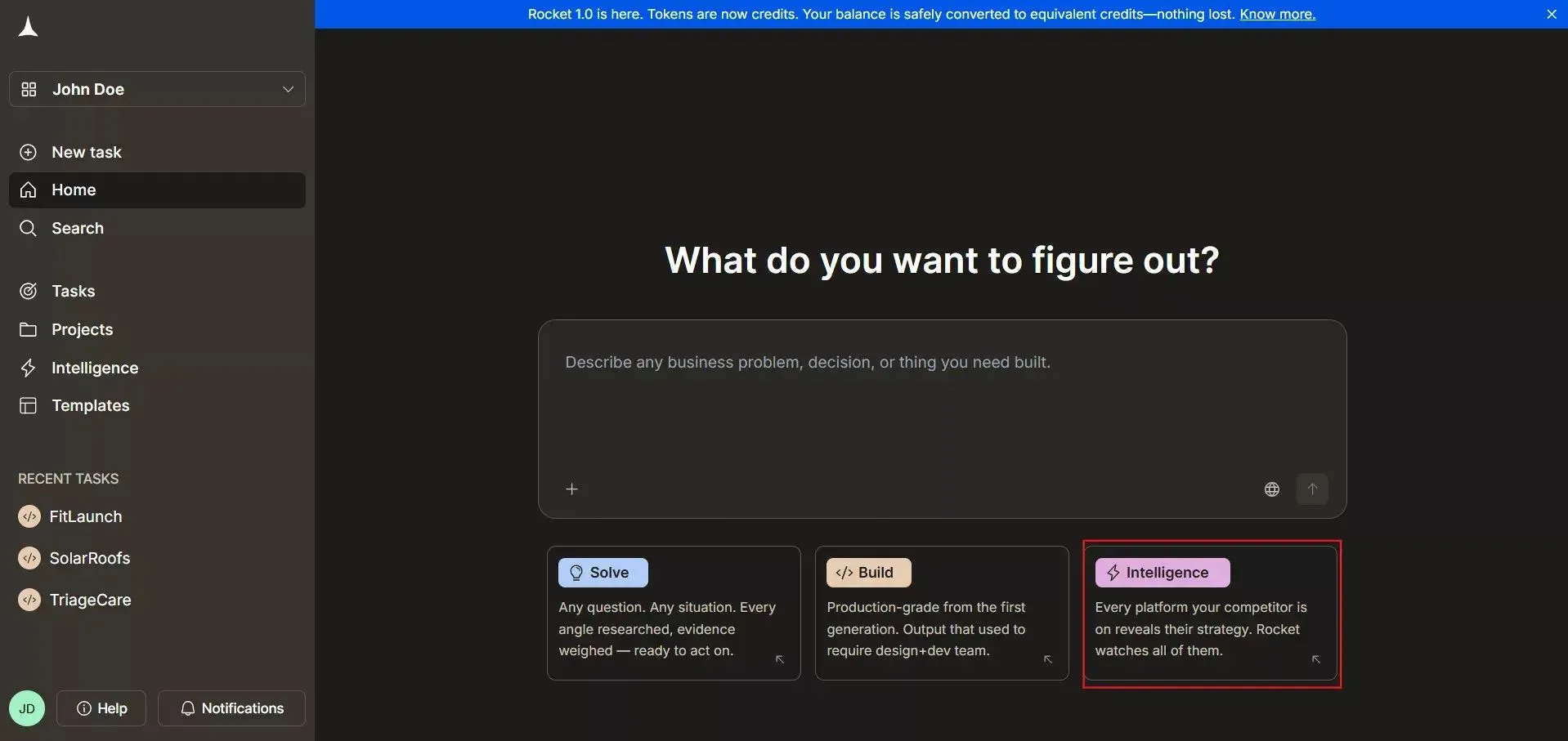
Rocket.new's Intelligence monitors competitor websites, pricing pages, and market positioning continuously.
-
Solve runs research on high-impact findings.
-
Build executes on the highest-priority items.
When a competitor changes course on their website, the platform surfaces that move and maps it to your roadmap. How competitive intelligence from the prior week enters the system makes all the difference in the world.
A rival launches a free tier on April 8, so Rocket prioritizes pricing models experiments for customers. Another company announces a Salesforce integration on April 10, pushing CRM project work to the top of the team's list.
Market positioning shifts appear in new landing pages, triggering onboarding workflow changes.
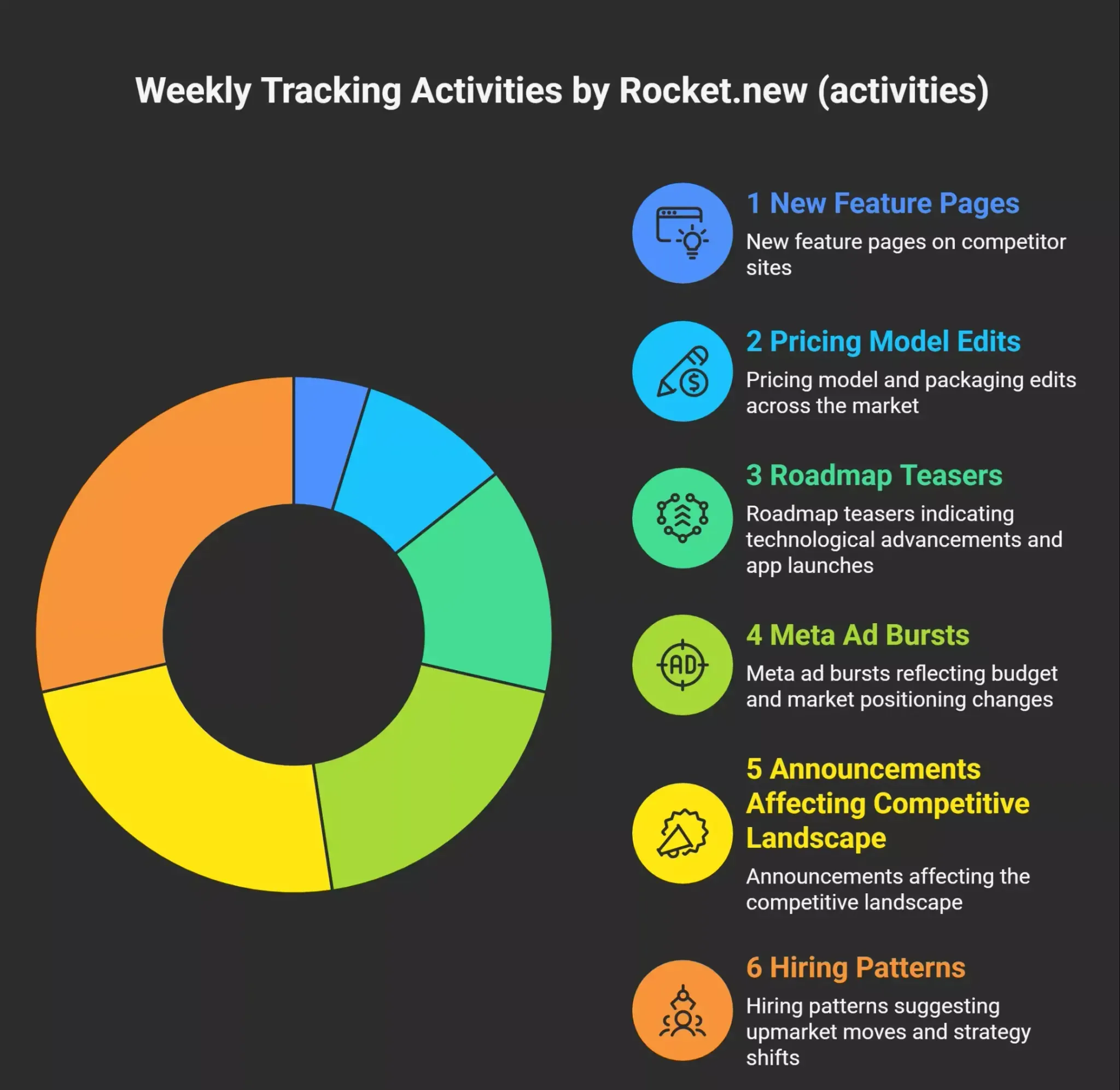
What the System Tracks Every Seven Days
-
New feature pages on competitor sites and market findings.
-
Pricing models and packaging edits across the market.
-
Roadmap teasers indicating technological advancements and app launches.
-
Meta ad bursts reflecting budget and market positioning changes.
-
Announcements affecting the competitive landscape.
-
Hiring patterns that suggest upmarket moves and strategy shifts.
Why Last Period's Competitive Intelligence Matters More Than Quarterly Reviews
Modern SaaS markets move fast. Quarterly roadmapping leaves your company reacting to moves competitors made months ago, which costs both customers and market positioning over time.
Industry experts agree that limited quarterly cycles create blind spots in a world where competitors launch daily.
-
Rocket.new uses a competitive intelligence window to directly change this cycle's build plan. Data-driven insights from the past seven days flow into Monday planning.
-
Data-driven organizations outperform peers. What your team learned recently should shape what you create next.
A solid competitive intelligence program helps teams track market trends, understand competitor intelligence, and improve competitive positioning, which can lead to increased market share.
Success in fast-moving markets depends on how competitive intelligence reaches your team before competitors gain ground.
From Raw Signals to a Ranked Feature List
Competitive intelligence involves monitoring competitor websites, press releases, analyst reports, industry reports, and social media to gather actionable insights that inform strategic decisions.
In Rocket, Intelligence monitors competitor websites, pricing pages, changelogs, and app store listings. It creates reports from market data and uses research capabilities to identify patterns across the competitive landscape.
-
Entries normalize into a change log per competitor.
-
Each entry gets scored on impact and relevance to target customers.
-
Significant results trigger Solve tasks for deeper review and analysis.
-
Recent market changes map to the backlog with strategy context
The scoring formula: impact times urgency times differentiation gap.
The Prioritization Flow
-
Monitor: Track competitors across channels.
-
Summarize: Aggregate seven days into a findings report
-
Score: Rate each entry on impact and analysis.
-
Map to Backlog: Connect results to project work.
-
Reprioritize: Reorder this cycle's build plan
How Prior-Week Moves Reorder Current Priorities
-
Example 1: On 7 April 2026, a competitor launches an AI onboarding assistant. Rocket.new gives priority to guided setup flows for the same period.
-
Example 2: On 10 April 2026, a competitor's website adds usage-based pricing models. Rocket reorders the backlog for metering and comparison tools.
-
Example 3: Industry experts publish detailed product strategy documents on enterprise expansion. Rocket.new launches competitive intel reviews and gives priority to compliance features.
The system does not copy competitors. It focuses on solutions that differentiate: deeper insights, tighter integration, or new category-defining features for customers. The value of competitive intelligence lies not in imitation but in positioning your product-building strategy ahead of the market.
Inside the Describe-Intelligence-Solve-Build-Refine-Ship Loop
Rocket.new cycles through: Describe, Intelligence, Solve, Build, Refine, Ship. This loop ties competitive intelligence to product creation at the workspace level.
How competitive intelligence shapes each stage matters for the whole team.
-
Rocket checks competitive research before writing code.
-
Every product idea in Build is compared against the latest competitor state.
-
When the competitive intelligence from the recent period is significant, users launch a Solve run and then feed the conclusions into their strategy.
-
The impact extends to features, pricing models, and collaboration on category creation.
Turning Last Period's Competitive Intelligence Into Monday's Plan
Monday morning at Rocket.new, the Intelligence dashboard shows findings from the last 7 days. Entries cluster by theme: pricing, features, positioning, connections. Customer research from the prior week appears alongside competitive intelligence in a single report. The operating model makes business sense for teams in any industry.
- Members mark "response candidates" for feature parity or category-defining moves. Rocket auto-suggests items with summary cards, impact scores, and strategy notes
Mid-Sprint Reprioritization When New Competitive Intelligence Arrives
If Intelligence picks up a high-impact update mid-cycle, Rocket.new nudges users to swap lower-impact tasks. The Detect-Analyze-Ship workflow allows rapid response without derailing the broader strategy. Teams operating in limited-resource environments value this approach because it protects long-term build plans.
- Quick wins include copy changes, sales enablement updates, and onboarding improvements. Cards show context and findings: "Flagged based on April 11 pricing change at Rival B."
Concrete Feature Areas Affected by Prior-Week Competitive Intelligence
| Feature Area | Example Prior-Week Signal | Priority Shift |
|---|---|---|
| Integrations | Competitors announce HubSpot connection | Deeper CRM tools given priority |
| Pricing and Packaging | A competitor cuts the entry price | Trial experiments, feature-gated plans |
| Onboarding | A competitor launches a guided setup app | Template curation, AI starter solutions |
| Reporting | Competitor launches new dashboards | CI dashboard revamps, early warning widgets |
When users open Rocket.new on Monday, they see "suggested moves" shaped by last period's competitive landscape and market findings. Simple prompts guide users toward newly prioritized items and show which competitor update triggered each one. Users choose from three strategic response types: Fast-follow to match a competitor feature, Leapfrog to differentiate, or Ignore to record rationale for non-response.
Balancing Reactivity With Long-Term Strategy
-
Assign weight to strategy themes (e.g., "CI automation" over "UI polish"). Prior-week competitive intelligence affects priorities in areas that matter, not every detail
-
Lock epics for 4 to 6 cycles while smaller items shift on shorter cadences. Refresh competitive research quarterly to maintain current knowledge in a changing world
How Rocket.new Turns Competitive Intelligence Into Shipped Code
The platform routes competitive intelligence through three products working together, so your team never builds in a vacuum. Research capabilities and competitive insights feed into every build cycle. The value for teams with limited resources is that competitors' moves become your next project.
-
Vibe-solutioning platform: Describe what you want, and Rocket generates production-ready apps for customers
-
25k+ templates, free to use: Reduce token consumption by up to 80%. Flutter (mobile) and Next.js (web): Ship production-ready code from one system
-
Collaboration built in: Your team shares insights and co-builds together. Solve, Build, Intelligence: Three products, one platform
Real use cases show the connection: a company sets up Intelligence for five competitors, gets a report, and reprioritizes every Monday. An industry group uses Solve to review a competitor's landing pages, then starts a differentiated experiment.
Community Take
"Competitive Intelligence is not tracking press releases or reacting to lost deals. Real CI is about anticipation, not reaction. It answers: Where will competitors place their next bet, before it's visible?" - Hiren Sheth, LinkedIn
This matches how Rocket.new operates. Intelligence surfaces competitor moves, scores them, and feeds competitive insights into your next creation cycle. Teams that understand competitor strategy before those moves become visible gain a lasting advantage in their industry.
Operationalizing Prior-Week Competitive Intelligence in Your Build
Rocket.new turns last period's market intelligence into this cycle's output.
-
Your team works with live competitive insights instead of stale plans on the platform. This operating model runs continuously across your company and scales to any industry.
-
Intelligence tracks competitors across channels. The digest highlights market changes in a structured findings report.
-
Solve deep dives and significant moves with analysis tools. The backlog reprioritizes based on research and positioning data.
-
Build and ship with a clear intent for customers
In fast-moving markets, teams that connect competitive intelligence to strategy stay ahead.
Set up Intelligence today! Watch how competitive intelligence transforms your business decisions into focused execution.
Set up Intelligence for 3 to 5 competitors in your sector, run for two weeks, then start your next build using those insights.
Table of contents
- -What Prior-Week Competitive Intelligence Looks Like Inside Rocket.new
- -What the System Tracks Every Seven Days
- -Why Last Period's Competitive Intelligence Matters More Than Quarterly Reviews
- -From Raw Signals to a Ranked Feature List
- -The Prioritization Flow
- -How Prior-Week Moves Reorder Current Priorities
- -Inside the Describe-Intelligence-Solve-Build-Refine-Ship Loop
- -Turning Last Period's Competitive Intelligence Into Monday's Plan
- -Mid-Sprint Reprioritization When New Competitive Intelligence Arrives
- -Concrete Feature Areas Affected by Prior-Week Competitive Intelligence
- -Balancing Reactivity With Long-Term Strategy
- -How Rocket.new Turns Competitive Intelligence Into Shipped Code
- -Community Take
- -Operationalizing Prior-Week Competitive Intelligence in Your Build