
The CI cycle turns competitor signals into decisions across five stages: planning, collection, analysis, dissemination, and feedback. Teams that run it continuously stay ahead of rivals instead of reacting to them. Rocket automates collection and dissemination so the cycle never breaks down.
Is your competitive intelligence actually driving decisions? Most companies track competitors in some form - scanning pricing pages, reading press releases, or maintaining a spreadsheet that goes stale by next quarter. But gathering signals is not the same as having a functioning CI program.
According to a Semrush survey of 100 marketers, 45% say the biggest benefit of competitive intelligence is understanding market trends and customer expectations.
Yet most teams never connect those insights to a real decision. The gap between companies that grow market share and those that react too late comes down to structure. CI done right runs as a repeating five-stage cycle where each pass produces sharper collection, better analysis, and faster decisions.
This blog breaks down every stage so you can build a program that actually changes how your organization competes.
The Five Stages of the CI Cycle
The CI cycle is a continuous loop, not a checklist you complete once. Each pass through produces better-targeted collection, sharper analysis, and faster decisions than the last.
| Stage | Purpose | Primary Input | Key Output |
|---|---|---|---|
| 1. Planning and Direction | Define what to track and why | Business strategy, open questions | Intelligence requirements |
| 2. Collection | Gather raw data from multiple sources | Websites, reviews, press releases, social, sales calls | Raw data pool |
| 3. Analysis | Convert raw data into intelligence | Patterns, comparisons, industry trends | Validated insights |
| 4. Dissemination | Deliver intelligence to decision makers | Finished analysis, reports | Briefings, alerts, battlecards |
| 5. Feedback and Reset | Evaluate what worked; sharpen requirements | Stakeholder input | Updated intelligence plan |
Each stage shapes the next. A vague planning stage produces unfocused collection. Poor analysis means insights reach teams too late or too generic to act on.
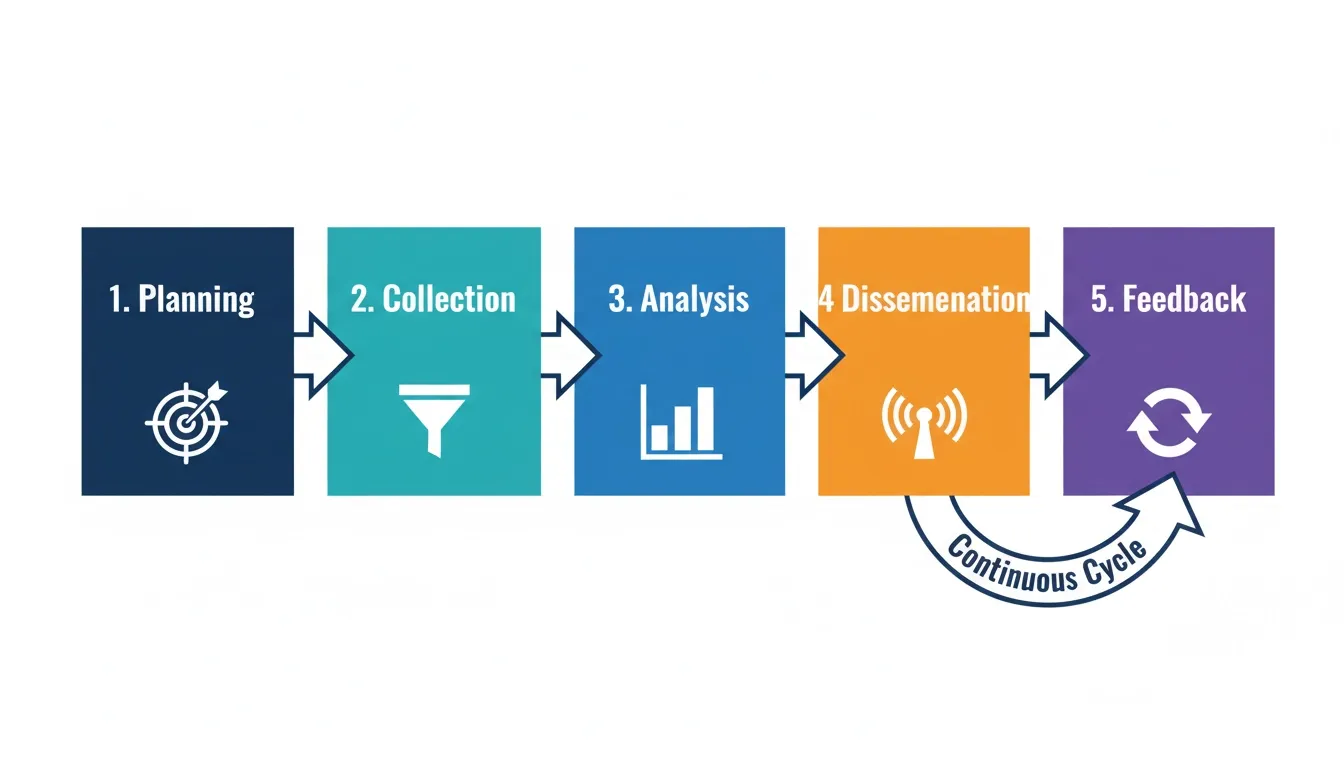 The CI cycle is a continuous loop. Each stage feeds the next, and the feedback stage sharpens the next round of planning.
Why CI is an ongoing process, not a project
The most common CI mistake is treating it like a sprint - launch a research project, publish a report, then move on. The market does not pause between your research cycles.
-
Pricing pages shift overnight and competitor product launches arrive without warning.
-
Job postings from a rival reveal a strategic investment months before any announcement confirms it.
-
A CI program running continuously catches signals as they emerge; a project-based approach catches them after they have already shifted your market position.
Ongoing CI is what separates organizations that anticipate competitors from those that react to them. The cycle structure is what makes that consistency achievable over time.
Stage 1: Planning and Direction
Every CI program starts here, and most CI problems start here too. Without clear direction, teams collect data nobody asked for and produce analysis nobody acts on.
-
The planning stage defines intelligence requirements - the specific questions your business needs answered to make better strategic decisions.
-
Good planning identifies which specific competitors deserve the deepest focus, rather than spreading effort across every rival in the category.
-
Most CI programs fail not because of poor collection tools but because requirements were never clearly defined in the first place.
The quality of the planning stage determines the quality of everything downstream. This is where competitive intelligence programs win or lose before any data gets collected.
Defining your intelligence requirements
Intelligence requirements are not topic areas. They are specific, decision-linked questions with a named owner.
-
"Track competitor activity" is not a requirement. "Identify Competitor X's product shipping timeline and assess its risk to our renewal rate this quarter" is.
-
A growth team asking where to focus the roadmap next quarter needs different sources and output formats than a sales team asking why they are losing competitive deals to a specific rival.
-
Competitive intelligence professionals who run strong programs invest more time here than in any other stage - because requirements determine what gets collected and what gets ignored.
This is the stage that separates CI programs that drive strategy from programs that produce slide decks nobody revisits.
For a deeper look at how to structure this work, see how to build a competitive intelligence program.
Who decides what to track?
The CI team cannot define requirements alone. The best programs gather input from every function that needs competitive insight before a single source gets monitored.
-
Sales leadership surfaces deal-level gaps - where they lack context when a competitor enters a conversation.
-
Product teams flag where they have no signal on rival roadmaps, shipping timelines, or hiring activity.
-
Marketing teams identify where positioning is being challenged in conversations with buyers and direct competitors in the field.
-
The CI team synthesizes these inputs into a prioritized plan, with leadership teams providing broader strategic context.
Getting stakeholder buy-in at the planning stage means CI findings are far more likely to influence real decisions when they land. Competitive intelligence professionals in well-run programs invest as much time here as on any collection work that follows.
Stage 2 Through 4: Collection, Analysis, and Dissemination
What sources do CI teams actually rely on?
Gathering competitive intelligence starts with knowing which sources match each requirement. Most CI programs draw from two distinct categories.
Secondary sources - publicly available, suited for continuous monitoring:
-
Competitors websites, pricing pages, feature announcements, messaging changes, and case studies
-
Press releases, annual reports, and financial statements
-
Industry publications and analyst reports
-
Customer reviews on G2, Capterra, and Trustpilot
-
Social media and online activity across LinkedIn, X, and Reddit
-
Job boards - open positions reveal where rivals are investing before any announcement confirms it
-
Trade shows and conference recordings
Primary research - direct data collection, best reserved for strategic questions secondary sources cannot answer:
-
Customer interviews and win-loss calls
-
Focus groups and surveys
-
Conversations with industry experts
The discipline is not in tracking more sources - it is in choosing the right ones for each intelligence requirement. Market intelligence about broader industry trends and overall market trends sits alongside competitor-specific data, but each answers a different question.
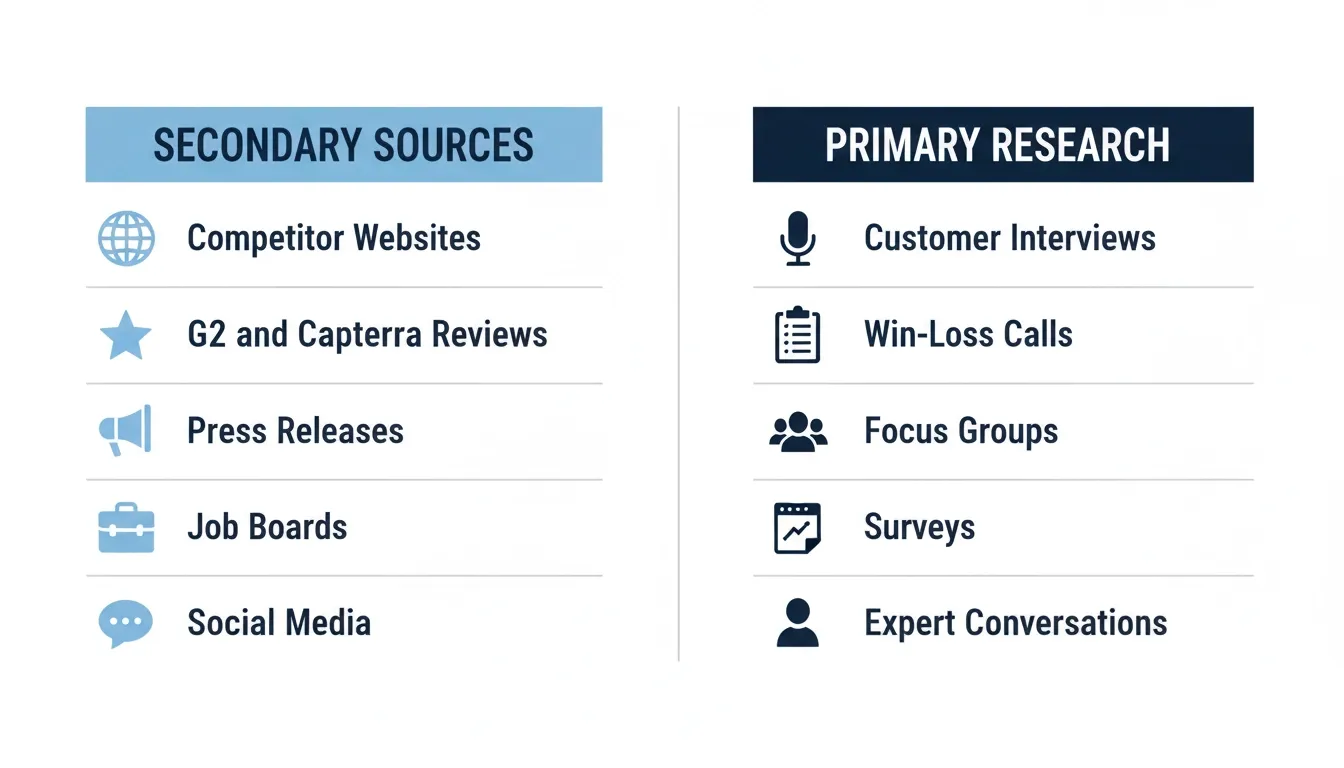
Secondary sources power continuous monitoring. Primary research answers strategic questions that public data alone cannot resolve.
The analysis step: turning raw data into intelligence
Analysis is where individual signals get cross-referenced and tested against your business context. Raw data is not intelligence - signal clusters are.
-
A competitor pricing page change is one signal. That same change plus enterprise-focused job postings, defensive review responses, and a messaging shift toward mid-market buyers is a finding worth acting on.
-
Common analysis methods: comparative analysis across pricing and features; strengths and weaknesses assessment of direct competitors; pattern detection across multiple sources; win-loss analysis tied to deal data.
-
The output should be honest and realistic recommendations - findings decision makers can act on without re-verifying the underlying competitive intelligence data themselves.
Credibility built in the analysis stage is what keeps stakeholders engaged with the next cycle and increases the competitive intelligence program's reach over time.
Understanding how to analyze, map, and visualize the competitive landscape is a critical skill at this stage.
Dissemination: who gets the intel and in what format?
Most CI programs break down here. Analysis is only valuable if the right people receive it in a format they can actually use.
-
Sales teams need battlecards, quick-reference summaries, and real-time alerts when specific competitors enter active deals.
-
Product teams need structured research reports with trend data, feature comparisons, and competitive analysis tied to roadmap decisions.
-
Leadership teams need concise strategic intelligence with clear, prioritized recommendations.
-
Competitive intelligence data buried in a long report or locked in a shared folder might as well not exist.
The dissemination stage is every bit as strategic as collection. Competitive intelligence activity that never reaches the right audience is expensive noise.
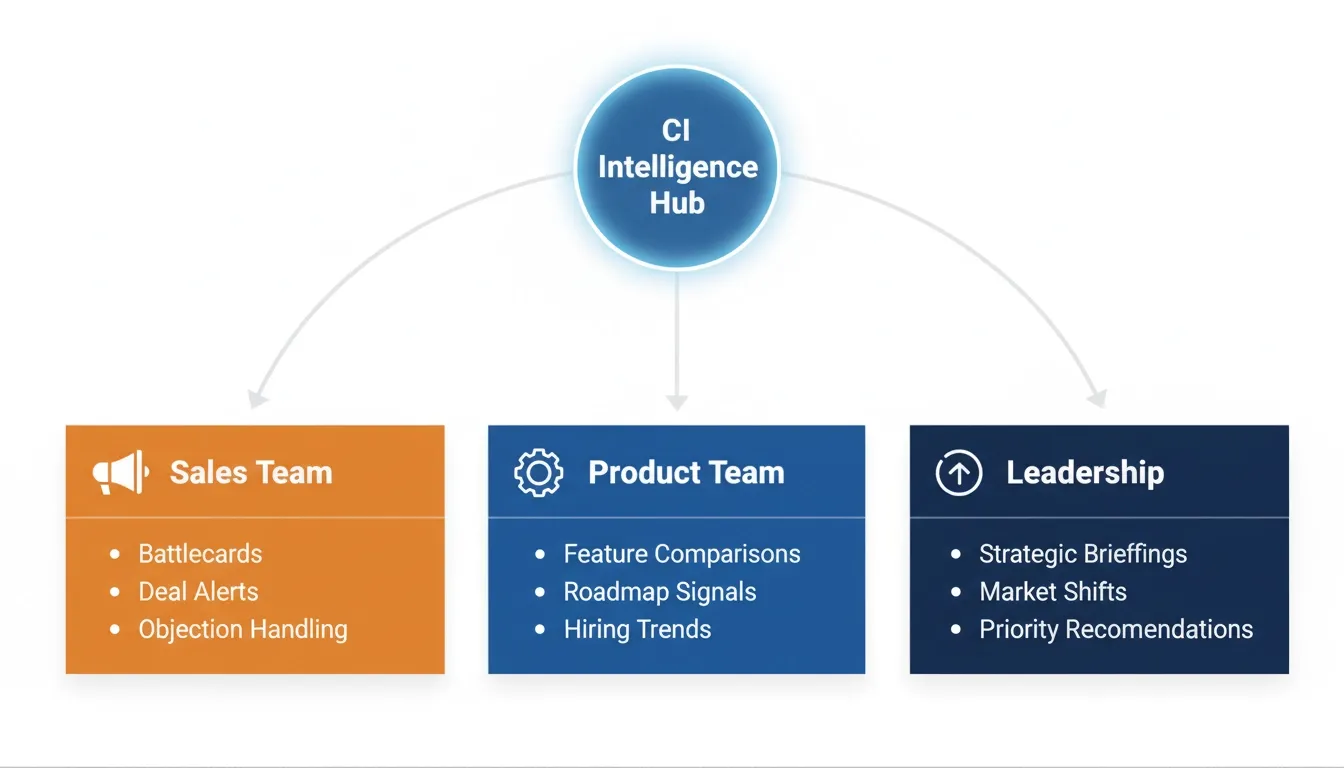 Effective dissemination means each team receives intelligence in the format they can act on - battlecards for sales, roadmap briefs for product, strategic summaries for leadership.
Why does most CI fail to reach the people who need it?
Two problems consistently block competitive intelligence from reaching the stakeholders who need it most. Neither is a data quality problem.
-
There is no clear owner for delivering intelligence to each audience, so findings get shared once and forgotten.
-
CI teams produce one-size-fits-all reports rather than tailored briefs for each function.
-
The fix: build a recurring delivery cadence per audience - weekly competitive alerts for sales, monthly deep-dives for product teams, quarterly strategic briefings for leadership.
Getting dissemination right is what turns a CI process from a reporting exercise into a genuine business function. This is where CI practitioners consistently report the greatest friction in their programs.
Making CI Actionable: From Insights to Decisions
Having competitive intelligence is not the same as using it. The gap between insight and decision is where most competitive intelligence efforts stall.
-
Sales teams receive battlecards they do not trust because the data feels outdated.
-
Product teams hear about competitor moves weeks after the fact.
-
Marketing teams adjust messaging without understanding the full competitive context.
-
The CI cycle is only complete when insights actually change a decision.
Market intelligence about where your category is heading combined with competitor intelligence on what rivals are shipping feeds into one structured output your organization can act on.
Rocket's competitive intelligence roadmap planning capability connects research directly to strategic decision-making, so intelligence feeds into active business questions rather than sitting in a document nobody revisits.
How do you know which insights to act on first?
Not every competitive insight demands an immediate response. Prioritization is what separates CI programs that drive action from programs that generate noise.
-
A rival updating their homepage is a very different signal from a rival filing a patent in your core product category or closing a significant funding round.
-
Prioritize on two dimensions: how much does this affect the business, and how quickly is the situation developing? High on both means action now. Low on both means monitoring backlog.
-
This triage keeps competitive enablement practical for small CI teams without letting genuinely strategic signals fall through the cracks.
Urgency and business impact together define what reaches decision makers before the window to respond closes.
Building a feedback loop into the cycle
The feedback loop is the most frequently skipped stage. It is also what makes the cycle self-improving rather than self-repeating.
-
After intelligence reaches stakeholders and decisions get made, the CI team needs to know: was this useful, and did it change anything?
-
Feedback from the sales team about which competitive battlecards won competitive deals tells you which rivals and topics to track more closely next cycle.
-
Feedback from leadership about which strategic decisions lacked competitive support tells you exactly where your collection gaps are.
This feedback shapes the next planning stage. Organizations that skip it tend to gather the same competitive data year after year, regardless of whether it is actually driving better data-driven decisions for the business.
How Rocket Puts Your Competitive Intel on Autopilot
The hardest part of running a strong CI program is not the initial setup. It is sustaining the work month after month without coverage slipping.
-
Manual intelligence gathering is time-consuming and leaves gaps between monitoring cycles.
-
The people who most need competitive intel - your sales team mid-deal and your product team planning the next sprint - rarely have time to search for it themselves.
-
Rocket Intelligence monitors every public platform a competitor operates on, continuously, and interprets what signals mean for your specific business.
-
According to Klue's AI in Competitive Intelligence Report 2026, 97% of CI teams are actively building AI workflows - yet 76% have had AI outputs they could not stand behind, largely because underlying data is unweighted and goes stale.
-
Rocket addresses this with continuous collection and structured interpretation, not just raw alerting.
The result is a CI program that stays current, reaches the right people, and scales without the manual overhead that makes traditional monitoring unsustainable for most teams.
Monitoring at scale without the manual overhead
Add any competitor by URL. Rocket maps every public surface they operate on and delivers a daily brief each morning.
-
Signals covered: website changes, social media activity, news coverage, customer review shifts, hiring patterns, and ad campaign changes.
-
Every signal gets captured, tagged, and interpreted - connecting disparate data points into a clear picture of what each competitor did and what it means for your business right now.
-
For sales teams, deal-specific competitive information surfaces before they walk into a call.
-
For product teams, Rocket tracks competitor feature releases and job postings that reveal what rivals are building next.
-
For leadership, it connects market intelligence signals across channels months before formal announcements confirm the direction.
Competitive intelligence professionals running programs at scale need full-channel coverage continuously. Rocket delivers this without the overhead that makes traditional market intelligence monitoring unsustainable for most teams.
See how Rocket Intelligence serves sales, marketing, product, and strategy teams from a single source.
Where standalone CI tools fall short
Traditional competitive intelligence tools were built for dedicated CI teams with the resources to operate them. Most organizations do not have that.
-
Standalone tools require separate setup and maintenance, with outputs that live apart from the strategy and build work happening everywhere else.
-
Competitor intelligence data locked in a standalone tool rarely reaches the product manager, sales rep, or executive who needs it most.
-
Rocket is different: Intelligence sits inside a project workspace that holds your strategy research and active build work together.
-
The competitor signal from Monday's brief is available when a product manager opens a task on Wednesday.
-
CI output feeds directly into the decisions and work that follow - rather than sitting in a separate tool most team members never open.
Your competitive intelligence program becomes part of how your organization thinks and builds, not a parallel process that produces reports nobody reads.
Keeping CI a Habit, Not a Project
The organizations that get the most from competitive intelligence treat CI as a regular operating rhythm, not a quarterly task. A program that runs continuously, feeds insights to the right people, and resets with better requirements over time will always outperform a one-off deep-dive - regardless of how much was invested in that single effort.
The CI cycle - plan, collect, analyze, disseminate, and reset - is not complicated to describe, but what makes it hard is consistency. Assign clear ownership at every stage and make competitive intelligence a shared responsibility across sales, product, and marketing. That is how competitive advantage builds over time.
Whether you are tracking competitors, sharing insights across teams, or improving how intelligence reaches stakeholders, Rocket.new gives teams the speed and flexibility to stay ahead.
Start free with Rocket.new. No credit card required.
Table of contents
- -The Five Stages of the CI Cycle
- -Why CI is an ongoing process, not a project
- -Stage 1: Planning and Direction
- -Defining your intelligence requirements
- -Who decides what to track?
- -Stage 2 Through 4: Collection, Analysis, and Dissemination
- -What sources do CI teams actually rely on?
- -The analysis step: turning raw data into intelligence
- -Dissemination: who gets the intel and in what format?
- -Why does most CI fail to reach the people who need it?
- -Making CI Actionable: From Insights to Decisions
- -How do you know which insights to act on first?
- -Building a feedback loop into the cycle
- -How Rocket Puts Your Competitive Intel on Autopilot
- -Monitoring at scale without the manual overhead
- -Where standalone CI tools fall short
- -Keeping CI a Habit, Not a Project