
Strategy teams use Rocket’s Intelligence and Solve to replace weeks of manual prep with live competitive briefs, turning real-time monitoring of multiple sources into executive-ready QBR materials before every meeting.
Strategy teams that walk into quarterly business review meetings armed with real-time competitive intelligence make sharper decisions and gain stronger executive buy-in. If your QBR preparation still pulls from three-month-old data, Rocket’s Intelligence and Solve features are the best way to change that today.
Klue’s 2026 AI in Competitive Intelligence Report found that 97% of competitive intelligence teams are now actively building AI-powered workflows, because manual data gathering at this scale simply does not work anymore. Klue 2026 AI in Competitive Intelligence Report
The question strategy teams are asking now is not whether to use intelligence tools before a business review. It is how to turn continuous market monitoring into the kind of decision-making material that actually changes what happens in the executive room.
This post breaks down that process and shows how Rocket’s Intelligence and Solve features are purpose-built for exactly this job.
What Makes a Quarterly Business Review Different From a Status Meeting?
A quarterly business review is a strategic meeting held every three months to evaluate performance, align on business goals, and plan for the period ahead. Unlike a status meeting that reports activity, a quarterly business review forces teams to step back, assess results, and make intentional decisions.
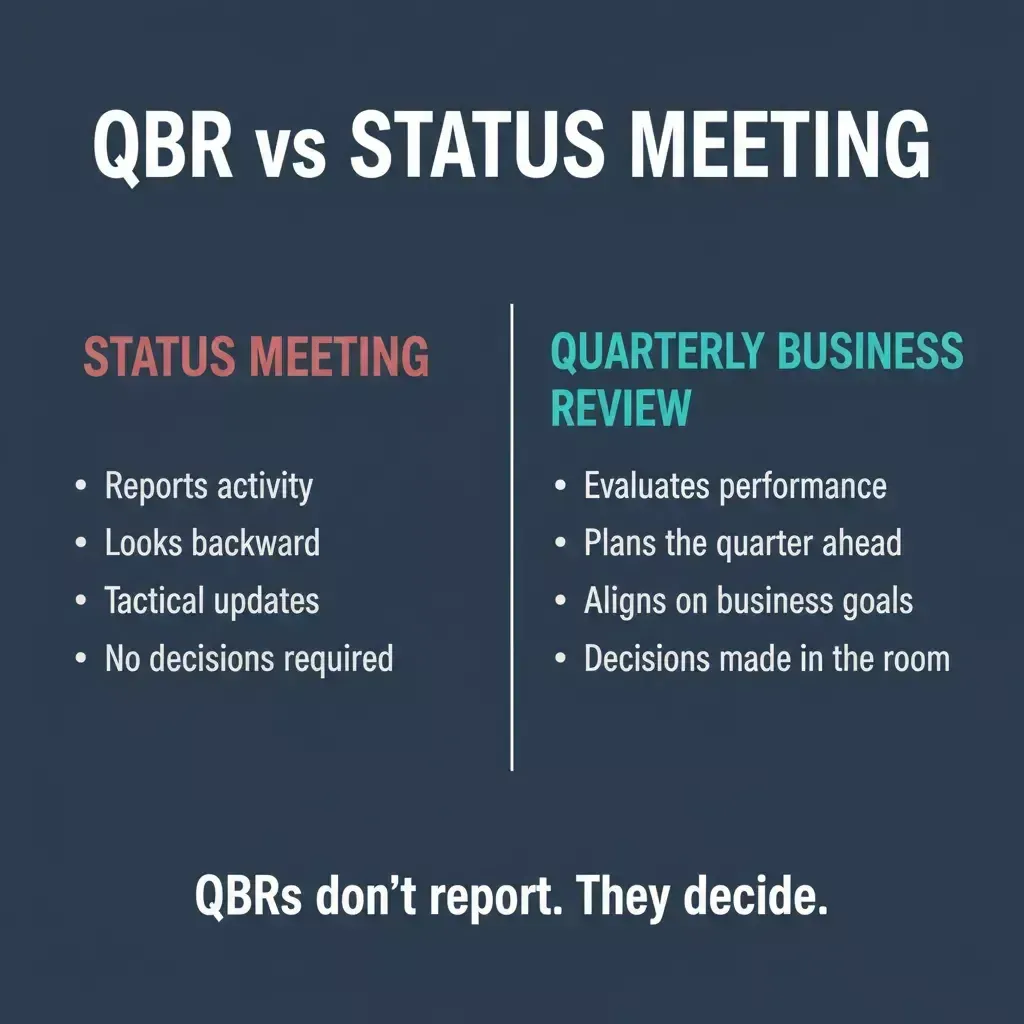
The Three-Month Rhythm That Forces Strategic Thinking
Quarterly business reviews (QBRs) follow a three-month cadence for a reason. Three months is long enough for meaningful business performance trends to emerge and short enough to course-correct before small problems compound into larger ones.
The rhythm creates discipline. Every quarter, cross-functional teams step back from day-to-day operations and ask the questions that actually matter:
-
Are key performance indicators moving in the right direction? Is the sales team tracking toward its business goals?
-
Have business objectives shifted based on what the market is doing?
The quarterly meeting is the one time the whole business surfaces together for a coordinated performance review, not to report, but to decide.
Who Belongs in the Room?
An effective quarterly business review brings together key stakeholders at every level. Senior decision-makers set strategic direction. Day-to-day operators bring ground-level performance data. Sales team leaders share pipeline and sales performance figures.
The mix matters. When the executive team sits alongside the people doing the work, the conversation shifts from reporting to decision-making. That shift is what makes a business review strategic rather than administrative.
What a QBR Actually Covers
A strong business review moves through four layers: a look at past performance against targets, a read on market context and competitor moves, a review of customer success metrics and customer feedback, and a forward plan for the next quarter. These are the key components of a useful QBR structure.
Cascade’s guide to quarterly business review meetings notes that QBRs should focus on gathering insights and key takeaways, not just showcasing results. The goal is to turn data into aligned decisions. This structure works best when the team shares a focused agenda with attendees in advance to set expectations for the discussion.
The Hidden Cost of Outdated QBR Preparation
Strategy teams preparing for a quarterly business review face a structural problem most do not talk about openly: the data powering the meeting is rarely current.
By the time the sales team compiles its numbers, customer success pulls retention data, and the strategy lead assembles a market overview, many of the inputs are already weeks or months old. Performance data arrives late to a meeting that is supposed to drive forward decisions.
Three-Month-Old Data in a Fast-Moving Market
Traditional quarterly business review preparation often relies on data collected at the start of the quarter. That means the insights presented to the executive team are three months old by the time the business review begins.
A competitor could have changed pricing, shifted positioning, or made a significant hire in the time between your last QBR and this one. If the sales team walks in without knowing that, the strategic conversation starts from the wrong premise.
Manual Prep Kills Strategy Team Hours
For most teams, quarterly business review preparation means weeks of data collection. Someone owns financial metrics. Someone owns sales performance. Someone owns market trends. Someone owns customer success health.
That coordination time is not strategy work. It is logistics. Every hour spent on it comes directly out of the time the team has to actually think about what the business should do in the upcoming quarter.
What Gets Missed When Data Is Stale
When performance data is outdated, three things go wrong. First, the sales team presents numbers that do not reflect the most recent activity. Second, customer success metrics may mask retention risks that emerged mid-quarter. Third, the market context presented to executives is backward-looking rather than forward-looking.
Executives do not want a history lesson. They want to understand evolving customer needs and competitive shifts, and they want the strategy team to tell them what to do about those shifts.
Three data points that make the case for real-time QBR preparation.
What Data Does a Strategy Team Actually Need Before Walking Into the Executive Room?
A strong quarterly business review does not just require data. It requires the right data, organized to support real-time analysis and confident decision-making. Four categories cover it: competitive signals, customer success health, financial performance against KPIs, and a read on market trends shaping the next period.
Together, they give the executive team a complete picture: past performance, current market context, and a basis for planning.
Competitive Signals
Before the meeting, the strategy team needs a current read on competitor moves. That means recent pricing changes, new product announcements, hiring patterns that signal product direction, and shifts in messaging or market positioning.
When the executive team asks where the business stands relative to the market, the team needs a current answer grounded in real-time data analysis, not three-month-old assumptions. Understanding evolving customer behavior through the lens of what competitors are doing is what separates a strong executive business review from a routine update.
Customer Success Health
The customer success layer of a strong QBR covers active customer satisfaction scores, customer retention rates, patterns in customer feedback that point to product or service gaps, and whether action items from the meeting are actually completed. Customer success metrics like health scores and support ticket trends show the executive team whether the business is holding its customer base or quietly losing ground, especially when the customer success team can tie those signals back to the actual customer, changing customer expectations, and the broader customer experience.
Connect customer success data to business ROI and the customer's business goals to show the value delivered and uncover where the team can create more value while strengthening customer relationships.
Customer engagement data, product usage, session depth, and response to new features fill the picture of how customers feel about the product right now.
Revenue and Financial Metrics
The executive team expects clean financial performance data: revenue, growth rate, pipeline, and variance against plan. Sales performance by segment, customer acquisition trends, and revenue performance against business goals all need to be present.
Financial metrics should also show business outcomes against the targets set at the last quarterly business review. Without that comparison, the meeting is a report, not an evaluation.
Market Trends and Shifts
A complete QBR preparation includes a read on the broader context. What is changing in the customer’s business environment? Where are growth opportunities emerging? What are the evolving customer needs that will shape demand over the next quarter?
High-level business objectives set at the start of the year may need adjustment if the market has moved. This is the layer that turns a backward-looking performance review into a forward-looking strategic meeting.
How Rocket Gives Strategy Teams the Intelligence to Walk In Ready
There is a gap between knowing what intelligence a quarterly business review needs and actually having it when the meeting starts. Most strategy teams close that gap poorly: spending the weeks before a QBR manually pulling data from disconnected sources. Rocket closes that gap differently.
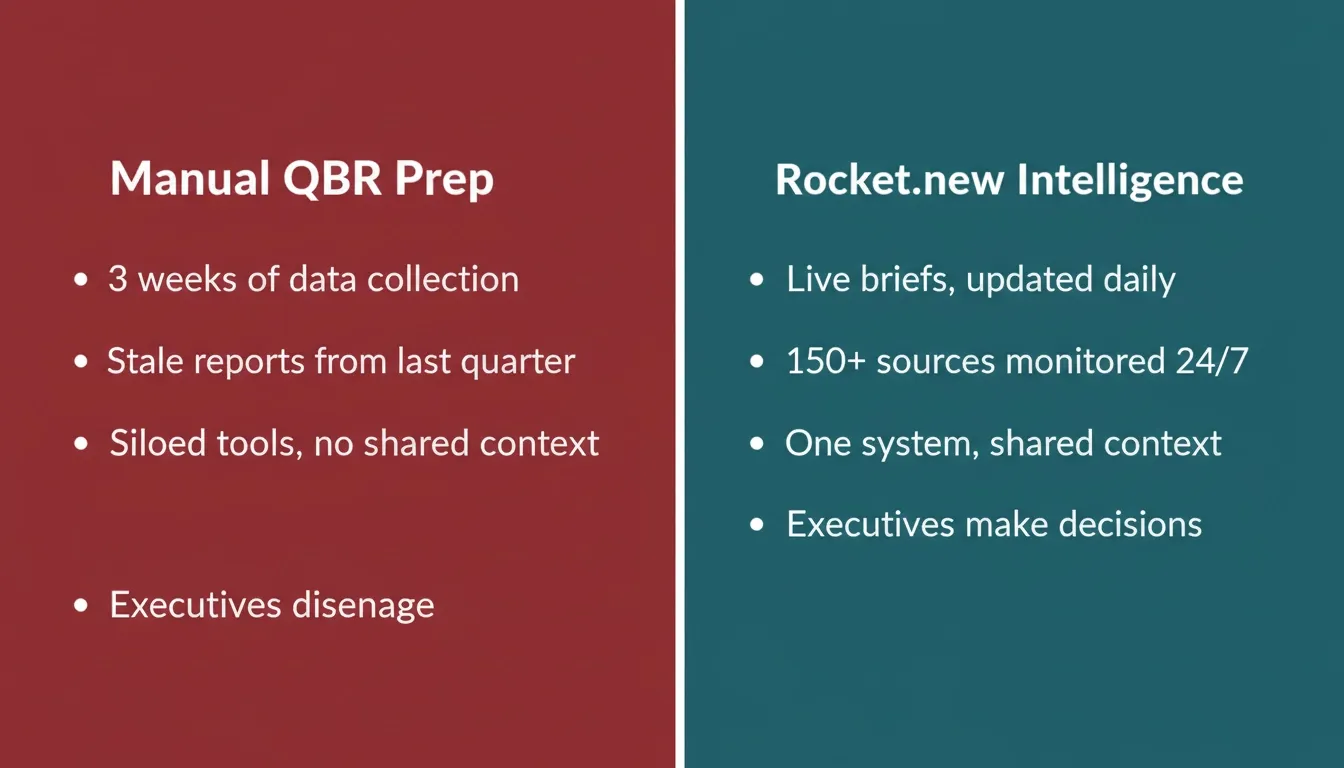 Manual preparation versus Rocket.new Intelligence: the gap in data freshness and strategic readiness.
Intelligence: Continuous Signals, Not Stale Reports
Rocket’s Intelligence feature monitors six signal categories across every public platform a competitor operates on, website changes, social media activity, news and press, customer reviews, hiring signals, and competitor ad spend, organizing everything into structured daily briefs. Amazon’s strategy team uses Rocket.new to replace manual reporting with automated, real-time intelligence for business reviews, which helps with tracking business performance.
By the time a quarterly business review comes around, the strategy team already has a running record of every meaningful competitor move made during the quarter. This is not periodic scanning. It is always-on monitoring that surfaces signals as they happen. That gives leadership valuable insights before the review starts.
Quarterly business reviews (QBRs) with this kind of preparation are never the first time a team sees a competitive shift. Teams walk in with current intelligence, not hindsight.
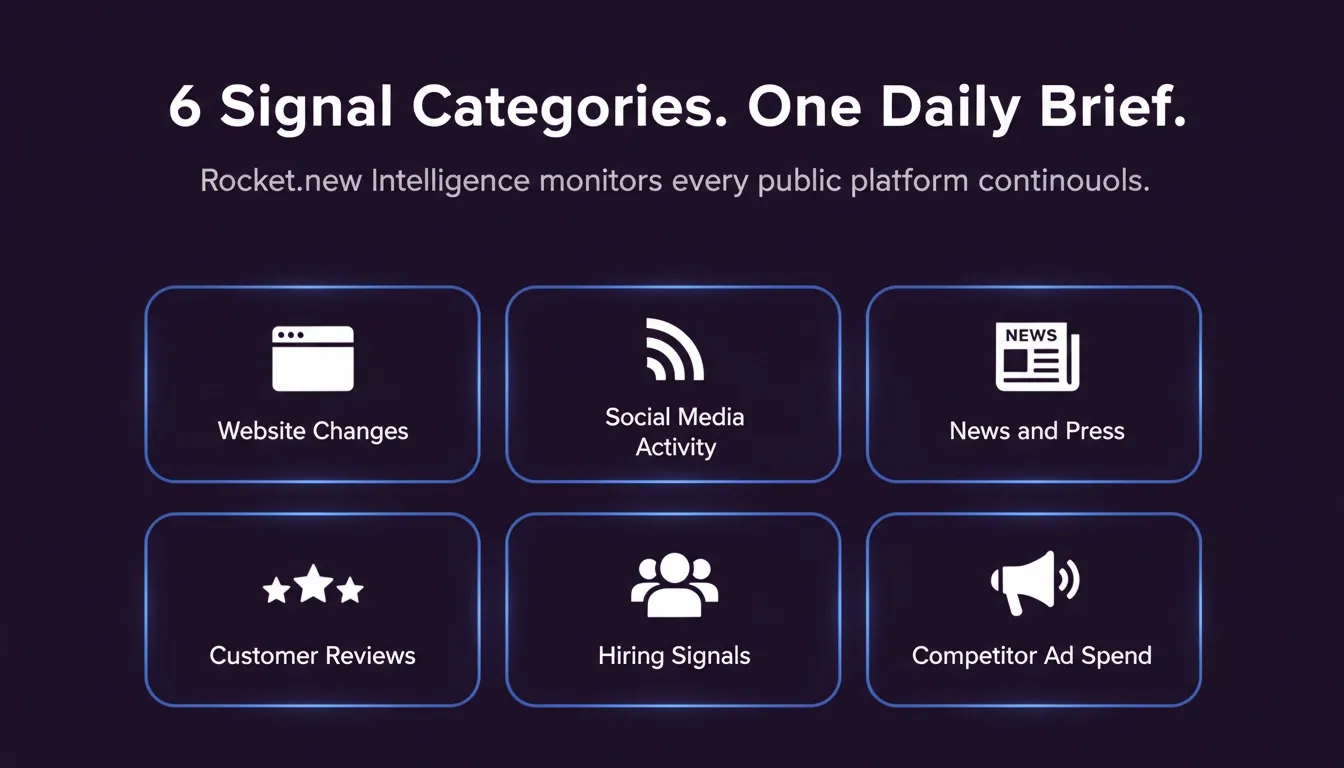 Rocket.new Intelligence monitors six signal categories continuously across every public platform a competitor operates on.
Solve: From Market Gap to Executive Recommendation
Intelligence tells the team what is happening. Rocket's Solve feature tells them what it means.
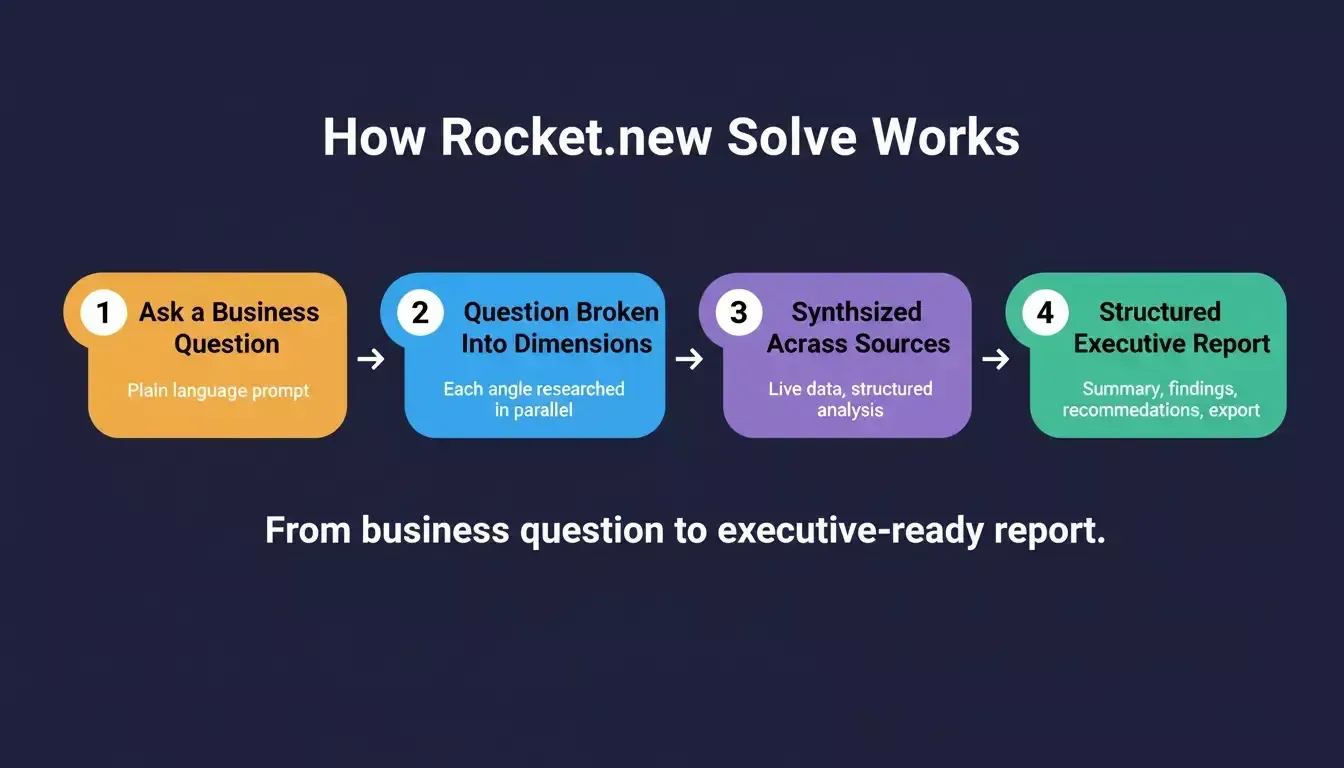
The strategy team submits a business question in plain language, what is driving a competitor's pricing shift, or " What is the best growth opportunity in a given segment this quarter.
Solve breaks the question into component dimensions, runs each as a parallel research stream across multiple sources, and delivers a structured, evidence-backed report. The output covers an executive summary, detailed analysis, supporting evidence, and clear recommendations, exportable for use outside Rocket.
 Keeping research, analysis, and execution in one place means Rocket.new bridges the gap between raw market monitoring and execution, so strategic goals discussed in a meeting are grounded in the same data used to prepare for it. That alignment is what produces data-driven decision-making rather than opinion-based conversations.
Rocket.new Solve takes any business question and delivers a structured executive report built from live, synthesized data.
What Standalone Competitive Intelligence Tools Cannot Match
Many competitive intelligence tools address specific use cases like battlecard generation or win/loss analysis. But they are not designed to serve a strategy team preparing quarterly business reviews for executive leadership.
Rocket combines continuous market monitoring, on-demand Solve research, and the ability to build operational assets, like ROI calculators or comparison dashboards, without tying up engineering resources. Strategy teams get full intelligence coverage for QBR meetings in one place rather than spread across multiple tools with siloed outputs.
For teams that also use Rocket's intelligence for roadmap planning for next quarter, the QBR brief and the product roadmap brief draw from the same live data, eliminating the reconciliation problem that plagues teams using siloed tools.
Build Your First QBR Brief on Rocket
If your team still walks into quarterly business reviews with a deck assembled from stale data, the fix is straightforward. Set up Intelligence in Rocket, define the competitors and market signals that matter, and let the system run. When your next business review arrives, preparation starts with a live brief rather than a blank page.
Teams that want to go further can use Rocket's Solve feature to run a structured competitive assessment before the meeting, framing the exact questions the executive team will ask and answering them with evidence before anyone enters the room.
Rocket.new Solve takes any business question and delivers a structured executive report in 60 to 90 minutes.
Building the QBR Agenda With Intelligence-Backed Data
A quarterly business review is only as good as the agenda that structures it. And the agenda is only as good as the data that fills it. Here is how intelligence-backed preparation maps to every section of an effective QBR meeting.
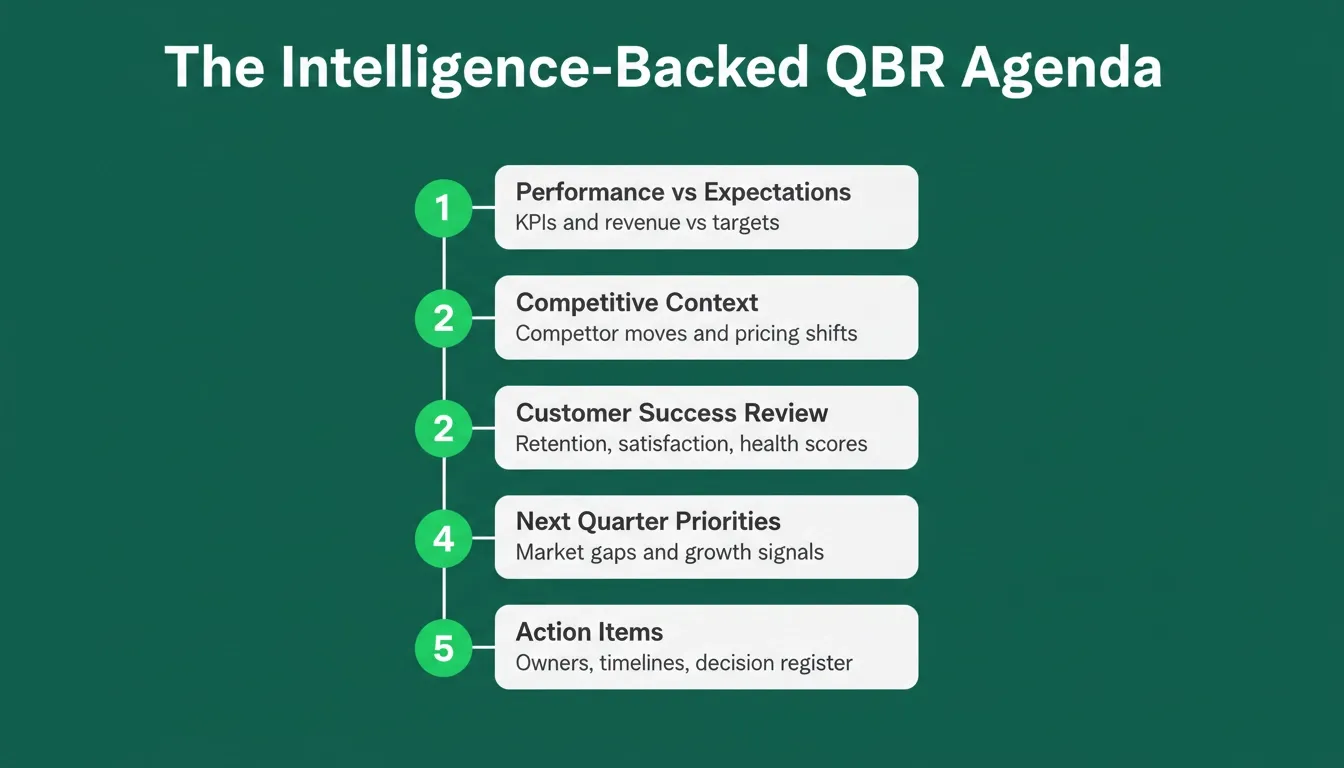 Five sections, each powered by a specific Rocket data source, from daily briefs to Solve research reports.
| QBR Agenda Section | Data Type Needed | Rocket Source | Executive Output |
|---|---|---|---|
| Performance vs. Expectations | KPIs, revenue metrics | Intelligence Daily Brief | Variance analysis |
| Competitive Context | Competitor moves, pricing shifts | Intelligence signals feed | Risk and opportunity map |
| Customer Success Review | Retention, satisfaction, support tickets | Solve the research report | Customer health summary |
| Next Quarter Priorities | Market gaps, growth signals | Intelligence and Solve combined | Prioritised strategic initiatives |
| Action Items and Follow Up | Open owners, timelines | Exported brief | Decision register |
Opening: Performance vs. Expectations
The first section of any QBR meeting should be a clean performance review: a direct comparison of key metrics against targets set at the last quarterly business review. Sales performance, revenue performance, and customer success metrics all go here.
Key performance indicators should appear alongside targets, not in isolation. A number without a benchmark is data, not a business review.
This is where the team evaluates performance honestly, including where things fell short, before moving into why.
Middle: Market and Competitive Context
This is where market trends, competitor signals, and customer feedback inform the conversation. What have competitors done this quarter? What are customers asking for that the business is not yet delivering? Where do growth opportunities sit for the next quarter?
Research from MarketsandMarkets shows that teams maintaining current competitive intelligence and conducting regular win/loss interviews see up to a 14.2% increase in win rates. That advantage compounds when competitive data feeds directly into the QBR agenda rather than sitting in a separate tool.
Relevant data from the Intelligence brief, competitor pricing changes, hiring signals, product launch activity belong in this section. So does any client feedback surfaced by customer success teams since the last QBR?
The Decision Layer: Next Quarter Priorities
Mid-QBR is where the meeting either becomes strategic or stays tactical. Armed with performance data, competitive context, and customer insights, the team needs to answer one question: what are we doing differently in the upcoming quarter?
This section drives alignment on business goals, resource prioritization, and strategic shifts. The decisions made here define what the next QBR’s opening performance review will show. This is also where strategic initiatives get named, owned, and resourced.
Teams using Rocket’s competitive intelligence for enterprise sales find that the same signals powering the QBR brief also sharpen the sales team’s positioning for the quarter ahead, one source, two functions.
Closing: Action Items and Follow Up
Every quarterly business review should close with documented action items, clear owners, and agreed timelines for the upcoming quarter. This follow-up mechanism is what turns a good meeting into real business performance improvement.
Setting the same objectives for the next QBR before leaving the room is what separates teams that make continuous progress from those that relitigate the same issues quarterly. That accountability loop is the core of a high-functioning QBR process.
How Does Executive Engagement Change When the Numbers Are Fresh?
There is a well-documented pattern in executive business review meetings. When data is stale and preparation is shallow, executives disengage. They answer questions with opinions rather than evidence. The conversation stays tactical. Decisions get deferred.
When the numbers are fresh and intelligence is current, something different happens.
From Tactical Update to Strategic Conversation
Fresh intelligence moves the quarterly business review from a reporting session to a forum for strategic growth decisions. Instead of spending the first third of the meeting debating whether a number is accurate, the executive team can engage immediately with what the data means.
That shift is what makes a successful quarterly business review feel different from a routine status meeting. Business goals get refined. Priorities get aligned. Budget questions get resolved rather than deferred.
Key stakeholders who arrive prepared, with the current competitive context, current customer success health, and current financial performance, contribute more effectively. Relationship building at the executive level starts with that credibility.
Why Executives Lean In When Data Is Current
Research shows that B2B customers with strong executive engagement in quarterly business reviews (QBRs) are 2.5 times more likely to renew, highlighting what is at stake when executive teams are actively invested in QBR discussions.
That engagement does not happen by accident. It comes from relationship building grounded in consistent, credible intelligence. When the strategic goals presented in the quarterly business review are backed by real-time market data, the executive team trusts the analysis.
That trust turns a quarterly business meeting into an executive business review, a conversation that matters past the 90 minutes in the room.
Building Long-Term Trust Through Consistent Intelligence
The QBR process works best as a compounding system. Each quarterly business review should build on the last: better intelligence, sharper analysis, more aligned decisions.
This is why data freshness matters so much in a quarterly business review context. The executive team only stays engaged when they trust the source. Trust erodes the moment a number turns out to be outdated or a competitive claim turns out to be wrong.
Rocket’s Intelligence feature addresses this directly. Continuous monitoring means the data used in QBR preparation reflects the world as it is now, not as it was three months ago. And that continuous improvement in data quality is what keeps the executive team coming back to QBR meetings with genuine engagement.
Teams that want to understand how Rocket’s intelligence layer works across sales, marketing, product, and strategy can explore the full breakdown of Rocket Intelligence for cross-functional teams.
Turning QBR Takeaways Into Actions for the Next Quarter
The real value of a quarterly business review is not the meeting itself. It is what happens after. Transforming quarterly business reviews from reporting exercises into continuous improvement cycles requires a clear handoff from insight to action.
Documenting Decisions Before You Leave the Room
Every strategic decision made during the business review meeting needs to be documented before the meeting closes. Key takeaways, priority shifts, and unresolved questions go into a shared decision register.
Waiting until the follow-up email loses the sharpness of what was actually agreed. The same objectives confirmed in the room need to be visible to the whole team within 24 hours. That visibility creates accountability for the upcoming quarter.
Assigning Owners to Every Action Item
A quarterly business review without clear ownership is a performance review without consequence. Every action item identified in the meeting needs a named owner, a success metric, and a timeline that ties to the next QBR.
Customer success teams, the sales team, and cross-functional leads each take responsibility for their slice of the plan. Strategic growth does not happen because a meeting produced insights. It happens because specific people owned specific tasks with clear deadlines.
Setting the Agenda for the Next QBR Before This One Ends
One habit that separates strong QBR teams from average ones: closing every quarterly business review by sketching the opening framework for the next QBR. What questions need to be answered in three months? What performance markers confirm the team is on track?
Revenue performance, business growth targets, and strategic initiatives identified this quarter become the monitoring brief for Rocket’s Intelligence feature going forward. The system continues gathering signals. The team continues acting on them. The cycle runs.
Teams that want to see how Rocket’s compound context architecture eliminates the handoff problem between research and execution can read about how Rocket’s intelligence compounds over time.
Stop walking into quarterly business reviews with a deck built on stale data. Rocket’s Intelligence and Solve features give your strategy team the live competitive signals, customer health data, and market context needed to lead the executive room, not just report to it. Start your first QBR brief on Rocket.new today.
Table of contents
- -What Makes a Quarterly Business Review Different From a Status Meeting?
- -The Three-Month Rhythm That Forces Strategic Thinking
- -Who Belongs in the Room?
- -What a QBR Actually Covers
- -The Hidden Cost of Outdated QBR Preparation
- -Three-Month-Old Data in a Fast-Moving Market
- -Manual Prep Kills Strategy Team Hours
- -What Gets Missed When Data Is Stale
- -What Data Does a Strategy Team Actually Need Before Walking Into the Executive Room?
- -Competitive Signals
- -Customer Success Health
- -Revenue and Financial Metrics
- -Market Trends and Shifts
- -How Rocket Gives Strategy Teams the Intelligence to Walk In Ready
- -Intelligence: Continuous Signals, Not Stale Reports
- -Solve: From Market Gap to Executive Recommendation
- -What Standalone Competitive Intelligence Tools Cannot Match
- -Build Your First QBR Brief on Rocket
- -Building the QBR Agenda With Intelligence-Backed Data
- -Opening: Performance vs. Expectations
- -Middle: Market and Competitive Context
- -The Decision Layer: Next Quarter Priorities
- -Closing: Action Items and Follow Up
- -How Does Executive Engagement Change When the Numbers Are Fresh?
- -From Tactical Update to Strategic Conversation
- -Why Executives Lean In When Data Is Current
- -Building Long-Term Trust Through Consistent Intelligence
- -Turning QBR Takeaways Into Actions for the Next Quarter
- -Documenting Decisions Before You Leave the Room
- -Assigning Owners to Every Action Item
- -Setting the Agenda for the Next QBR Before This One Ends