Competitive intelligence breaks into distinct types: strategic, tactical, market, competitor, product, customer, and technological. Each serves a different team and time horizon. Knowing which type to run, and when, is the real edge. Rocket covers all of them automatically.
What if the right type of intelligence matters more than the total volume of data you collect?
Competitive intelligence covers six main categories: strategic, tactical, market, competitor, product, customer, and technological intelligence. Each type answers a different question, serves a different team, and runs on a different collection schedule.
According to Crayon's 2025 State of Competitive Intelligence report, sellers face direct competition in 68% of deals, yet the average team rates its competitive selling ability at just 3.8 out of 10. That gap is rarely a data problem. It is a categorization problem.
Getting that taxonomy right changes how your team gathers, analyzes, and acts on what competitors do. That is what this guide covers.
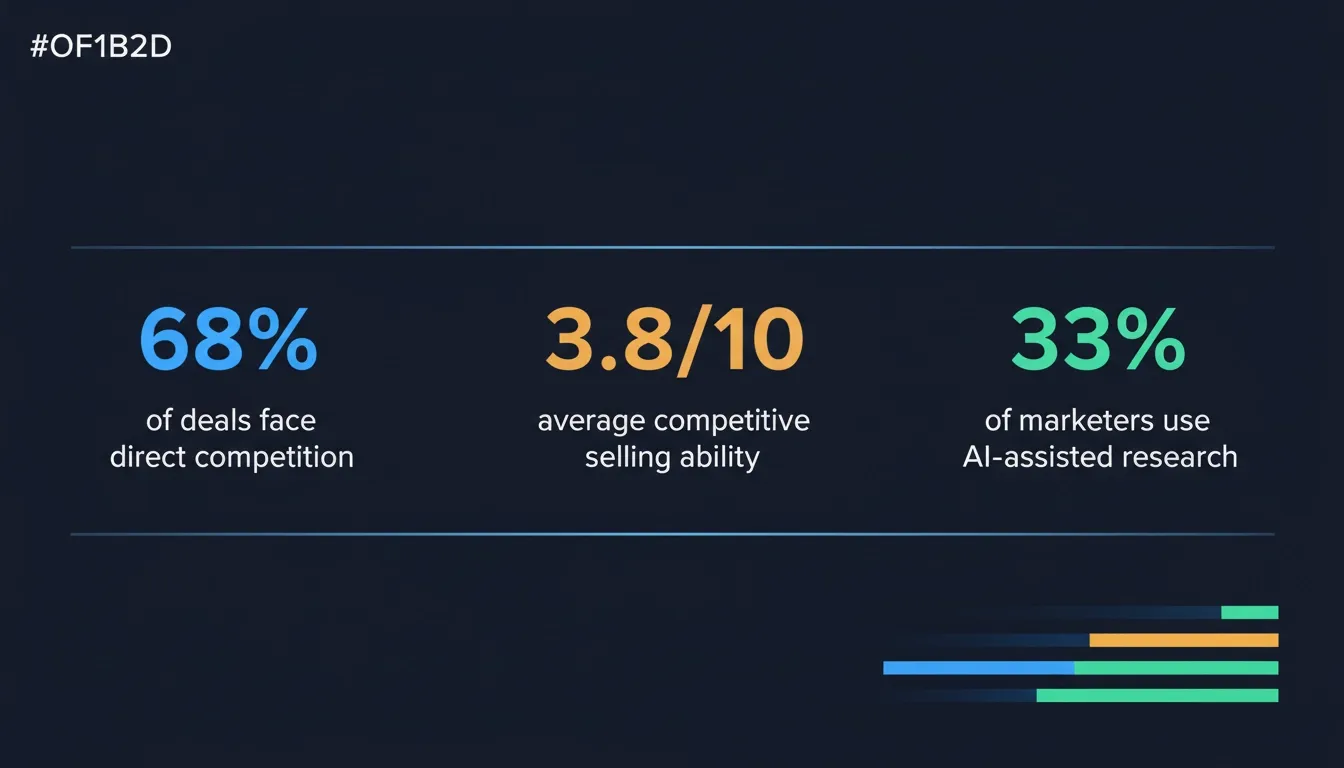 Key competitive intelligence statistics every GTM team should know
What Makes Competitive Intelligence More Than Just Researching Rivals?
Most people treat competitive intelligence as a single activity. That framing leads to scattered research, conflicting priorities, and CI work that never quite connects to a real decision.
The Line Between Monitoring and Intelligence
Raw monitoring means collecting signals: a competitor's press release, a job posting, a pricing change. Intelligence means taking that information and connecting it into a picture that drives a specific business decision, and ultimately feeds into broader business intelligence across the organization.
-
Monitoring collects raw signals. It surfaces events: a new product launch, a hiring surge, a competitor repositioning move.
-
Intelligence contextualizes those signals. It answers what a move means for your own pricing, positioning, or product roadmap within the competitive landscape.
-
The gap between the two is where most CI programs fail. Teams gather a great deal but analyze little, leaving strategic decisions still based on gut feel rather than evidence.
Competitive intelligence, at its best, is a structured discipline, not a research task someone runs on demand. Understanding the different categories is the first step toward building a CI program that actually changes how decisions get made.
How Do Strategic Intelligence and Tactical Intelligence Actually Differ?
Two main types of competitive intelligence organize almost everything else: strategic and tactical. They are not interchangeable, and most organizations need both running in parallel.
Strategic Intelligence: The Long Game
Strategic competitive intelligence focuses on understanding the broader forces shaping your market over the next one to three years.
-
Strategic intelligence informs long-term business strategy. It covers competitor positioning shifts, market entry moves, funding rounds, and leadership direction changes.
-
The primary audience is leadership. Outputs feed into quarterly reviews, board presentations, and annual planning cycles.
-
Sources lean toward structured research: industry reports, financial statements, patent filings, and analyst briefings.
When done well, strategic competitive intelligence prevents companies from being caught off guard by shifts that were visible months in advance.
Tactical Intelligence: The Immediate Play
Tactical competitive intelligence is short-term and action-oriented. It answers the questions your sales team or marketing team needs answered this week.
-
Tactical intelligence supports day-to-day decisions. Pricing comparisons, competitor product updates, campaign messaging, and battlecard refreshes all draw from it.
-
The primary audience is frontline teams. Sales reps, product marketers, and demand generation managers rely on it most.
-
Sources are faster and more frequent: social media activity, press releases, competitor websites, and customer reviews.
Tactical CI keeps you responsive. Strategic CI keeps you directional. Running only one of them leaves a critical gap.
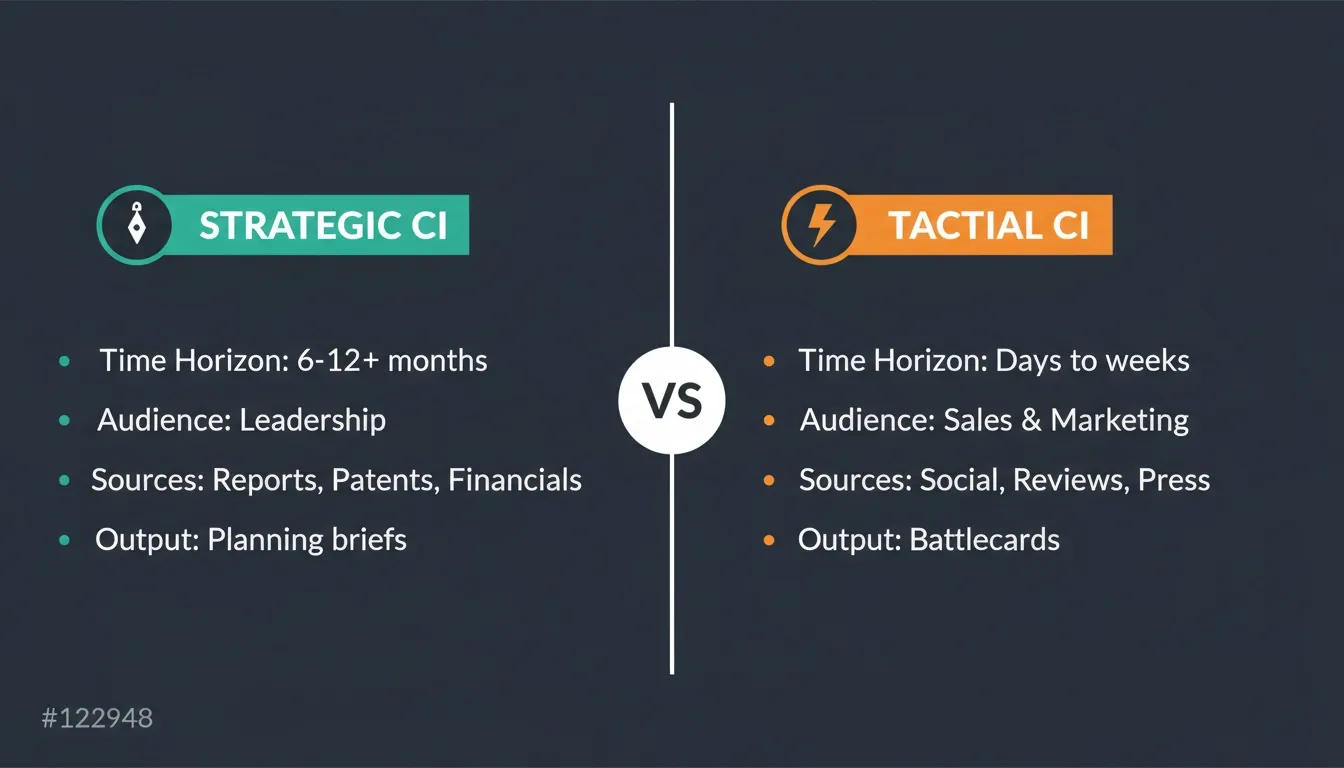 Strategic CI and tactical CI serve different decisions — most teams need both running in parallel
When to Use Each
The right type of CI depends on the decision in front of you, not on preference or habit.
-
Use strategic CI for: entering a new market, planning a product roadmap, preparing for an acquisition, or forecasting competitive threats twelve months out.
-
Use tactical CI for: preparing for a sales call, responding to a competitor announcement, adjusting campaign messaging, or repricing in response to market changes.
-
Use both when building a competitive strategy that needs to be defensible long-term and executable right now.
Most well-run teams treat strategic and tactical CI as separate workflows with separate owners, not a single catch-all research function.
The Core CI Categories Every Team Should Know
Strategic and tactical CI describe when and why you collect intelligence. The five core categories below describe what you collect and which team it serves most directly.
Market Intelligence
Market intelligence focuses on the broader space your business operates in, not just on your direct competitors.
-
It covers industry trends, market share shifts, regulatory changes, and customer demand patterns. The goal is a clear picture of broader market trends and where the market is heading.
-
Market research, industry reports, and economic data are the primary inputs for teams gathering market intelligence.
-
Teams use market intelligence to identify opportunities before rivals do and to spot potential threats still forming on the horizon.
Market intelligence is most valuable when it runs continuously, not as a one-time research project.
Competitor Intelligence
Competitor intelligence zeros in on specific rivals: their moves, their messaging, their team changes, and their product direction.
-
It includes tracking competitor offerings, analyzing their pricing strategies, and monitoring hiring patterns. Job postings alone can reveal a great deal about near-term product plans.
-
Direct competitors are the obvious focus, but indirect competitors and adjacent-market entrants deserve equal attention.
-
Competitor intelligence feeds battlecards, win/loss analysis, and competitive positioning work.
The goal of competitor intelligence is not surveillance. It is a deeper understanding of why rivals make the moves they do. That context is what turns raw data into decisions.
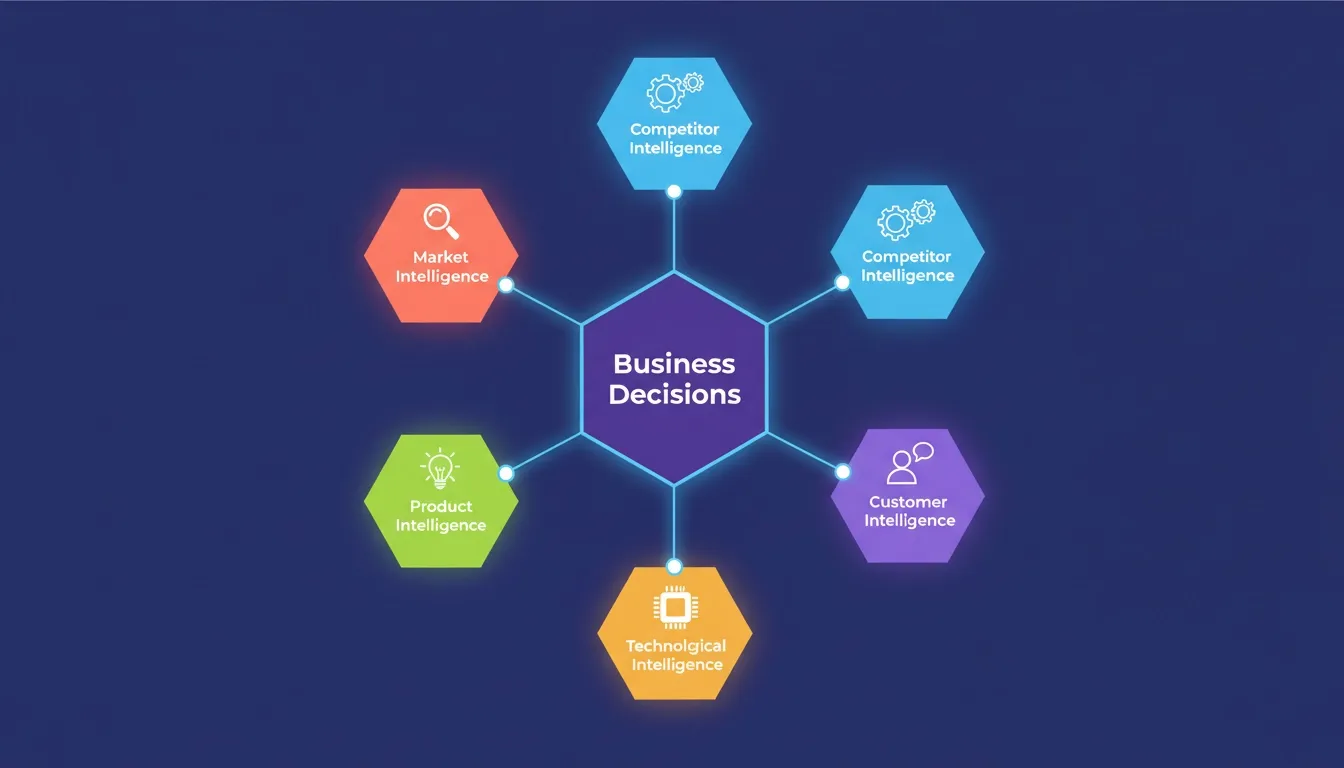 The five core CI categories, each covering a distinct layer of competitive insight
Product Intelligence
Product intelligence focuses on what competitors are building, shipping, and discontinuing, along with what customers think about it.
-
Tracking competitor products through release notes, customer reviews, and app store updates provides a granular view of feature direction.
-
Product teams use this intelligence to prioritize their own roadmaps, identify gaps in the market, and avoid building features that are already commoditized.
-
Product intelligence also covers competitor pricing structures, packaging decisions, and trial-to-paid conversion signals.
When product intelligence is shared across product, marketing, and sales, it stops being a research output and starts driving actual decisions. Teams that combine this with user feedback analysis get the clearest picture of where gaps exist.
Customer Intelligence
Customer intelligence gathers what the market actually feels about competitors: from reviews, from social media, from support conversations.
-
It surfaces competitor weaknesses by analyzing customer feedback on platforms like G2, Capterra, and Reddit. Real user frustrations are some of the most honest competitive data available.
-
Customer intelligence also tracks shifting consumer behavior and customer satisfaction signals across the market segment.
-
Teams use it to sharpen their messaging, address unmet customer needs, and spot churn risk patterns before they become a wider trend.
Customer intelligence turns competitor weakness into your own positioning advantage without requiring a single direct confrontation.
Technological Intelligence
Technological intelligence tracks the tech choices competitors make and the emerging technologies taking shape across the industry.
-
It covers competitor tech stacks, patent filings, R&D investments, and partnerships with technology providers.
-
Technological advancements in adjacent sectors often signal where the competitive environment is heading before any announcement confirms it.
-
Teams monitoring emerging technologies can use this intelligence to build proactive roadmaps rather than reactive ones.
For companies where technology is a core differentiator, this category is one of the hardest to collect manually but one of the most valuable to have.
A Quick-Reference Guide to CI Types
| CI Type | Focus | Time Horizon | Common Sources |
|---|---|---|---|
| Market Intelligence | Industry trends, demand shifts, and regulatory changes | Long-term (12+ months) | Industry reports, economic data, analyst briefings |
| Competitor Intelligence | Rival moves, pricing strategies, hiring, messaging | Short to medium-term | Competitor websites, job boards, press releases, and social media |
| Product Intelligence | Competitor features, roadmap signals | Medium-term (3-12 months) | Release notes, app reviews, customer feedback, patents |
| Customer Intelligence | Customer sentiment, competitor weaknesses | Ongoing | G2, Capterra, Reddit, social media listening |
| Technological Intelligence | Tech stack choices, R&D direction, patent filings | Long-term | Patent filings, job postings, technology partnerships |
Each type serves a distinct purpose, and the most effective competitive intelligence programs run all five in parallel, feeding into both strategic planning and day-to-day decision-making.
What Does Gathering Competitive Intelligence Look Like in Practice?
Understanding the categories of CI is one thing. Seeing how they operate in a real workflow is another.
Strategic CI in Action
A software company preparing to enter a new vertical might run strategic competitive intelligence for eight to twelve weeks before committing budget.
-
They analyze financial reports and funding announcements from established competitors in that vertical to understand capital position and growth trajectory.
-
They review industry reports and analyst briefings, producing a competitive intelligence report that maps positioning across the space.
-
The output informs business strategy directly, assessing whether the market opportunity justifies the investment, not just listing competitor names.
Strategic CI is the difference between entering a market with a plan and entering blind. Teams that embed this into competitive intelligence roadmap planning consistently make faster, more confident resource decisions.
Tactical CI in Action
A sales team preparing for a competitive deal against a well-funded rival runs a very different CI workflow.
-
They pull recent press releases and product updates from the competitor's website to identify new capabilities announced in the last 30 days.
-
They review customer feedback on G2 and Capterra to find the pain points customers report with the competitor's product and build objection-handling language around them.
-
They conduct competitive intelligence research across social media and marketing campaigns to understand the messaging the competitor is pushing right now.
One Director of Product Marketing in Fintech described the challenge in Klue's 2026 AI in Competitive Intelligence Report: "We have scenarios where AI will overweight recent news or mentions on social or news sources at the detriment of the harder trends." Speed versus analytical depth is the defining tension in gathering competitive intelligence data.
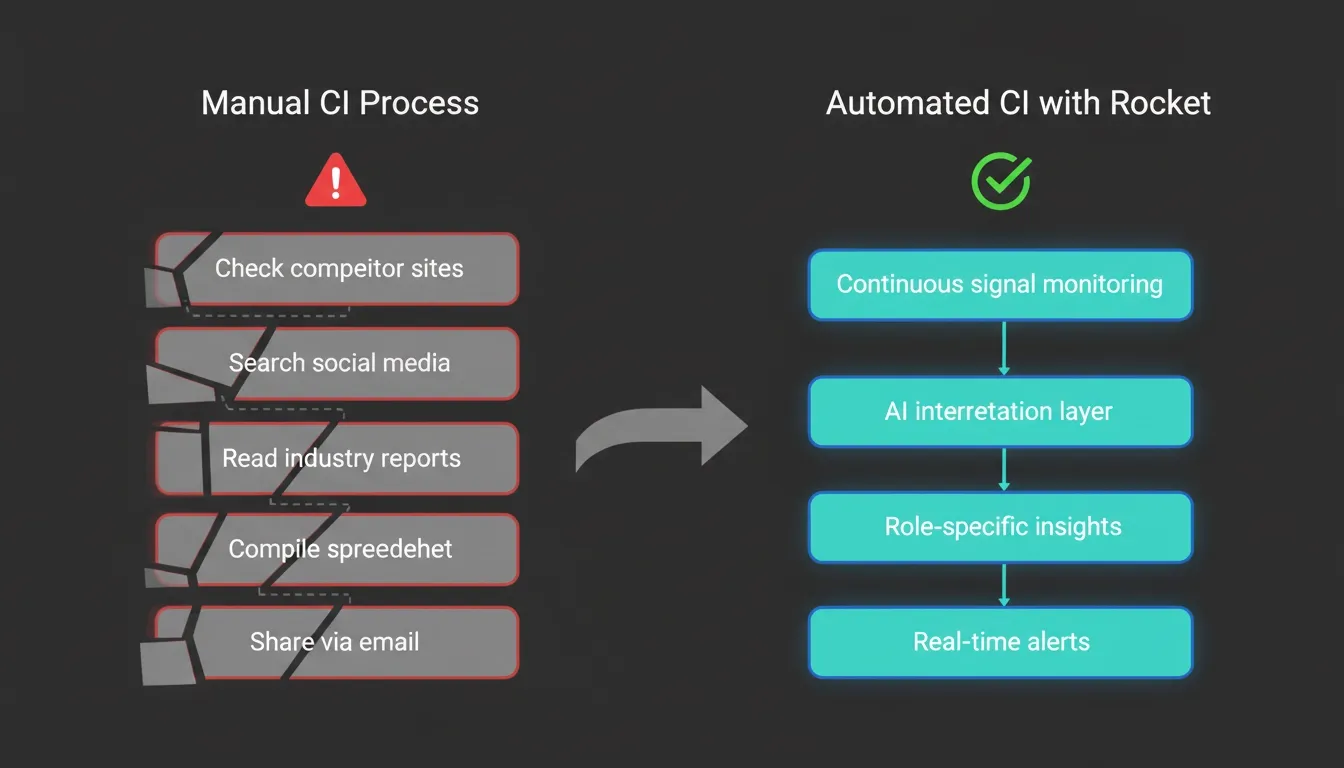 Manual CI processes create gaps; automated coverage keeps every signal layer active
How Customer and Technological Intelligence Tie It Together
The two most overlooked CI categories are often the ones that connect the dots between what competitors are doing and what customers actually want.
-
Customer intelligence gathered from review sites provides a continuous, unsolicited stream of competitor weakness data. No survey required, no analyst needed.
-
Technological intelligence rounds out the picture by revealing where competitor products are heading before any public announcement confirms it.
-
When these two layers are combined with strategic and tactical CI, the result is competitive intelligence analysis that covers the full spectrum from long-horizon planning down to this week's sales call.
According to HubSpot's competitive analysis guide, 33% of marketers now rank AI-assisted research as their top AI use case, a sign that teams are starting to automate the more repetitive parts of the gathering process.
How Rocket Keeps Every CI Layer Working Without the Manual Work
Running all five CI categories continuously is not realistic for most teams. Monitoring signals, analyzing data, formatting reports, and distributing findings to the right people adds up to more capacity than most organizations can dedicate to it.
What Tools Struggle to Cover Automatically
Most competitive intelligence tools handle one or two of the five categories reasonably well. Covering all of them together, with the context to connect signals across categories, is where most platforms fall short.
-
Point solutions track competitor websites or social media, but they do not connect pricing changes to hiring signals to product announcements into a single strategic picture.
-
Manual CI processes are time-consuming, inconsistent, and dependent on whoever on the team remembers to check. When that person leaves, so does the institutional knowledge.
-
Without a real-time layer, tactical CI goes stale before it reaches the sales team, and strategic CI becomes a quarterly report that no one reads in full.
The gap is not effort. It is architecture. Effective competitive intelligence requires a system that watches all signal types in parallel, not a checklist someone runs once a week.
Where Rocket.new Fits in Your CI Stack
Rocket.new Intelligence is built to monitor the signals that matter across all five CI categories and provide insights that are interpreted and role-specific, rather than raw data dumps.
-
It tracks pricing changes, hiring patterns, product announcements, marketing campaigns, and market shifts across the companies you follow, automatically and continuously.
-
Every entity on Rocket has a public intelligence profile that your team can follow, with personalized intel delivered based on your role and the questions you carry into your work.
-
When two or more competitor moves intersect, such as a pricing shift paired with a hiring spike, Rocket surfaces the convergence as a strategic signal, not two separate data points.
Teams that want to understand how this interpretation layer differs from a standard monitoring dashboard will find the distinction matters significantly for how CI gets used day-to-day.
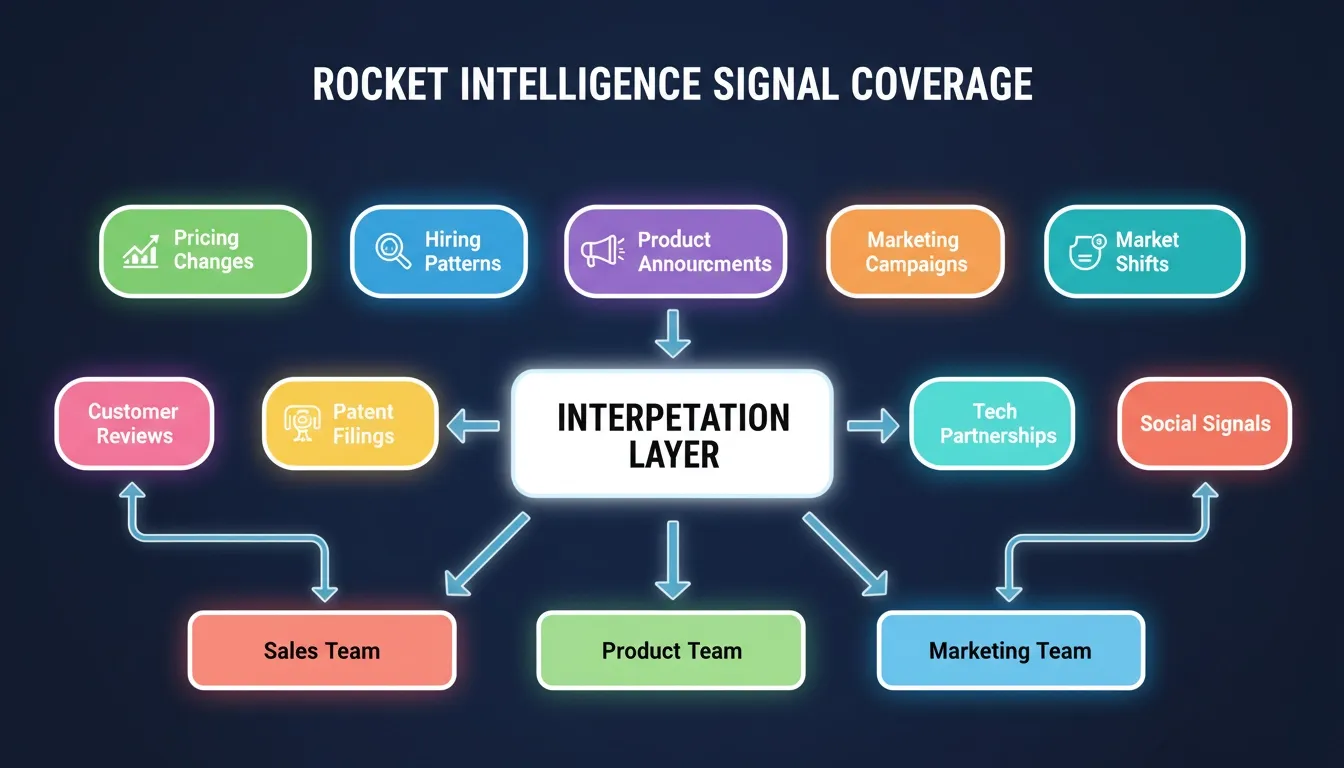 Rocket Intelligence monitors nine signal types and delivers role-specific insights across all five CI categories
Wrapping Up
Knowing the different CI categories is what separates teams that react from teams that plan. Strategic intelligence shapes where you play. Tactical intelligence shapes how you win. Market, competitor, product, customer, and technological intelligence each fill a specific layer of what your team needs to make confident decisions and stay ahead of competitors.
The gap between knowing what rivals are doing and acting on it is mostly a collection and organization problem. Build a CI system that covers all five categories continuously, and your competitive advantage compounds over time rather than showing up in a quarterly slide deck.
Stop running CI manually across five disconnected tools. Rocket monitors every signal layer automatically and delivers role-specific intelligence your team can act on today.
Start for free at Rocket and see it working on your actual competitors.
Table of contents
- -What Makes Competitive Intelligence More Than Just Researching Rivals?
- -The Line Between Monitoring and Intelligence
- -How Do Strategic Intelligence and Tactical Intelligence Actually Differ?
- -Strategic Intelligence: The Long Game
- -Tactical Intelligence: The Immediate Play
- -When to Use Each
- -The Core CI Categories Every Team Should Know
- -Market Intelligence
- -Competitor Intelligence
- -Product Intelligence
- -Customer Intelligence
- -Technological Intelligence
- -A Quick-Reference Guide to CI Types
- -What Does Gathering Competitive Intelligence Look Like in Practice?
- -Strategic CI in Action
- -Tactical CI in Action
- -How Customer and Technological Intelligence Tie It Together
- -How Rocket Keeps Every CI Layer Working Without the Manual Work
- -What Tools Struggle to Cover Automatically
- -Where Rocket.new Fits in Your CI Stack
- -Wrapping Up