
This blog covers how businesses can detect competitor repositioning early by monitoring key signals across job postings, website changes, social media, and more. It explains why manual tracking fails at scale and how Rocket.new's Intelligence feature provides automated, continuous monitoring across six signal categories.
Why Most Businesses React Too Late?
When was the last time a competitor surprised you with a product launch, a pricing update, or a new market push - and you found out only after the damage was done?
Competitor repositioning early detection is the practice of catching those shifts while you still have room to respond.
According to Crayon's 2025 State of Competitive Intelligence report, 68% of deals now involve at least one direct competitor - yet 44% of sales teams still lack visibility into which competitors are active in their deals.
That gap is expensive. And for most businesses, it is entirely avoidable.
What Competitor Repositioning Actually Looks Like
A new competitor does not always announce itself. Repositioning tends to be quiet at first. It starts with small signals - a pricing page update here, a new job posting there, a subtle shift in messaging across social media.
Most leadership teams are built to track established competitors. They compare product features, monitor market share, and review pricing. That discipline matters. But it is also insufficient on its own.
As a recent LinkedIn analysis on spotting emerging competitors put it:
"The most consequential threats rarely arrive looking like direct competitors. They appear first as tools, communities, platforms, channels, or convenient alternatives. By the time an emerging competitor appears clearly in your dashboards, the real damage is usually already underway." - The Rivals You Are Not Watching Yet, LinkedIn Pulse
That is the core problem with reactive competitive intelligence. By the time a competitor move is obvious, the window to counter it effectively has already closed.
The Signals That Reveal a Strategic Pivot
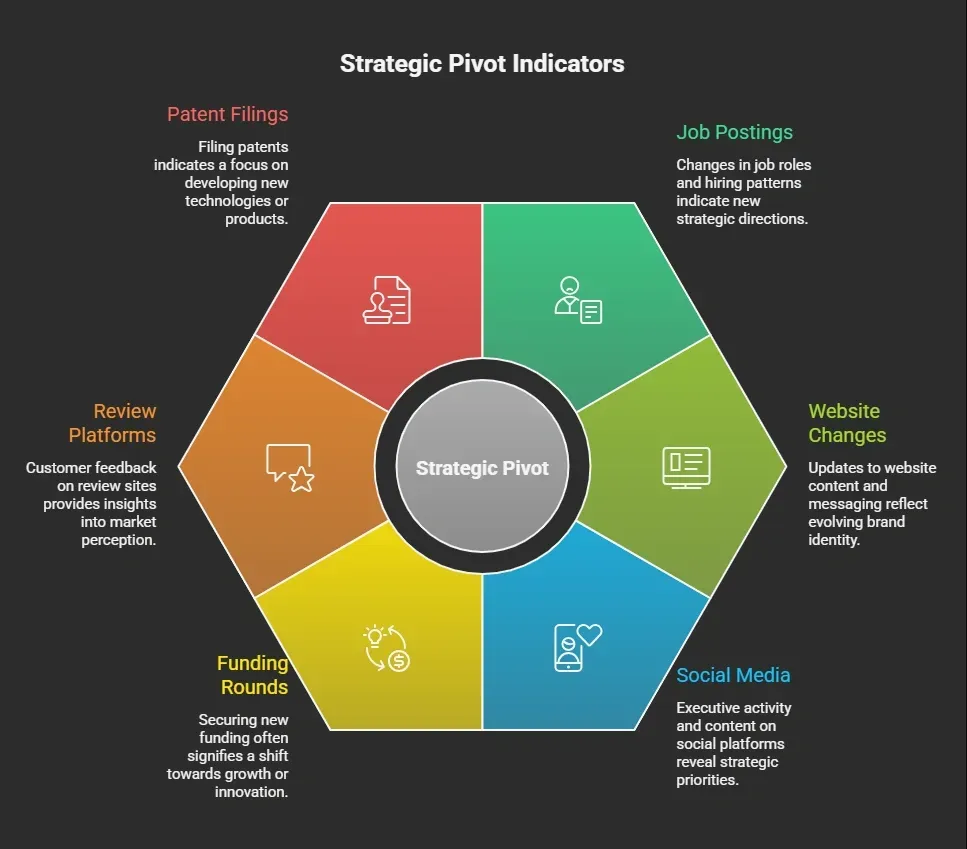
Competitor repositioning leaves traces across multiple surfaces before any official announcement. Here are the signal categories that reveal the most about competitor direction:
Job Postings and Hiring Patterns
Job postings are among the most underrated sources of competitive intelligence. A wave of enterprise sales engineering roles signals an upmarket push. New healthcare-specific engineering hires reveal vertical expansion. Tracking hiring velocity and department focus gives strategy teams a 3-6 month preview of where competitors are heading - well before any product announcement confirms it.
Website Changes and Messaging Shifts
Pricing page changes, feature list updates, and messaging shifts on a competitor's website are often the first visible signs of a strategic pivot. When a company rewrites its homepage headline from "workflow automation" to "AI-powered workflow intelligence," that is not a copywriting tweak. That is a repositioning in motion.
Social Media and Executive Activity
Social media reveals what competitors want their market to believe. Tracking post themes, campaign keywords, and engagement patterns across platforms helps identify when a company is testing new positioning or pushing into new markets. Individual executive activity on LinkedIn or X often previews the company's product direction weeks before any formal announcement.
Funding Rounds and Management Changes
Funding rounds signal capability buildout. When a competitor closes a new round, something is coming - new hires, product launches, geographic expansion, or pricing changes. Management changes at the VP or C-suite level often indicate a broader strategy shift that will eventually be visible in the product and messaging.
Review Platforms and Customer Feedback
Customer reviews on G2, Capterra, and Trustpilot are valuable for competitive analysis. Tracking sentiment shifts over time, not just star ratings, reveals whether a competitor is gaining ground in a specific segment or losing traction on a feature that used to be a strength. Community discussions in forums and review platforms surface real-world customer reactions before they appear in analyst reports.
Patent Filings
Patent filings are a longer-range signal. They reveal product direction 12-18 months before any feature hits the market. Monitoring patent activity is particularly useful for tracking established competitors who file regularly in your domain.
The Real Cost of Manual Competitive Monitoring
Most businesses track competitors manually - a spreadsheet, a Google Alert, or someone occasionally checking a competitor's LinkedIn page.
According to data from ARISE GTM, B2B SaaS sales teams spend 8-12 hours per month per rep on competitive research, and product marketing spends 30-40 hours per quarter updating battlecards that are outdated within 30 days. For a 50-person sales organization, the annual cost exceeds $400,000 in direct labor alone - before you factor in the deals lost to stale intelligence. (source)
The result is a reactive monitoring cycle where a competitor makes a strategic move, the sales rep encounters it in a live deal 2-4 weeks later, product marketing takes another 2-3 weeks to research and update battlecards, and the total lag reaches 6-9 weeks from competitor action to rep knowledge. Competitive damage is already done by the time the team is ready to respond.
That 6-9 week lag creates a systematic disadvantage. Every significant move a competitor makes gives them a 1.5-2 month head start. Over a year, that compounds into a real market share problem.
Common Mistakes That Kill Early Detection
Only Watching Your Direct Competitors
Focusing on your known direct competitors is one of the most common mistakes businesses make. Emerging players often start at the edge of your market - serving customers you have underserved or priced out. By the time they appear in your formal competitive analysis, they have already built real momentum in a segment that should have been yours.
Treating CI as a One-Time Deliverable
Competitive intelligence is not a quarterly report. It is a continuous monitoring discipline. A competitor analysis that is three months old is often worse than no analysis at all, because it gives your sales teams false confidence when they go into deals.
Missing Weak Signals in the Data
Strong signals are easy to spot. A new competitor raises $50M - everyone notices. But the weak signals are where early detection actually happens: a subtle messaging shift, a cluster of new engineering hires in a specific domain, a pricing page that quietly removed a tier. Early detection requires pattern recognition across multiple data sources - not just a single alert.
Building an Early Warning System for Your Market Positioning
An early warning system for competitor repositioning does not need to be complex. It needs to be consistent. Here is a practical tracking framework:
| Signal Category | What to Watch | Recommended Frequency |
|---|---|---|
| Job Postings | Hiring velocity, new roles by department | Weekly |
| Website Changes | Pricing, messaging, feature pages | Daily |
| Social Media | Post themes, campaigns, executive activity | Daily |
| Funding Rounds | Round size, investors, timing | As announced |
| Review Platforms | Sentiment trends, reviews by feature topic | Weekly |
| Patent Filings | New applications in your domain | Monthly |
| Media Mentions | Press coverage volume, key topics discussed | Weekly |
The real value comes from reading signal clusters together, not individual data points in isolation. A pricing change alone is noise. That same pricing change alongside new enterprise sales job postings, shifted messaging toward compliance, and an executive posting about compliance features - that is a clear, actionable signal of an upmarket move.
Why Automated Competitor Monitoring Outperforms Manual Tracking
Manual monitoring simply does not scale. A skilled analyst can effectively track 15-20 sources manually. Most businesses at growth stage are dealing with 150+ monitoring points across multiple competitors, platforms, and signal types.
Automated competitor monitoring changes this dynamic. The global competitive intelligence tools market was valued at $0.71 billion in 2025 and is projected to reach $4.03 billion by 2034, growing at a CAGR of 21.17%. (source) The shift from manual to automated is not just a productivity gain. It is the difference between reactive and proactive strategy.
Organizations implementing automated competitive intelligence report:
-
85-95% reduction in manual research time
-
30-40% improvement in competitive win rates
-
Intelligence lag reduced from 6-9 weeks to hours or days
The key distinction is between alerting and interpretation. Alerting tells you something changed. Interpretation tells you what it means for your business and what you should do about it.
Rocket.new: Your Competitive Radar That Never Sleeps
For teams that need continuous competitor monitoring built into their workflow, Rocket.new's Intelligence feature is purpose-built for this problem - at a scale that manual tracking simply cannot match.
Six Signal Categories, One Continuous Feed
Rocket's Intelligence monitors every public platform a competitor operates on and interprets what the signals mean for your business specifically. Six categories are tracked across every competitor you add:
-
Website - every page change, messaging shift, pricing update, feature announcement, and positioning pivot, with a full before/after strategic comparison
-
Social Media - every post and campaign across LinkedIn, X, Instagram, Facebook, YouTube, TikTok, and Reddit
-
News and Web Presence - press coverage, media mentions, partnership announcements, and executive interviews, with volume tracked over time
-
Reviews and Reputation - G2, Glassdoor, Capterra, and other review platforms with sentiment shifts tracked over time
-
People - employee count, hiring velocity, new hires, exits, and open positions by department (revealing where competitors are investing before product announcements confirm it)
-
Performance Marketing - ad activity across LinkedIn, Meta, and TikTok
Every morning, before the first meeting of the day, Intelligence delivers a structured brief for each competitor: what signals moved, what patterns to watch, and a direct recommendation for what your business should do next.
Reading Competitive Signals as Clusters, Not Noise
Rocket reads signal patterns together, not individual data points. A competitor pricing update in isolation might mean nothing. But that same update alongside new enterprise sales job postings, a defensive tone shift in G2 responses, and an executive posting about compliance features - Intelligence connects those signals into one clear strategic picture.
That is not alerting. That is actionable intelligence.
Four Teams. One Source. No Duplication.
Where most businesses run separate competitive intelligence setups for sales, marketing, product, and strategy teams, Rocket serves all four from a single shared source:
-
Sales teams get deal-specific competitive briefs and weekly updates
-
Marketing gets real-time differentiation data against current competitor activity
-
Product sees what competitors shipped in the last 90 days and what job postings signal they are building next
-
Strategy teams get M&A signals, market entry moves, and enterprise positioning shifts - pattern detection months before formal announcements
And unlike standalone competitive intelligence platforms, everything inside Rocket connects. The signal from Monday's brief is present when your product team opens a task on Wednesday. The pricing move from last week is there when marketing writes the landing page. Context compounds - it does not reset.
90% of Fortune 500 companies already use competitive intelligence to gain an advantage. (source) The question is no longer whether to monitor competitors - it is how fast you can turn those signals into decisions.
Stop Reacting. Start Detecting Competitor Repositioning Early.
Competitor repositioning early detection is not optional when 68% of deals involve at least one direct competitor and market dynamics shift faster than quarterly reporting cycles can track. Waiting for repositioning to become obvious means reacting after the market has already moved.
The difference between businesses that stay ahead and those that scramble to catch up is not access to better data. It is the speed at which they identify signal patterns, understand what they mean, and act on them. Continuous monitoring of competitor signals - across websites, social media, job postings, funding rounds, review platforms, and executive activity gives your team the early warning system needed to turn competitive threats into opportunities before they become problems.
Table of contents
- -What Competitor Repositioning Actually Looks Like
- -The Signals That Reveal a Strategic Pivot
- -Job Postings and Hiring Patterns
- -Website Changes and Messaging Shifts
- -Social Media and Executive Activity
- -Funding Rounds and Management Changes
- -Review Platforms and Customer Feedback
- -Patent Filings
- -The Real Cost of Manual Competitive Monitoring
- -Common Mistakes That Kill Early Detection
- -Only Watching Your Direct Competitors
- -Treating CI as a One-Time Deliverable
- -Missing Weak Signals in the Data
- -Building an Early Warning System for Your Market Positioning
- -Why Automated Competitor Monitoring Outperforms Manual Tracking
- -Rocket.new: Your Competitive Radar That Never Sleeps
- -Six Signal Categories, One Continuous Feed
- -Reading Competitive Signals as Clusters, Not Noise
- -Four Teams. One Source. No Duplication.
- -Stop Reacting. Start Detecting Competitor Repositioning Early.