
Most ideas die before reaching customers. The best teams use a structured four-stage path from concept through market validation, revenue model design, and sales to generate consistent revenue. Rocket compresses every stage into one platform.
Why Do The Most Ideas Never Reach Paying Customers?
Why do so many promising ideas collect dust instead of dollars? For most teams, the answer is a missing process, not missing talent.
The global workflow automation market is projected to surpass $78 billion by 2030, growing at a CAGR of around 19.5% (Grand View Research, 2025). Yet most companies still run their product cycles manually, losing time and momentum at every handoff.
The gap between a raw idea and real revenue is a process problem. Teams that define each stage, from capturing the initial concept through market validation to building and selling, consistently reach revenue faster than those that jump straight to shipping.
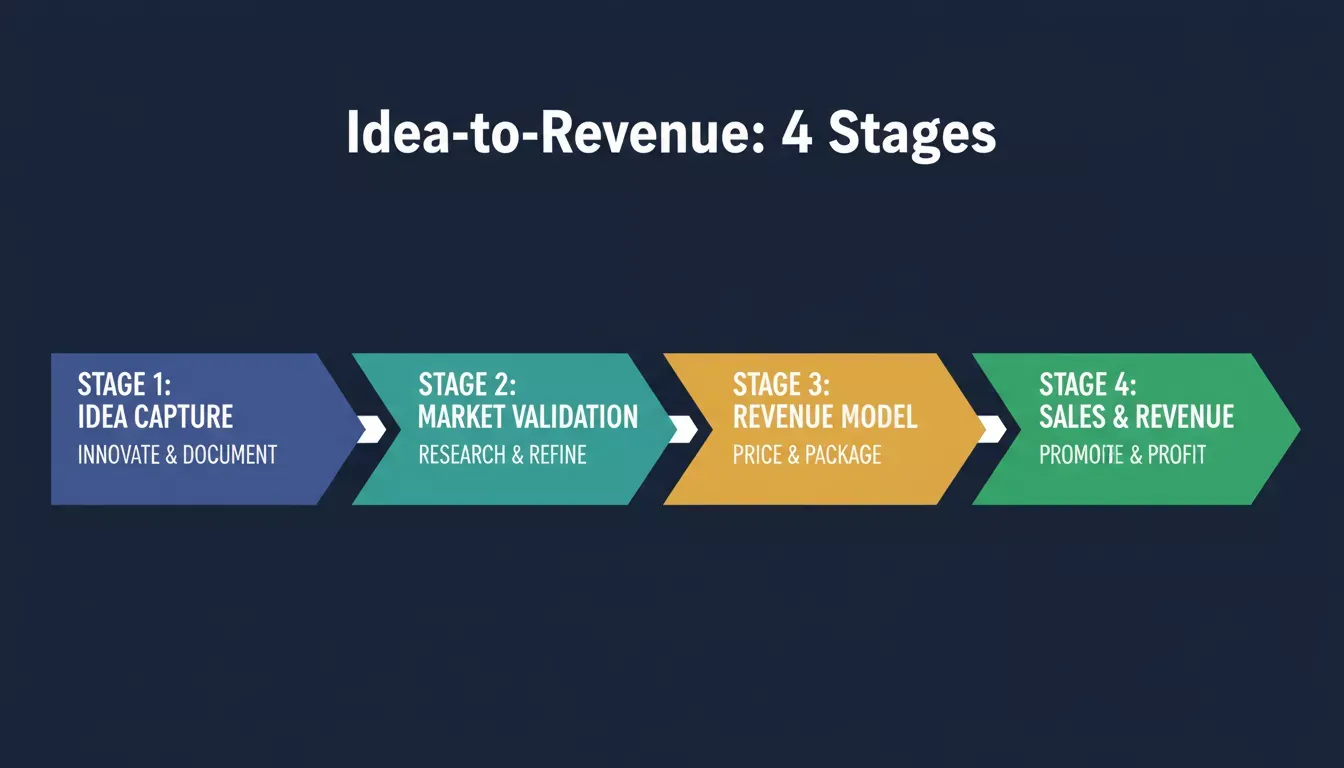
The four stages of the Idea-to-Revenue Workflow, from raw concept to consistent revenue
What Is the Idea-to-Revenue Workflow?
The Idea-to-Revenue Workflow is an end-to-end sequence that takes a raw concept and converts it into consistent, measurable revenue.
It covers four broad phases:
-
Idea capture and screening
-
Market validation
-
Product development with a clear revenue model
-
Go-to-market execution with ongoing revenue stream management
Most teams run these phases separately, with different tools, different owners, and no shared context between steps.
That disconnect is exactly where revenue gets lost. A well-designed workflow connects every phase into a single traceable path.
Each decision, from defining the revenue stream to choosing a business model, becomes part of a documented, repeatable process rather than a one-off call.
Why the Workflow Matters for Modern Teams
Speed used to belong only to large, well-funded teams. That advantage has largely disappeared.
-
Repetitive work kills momentum: Most companies spend a significant part of their product cycle on manual tasks, syncing data, chasing approvals, and redoing research that already exists somewhere else.
-
Teams without a workflow react instead of plan: Without a clear process, every stage feels like starting from scratch, and focus shifts to whatever is loudest rather than what drives value.
-
Structured teams ship faster and earn more: Companies using defined workflows report 30-40% productivity gains in their first year, with measurable improvements in revenue outcomes.
-
Context loss at handoffs is the silent bottleneck: When the person who ran the research is not the same one building the product, most of the value gets lost between steps.
A shared workflow is not just a productivity tool: It is the difference between a team that iterates toward revenue and one that stays busy without getting paid. Teams looking to automate product development with AI are finding that structure is the prerequisite, not the afterthought.
Why Do Most Ideas Fail to Generate Revenue?
Most ideas fail because they never travel through a structured path to paying customers. They stall, sometimes at validation, sometimes at pricing, sometimes at the first sales conversation.
Three recurring failure patterns account for most cases:
-
Teams skip validation and build what they assumed, not what customers actually need.
-
They pick a revenue generation approach without testing whether customers will pay for it at the proposed price.
-
They build something real but have no defined process for converting interest into signed contracts and collected revenue.
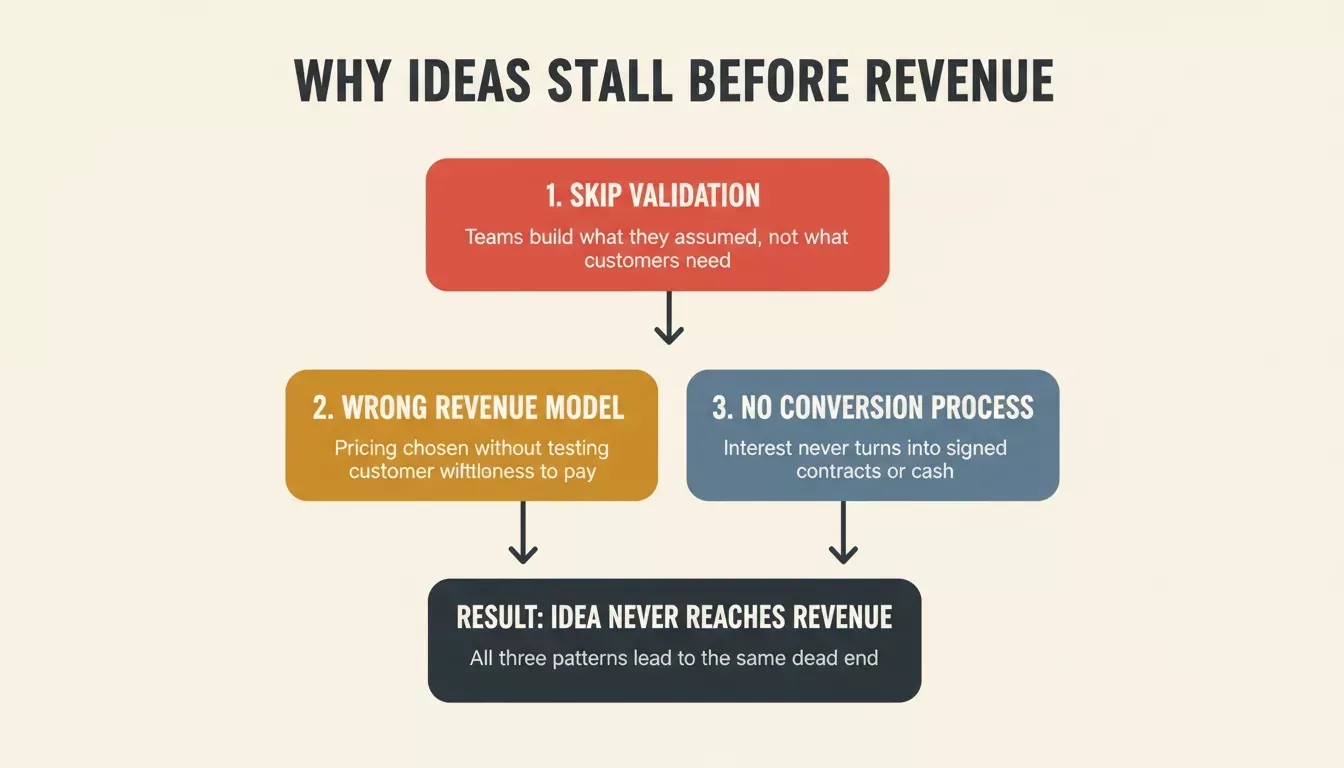
The three most common failure patterns that prevent ideas from reaching paying customers
Common Bottlenecks in the Idea-to-Cash Pipeline
-
No single source of truth: Teams scatter research across document systems, email threads, and shared files, and none of it connects to the product being built.
-
Market data that goes stale: By the time a team completes their research cycle, conditions have shifted and the data no longer reflects current reality.
-
Resource constraints misread as strategy problems: When companies run low on time or money mid-cycle, they cut validation steps, causing bigger failures downstream.
-
Demand signals mistaken for commitment: "Interesting" and "I'll pay for that" are very different responses, but most teams treat early interest as confirmed demand.
-
Finance and product operating in silos: The team tracking the revenue model is rarely the team defining the product roadmap, leading to a mismatch at every stage.
Catching these patterns early, before a budget is committed, separates the teams that reach revenue from those that run out of runway.
Stage 1: Capturing Ideas and Identifying Opportunities
The first stage most teams skip in their rush to build: deliberately capturing ideas and screening them to identify opportunities worth pursuing.
-
Capture everything, screen fast: Build a simple log for every incoming idea, from customer conversations, competitor signals, or internal discussions. Then apply a quick screen: does this reflect real market conditions? Does the problem clearly exist for a defined group?
-
Identify opportunities with a market lens: The best ideas solve a specific, documented problem for a defined group. A few hours of research around buyer behavior and existing solutions can save months of wasted development effort.
-
Start with the concept, not the solution: Teams that fall in love with their solution before validating the concept almost always build the wrong thing. The concept should be testable before it is buildable.
-
Narrow market segments early: Identifying opportunities sharpens considerably when you target a specific group with a specific need, not "businesses" but "B2B SaaS companies with fewer than 20 people and no dedicated sales team."
Ideas that pass this stage are not just interesting. They are grounded in evidence and scoped tightly enough to test.
What Makes an Idea Worth Pursuing?
-
Early customers exist and are vocal: When potential customers describe the problem unprompted, that is a strong signal. When they say "I've tried three options and none work," that is stronger still.
-
The target audience is specific: Ideas aimed at a precise customer base with a measurable pain point are far easier to validate and sell than ones targeting a broad, vague market.
-
Market segments are reachable: An idea in a market segment you have no way to reach, no connections, no channels, no path to a pilot, carries real risk regardless of how strong the concept is.
-
Someone is already paying for a partial solution: Spreadsheet workarounds, manual processes, and expensive consultants all signal that real demand exists and current supply is poor.
The honest filter question: if you asked 10 people in your customer segments about this problem, how many would take a 30-minute call without hesitation?
Founders using Rocket.new's Solve for market research can run this screening systematically before committing a single hour of build time.
Stage 2: Market Validation and Potential Customers
Market validation is the most skipped stage in the workflow, and the most expensive to skip. The purpose is not to confirm your own beliefs. It is to discover, as cheaply as possible, whether potential customers will pay for your concept before you invest in building it.
-
Run validation before writing any code: Talk to potential customers before committing to a build. Ask about the problem, not the pitch, and let them describe the pain in their own words.
-
Set a clear threshold for what "validated" means: Decide upfront: 7 of 10 potential customers confirm the problem and describe a budget? That counts. Two enthusiastic friends? That does not.
-
Test purchase intent, not just interest: Validated demand means people entering a card, signing a letter of intent, or requesting early access, not just saying "that sounds useful."
-
Validate revenue model assumptions, too: Market validation should test pricing assumptions as much as product ones. Will customers pay monthly? Per seat? By usage?
Teams that validate properly arrive at the build phase with genuine conviction. They know who they are building for and roughly what people will pay.
How Do You Validate Demand Before Building?
Demand validation is not a formal research project. It is a deliberate set of conversations and signals collected before committing resources to a build, and it is now faster with the right tools.
-
Bain & Company's research on early AI deployments in sales found that AI-led teams achieve win rates more than 30% higher than non-AI teams.
-
Separately, LinkedIn's 2025 State of Sales report found that 56% of sales professionals now use AI daily, and teams using AI for research are twice as likely to hit their targets.
Large enterprises have always invested in pre-market intelligence; AI now makes that same capability accessible to teams of any size.
Practical methods that work:
-
Customer interviews focused on the problem, not the pitch
-
Waitlist landing pages, because signups tell you more than any survey
-
Concierge pilots: manually deliver the service before automating it
-
Competitor usage signals: if people are paying for something worse, your idea is pre-validated
Mapping Customer Segments and Target Audience
Not all customers are equal. The fastest path to revenue runs through the segment most likely to buy first.
-
Define your primary customer segment in one sentence: "Marketing managers at B2B SaaS companies with 10-50 employees who run manual email campaigns" is a segment. "Businesses" is not.
-
Separate target audience from total addressable market: Your target audience is who you are selling to today. Conflating it with the total market leads to unfocused positioning and slow early sales.
-
Look for customer segments where both pain and budget coexist: A segment with acute pain but no purchasing power is a frustrating target, so look for both before committing.
-
Use early customers to refine the map: Study who already said yes, their role, company size, and the exact words they use to describe the problem.
Getting sharp on customer segments now makes every downstream step, pricing, messaging, and outbound prospecting faster and more direct. Teams that want to move from validated research directly into a working product can follow the research-to-launch workflow documented in Rocket's guides.
Stage 3: Defining Your Revenue Model and Revenue Stream
A strong product with the wrong revenue model still fails. Defining how you will charge and what your revenue stream looks like matters as much as what you build.
-
Your revenue model is a hypothesis, not a permanent decision. Most companies iterate on their revenue model before finding product-market fit. Start with a testable model rather than leaving it undefined.
-
Match your revenue stream to customer buying behavior. A customer who pays per project needs a different revenue stream structure than one who renews monthly. Mismatches create friction at every deal.
-
Start with a single revenue stream. One clear model executed well reaches revenue faster than three half-built ones running in parallel.
-
Your business model is the container for your revenue model. The business model defines who you serve and how you deliver value. The revenue model is the specific mechanism inside it, subscription, licensing, usage, and services.
Which Revenue Model Fits Your Business?
| Revenue Model | Best Fit | Key Risk |
|---|---|---|
| Subscription / SaaS | Recurring value delivery | Churn if value delivery is inconsistent |
| Usage-based pricing | Platforms where value scales with usage | Unpredictable income in early months |
| Project / Retainer | Services, agencies, consulting | Hard to scale without growing headcount |
| Licensing | IP, data, software libraries | Requires strong legal and IP structure |
| Marketplace / Commission | Multi-sided platforms | Chicken-and-egg problem at launch |
Usage-based pricing works well when the value customers receive is directly proportional to their usage. SaaS tools, API services, and data platforms follow this revenue model frequently.
Rocket's Solve feature can benchmark competitor pricing and model willingness to pay before you set a single price point.
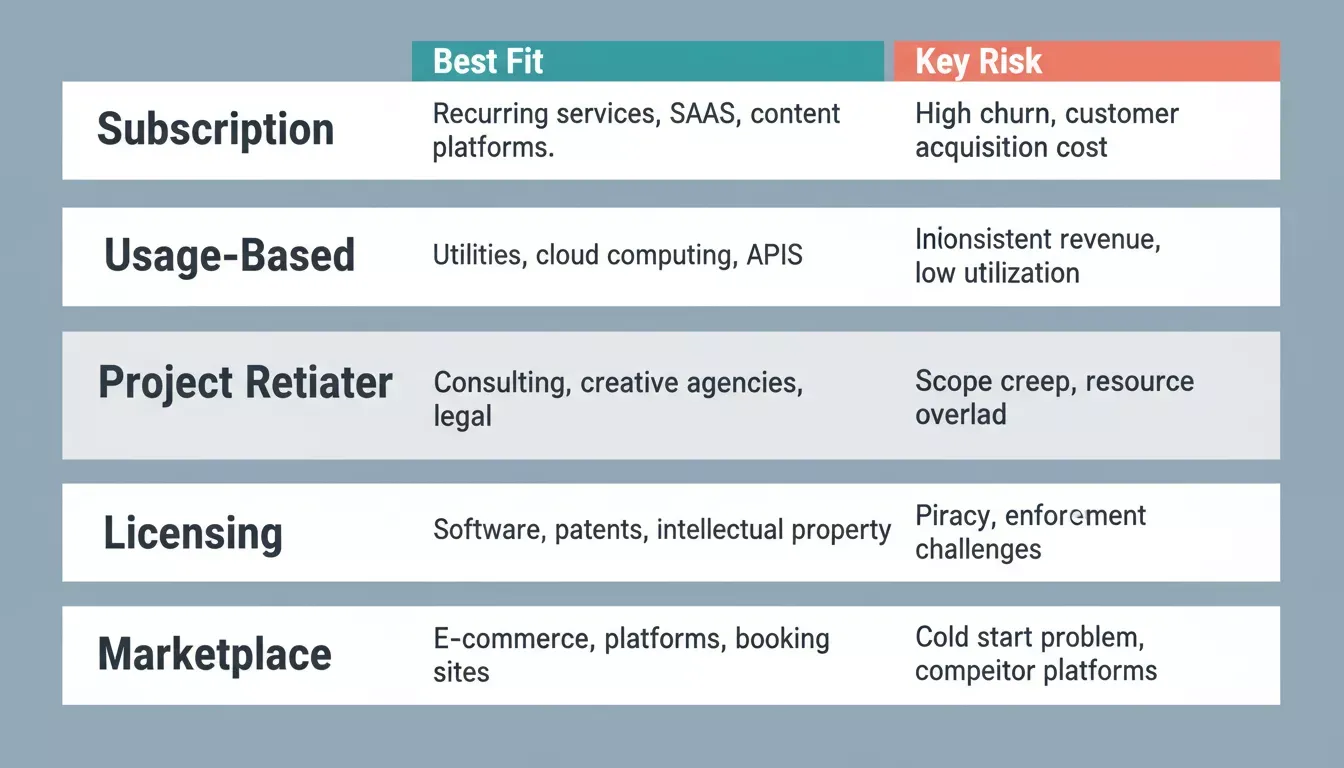
A quick-reference guide to matching your revenue model to your customer buying behavior
Pricing Strategy: What Customers Pay and Why
-
Price to reflect your value proposition, not your costs: If your product saves a client 10 hours per week, the pricing conversation starts with that outcome, not your infrastructure bill.
-
Anchor pricing to customer outcomes: Customers compare your price to the cost of their current situation: the manual process, the agency retainer, the unsolved problem. That is your real reference point.
-
Avoid competing on price alone: A clear value proposition lets you charge for results rather than cutting rates to win on cost.
-
Test pricing strategy with real potential customers: A simple question in a validation call, "what would this be worth to you?", produces better data than any competitive benchmarking session.
Building a Value Proposition That Converts
-
Make it specific: "We help teams move faster" is not a proposition. "We cut the time from concept to first paying customer from months to days" is.
-
Ground it in outcomes, not features: Users buy results. A proposition built around "your team ships production-ready products without a dev team" converts better than one built around feature lists.
-
Test it in one sentence: If it takes a paragraph to explain, it is not ready. The best value propositions pass the 15-second conversation test.
-
Revisit as your customer base grows: The proposition that wins early customers is rarely the one that scales to your second wave.
Build Products That Sell: The Build-to-Market Phase
After validation and a defined revenue model, the question becomes practical: how do you build products people will pay for, without burning months and budget finding out what works?
-
Build the smallest version that proves the core value: Win at this stage by shipping a focused version first, prove the value proposition on a small scale before committing to full scale.
-
Choose platforms that match your current stage: A validation-stage team does not need enterprise data storage. They need to move fast and create something real customers can respond to.
-
Access determines pace: The bottleneck is rarely the idea. It is access to the right tools and skills at the right moment.
-
Keep validation context in view during the build: The people who defined the revenue model and mapped customer segments need to stay connected to what is being built. Context loss here is where products drift from what customers actually need.
Build products with customer evidence always in view: The path to first revenue is shorter when what you ship matches what you already know people will pay for. Teams building B2B SaaS products with AI are compressing this entire stack into a single workflow.
Tools and Platforms That Speed Up Your Process
-
Research platforms: Customer data, competitor intelligence, and market signals gathered in one place beat three browser tabs and a scattered set of notes every time.
-
Build tools: Platforms that let non-technical team members create functional prototypes and production-grade products remove a major bottleneck on the path to first revenue.
-
Data storage: Keeping customer, product, and revenue data in a single system means the finance team and product team always share the same picture of what is happening.
-
Sales and outbound tools: The platforms handling lead capture, outreach sequences, and CRM work determine how quickly potential customers move from awareness to paying.
How Rocket Compresses Your Path to Revenue
Most teams run three to five separate tools across their idea-to-revenue cycle:
-
A research platform
-
Design tool
-
Build environment
-
Monitoring system
-
Reporting layer
Rocket.new collapses all of that into one.
It is built around the exact stages of this workflow.
You research the market with Solve.
Build the product with Build.
And track the competitive field with Intelligence.
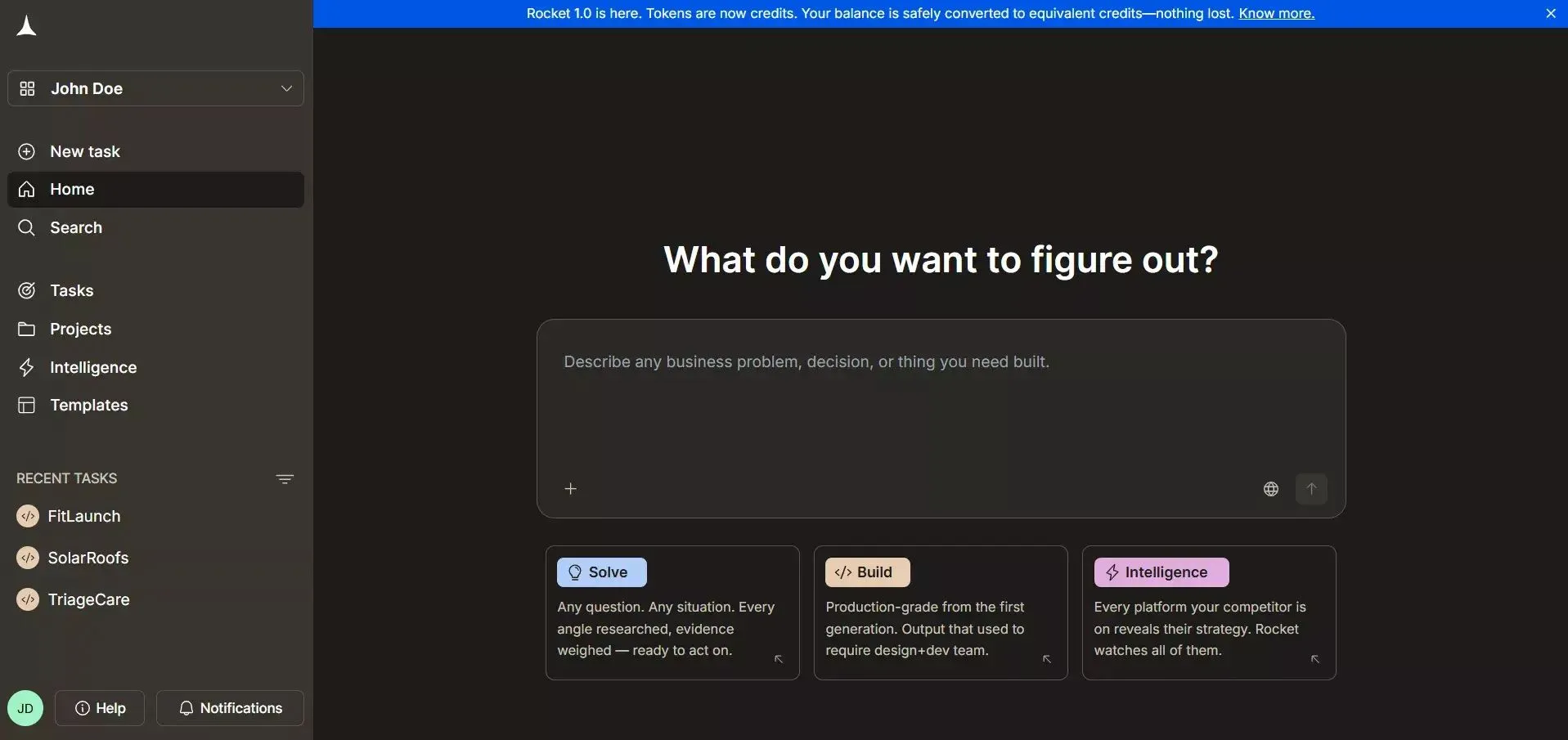 Traditional platforms force a handoff at every step. The market researcher passes a document to the product manager, who passes a brief to the developer, who builds without seeing the original customer signals. That handoff tax compounds fast.
Rocket removes it. The finance team, sales team, and product team all work inside the same project with the same accumulated intelligence informing every decision.
The repeatable Idea-to-Revenue cycle: validate, model, build, and scale
Research First with Solve: Validate Before You Build
Rocket's Solve feature takes any business question and delivers a structured, evidence-backed analysis, the kind that used to require hiring a research firm.
-
Ask market validation questions directly. "Is there demand for a B2B tool that automates invoice tracking for small finance teams?" Solve runs the research, surfaces the evidence, and returns a clear recommendation.
-
Get structured outputs you can act on. Not a list of links, but an actual analysis with findings, gaps, and a clear next step, exportable as a PDF or a presentation.
-
Test your revenue model assumptions. Use Solve to research pricing benchmarks, competitor pricing strategy, and customer willingness to pay before setting a single price point.
Build Faster with AI: From Concept to Launch in Days
Rocket's Build turns validated concepts into production-grade products, web apps in Next.js, Flutter mobile apps, high-converting landing pages, and full multi-page websites, without a development team.
-
Describe what you want in plain language. No code required. Rocket produces production-quality output from the first generation.
-
26+ connectors flow in automatically. Stripe, Supabase, Mailchimp, Linear, Notion, HubSpot, and more, connected once and available across every project.
-
Iterate from customer evidence, not assumptions. Because Solve research lives in the same project, every build decision is grounded in what customers actually told you.
Rocket.new unifies market research, app building, and competitor intelligence in one shared project
Track Competitors with Intelligence to Protect Revenue
-
Rocket's Intelligence monitors every public platform a competitor uses, including websites, social media, job posts, product updates, and ad activity, continuously.
-
Get interpretation, not just alerts. Intelligence tells you what a change means for your business, not just what changed. It watches across nine signal pillars, including product releases, hiring velocity, pricing moves, and customer sentiment.
-
Use competitor signals to inform your revenue model. Pricing moves from a key competitor are an early signal about customer expectations. Intelligence surfaces these before they affect your pipeline.
Stage 4: Sales, Leads, and Revenue Generation
All the validation and build work produce nothing without a functioning sales and revenue generation path.
-
Start generating leads before the product is ready: Leads need to be 4-6 weeks ahead of launch. Waiting until the build is complete to think about sales is one of the most common ways teams stall at this stage.
-
Match the sales approach to the revenue model: A usage-based model needs a self-serve path. A high-contract-value deal needs a human-led sales process. Mismatching these stalls affects revenue generation.
-
Earn from early customers before scaling: Early paying customers give you cash and evidence. Use both before investing in growth.
-
Track conversion at every funnel stage: Leads converting to revenue are the only real signal that your value proposition, pricing, and positioning are working together.
Sales start during validation. The conversations and objections from that phase are the foundation of every future outbound prospecting effort.
Outbound Prospecting and Inbound Channels That Work
-
Outbound prospecting works when you have a defined target. Direct outreach with a specific, evidence-based message to a precise customer segment converts. Generic outbound to a broad list does not.
-
Inbound compounds over time. Content and community presence build a demand channel that takes months to develop but becomes a reliable, lower-cost source of leads.
-
Use outbound to fund inbound. Win early revenue through direct outbound prospecting, then reinvest into content and SEO channels that generate leads at scale.
-
Study your first 10-20 clients closely. Their role, industry, and what they said yes to tells you where to focus outbound prospecting and what to create for inbound.
The best channel is the one your customers already use. Find it through early outbound, then build a system around it. Teams building SaaS products can use Rocket's buyer intent data guide to identify which accounts are already in-market before the first outreach.
How the Finance Team and Invoice Management Fit In
Revenue does not exist until it is collected. This is where many hard-won sales stall unexpectedly.
The pattern shows up frequently in B2B practitioner communities: teams close a strong pipeline quarter and still miss revenue targets because billing and invoice collection break down. Signed contracts do not automatically equal cash in the account.
Removing manual billing steps frees finance professionals for higher-value work and measurably reduces days-sales-outstanding.
-
Consistent invoice number sequencing from day one: A clean invoice number mapped to each contract number makes reconciliation fast and dispute-free.
-
Match line items to what the customer agreed: Discrepancies between line items on an invoice and the original contract create payment delays and strain on client relationships.
-
Agree on payment terms before signing: The finance team and sales team need to settle on net-30 vs. upfront before, not after, the contract closes.
-
Automate invoice delivery and follow-up reminders: Manual billing is a revenue tax. Structured follow-up reduces days-sales-outstanding significantly.
The finance team is not downstream of revenue. They are part of creating it.
Why Most Companies Get Stuck Before Scaling
Reaching first revenue is one milestone. Building a business that sustains consistent revenue at scale is a different challenge, and most companies underestimate the gap between the two.
| Stage | Stall Pattern | Root Cause |
|---|---|---|
| Post-launch | Revenue plateaus after early customers | No structured outbound or inbound channel |
| Growth | Customer base grows, but margins compress | Pricing model not designed for scale |
| Scale | Support volume grows faster than revenue | No self-serve tier in the revenue model |
| Expansion | Cannot enter new market segments | Model built around one customer type |
| Finance ops | Cash flow gaps despite growing revenue | The invoice and collection process is manual |
The most common thread: companies that struggle to scale were building for today's customers rather than designing a process capable of serving tomorrow's.
Resources spent fixing a broken scaling process are resources not spent on innovation and growth. Catching these patterns during the revenue model and market validation design phases is far less expensive than redesigning everything post-launch.
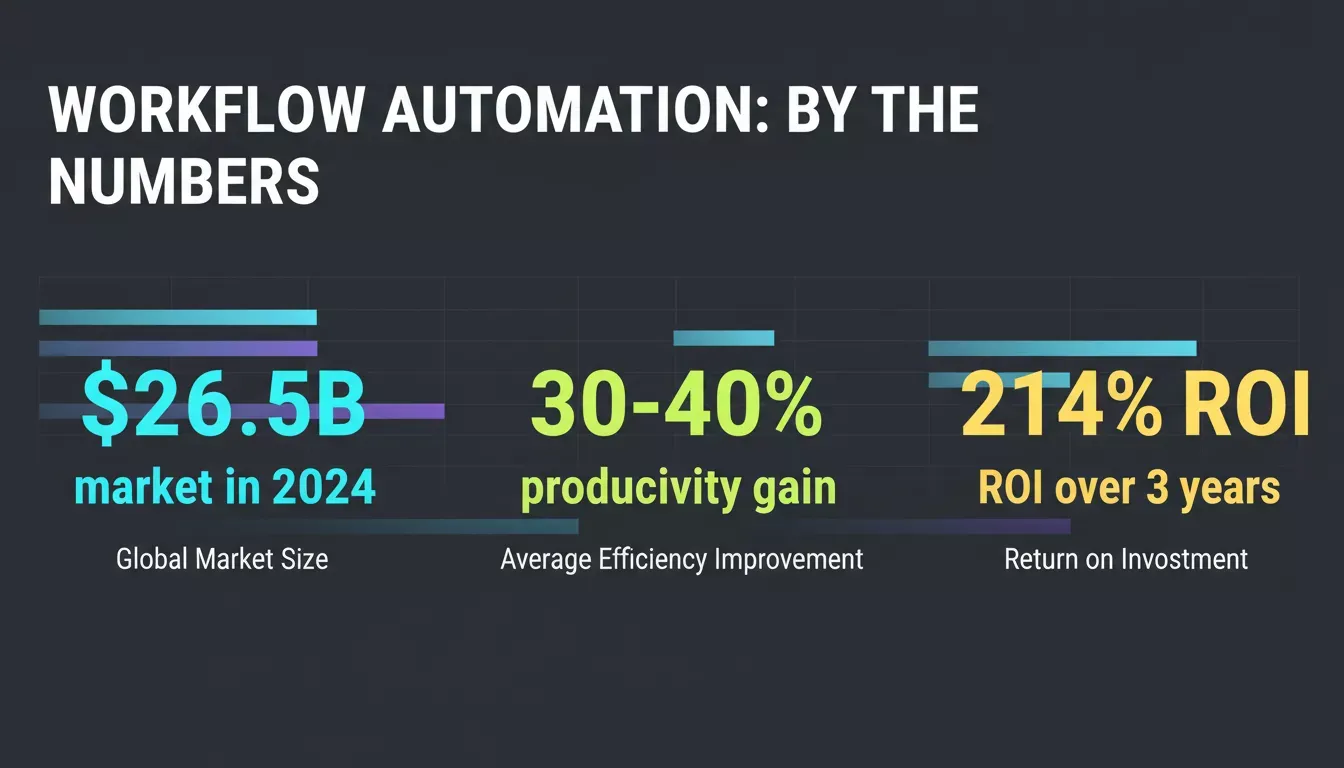
Key data points on workflow automation adoption and ROI, sourced from Grand View Research and Forrester
Building a Repeatable Process for Long-Term Growth
A workflow you run once is a project. A workflow you can run repeatedly, with different products, teams, and markets, is a business.
The goal of this entire sequence is a repeatable process: one where the outputs are predictable, the stages are documented, and each run gets faster than the last.
-
Document every decision. Each run of the cycle should produce documentation, customer signals, validation results, model choices, that makes the next run faster.
-
Measure three numbers: conversion from idea to validated concept, time from concept to first revenue, and customer acquisition cost per early customer.
-
Keep cycles short. Long-term growth comes from running many short, validated cycles. A team on 30-day validation cycles learns faster than one running 6-month cycles.
-
Feed each new cycle with signals from the last. The feedback, complaints, and usage patterns from current customers are the raw material for the next idea capture stage.
A repeatable process is not rigid. It has enough structure to run confidently and enough flexibility to improve every time.
Ready to compress your own idea-to-revenue cycle?
Rocket gives your team a single platform to research your market, build your product, and track the competition, without the tool-switching, context loss, or handoff delays that slow most teams down.
Table of contents
- -Why Do The Most Ideas Never Reach Paying Customers?
- -What Is the Idea-to-Revenue Workflow?
- -Why the Workflow Matters for Modern Teams
- -Why Do Most Ideas Fail to Generate Revenue?
- -Common Bottlenecks in the Idea-to-Cash Pipeline
- -Stage 1: Capturing Ideas and Identifying Opportunities
- -What Makes an Idea Worth Pursuing?
- -Stage 2: Market Validation and Potential Customers
- -How Do You Validate Demand Before Building?
- -Mapping Customer Segments and Target Audience
- -Stage 3: Defining Your Revenue Model and Revenue Stream
- -Which Revenue Model Fits Your Business?
- -Pricing Strategy: What Customers Pay and Why
- -Building a Value Proposition That Converts
- -Build Products That Sell: The Build-to-Market Phase
- -Tools and Platforms That Speed Up Your Process
- -How Rocket Compresses Your Path to Revenue
- -Research First with Solve: Validate Before You Build
- -Build Faster with AI: From Concept to Launch in Days
- -Track Competitors with Intelligence to Protect Revenue
- -Stage 4: Sales, Leads, and Revenue Generation
- -Outbound Prospecting and Inbound Channels That Work
- -How the Finance Team and Invoice Management Fit In
- -Why Most Companies Get Stuck Before Scaling
- -Building a Repeatable Process for Long-Term Growth