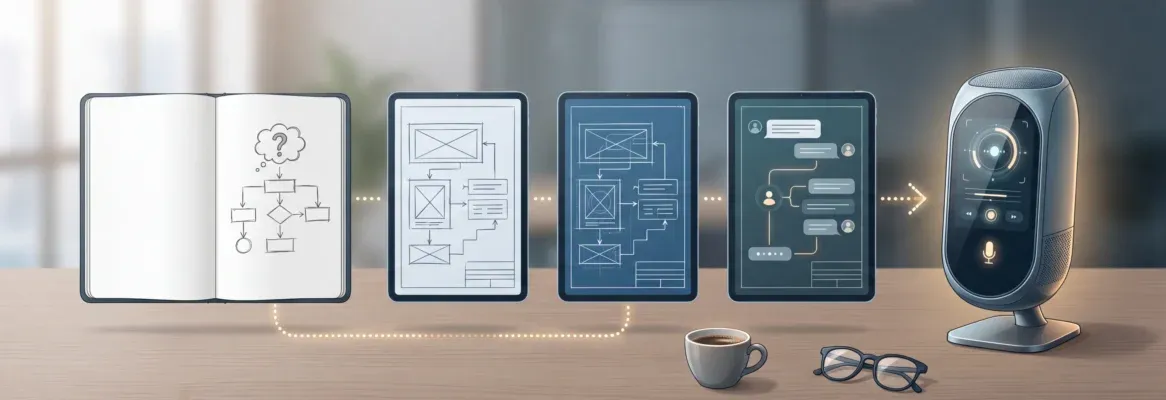
Structured AI prompts for non-technical founders turn vague ideas into validated products. This blog covers 20 copy-ready prompts across market research, MVP building, competitive analysis, and growth, with no coding required.
AI prompts for non-technical founders are the single highest-leverage skill in the modern startup toolkit.
According to Forbes Advisor, 72% of businesses have adopted AI for at least one business function. Yet most founders get generic outputs because their prompts lack structure. The gap between founders who get real, actionable results and those stuck with surface-level answers comes down entirely to how they frame their instructions.
This blog delivers 20 field-tested, copy-ready prompts across market validation, MVP building, competitive research, and post-launch growth. Each one is designed to produce a deliverable you can act on today.
Why AI Prompting Is the New Founder Superpower?
The cost of building a product dropped dramatically over the last three years. What once required a six-figure engineering team can now be described in plain language and generated in minutes. That shift, however, created a new bottleneck. Most founders use AI tools like a search engine, typing a vague question and hoping for a useful answer.
That approach fails for a predictable reason. AI models respond to the quality of the instruction they receive. A vague prompt produces a generic output. A structured prompt, one that includes role, context, constraints, and output format, produces a deliverable that moves your business forward.
The right prompt structure is the difference between a paragraph of fluff and a deliverable you can act on.
CB Insights analyzed 431 VC-backed companies that shut down since 2023 and found that poor product-market fit was the primary cause in 43% of cases. That is not a product problem. It is a thinking problem that happened before the product was built. The right AI prompts for non-technical founders solve that problem at the source.
What Makes a Prompt "Founder-Grade"?
Not all prompts are equal. A founder-grade prompt has four components that separate it from a casual chatbot query.
A role assignment tells the AI what expert it should behave as. "You are a senior product strategist with ten years of B2B SaaS experience" produces fundamentally different output than an unframed question.
A situation brief gives the AI your specific context. Industry, target customer, stage, budget, and geography all shape the quality of the response. The more specific your brief, the more actionable the output.
An output format instruction tells the AI exactly what to produce. "Give me a ranked list of five items with a one-sentence rationale for each" eliminates the rambling paragraph response that looks thorough but says nothing.
A constraint layer mirrors your real-world limits. "Assume a team of one, a monthly budget under $500, and a six-week launch window" forces advice you can actually execute, not advice designed for a Series A company.
The Prompt Anatomy Framework
Every prompt in this guide follows the same underlying structure. Understanding it lets you adapt any prompt to your specific situation.
Role + Context + Task + Format + Constraints = Founder-Grade Output
When you apply this framework consistently, you stop getting generic answers and start getting structured deliverables. The difference between a useful AI output and a useless one is usually three extra sentences of context in your prompt.
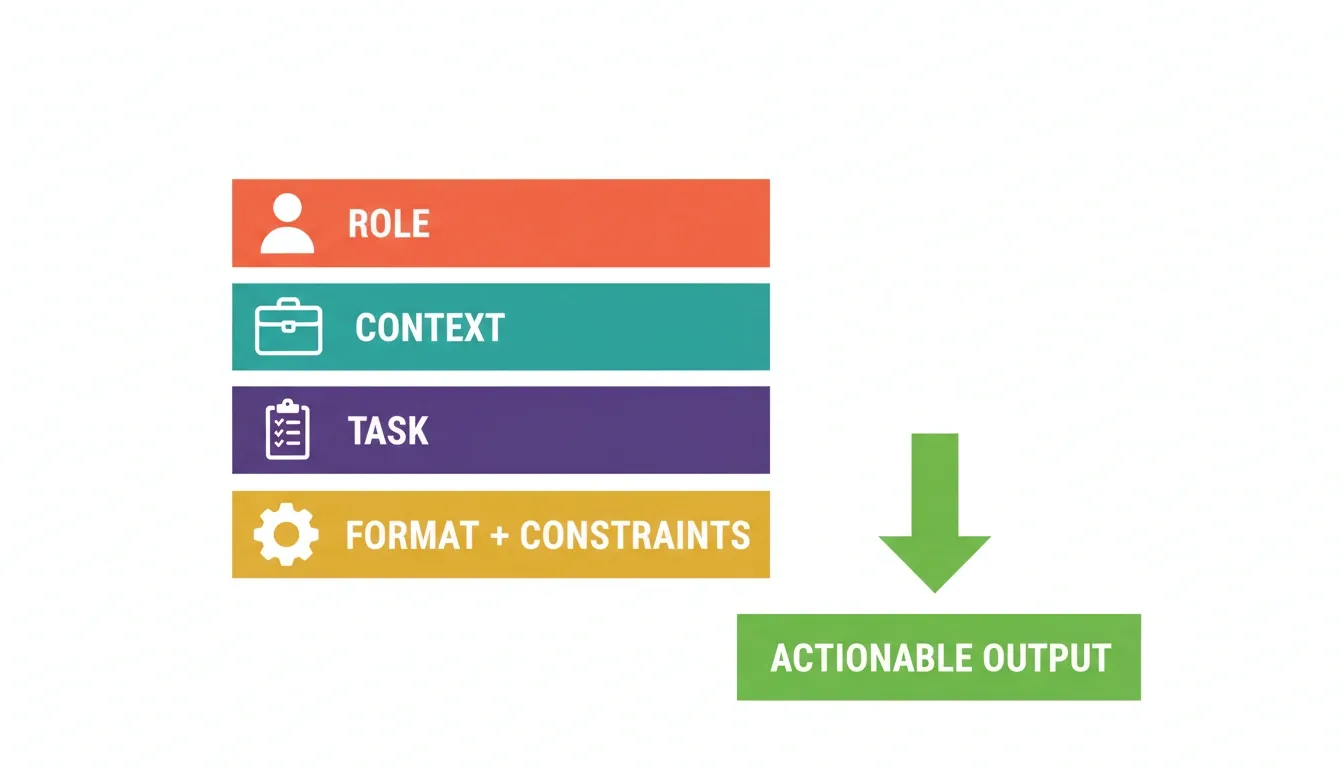
The four-component prompt anatomy framework. Apply this structure to every prompt for consistently stronger outputs.
How to Structure AI Prompts for Maximum Output Quality
Before jumping into the twenty prompts, it helps to understand the structural principles that make them work. These apply whether you are using ChatGPT, Claude, Gemini, or a purpose-built platform.
Lead with role and context. This single change improves output quality more than any other technique. State the output format you want, whether bullet points, a table, a one-page brief, or a step-by-step plan. Vague prompts produce vague answers. Specific format requests produce usable documents.
Include constraints that mirror your real world. Budget, timeline, team size, and target market all shape better outputs. Ask for reasoning, not just answers. Phrases like "rank these options and tell me why" force deeper analysis and surface assumptions you can challenge.
Iterate in the same thread. Follow-up prompts that build on prior answers create compounding value, much like a structured approach to prompting for app creation. Each iteration adds context the AI retains, producing progressively richer outputs.
Good prompts feel like briefing a smart consultant who has five minutes to understand your business. Give them what they need upfront, and the output shifts dramatically.
Prompt Quality Comparison
| Prompt Type | Example | Output Quality |
|---|---|---|
| Vague | "Help me with my startup idea" | Generic advice, no actionable steps |
| Moderate | "What should I build for HR teams?" | Broad suggestions, some relevance |
| Structured | "You are a product strategist. I'm building a B2B HR tool for 10-50 person companies. Identify the top 3 unmet needs, estimate willingness to pay, and list 2 competitors for each." | Prioritized opportunity map with pricing data |
| Founder-Grade | Above + "Format as a table. Assume a solo founder with $2K/month budget and 8-week runway." | Actionable deliverable ready for investor deck |
Which AI Prompts Help Non-Technical Founders Validate Their Market?
Market validation is where most startups live or die. CB Insights found that poor product-market fit was the primary cause in 43% of startup failures, a problem that structured research prompts can catch before a single line of code is written.
So, here are five prompts that replace weeks of manual research with focused AI-driven analysis. Each one is designed to produce a specific deliverable, not just an answer.
The 5 Market Validation Prompts
| # | Prompt | What It Produces |
|---|---|---|
| 1 | You are a market research analyst. Identify the top 5 unmet needs in [industry] for [target customer]. For each, estimate willingness to pay and list 2 existing alternatives. | Prioritized opportunity map |
| 2 | Estimate the total addressable market for a [product type] serving [customer segment] in [region]. Show your math using bottom-up and top-down methods. | TAM calculation with methodology |
| 3 | Analyze 10 recent customer complaints about [competitor product] from review sites. Group them into themes and identify which theme represents the biggest opportunity. | Competitor weakness analysis |
| 4 | Write 5 customer interview questions that test whether [problem statement] is painful enough for [target user] to pay for a solution. | Interview script for validation calls |
| 5 | Create a lean canvas for a [product idea] targeting [audience]. Fill in each box with your best hypothesis and flag which assumptions carry the most risk. | One-page business model with risk flags |
How to Chain These Prompts for Maximum Impact
The real power comes from chaining these prompts sequentially. Run prompt 1 first to identify the highest-opportunity unmet need. Then feed that output directly into prompt 5 to build a lean canvas grounded in real market gaps rather than assumptions. Finally, use prompt 4 to design customer interviews that test the riskiest assumptions your lean canvas flagged.
This three-prompt chain takes under two hours and produces the same depth of market intelligence that would otherwise take weeks.
Real-World Example: SaaS Founder Using Prompt 1
A solo founder building a scheduling tool for independent physiotherapists ran prompt 1 with their specific industry context. The output identified "automated insurance pre-authorization" as the highest-pain unmet need, with an estimated willingness to pay of $150/month. That was significantly higher than the founder's initial assumption of $49/month. That single insight reshaped the entire product strategy before a single screen was designed.
Founders who pair these prompts with AI builders designed for non-developers can go from market insight to working prototype the same afternoon.
Ready to run these validation prompts on a platform that turns your research directly into a working product? Start building on Rocket for free and run your first validation prompt.
What AI Prompts Help Non-Technical Founders Build Their MVP Faster?
Once you know the market wants what you are building, the next bottleneck is speed. These prompts help non-technical founders scope, plan, and describe their product without writing a line of code.
The key insight: AI tools respond best to product descriptions that separate what from how. Tell the AI what the user does and what outcome they expect. Let the platform decide how to implement it.
The 5 MVP Building Prompts
Prompt 6:
You are a product manager. Break down this product idea into the 3 core features needed for a v1 launch: [idea]. For each feature, describe what the user does and what they see.
This prompt forces you to think in user actions rather than technical specifications. The output becomes the brief you hand to an AI builder. The more clearly you describe what the user does, the more accurately the builder generates what you need.
Prompt 7:
Write 8 user stories in the format "As a [user type], I want to [action] so that [outcome]" for a [product] targeting [audience]. Prioritize by which story proves the most value fastest.
User stories are the universal language between founders and builders. This prompt produces a prioritized backlog that tells you exactly what to build first and why. The prioritization instruction is critical because it forces the AI to apply product thinking, not just list features.
Prompt 8:
Describe the onboarding flow for a new user of [product]. Walk through each screen, what information they enter, and what they see after completing signup.
Onboarding is where most MVPs fail. Users who do not reach their first value moment within the first session rarely return. This prompt maps the critical path from signup to value delivery, screen by screen.
Prompt 9:
Generate a database schema for a [product type]. Include the main entities, their relationships, and which fields are required vs optional. Keep it minimal for a first version.
Non-technical founders often skip data modeling, which creates expensive rework later. This prompt produces a minimal schema that an AI builder can implement directly, without you needing to understand SQL or entity-relationship diagrams.
Prompt 10:
Write a product description prompt I can paste into an AI app builder to generate [product type]. Include: the purpose, target user, 4 key screens, design preference (modern/minimal), and one integration (Stripe for payments).
Prompt 10 is the bridge between planning and building. It produces the exact input format that purpose-built platforms accept to generate a working application. No developer handoff. No waiting.
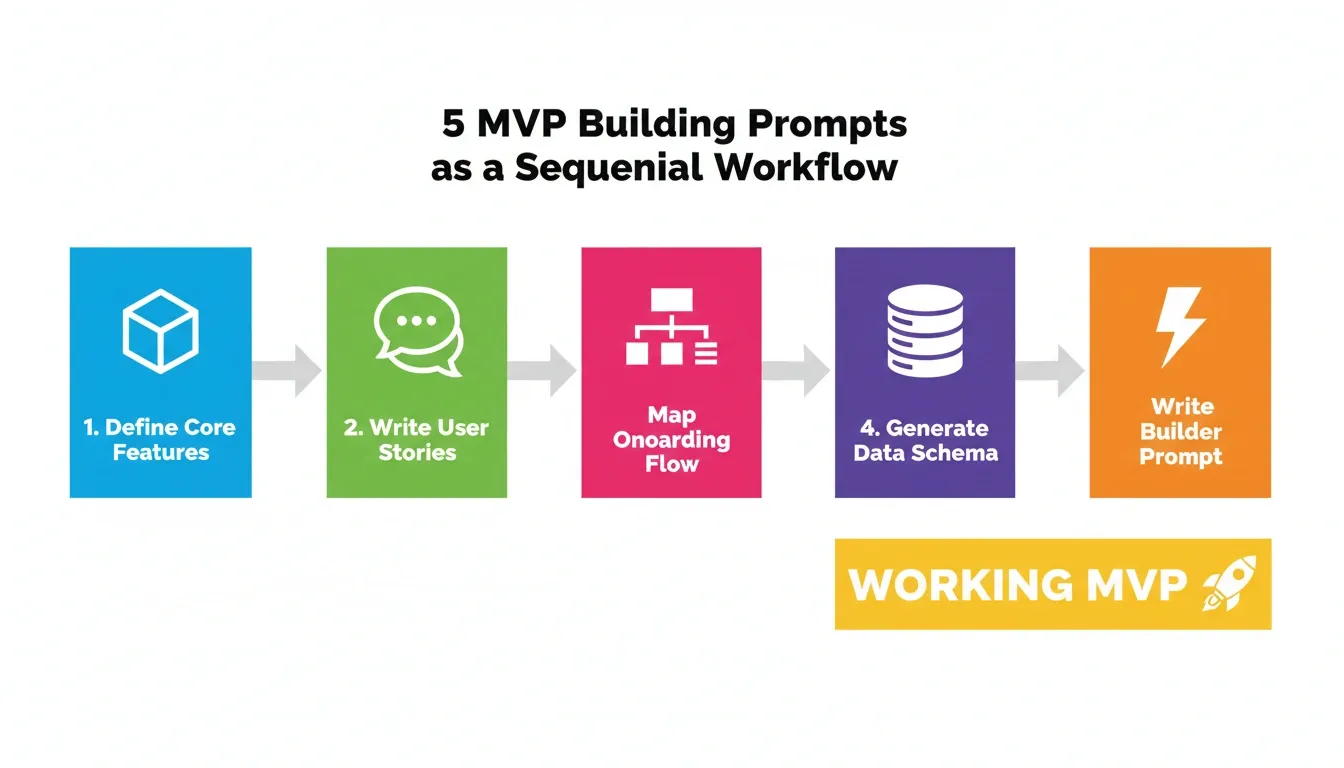
The five MVP prompts form a sequential workflow. Each output feeds the next, ending with a builder-ready product description.
Use Case: Non-Technical Founder Builds a Booking App
A founder with no coding background used prompts 6 through 10 sequentially to build a booking platform for independent yoga instructors. The output of prompt 10 was a 200-word product description she pasted directly into an AI builder's interface. The result was a working web app with Stripe payments, user authentication, and a booking calendar.
The total time from idea to working product was three hours. A two-sentence prompt gets you a generic to-do app. A structured six-line prompt built from this workflow gets you a production-ready SaaS with auth, payments, and a real design system.
For a deeper look at how prompt structure affects app quality, see how AI app builders save development costs.
You have your MVP prompts ready. Paste prompt 10 directly into Rocket and watch it generate a working app in minutes. Try Rocket for free and go from product description to live app.
Which AI Prompts Help Non-Technical Founders Decode the Competition?
Competitive research is where non-technical founders often feel most stuck. You know competitors exist, but translating that awareness into strategic positioning requires structured analysis. Fortunately, these prompts turn publicly available information into competitive clarity.
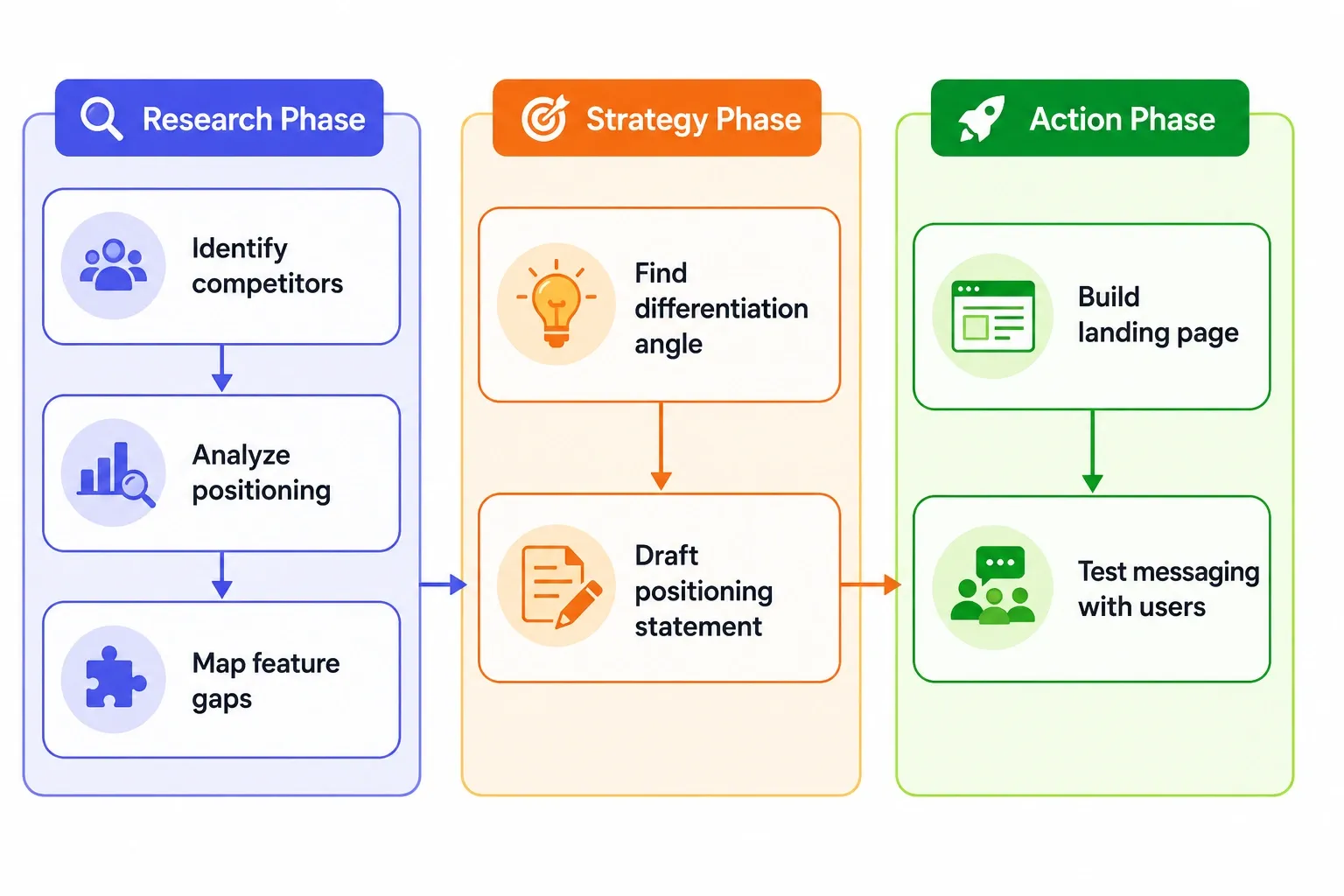
The 5 Competitive Research Prompts
Prompt 11:
Compare [my product idea] against [competitor 1] and [competitor 2]. For each, list their target audience, pricing model, strongest feature, and biggest weakness based on public reviews.
This prompt produces a structured competitive matrix in minutes. Using "public reviews" grounds the output in real customer sentiment rather than marketing copy, which is where genuine weaknesses live.
Prompt 12:
You are a brand strategist. Write a positioning statement for [my product] that differentiates it from [competitor] by focusing on [unique angle]. Use the format: For [target], [product] is the [category] that [key benefit] unlike [competitor] which [limitation].
The positioning statement format forces clarity. If you cannot fill in each blank specifically, you do not yet have a differentiated position. This prompt surfaces that gap before you spend money on marketing.
Prompt 13:
Analyze the pricing page of [competitor URL]. What pricing psychology tactics are they using? What tier is missing that my product could fill?
Pricing gaps are often the fastest path to differentiation. This prompt reframes the question from "what should I charge?" to "what position is unoccupied?", a fundamentally more strategic inquiry.
Prompt 14:
List 10 features [competitor] does NOT have based on their public marketing and documentation. Rank them by how valuable each would be to [target user].
Feature gap analysis from the customer's perspective, not the founder's wishlist. The ranking instruction forces prioritization. The output becomes a direct input to your product roadmap.
Prompt 15:
Write a SWOT analysis for entering [market] with [product idea]. Be specific about threats from [competitor 1] and opportunities from [market trend].
The specificity instruction is the key differentiator here. A generic SWOT is useless. A SWOT that names specific competitors and specific market trends produces strategic insights you can act on.
According to OpenAI's prompt engineering guide, providing relevant context and clear output constraints dramatically improves response quality. These competitive prompts apply both principles: they name specific competitors and ask for structured deliverables.
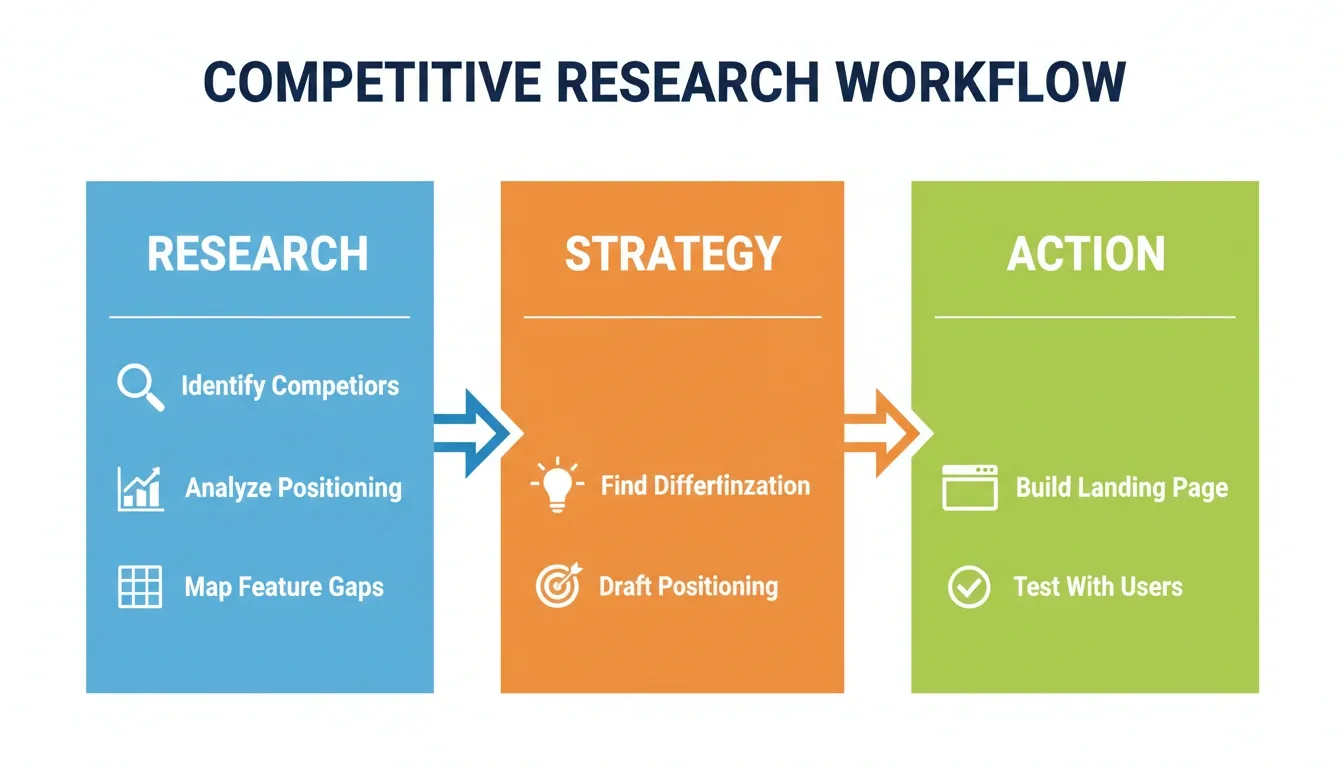
Three-phase competitive research workflow. From identifying competitors to testing your positioning with real users.
The founders who win are not the ones with the best ideas. They are the ones who understand their competitive position clearly enough to explain it in one sentence.
Run these competitive prompts on Rocket and your research feeds directly into your product build. No re-explaining. No copy-pasting. Sign up for free on Rocket and turn your competitive insight into a product that wins.
What AI Prompts Drive Growth After a Non-Technical Founder Launches?
Shipping is half the battle. The other half is getting the right people to notice. These prompts cover marketing copy, landing pages, investor preparation, and content that compounds over time.
The 5 Growth and Marketing Prompts
Prompt 16:
Write landing page copy for [product] targeting [audience]. Include: a headline (max 8 words), a subheadline explaining the key benefit, 3 feature blocks with icons, and a CTA button. Tone: confident, simple, no jargon.
Landing page copy is where most non-technical founders lose significant revenue. This prompt produces a complete copy structure in one pass. The format instruction mirrors the structure of every high-converting SaaS landing page.
Prompt 17:
Create a 60-second elevator pitch for [product] that I can use with investors. Structure: problem (10 sec), solution (15 sec), traction or proof (15 sec), ask (10 sec), memorable close (10 sec).
The time-boxed structure forces ruthless prioritization. If you cannot describe your problem in ten seconds, you do not yet understand it well enough to pitch it. This prompt surfaces that gap and forces you to resolve it.
Prompt 18:
Write 5 cold outreach emails for [product] targeting [decision maker title] at [company type]. Each email should use a different angle: pain point, social proof, curiosity, direct ask, and value-first.
Five emails with five different angles gives you a testing matrix. Send each to a different segment of your prospect list and measure reply rates. The highest-performing angle becomes your primary outreach template.
Prompt 19:
Generate a 30-day content calendar for [product] on LinkedIn. Mix: 2 educational posts, 2 behind-the-scenes posts, 1 customer story, 1 contrarian take, and 1 product demo per week.
Content consistency is the compounding asset most founders underinvest in. This prompt produces a complete 30-day plan in under a minute. The content mix instruction ensures variety, which is the primary driver of audience retention on LinkedIn.
Prompt 20:
Prepare me for a 5-minute investor pitch about [product]. List the 10 hardest questions a VC would ask, and draft a confident 2-sentence answer for each.
Investor preparation is where most first-time founders fail, not because their answers are wrong, but because they have never been asked the hard questions before. This prompt simulates the adversarial questioning of a real pitch meeting, so you arrive prepared rather than surprised.
Founders applying proven prompt engineering techniques consistently report that structured prompts cut their content production time by 60 to 70%. The pattern across all twenty prompts is the same: specificity, structure, and constraints produce useful outputs.
Your growth prompts are ready. Use them on Rocket and go from landing page copy to a live, deployed site in one session. Get started free on Rocket and ship your first growth asset.
How to Use AI Prompts Across Different Founder Stages
The twenty prompts in this guide are not all relevant at the same time. Using the right prompt at the right stage of your startup journey is as important as the prompt structure itself.
Prompt Relevance by Founder Stage
| Founder Stage | Highest-Value Prompts | Primary Goal |
|---|---|---|
| Idea validation (pre-product) | 1, 2, 3, 4, 5 | Confirm market need before building |
| MVP scoping | 6, 7, 8, 9, 10 | Define what to build and in what order |
| Pre-launch | 11, 12, 13, 14, 15 | Establish competitive position |
| Launch and growth | 16, 17, 18, 19, 20 | Acquire users and attract investment |
| Scale | All 20 with updated context | Iterate on what is working |
Industry-Specific Prompt Adaptations
The twenty prompts work across industries, but the specificity of your context variables determines output quality. Here are adaptations for three common founder verticals.
For SaaS founders, replace [industry] with your specific software category and [target customer] with the job title of your primary buyer. "VP of Customer Success at Series B SaaS companies" produces far better output than "business professional."
For marketplace founders, prompt 2 (TAM calculation) requires a different methodology. Add "Use a marketplace-specific TAM model that accounts for both supply-side and demand-side participants" to the base prompt.
For mobile app founders, prompt 8 (onboarding flow) should include "Optimize for mobile-first UX patterns including swipe navigation, progressive disclosure, and social login" to ensure the output reflects mobile conventions rather than web defaults.
Common Prompt Mistakes Non-Technical Founders Make
Understanding what makes prompts fail is as valuable as knowing what makes them succeed. These are the five most common mistakes and the specific fix for each.
Mistake 1: Treating AI like a search engine. "What are the best tools for non-technical founders?" is a search query, not a prompt. Fix: add role, context, and constraints to every question.
Mistake 2: Asking for opinions instead of deliverables. "What do you think about my business idea?" produces hollow encouragement. Fix: ask for a structured critique with a specific format.
Mistake 3: One-shot prompting on complex topics. Complex tasks require iterative prompting. Fix: break complex tasks into a prompt chain where each output feeds the next.
Mistake 4: Ignoring output format instructions. Getting a wall of text when you needed a table wastes time. Fix: always end your prompt with an explicit format instruction.
Mistake 5: Using generic context variables. Generic inputs produce generic outputs. Fix: replace every placeholder with the most specific description you can write.
For more on building products without a technical background, see how to build a web app without coding.
Why the Platform You Run Your Prompts On Changes Everything
Here is what most prompt guides will not tell you. The platform you run your prompts on matters as much as the prompts themselves.
Most AI tools treat every conversation as a blank slate. You paste a prompt, get an answer, then start over. Context disappears. The research you did yesterday has no connection to the product you are building today.
You describe the problem. Rocket researches it, recommends a direction, and builds from that direction.
Every prompt, every research thread, every decision stays connected inside a Project. The market validation you ran last week informs the landing page you build today, automatically. When you prompt Rocket to analyze your market, that output feeds directly into the Build step. No copy-pasting between tools. No translation loss between your insight and your product.
Rocket generates Next.js web apps and Flutter mobile apps with real design systems, dark/light theming, and built-in SEO. Not wireframes, but working products that are WCAG-accessible and GDPR-compliant by default. 25+ integrations including Stripe, Supabase, Google Analytics, and Mailchimp flow into your build automatically.
1.5 million people have tried Rocket across 180 countries. From solopreneurs shipping MVPs to enterprise teams rethinking their entire stack.
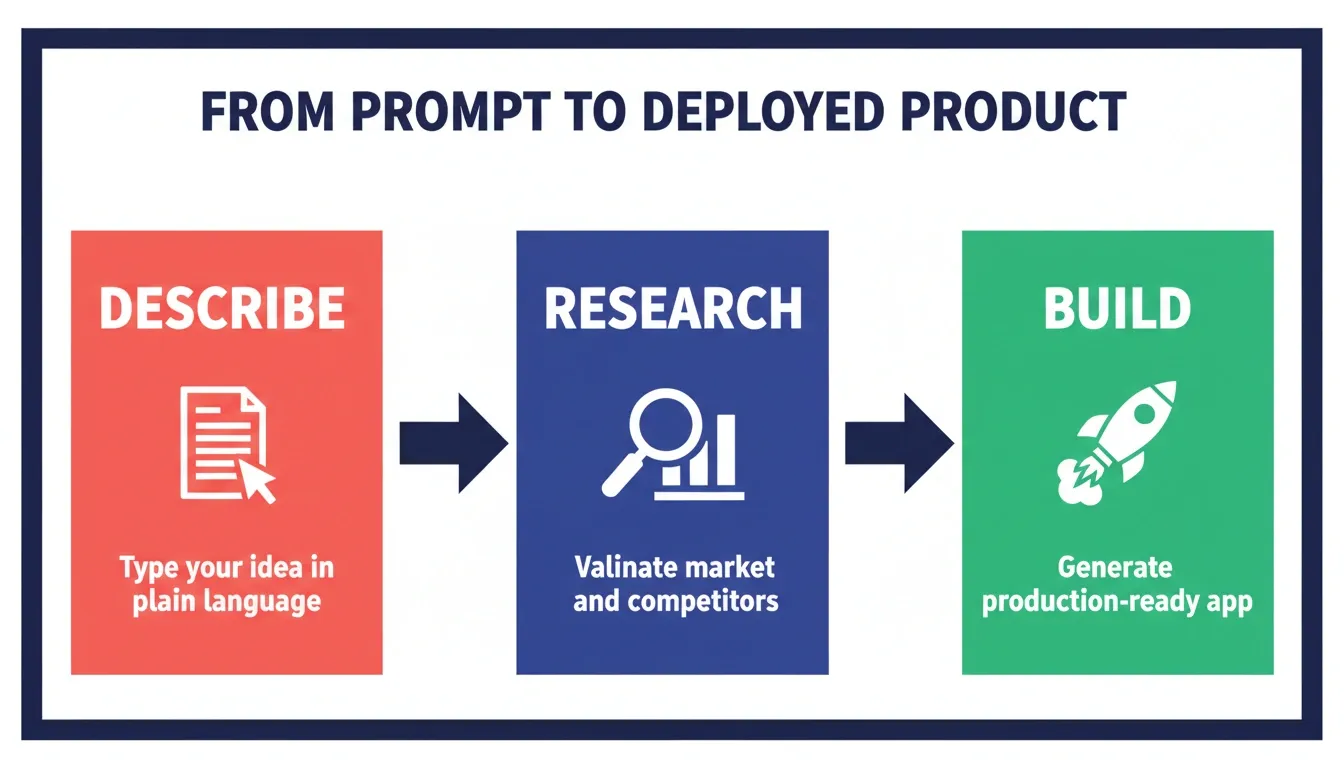 Rocket's three-step workflow connects your prompts directly to a deployed product. Research and build share the same context.
On Reddit, user u/buildfast_shipfaster shared: "I went from a vague SaaS idea to a deployed MVP with Stripe payments in a single weekend using Rocket. The fact that my market research fed directly into the build prompt made the whole thing feel like one continuous thought."
The difference is not speed alone. It is coherence. When your research, your decisions, and your product live in the same system, nothing gets lost.
See how Rocket's shared memory architecture works for a deeper look at how context compounds across tasks.
Rocket Pricing Plans
All plans include unlimited team members. Credits are the usage currency and one balance covers Solve research, Build generation, and Intelligence monitoring. Credits never expire and roll over month to month.
| Plan | Monthly Price | Monthly Credits | Key Capabilities |
|---|---|---|---|
| Free | $0 | 20 | Build websites, web apps, mobile apps; personalized business intelligence |
| Pro | $25 | 100 | All Free features; buy additional credits as needed |
| Rocket | $50 | 250 | All Pro features; consultant-grade solutions on demand |
| Booster | $250 | 1,500 | All Rocket features; power users and fast-moving teams |
Annual plans save 20%. Intelligence tracking costs 500 credits/month per competitor tracked (approximately $100/month).
The Complete AI Prompt Reference for Non-Technical Founders
| # | Category | Prompt Summary | Output |
|---|---|---|---|
| 1 | Market Validation | Top 5 unmet needs with willingness to pay | Opportunity map |
| 2 | Market Validation | TAM calculation bottom-up and top-down | Market sizing |
| 3 | Market Validation | Competitor review theme analysis | Weakness map |
| 4 | Market Validation | Customer interview question design | Interview script |
| 5 | Market Validation | Lean canvas with risk flags | Business model |
| 6 | MVP Building | Core features for v1 launch | Feature brief |
| 7 | MVP Building | Prioritized user stories | Product backlog |
| 8 | MVP Building | Screen-by-screen onboarding flow | UX map |
| 9 | MVP Building | Minimal database schema | Data model |
| 10 | MVP Building | AI builder-ready product description | Build prompt |
| 11 | Competitive Research | Structured competitor comparison | Competitive matrix |
| 12 | Competitive Research | Differentiated positioning statement | Brand positioning |
| 13 | Competitive Research | Pricing gap analysis | Pricing strategy |
| 14 | Competitive Research | Feature gap ranking | Roadmap input |
| 15 | Competitive Research | Specific SWOT analysis | Strategic brief |
| 16 | Growth | Landing page copy structure | Marketing copy |
| 17 | Growth | Timed elevator pitch | Investor pitch |
| 18 | Growth | Multi-angle cold outreach emails | Outreach templates |
| 19 | Growth | 30-day LinkedIn content calendar | Content plan |
| 20 | Growth | VC question prep with answers | Pitch preparation |
The Future of AI Prompts for Non-Technical Founders
The prompting skills that matter today will matter even more as AI capabilities compound. Several trends are shaping how non-technical founders will use AI prompts over the next two to three years.
Context persistence is becoming the primary competitive advantage. Platforms that retain the full history of your research, decisions, and product iterations produce dramatically better outputs than tools that reset with every session. The twenty prompts in this guide become exponentially more powerful when run inside a system that remembers everything.
Multimodal prompting, which combines text, images, and data in a single prompt, is expanding what non-technical founders can accomplish without technical skills. Describing a competitor's pricing page by uploading a screenshot and then asking for a gap analysis produces more accurate output than describing the page in text.
Agentic workflows are shifting prompting from a one-shot activity to an ongoing process. Rather than running a prompt and acting on the output manually, founders will increasingly use platforms where a single prompt triggers a chain of automated research, analysis, and building steps.
The founders who invest in prompt quality today are building a compounding advantage. Every structured prompt you write teaches you to think more clearly about your business. That clarity compounds across product decisions, investor conversations, and team alignment.
For a broader view of how AI is reshaping the startup journey, see how AI is changing product development.
Start With Your Next Prompt
Twenty prompts will not change your business sitting in a bookmarks folder. The ones that matter are the ones you run today, with your actual idea, your actual constraints, and your actual market.
Start with prompt 1 or prompt 6, whichever matches where you are right now. These AI prompts for non-technical founders are not just a guide. They are the thinking layer that separates founders who build what people want from founders who build what they assumed people wanted. You type the problem. Rocket researches it, recommends a direction, and builds from that direction. Sign up for free at Rocket.new and turn your next prompt into a live product.
Table of contents
- -Why AI Prompting Is the New Founder Superpower?
- -What Makes a Prompt "Founder-Grade"?
- -The Prompt Anatomy Framework
- -How to Structure AI Prompts for Maximum Output Quality
- -Prompt Quality Comparison
- -Which AI Prompts Help Non-Technical Founders Validate Their Market?
- -The 5 Market Validation Prompts
- -How to Chain These Prompts for Maximum Impact
- -Real-World Example: SaaS Founder Using Prompt 1
- -What AI Prompts Help Non-Technical Founders Build Their MVP Faster?
- -The 5 MVP Building Prompts
- -Use Case: Non-Technical Founder Builds a Booking App
- -Which AI Prompts Help Non-Technical Founders Decode the Competition?
- -The 5 Competitive Research Prompts
- -What AI Prompts Drive Growth After a Non-Technical Founder Launches?
- -The 5 Growth and Marketing Prompts
- -How to Use AI Prompts Across Different Founder Stages
- -Prompt Relevance by Founder Stage
- -Industry-Specific Prompt Adaptations
- -Common Prompt Mistakes Non-Technical Founders Make
- -Why the Platform You Run Your Prompts On Changes Everything
- -Rocket Pricing Plans
- -The Complete AI Prompt Reference for Non-Technical Founders
- -The Future of AI Prompts for Non-Technical Founders
- -Start With Your Next Prompt