
Founders are switching from drag-and-drop website builders to AI full stack tools. Traditional builders cap out at landing pages. Rocket.new generates complete apps with backend, mobile, and database from a single prompt, with no developer needed.
Founders are quietly switching from drag-and-drop website builders to AI-powered full stack platforms.
The global website builder market is projected to hit \$24.24 billion by 2035, growing at 10.6% annually, according to Precedence Research. That growth tells one story.
But the story founders are actually living is different: they started on Wix, Squarespace, or Webflow, hit a wall, and moved on.
This blog breaks down exactly why that shift is happening, what a drag and drop website builder cannot do, and why Rocket.new is where serious builders are going in 2026.
Is Your Website Builder Holding Your Startup Back?
The website builder market has split into two camps, and the gap widened sharply in 2025-2026 as AI-powered full stack generation became reliable enough to ship real products. Traditional drag-and-drop tools still serve a large audience, but founders building real products have outgrown them. Most tools in Camp 1 were built for Camp 1 users and were never designed for Camp 2.
-
Camp 1 - Content sites and portfolios: Wix, Squarespace, GoDaddy. Great for landing pages, blogs, and brochure websites. Drag and drop, fast setup, no coding knowledge needed.
-
Camp 2 - Product builders: Founders who need web apps, mobile apps, backend logic, databases, user authentication, and production-ready code. This group has moved to AI app builders.
If you are building a product, not just a website, you are probably already in the wrong tool.
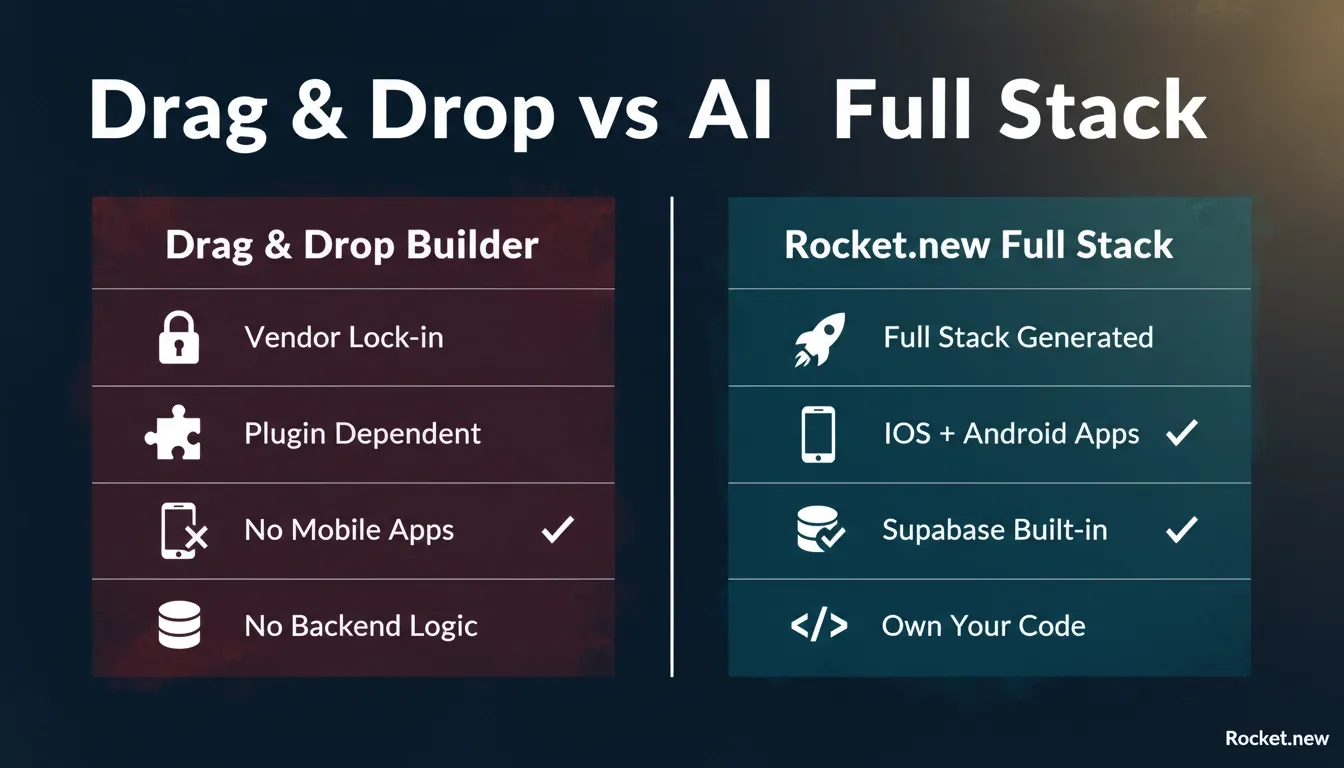
What a Drag and Drop Website Builder Actually Gives You
Drag and drop editors made website creation accessible to millions. That was a genuine breakthrough, but it came with hard structural limits that no amount of plugins can fully overcome. Visual editing, template-based layouts, and bundled hosting are genuinely useful for simple sites.
-
Visual editing without code: Move blocks, swap images, change fonts. No developer needed for basic sites.
-
Template-based layouts: Pick a design, fill in your content, publish. Fast for simple use cases.
-
Limited backend logic: Most builders handle contact forms and basic e-commerce. Anything beyond that requires third-party integrations or plugins.
-
Vendor lock-in: Switching platforms means rebuilding from scratch. Your content, design, and customer data do not travel with you, as noted in independent platform reviews.
-
Paid plans that add up: Wix starts at \$17/month, Squarespace at \$16/month, Shopify at \$29/month, and most advanced features require higher-tier paid plans.
For a landing page or a portfolio, these tools are fine. For a working product with backend logic and real users, they run out of runway fast.
The Wall Founders Keep Hitting
There is a pattern that repeats across early-stage teams. They start with a drag-and-drop editor, get something live quickly, then hit the same wall. This is not a skill problem. It is a tool problem.
Here is what that wall looks like in practice:
-
You need user authentication: Most drag-and-drop builders do not generate real auth flows. You end up patching in third-party tools.
-
You need a database: Traditional builders do not offer database setup. You are stitching Airtable or Notion into your site.
-
You need mobile apps: Drag and drop editors build websites, not mobile apps. Flutter or React Native requires a developer.
-
You need version history: Most traditional builders offer limited or no version history. One bad edit and you are rebuilding.
-
You need staging and production environments: Testing changes safely before going live is a basic developer workflow. Most website builders do not support it.
-
You need full control over your code: Drag and drop tools generate locked, proprietary output. Code ownership is either impossible or severely limited.
Non-technical founders hit this wall and face a hard choice: hire a developer, or find a tool that actually generates full stack apps. That is exactly the gap Rocket.new was built to close, and why founders who need to move fast are making the switch.
How AI App Builders Changed the Game
AI app builders did not just make website creation faster. They changed what non-technical founders could actually ship, turning a multi-month engineering project into a single prompt. The shift from drag-and-drop to AI app building is structural, not incremental.
-
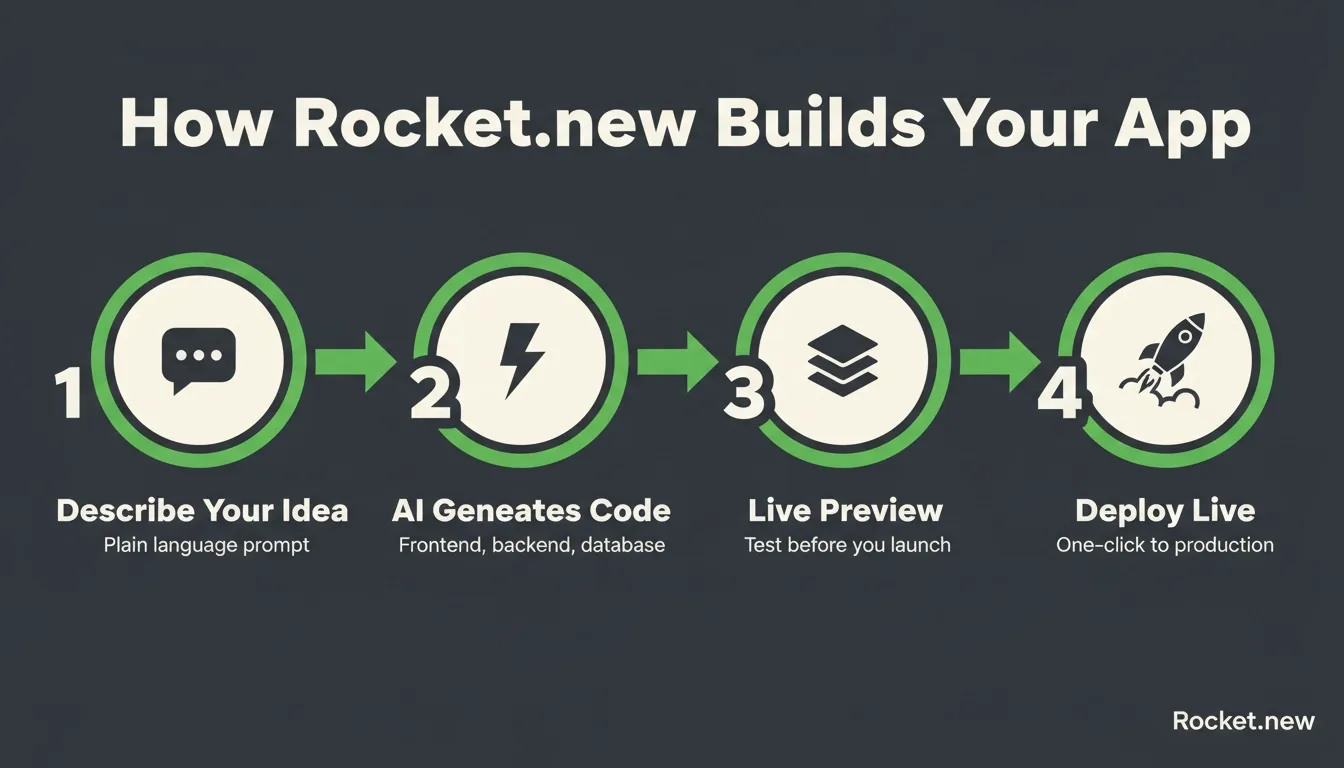
Natural language to full stack: Describe what you want in plain language. The AI generates frontend, backend logic, database setup, and APIs together.
-
Production-ready code from the first generation: Not a prototype or wireframe. Actual deployable code that you own and can export.
-
Web and mobile from one prompt: Rocket.new generates web apps using Next.js and mobile apps using Flutter for iOS and Android from a single workflow.
-
No coding knowledge required: Non-technical founders can build real apps without writing a single line of code.
-
Shared context across the build: The AI remembers your decisions, product logic, and architecture throughout the project. No context loss between sessions.
-
GitHub sync: Two-way code sync keeps your project in version control so teams can collaborate using standard developer workflows.
"I spent three months trying to make Webflow do things it was never designed to do. Switched to an AI builder and had a working product in a week. The difference is night and day." - Shared on Reddit r/startups
Rocket.new vs Traditional Website Builders: A Deep Dive
The comparison between Rocket.new and traditional website builders is not about design quality. It is about what each tool is actually built to do. Traditional builders are optimized for publishing. Rocket.new is optimized for building.
| Feature | Drag and Drop Builders | Rocket.new |
|---|---|---|
| Frontend | Visual editor, templates | AI-generated, production-ready |
| Backend logic | Limited or plugins | Full backend generated |
| Database setup | None or third-party | Built-in with Supabase |
| Mobile apps | Not supported | Flutter for iOS and Android |
| Code ownership | Locked or no export | Full exportable code, GitHub sync |
| Version history | Limited | Full history, one-click rollback |
| Staging environments | Rarely supported | Supported |
| Custom domain | Yes, on paid plans | Yes |
| Free plan | Yes, with limitations | Yes, 20 free credits (one-time) |
| SEO ready structure | Basic | Built-in by default |
| Accessibility | Varies | WCAG 2.1 AA compliance built-in |
| Native integrations | Plugin marketplace | 26+ native connectors |
1flowchart LR
2 A([Idea]) --> B{Tool?}
3 B -->|Drag & Drop| C[Landing Page]
4 B -->|Rocket.new| D[Full App]
5 C --> E{Need Backend?}
6 E -->|Yes| F[Hit the Wall]
7 E -->|No| G([Ship])
8 F --> D
9 D --> H([Live Product])
10 style A fill:#1a73e8,color:#fff
11 style B fill:#f5a623,color:#fff
12 style C fill:#e8453c,color:#fff
13 style D fill:#34a853,color:#fff
14 style E fill:#f5a623,color:#fff
15 style F fill:#e8453c,color:#fff
16 style G fill:#34a853,color:#fff
17 style H fill:#1a73e8,color:#fff
Why Founders Moved: The Rocket.new Plan
The Rocket.new plan for founders is about getting a working product without a developer, without the learning curve of traditional builders, and without the limitations of low-code tools. It covers the full range of what early-stage teams actually need to ship. Here is what founders actually get:
-
Full stack app generation from a single prompt: Rocket.new generates the complete app: UI, backend, database, auth, and APIs.
-
AI-powered iteration: Describe changes in natural language. Rocket.new updates the code without breaking existing logic.
-
Live preview and live URL: See your app running in real time. Share a live URL with investors or users before writing a line of code.
-
One-click deployment: Push to production without DevOps knowledge. Rocket.new handles hosting, deployment, and infrastructure.
-
Version history and rollback: Every build is saved. Roll back to any previous version with one click from the Build editor.
-
Shared context across sessions: Rocket.new remembers your product decisions. You do not re-explain your app every time you start a new session.
For solo founders and small teams, this is the difference between shipping in days and spending months trying to figure out tools. You can explore the full quick start guide to go from idea to live app in 10 minutes.
App Building Without the Learning Curve
Rocket.new is built specifically for non-technical founders who need real apps, not just pretty websites. The platform covers everything from SaaS products to internal tools to mobile apps, all from plain language prompts.
-
No coding skills needed: Describe your product idea in plain language. Rocket.new handles the rest.
-
Internal tools in minutes: Build dashboards, admin panels, and CRM tools without a developer. The internal tool recipe walks through the full process.
-
eCommerce stores with real checkout flows: A full e-commerce app with checkout flows, inventory, and customer portals. Not a template with a payment plugin.
-
SaaS products with user authentication: Sign-up flows, login, password reset, and role-based access all generated automatically.
-
Mobile apps alongside web apps: Ship mobile apps to iOS and Android from the same workflow. No separate Flutter developer needed. See sharing vs. app stores for distribution options.
-
26+ integrations built in: Stripe for payments, Supabase for databases, OpenAI for AI features, HubSpot for CRM, and more. All available as native connectors from chat.
The tools that used to require a team of developers now take a single prompt and a few minutes.
Backend Logic and Full Stack: What Sets Rocket.new Apart
The biggest gap between traditional website builders and AI app builders is backend logic. This is where most drag-and-drop tools completely fall short, and where Rocket.new delivers the most value for product-building founders.
Traditional builders handle frontend presentation. They do not generate APIs, server-side logic, or database schemas. Rocket.new generates full stack apps: frontend, backend, and database in one generation, with production-ready code that developers can read, extend, and deploy.
-
Supabase integration: Handles data storage, real-time updates, authentication, file storage, and edge functions out of the box.
-
AI-powered apps: Rocket.new generates apps with OpenAI, Anthropic, or Gemini integrations built directly into the backend.
-
Structured, maintainable code: The generated code follows modern architecture patterns.
-
GitHub sync: Two-way sync means your Rocket.new project stays in version control. Teams can collaborate using standard developer workflows.
Backend logic is where products live or die. Rocket.new generates it. Most website builders pretend it does not exist.
For a deeper look at the tech stack choices, see why Rocket.new generates Next.js and Flutter.
Free Plan and Pricing: What You Actually Get
The real cost of a traditional builder is almost never the base subscription price. Pricing is one of the most common questions founders ask when comparing website builders to AI app builders.
The true cost of a traditional builder grows fast once you add plugins, integrations, and developer time.
-
Traditional builders offer free plans with heavy limitations: branded subdomains, ads on your site, no custom domain, and restricted features.
-
Paid plans start at \$10 to \$30 per month for basic features on Wix, Squarespace, and GoDaddy, but advanced tools like eCommerce and analytics require higher tiers.
-
The real cost of traditional builders is the add-ons: third-party integrations, premium plugins, and the developer time spent making them work together.
-
Rocket.new's free plan gives you 20 credits to start building immediately. The Pro plan starts at \$25/month with 100 credits. The Rocket plan at \$50/month adds competitive intelligence and consultant-grade research. See the full pricing breakdown for details.
-
Credits are transparent: You know exactly what you are spending per build, with no hidden fees from plugin marketplaces.
The right tool is not always the cheapest one. It is the one that gets your product live without burning your runway.
Builder Alternatives: Where Rocket.new Fits
Understanding where each tool fits helps founders make the right choice for their specific use case. Rocket.new is not the only AI app builder out there, but it occupies a unique position in the market.
-
Bolt and Lovable are popular AI builders but focus primarily on web apps. They do not generate Flutter mobile apps or ship with the same production-ready defaults as Rocket.new.
-
Webflow is a powerful visual builder for designers, but it has a steep learning curve and does not generate backend logic or mobile apps. For a detailed comparison, see best Webflow alternatives for modern website building.
-
Bubble offers no-code app building but generates proprietary output with no code ownership. Scaling a Bubble app often means rebuilding it entirely.
-
WordPress powers a huge share of the web but requires plugins, hosting management, and developer knowledge for anything beyond a blog. See best WordPress alternatives for growing brands for a full breakdown.
-
Cursor and Windsurf are AI coding assistants for developers. They are not designed for non-technical founders and require existing coding knowledge.
-
Rocket.new sits in a unique position: it generates full stack apps with production-ready code, ships mobile apps, and is designed for founders without coding skills.
Most tools do one thing well. Rocket.new does the full stack, and it does it from a single prompt.
Why Rocket.new Was Built for This Moment
Rocket.new was built specifically for the gap between having a product idea and having a working product. That gap is where most founders get stuck, and it is where traditional website builders consistently fail.
-
The problem it solves: Non-technical founders could not build real products without hiring developers. Traditional website builders gave them a landing page but not a product.
-
The solution: A full stack AI builder that generates production-ready code, web and mobile apps, backend logic, and deployment from a single natural language prompt.
-
Who it is for: Solo founders, small teams, startups, and agencies who need to ship fast without a full engineering team.
-
What makes it different: Rocket.new generates Next.js for web and Flutter for mobile, the same tech stack professional developers use. The output is real, exportable, production-ready code.
For a deeper look at how the platform was designed, see the Rocket 1.0 launch post. Founders who used to spend months trying to make traditional builders do things they were not designed for are now shipping working products in days.
The Right Builder for Founders in 2026
The drag-and-drop website builder was a great tool for its time. It made the web accessible to millions of people who could not code. But for founders building real products, apps with users, databases, backend logic, and mobile experiences, it was always the wrong tool for the job.
The shift to AI app builders is about using a tool that matches what you are actually trying to build. If you need a landing page, a drag-and-drop website builder still works. If you need a working product with a real backend, user authentication, and mobile apps, you need something that generates full stack apps from a single prompt.
That is exactly what Rocket.new does. If you are ready to build a real product without a developer, without templates, and without the limitations of drag-and-drop editors, start building on Rocket.new for free and see what a full stack AI builder can do for your next product idea.
Table of contents
- -Is Your Website Builder Holding Your Startup Back?
- -What a Drag and Drop Website Builder Actually Gives You
- -The Wall Founders Keep Hitting
- -How AI App Builders Changed the Game
- -Rocket.new vs Traditional Website Builders: A Deep Dive
- -Why Founders Moved: The Rocket.new Plan
- -App Building Without the Learning Curve
- -Backend Logic and Full Stack: What Sets Rocket.new Apart
- -Free Plan and Pricing: What You Actually Get
- -Builder Alternatives: Where Rocket.new Fits
- -Why Rocket.new Was Built for This Moment
- -The Right Builder for Founders in 2026